

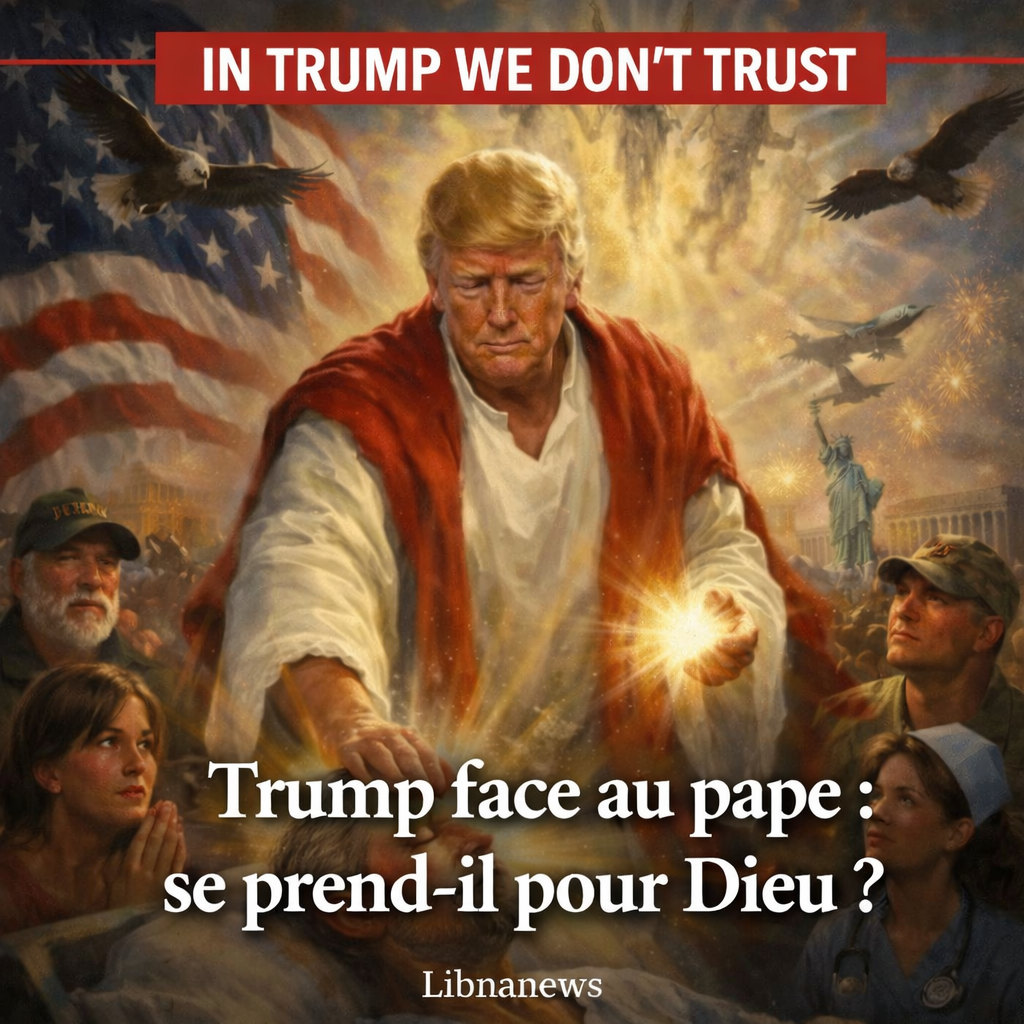
The targeted post corresponds well to the publication broadcast Sunday 12 April on Truth Social, and then extended in front of the press at Andrews. After attacking Pope Leo XIV on war, immigration and crime, Donald Trump relayed a visual showing him as a quasi-Christic healer. The episode goes beyond the simple polemic: it enlightens a way of doing politics by sacralizing the leader and contesting any competing moral authority.
Trump thinks he’s God?
By showing up as a salutary figure in the aftermath of a papal critique of war, Trump is not only trying to shock. It moves the symbolic hierarchy: the pope recalls moral limits to strength, the president responds with a staging where he appears as the one who heals, protects and enlightens. This sequence says less of a whim than a method.
Frontal attack on Leo XIV
On Sunday evening, Donald Trump crossed a threshold rarely reached in relations between the White House and the Vatican. On Truth Social, the American president is taken directly from Pope Leo XIV, accusing him of being weak in the face of crime and bad in foreign policy. A few hours earlier, however, the pontiff had spoken without mentioning the tenant of the White House. In Rome, during a vigil for peace, he denounced the logic of war, the demonstrations of force and the use of God’s name to cover violence. Trump’s response did not take the form of a conventional diplomatic disagreement. She took the one of a personal counter-offensive, where politics dressed in sacred.
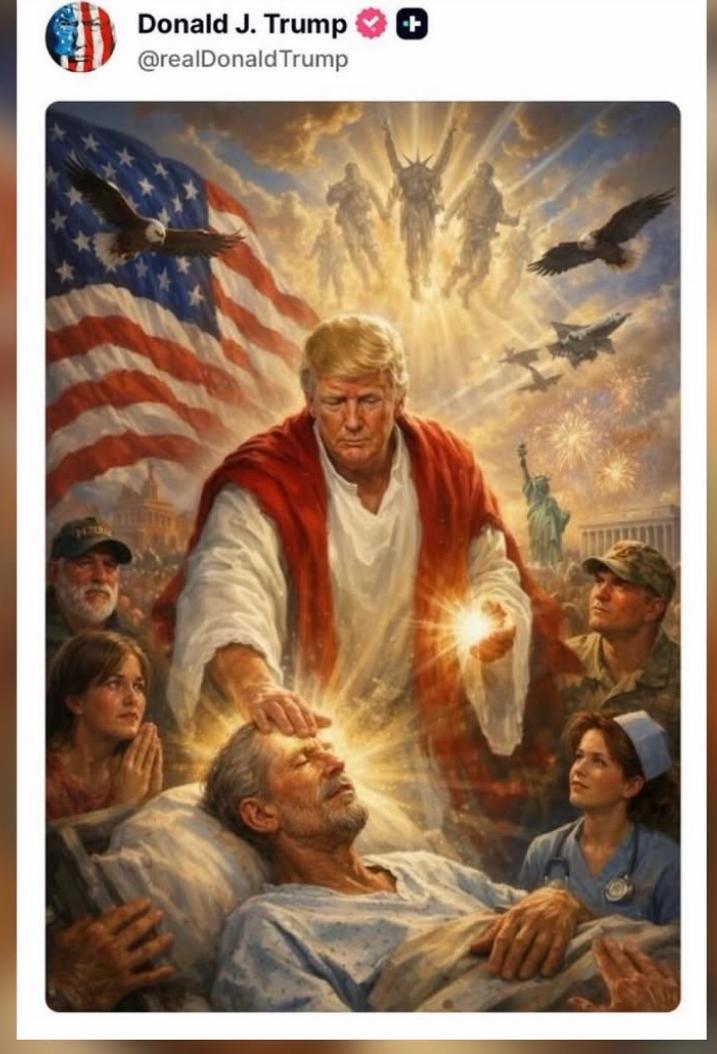
The heart of the case lies as much in the text as in the image. In his message, Trump essentially assured that Leo XIV owed his position to his own presence in power. He also explained that he did not want a pope to criticize the president of the United States when he said he would accomplish exactly what he was elected for. Then the president prolonged the attack in front of journalists, going so far as to suggest that the pope would be lenient to the crime. Then he broadcast a visual showing him in a healing posture, laying his hand on a sick man’s forehead, draped in colours evoking both religious and patriotic. The result is politically heavier than a simple verbal outburst.
When war meets faith
Before Sunday’s explosion, the tension was already rising. Leo XIV, the first American pope, has imposed himself in recent weeks as one of the most clear religious voices against the war waged by Washington and Israel against Iran. On Saturday, at St Peter’s Basilica, he called on politicians to break the logic of rearmament and confrontation. He castigated the fascination for power, denounced the instrumentalization of God’s name and called to return to the table of dialogue. The Vatican did not name Donald Trump. But the context left little doubt about the political target of this moral reminder, as the American administration has for weeks assumed a vocabulary of strength and strategic superiority.
Trump’s response is part of this collision. His message is not limited to the Iranian file. It mixes war, immigration, crime, Venezuela, the American left and until the very election of the pope. This way of merging everything says a lot. The President does not respond to an argument or even to a specific diplomatic position. He placed the pope in his own inner political theatre. In Trump, the adversary is never simply a counter-optor. He becomes a supposed actor on the opposite side. By presenting Leo XIV as a weak man, very liberal and complacent towards disorder, it is important in the religious field the codes of his permanent campaign. The pope ceases to be a universal spiritual authority. In the Trompian account, he becomes another opponent.
The post too, between miracle and patriotism
This is where the image then published makes sense. This visual not only shows Trump as a heroic character. He shows it as a figure of salvation. The hand placed on the patient, the light emanating from the gesture, the look towards him, the vertical composition of the scene and the accumulation of American symbols form a coherent message. The President is no longer content with the authority of the State. He appropriates a miracle iconography. The flag, eagles, soldiers and Statue of Liberty do not serve as an ordinary patriotic decoration. They set up the idea of a higher mission. Chief is no longer only commander-in-chief. He becomes the one through whom healing, protection and even redemption would be supposed to pass. This reading is based on an interpretation of the visual, but it is based on its composition and the public description made of it.
One can always sweep the episode of a backhand by talking about provocation, dubious humour or network culture. Yet it would be missing the essential. In contemporary politics, images do not come after power. They make power. They give him an emotion, a body, a vocation. An analysis of Reuters had already shown in 2025, when Trump was broadcasting one image of him as pope and another as king: these visuals are used to dominate the media cycle, project a symbolic force and blur the boundary between reality, fiction and self-promotion. In this logic, the figure of Christ is not only an aesthetic loan. It allows to move the debate. Whoever opposes Trump no longer contradicts just a president. He seems to attack a man who shows himself as a providential.
This strategy is therefore not new, but here it reaches a higher degree because it intervenes against the pope. When Trump claims that Leo XIV would not be in the Vatican without him, he does not just brag. He expresses a vision of the world where every institution eventually turns around his person. The Vatican becomes an additional decoration of the Trompian story. The head of the Catholic Church is no longer elected according to the dynamics of the conclave and the life of the Church; It is reinterpreted as an indirect product of the Trump presidency. This sentence summarizes the core of the problem. Power is no longer a burden limited by separate institutions, traditions or roles. It becomes the unique center around which everything has to gravitate.
Sacrifice the leader, delegitimize the pope
The contrast with Leo XIV explains the magnitude of the sequence. On this subject, the pope speaks the classical language of the Church’s social doctrine: refusal of war as a horizon, warning against the idolatry of power, attention to civilians, call for dialogue, criticism of the religious use of politics. Trump opposes a rhetoric of victory, balance of power and personal legitimation. The two men do not hold the same office, but they are now fighting a common ground: the ability to name good, to say what is right and to give moral meaning to the conflict. That’s why the confrontation overflows the only quarrel between a president and a pope. It concerns the confiscation of religious vocabulary by political power.
Reactions soon took place. Archbishop Paul S. Coakley, President of the Conference of Catholic Bishops of the United States, said his dismay and recalled that the pope was neither a personal rival of Trump nor a partisan actor. On the Vatican side, no frontal response was given immediately, while Leo XIV was preparing for a trip to Africa. This silence is almost a doctrine: the papacy does not enter into controversy at the pace of the platforms. But the absence of an official reply does not mean that the episode is minor. It exposes to the open an already ancient fracture between a part of the Trumpian right and the Catholic authority when it refuses to bless the brutal migration or the military auction. This time, the rupture is no longer felt. It is theatricalized by the President himself.
A political risk to the Catholic electorate
It is also necessary to measure the American domestic issue. In 2024 Trump won 55% of the Catholic vote. This fact counts, as it nourishes in him the conviction that he can speak on behalf of a believing America without going through classical religious mediations. It is precisely this symbolic monopoly that Leo XIV comes to disturb. First pope born in the United States, he knows the moral and political grammar of his home country. When he criticizes war, the inhumanity of the treatment of migrants or the use of God in martial discourses, he deprives Trump of an essential register: that of a moral without a contradictor. In this context, the presidential attack also aims to delegitimize, in the eyes of part of his electorate, a Catholic word that refuses to align.
The most striking, at the bottom, is the shift from religious to staff. Trump doesn’t really debate theology or even diplomacy. He reacts as if any moral objection was an infringement of his own sovereignty. This logic explains the almost natural transition from text to image. The man who feels challenged answers not only with the argument. He restored his centrality by iconography. He returns to the centre of the painting, literally, as a source of light, care and order. There lies the real focus of this case. Trump doesn’t say he’s God. It would be too simple. He builds something more political and more effective: the representation of a leader who no longer bears authority over him, not even that of a pope when he recalls the moral limits of force. This last sentence is an analysis, based on the documented sequence of facts and the staging broadcast by the President.
This escalation is all the more noticeable as tensions between Washington and Rome usually follow agreed codes. Disagreements often existed over war, the death penalty, immigration or poverty, but they passed through prudent communiqués, coded formulas and indirect exchanges. Here, the American president chose the frontal attack against the leader of the Catholic Church, in meeting and platform language. Vatican specialists interviewed in the wake saw a rare break in both tone and publicity. This rhetorical brutality also sheds light on the new role of social networks in the exercise of power: it allows us to short-circuit any institutional filter and to turn a diplomatic dispute into an identity spectacle.
The sequence finally recalls that Trump has already played with religious symbols far beyond the traditional uses of the presidency. In 2025, he had already broadcast an image generated by IA showing him as a pope, before explaining that it was a joke. Reuters reported that communication experts saw these visuals as a tool of narrative domination, capable of creating a heroic fantasy around the leader and guaranteeing him permanent media centrality. A year later, repetition changed reading. When a politician repeatedly uses images that place him at the heart of a sacred iconography, it is no longer just bad taste. This is a method. The process is to trivialize the idea that no clear border separates the political leader from the providential figure. It is this banalization, much more than an evening’s outburst, which deserves to be looked at closely.
While war serves as a backdrop, the rhetoric of force gains ground and networks impose their instant emotions, the conflict between Trump and Leo XIV poses a simple question: who still has the right to say no to power? The Pope made in the name of peace, dialogue and a moral limit to war. Trump responded with insult, extreme personalization and self-directed redemptive figure. Between these two gestures an increasingly clear line of fracture emerges: either religion reminds the power that it is not all-powerful, or the power uses the religious to make believe that it is.




