

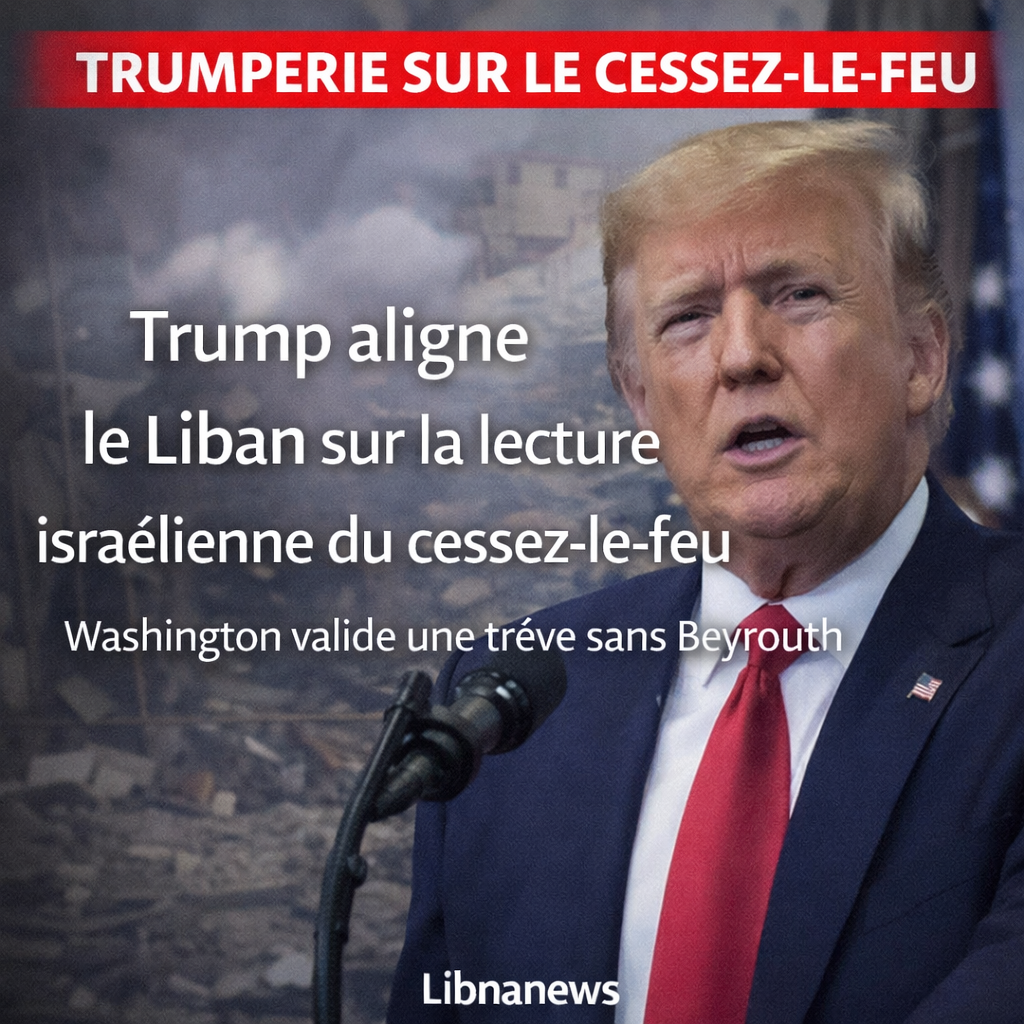
Donald Trump chose his line: for Washington, Lebanon is not part of the truce agreement with Iran. This position joins that of Benyamin Netanyahu, who supported the two-week pause on the Iranian front while affirming that the war against Hezbollah was continuing. By aligning it with the Israeli reading, the White House greatly reduces the regional reach of the ceasefire and transforms Lebanon into the main dead end of de-escalation. While Pakistan, the mediator of the agreement, contends that Lebanon should be included, and that several European capitals are calling for it to be included, Washington actually validates a partial truce that protects the American-Iranian axis without stopping the bombings on Lebanese territory.
An American position that exactly matches Israel’s
The facts are now clear. Reuters reports that Israel supported Trump’s decision to suspend the strikes against Iran for two weeks, but with a clear political condition: the ceasefire does not apply to Lebanon. The Netanyahu office explicitly said, and the Israeli army continued to present the Lebanese front as separate from the agreement. At the same time, several press reports on the truce show that Trump accepted this architecture without imposing the inclusion of Lebanon. The American line and the Israeli line thus converge on a central point: the pause concerns Iran, not Hezbollah or the Lebanese theatre.
This alignment is not a technical detail. It alters the very nature of the ceasefire. Instead of appearing as a regional de-escalation, the agreement becomes a targeted suspension, limited to the direct front between Washington and Tehran. Lebanon remains exposed, and Israel retains its freedom of action. In practice, this means that Trump did not seek to impose a broader stabilization logic on the Levant. He agreed to a formula that serves the Israeli objective of continuing the war against Hezbollah while reducing the risk of a broader direct confrontation with Iran.
Pakistan says one thing, Trump validates another
The contrast is all the stronger as Pakistan, the central mediator of the truce, supports the opposite. Prime Minister Shehbaz Sharif said the agreement also included a ceasefire in Lebanon. This reading was also repeated by Iranian relays and by sources close to Hezbollah. In other words, the actor who helped to pull the break says that Lebanon is part of it, while Trump lets impose a restrictive definition in accordance with the Israeli position. This lag creates a major political ambiguity around the agreement.
By letting Israeli reading prevail, Trump also weakens the role of the Pakistani mediator. Islamabad cannot appear as the guarantor of a cease-fire if one of the theatres he says is covered continues to be bombarded with Washington’s implicit avalanche. This undermines the credibility of the talks planned in Islamabad and shows that, in the final arbitration, the White House has favoured compatibility with Israeli requirements rather than an extensive interpretation of the truce.
Trump reduces de-escalation to one-on-one with Iran
The American position reveals a very clear hierarchy of priorities. Trump’s goal is to avoid a direct escalation with Iran, to at least partially restore traffic to Ormuz and to open a diplomatic window. On the other hand, the war in Lebanon does not appear to be an element he wants or can compel immediately. The Washington Post points out that the truce was mainly designed to stop a direct confrontation that became politically and economically costly for Washington, not to settle all the fronts linked to the Iranian axis.
This choice has an immediate political effect: Lebanon ceases to be treated as a natural component of regional peace and becomes a separate battlefield. In other words, Trump accepts that de-escalation is incomplete. He endorsed a pattern in which the United States suspended its confrontation with Tehran, but allowed Israel to continue with Hezbollah. For Beirut, that is to say, Washington is not defending a regional truce in the full sense, but a selective truce, compatible with the continuation of the Israeli campaign in Lebanon.
An alignment that reinforces the Israeli reading of the war
By supporting a truce excluding Lebanon, Trump offers Israel a form of political coverage. The strikes on Beirut, the South and the Bekaa can no longer be presented only as an Israeli unilateral initiative; They are now part of a framework where Israel’s main ally has not conditioned them to regional de-escalation. AP also reports that Israel was able to launch its most important campaign strikes in Lebanon only a few hours after the announcement of the ceasefire, while maintaining that it did not apply to Hezbollah.
This gives the Israeli army valuable room for manoeuvre. It can continue its operations while claiming that it does not violate the agreement, since the agreement, according to Washington as according to Jerusalem, does not include Lebanon. American alignment is therefore not limited to a diplomatic formulation. It has a direct operational consequence: it allows Israel to continue the war in Lebanon without immediately contradicting the public line of the White House.
Lebanon becomes the official forgotten of the ceasefire
For Lebanon, the effect is brutal. The country suffers the regional consequences of the war, but does not enter the perimeter of the truce validated by Washington. This situation aggravates the feeling of diplomatic cancellation already very strong in Beirut. President Joseph Aoun explained that the Lebanese State was working to be included in « regional peace », precisely because the risk of exclusion was becoming apparent. Trump’s position shows that this Lebanese request was not accepted by the main Western architect of the agreement.
This American choice also creates an internal political impasse in Lebanon. If Beirut says that Lebanon is included in the truce, it contradicts Washington and approaches Iranian and Pakistani reading. If he admits that he is excluded, he admits that regional de-escalation takes place without him, even though he continues to be hit. Trump’s alignment with Israel, therefore, does not only weigh on the military front. It also complicates the position of the Lebanese Government and the presidency, which face a diplomatically and politically costly alternative.
A less regional truce than announced
The result is a small truce. On paper, she had to calm the area. In fact, it mainly suspends direct confrontation between Washington and Tehran, leaving one of the most explosive fronts active. This explains why several European observers and capitals already consider the agreement incomplete. The Guardian and Le Monde both note that the continuation of the war against Hezbollah prevents us from talking about a fully regional de-escalation.
By aligning with the Israeli position, Trump therefore makes a very specific strategic choice: to save the diplomatic window with Iran without forcing Israel on Lebanon. This calculation can respond to an immediate crisis management logic. But it has a clear cost: it leaves intact the main source of violence in the Levant and exposes the truce to a rapid protest by Tehran and the mediators, who can now argue that a ceasefire excluding Lebanon is not a real regional ceasefire.
The signal sent: priority to Israel, not Lebanon
In essence, Trump’s position sends a simple message. Between a reading of the ceasefire that would include Lebanon and limit Israeli strikes, and a reading that preserves Israel’s freedom of action against Hezbollah, the White House chose the second. That is why we can talk about alignment with Israeli positions. Washington did not arbitrate in favour of wider regional peace. He validated a cutting of the fronts in line with the immediate interests of Jerusalem.
For Lebanon, this sequence has far-reaching consequences. It means that the truce announced elsewhere does not protect him. It also means that Israel’s main ally will not contest, at this stage, the idea that war can continue on its territory. Hence, de-escalation appears less like a regional break than a suspension with variable geometry, where Lebanon remains the great excluded.




