

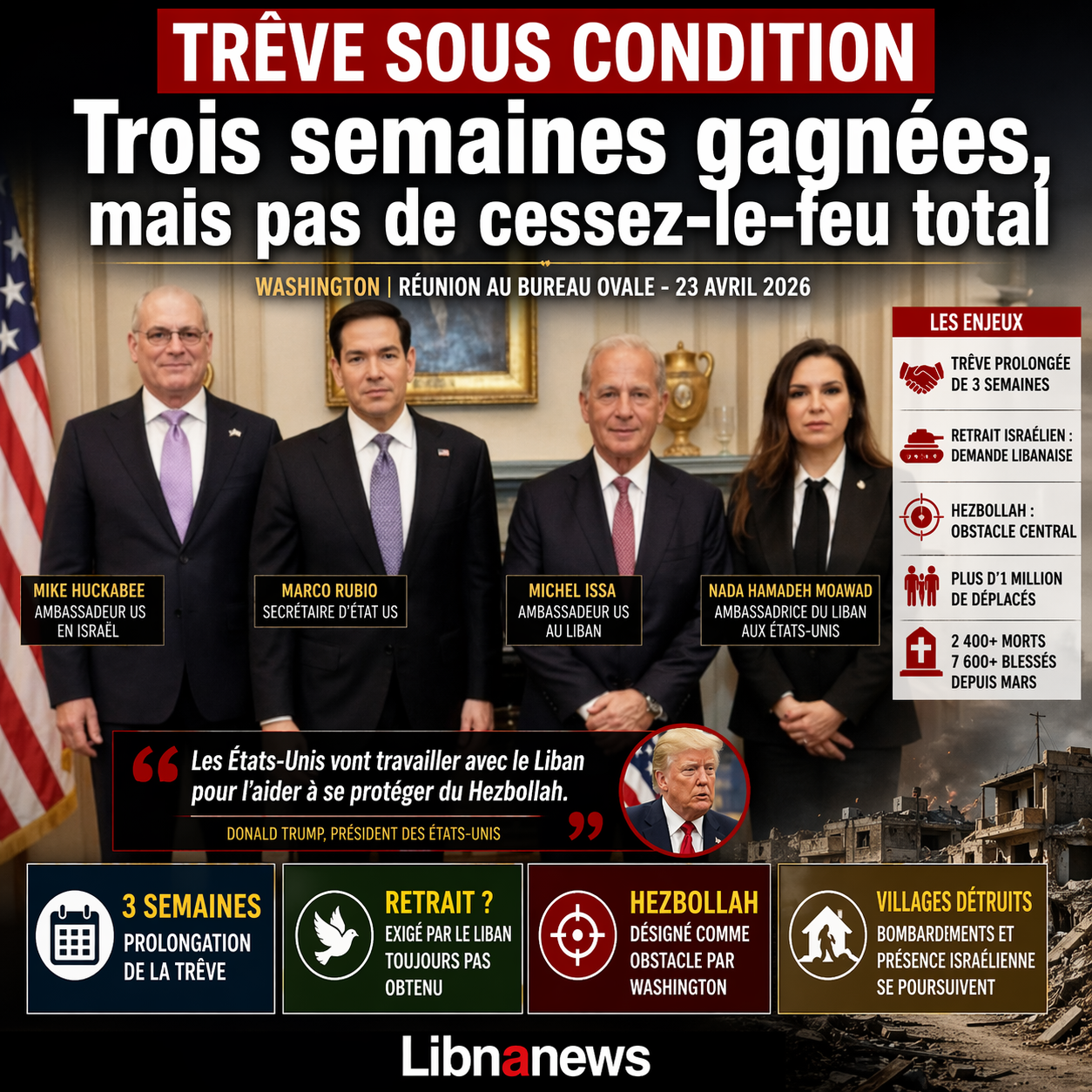
The extension of the truce in Lebanon was announced on Thursday 23 April by Donald Trump after a meeting organized in the Oval Bureau with representatives of Lebanon, Israel and the United States. It covers three weeks and follows a first 10-day ceasefire, concluded the previous week under American mediation.
The decision is not a complete truce. The level of fighting has decreased since the first break came into effect, but strikes, fire, demolitions and traffic restrictions continued in the south of the country. The extension therefore creates a diplomatic period. It does not yet resolve the military situation on the ground.
The central point is now double. Washington wants to maintain a direct channel between Beirut and Tel Aviv, despite the absence of diplomatic relations between the two countries. Lebanon wants to stop the attacks and Israeli withdrawal. Israel wants to maintain a margin of action against Hezbollah and prevent its return near the border.
A meeting moved to the Oval Bureau
The meeting held in the White House on Thursday 23 April, following a format change a few hours before the scheduled start of the discussions. The ambassadors of Lebanon and Israel were to first find themselves in a framework led by the State Department. The meeting was eventually transferred to the Oval Office, with Donald Trump’s direct participation.
The Lebanese delegation was led by Nada Hamadeh Moawad, Ambassador of Lebanon to the United States. The Israeli delegation was represented by Yechiel Leiter, Ambassador of Israel to Washington. Both countries remain officially in a state of war. The holding of a second direct exchange at ambassadorial level in a week is therefore a notable diplomatic event.
On the American side, Donald Trump was surrounded by Vice President JD Vance, Secretary of State Marco Rubio, US Ambassador to Israel Mike Huckabee and US Ambassador to Lebanon Michel Issa. The US press also reported on the role of State Department adviser Michael Needham in preparing the discussions.
Hezbollah was not present. The Shiite movement challenged the principle of direct contact with Israel and affirmed that any truce must be based on full respect for the ceasefire by Israel. This absence limits the operational scope of the meeting, as Hezbollah remains the central armed actor on the southern Lebanese front against the Israeli army.
Trump’s message on Truth Social
The public announcement came from a message published by Donald Trump on Truth Social after the meeting. The U.S. president wrote that the meeting had been « very good. » He then announced that the ceasefire between Israel and Lebanon would be extended by « three weeks ».
In the same message, Donald Trump added that the United States would work with Lebanon to help protect itself from Hezbollah. This formulation places the Shiite movement at the centre of American logic. It shows that Washington does not present the extension as a mere technical break, but as a step in a broader security process.
Donald Trump also reiterated his intention to soon receive Israeli Prime Minister Benjamin Netanyahu and Lebanese President Joseph Aoun at the White House. He had already mentioned this prospect at the announcement of the first ten-day truce. On Thursday night, he placed it in the calendar opened by the additional three weeks.
In front of the journalists present in the Oval Bureau, the U.S. president expressed hope that this meeting could take place during the extension period. No date has been made public. No detailed agenda was announced. Such a meeting would remain politically sensitive for Beirut, where official contacts with Israel remain contested.
Truce in Lebanon: What the extension provides for
The extension decided in Washington first fixes a duration. The ceasefire is extended by three weeks. No peace agreement has been signed. No public Israeli withdrawal calendar was presented. No detailed and public mechanism for monitoring violations was announced at the end of the meeting.
The truce in Lebanon therefore remains a limited framework. It aims to avoid the resumption of wider confrontation, but it does not prevent all military actions. Donald Trump said Israel must be able to defend itself in case of an attack. He also stated that the defence should remain prudent and focused.
This precision is essential to understand the nature of the truce. Israel retains a margin of action that it presents as defensive when it says it targets Hezbollah fighters, launchers, vehicles or infrastructure. Lebanon regards these operations as violations when they take place in its territory during the ceasefire.
The extension also does not change the Israeli presence in southern Lebanon at this stage. The Israeli army maintains a military zone in border areas. Israel describes it as a protective zone to prevent rockets, drones and anti-tank missiles from firing at northern Israel.
What Lebanon was asking for
Before the meeting, Beirut requested a longer extension of one month. The Lebanese authorities also wanted to put on the agenda the cessation of strikes, the end of demolitions, the Israeli withdrawal, the release of Lebanese detainees in Israel, the delimitation of the land border and the return of displaced persons.
Lebanon obtained an extension of the truce, but only for three weeks. This is the concrete result of the meeting. This period avoids the immediate expiry of the first ceasefire, which was to end on Sunday. It gives Beirut additional time to defend its demands in the American channel.
Lebanon has also secured that its priorities remain in the next phase of discussions. Lebanese officials want Israeli withdrawal, access to villages, the return of displaced families, reconstruction and the issue of detainees to be addressed during this period. However, no specific Israeli public commitment was announced on these points.
Beirut finally obtained practical recognition of its institutional role. The meeting was held with the Ambassador of Lebanon, under the authority of President Joseph Aoun. The case was not treated solely as a consequence of exchanges between Washington, Tel Aviv and Tehran, even though the regional dimension remains present.
Lebanon has not achieved a complete truce. Strikes were not excluded in all cases. The Israeli presence in the South has not been lifted. Restrictions around several border areas have not disappeared. The inhabitants of the affected localities do not yet have a safe environment for sustainable return.
What Israel got
Israel obtained an extension without immediate withdrawal. This is the most tangible element for the Israeli government. The military zone in southern Lebanon remains in place. Israel therefore maintains, during the period opened by the extension, a depth of security which it deems necessary in the face of Hezbollah.
Israel has also secured that Hezbollah is designated as the main security obstacle by Washington. Donald Trump’s message about US aid to Lebanon against the Shiite movement has been given Israeli priority. Ambassador Yechiel Leiter defended this line by asking that discussions focus on the dismantling of the Hezbollah military apparatus.
Israel finally obtained the public maintenance of a right to self-defence. The US president said Israel must be able to defend itself in case of an attack. This formula allows the Israeli government to argue that some strikes remain compatible with the truce when, according to him, they respond to an immediate threat.
An incomplete truce on the ground
The situation on the ground explains why the truce is described as incomplete. Violence has fallen sharply from the most intense days, but it has not stopped. Israeli strikes were again reported in the South. Artillery fired at border areas. Drones continued to fly over several localities.
On the eve of the announcement, Israeli strikes killed at least five people in Lebanon, including a journalist, according to a news agency. The Lebanese Ministry of Health also reported deaths and injuries during the ceasefire period. These balances feed into the Lebanese position that the truce remains insufficiently respected.
Hezbollah claimed several operations during this sequence. The movement reported firing rockets in response to Israeli violations. The Israeli army reported that it intercepted several shots from Lebanon and conducted strikes against launchers or infrastructure used by Hezbollah.
Both stories respond without joining. Israel said it was acting to prevent further attacks. Hezbollah reports responding to Israeli strikes. The Lebanese government denounces violations of sovereignty and calls for the cessation of operations. The truce therefore functions as a disputed framework, not as a total cessation of hostilities.
Destroyed villages and impossible return for many civilians
The destruction in the southern villages is the other part of the case. Lebanese authorities and local sources report destroyed houses, damaged buildings, closed roads and inaccessible neighbourhoods in several border localities. The destruction of civilian infrastructure complicates the return of the inhabitants.
Israel claims to target Hezbollah positions or infrastructure. Lebanon contests this justification when it is accompanied by destruction of houses, restrictions of movement and impossibility of access to the affected areas. The question of destroyed villages is therefore one of the first practical tests of extension.
In several localities, displaced families can only return briefly when they succeed. They come to see the condition of their house, collect documents or check agricultural land. Returns often remain temporary due to fire, drones, damaged roads and military warnings.
The human and social cost remains high. According to a Lebanese report released this week by the American press, more than 2,400 people have been killed in Lebanon since the resumption of hostilities in early March, and more than 7,600 have been injured. More than one million people have been displaced, mainly in the south of the country.
Hezbollah at the heart of the blockade
Nor does the extension of the truce address the issue of Hezbollah. The United States and Israel want the Lebanese army and state institutions to regain security control of the South. The Lebanese Government claims to want to strengthen its authority, but it must deal with a powerful armed movement, present in national politics and in border regions.
Secretary of State Marco Rubio presented the additional three weeks as time to work for a permanent peace between two countries. He also referred to the existence of an armed organization in Lebanese territory as the central obstacle. This position is in line with the Israeli approach, but it places the Lebanese state in front of a major internal difficulty.
The issue of Lebanese laws prohibiting contact with Israel was also raised before Donald Trump. The U.S. president reacted by saying that he wanted to end this obstacle. The subject is sensitive to Lebanon, where any official contact with Israel remains framed by a legal and political environment marked by decades of war.
The prospect of a meeting between Joseph Aoun and Benyamin Netanyahu will therefore depend on several conditions. There will need to be agreement on the format, level of representation and topics. Beirut will seek to place Israeli withdrawal, detainees, destruction and the border at the forefront. Israel will insist on Hezbollah.
Three weeks to test commitments
Washington’s schedule now requires a series of close steps. The first concerns the mere observance of the ceasefire. If the bombing continues, even in the form of so-called targeted strikes, Lebanon will consider that the extension does not produce the expected effect. Israel, for its part, will continue to link its operations to the threat of Hezbollah.
The second stage concerns access to affected areas. The Lebanese authorities should be able to send municipal teams, relief, army units and technical services to the damaged villages. Without regular access, it will be impossible to quantify damage, reopen roads, restore water and electricity or prepare for the return of displaced persons.
The third stage concerns the political channel. Donald Trump wants to transform the three-week period into preparation for a higher-level sequence. But holding an Aoun-Nétanyahu meeting implies that each party finds an immediate interest. Lebanon will seek visible commitments. Israel will demand security assurances. The United States will have to maintain both objectives within one framework.
The three weeks opened by Donald Trump’s announcement begin in a specific situation. The ceasefire is extended. Direct discussions continue under American sponsorship. The Aoun-Nétanyahou meeting remains announced as an intention, but is not dated. On the ground, bombing, destruction, the Israeli military presence and the firing claimed by Hezbollah keep the truce in Lebanon in a partial format.




