

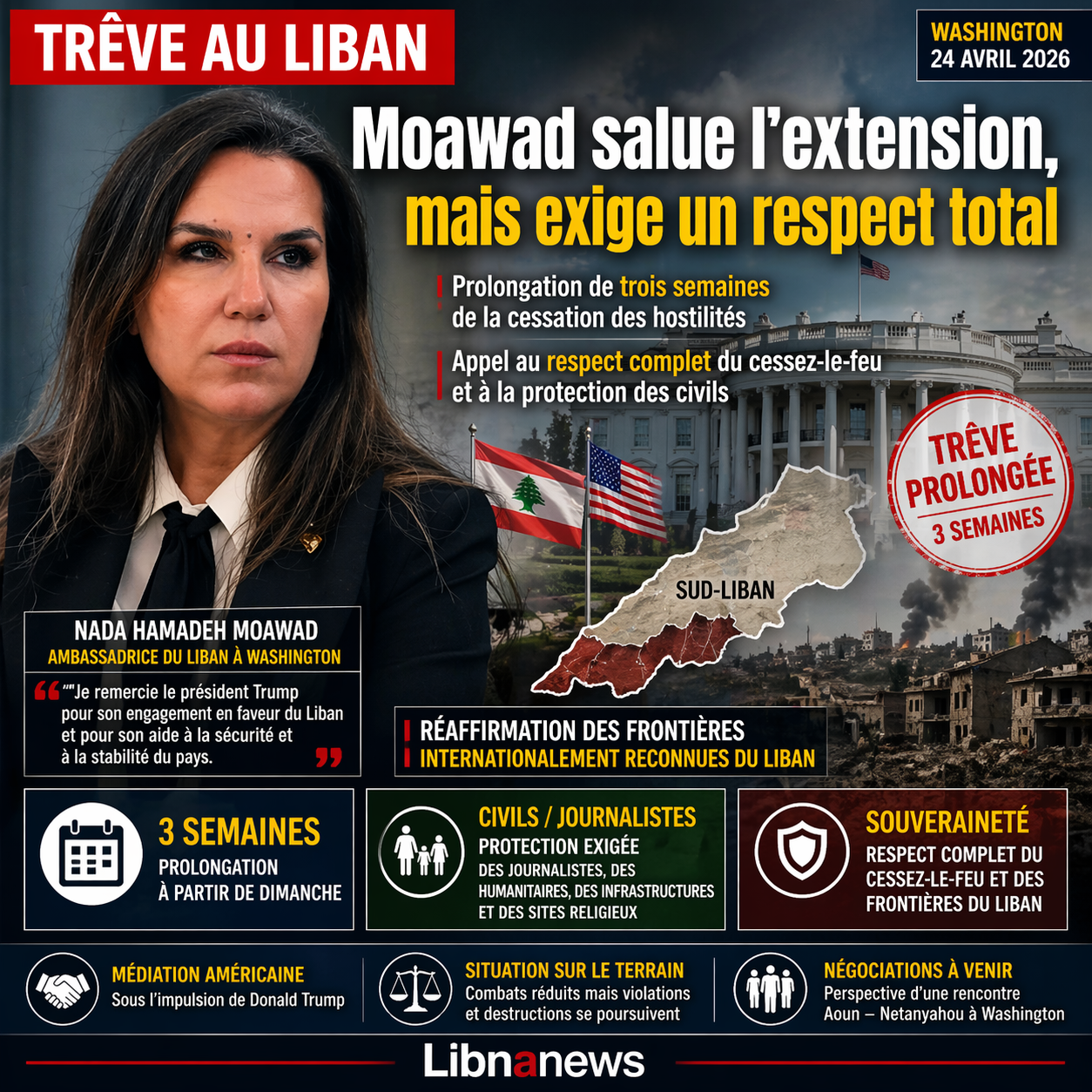
The truce in Lebanon reached a new stage in Washington, D.C., where Lebanese Ambassador Nada Hamadeh Moawad welcomed the extension of the cessation of hostilities for another three weeks from Sunday. The diplomat thanked Donald Trump for her commitment to Lebanon, following a second round of discussions at the White House with American and Israeli representatives.
In a post-meeting statement, the Ambassador presented this extension as a measure to reduce escalation and create the conditions for negotiations that were deemed useful. It also called for full respect for the declaration of cessation of hostilities, emphasizing the protection of civilians, journalists, humanitarian workers, infrastructure and religious sites.
The Lebanese statement is made in a context of a partial ceasefire. High-intensity fighting has decreased since the first ten-day truce, but shelling, firing, house demolitions and restrictions on access to southern villages have continued. The announced extension therefore does not address the merits of the case. It opens a three-week diplomatic deadline under American sponsorship.
A meeting in the Oval Bureau
The statement by Nada Hamadeh Moawad was made in the context of the second round of negotiations in the White House between Lebanon and Israel. The meeting was held in the Oval Bureau, in the presence of Donald Trump. It brought together the Ambassador of Lebanon to the United States, Nada Hamadeh Moawad, and the Ambassador of Israel to Washington, Yechiel Leiter.
On the American side, several senior officials participated in the sequence. Vice President JD Vance, Secretary of State Marco Rubio, US Ambassador to Israel Mike Huckabee and US Ambassador to Lebanon Michel Issa were present. This format gave the discussion a higher political dimension than a simple technical exchange between diplomats.
The meeting took place when the first truce, announced the previous week, was due to expire on Sunday. Washington therefore sought to avoid an immediate return to wider confrontation. The continuation of the diplomatic channel between the Lebanese and Israeli representatives was presented as a central element of the United States system.
Hezbollah did not participate in the discussions. The Shiite movement rejected the principle of direct contact with Israel. This absence remains an important point, as Hezbollah remains the main armed actor against Israel on the southern Lebanese front. The Lebanese government chose to be represented by its ambassador in Washington.
Trump’s announcement on Truth Social
The meeting resulted in a three-week extension of the cessation of hostilities. The announcement was made by Donald Trump, who posted a message on Truth Social after the meeting. The United States President indicated that the ceasefire between Israel and Lebanon would be extended by three weeks.
In the same message, Donald Trump said the United States would work with Lebanon to help protect itself from Hezbollah. This formula gave the political framework defended by Washington. It links the extension of the truce to the issue of security control in the south of the country and the military role of Hezbollah.
Donald Trump also reiterated his intention to welcome Lebanese President Joseph Aoun and Israeli Prime Minister Benjamin Netanyahu to the White House. He had already mentioned this prospect in the first truce. After the new meeting, he said he would like a meeting in the near future without announcing a date.
This prospect remains politically sensitive for Beirut. Lebanon and Israel do not have official diplomatic relations. Direct contacts with Israeli officials remain disputed in the Lebanese debate, and Hizbullah is opposed to them. The American wording is therefore not yet a summit. It announces a possible step if the political conditions are met.
Truce in Lebanon: what Moawad said
Nada Hamadeh Moawad thanked the United States, led by Donald Trump, for its efforts to help and support Lebanon. In front of the participants at the meeting, she said that with this help and support, Lebanon could be made « great again ». This formula, modelled on the US President’s political slogan, marked the public part of the meeting.
The diplomat then clarified her position in a statement. She said she thanked Donald Trump for his commitment to supporting Lebanon and for his assistance in efforts to strengthen security and stability. This formulation places US support within an institutional framework, centred on the Lebanese state and the stabilization of the territory.
It also welcomed the extension of the cessation of hostilities, under United States sponsorship, for another three weeks from Sunday. The use of this specific date makes it possible to distinguish the political announcement from its entry into the operational calendar. It confirms that the additional period must take over from the first period without interruption.
In its communiqué, Ambassador L’ambassador considered that this step reflected a common commitment to de-escalation. It also considered that it should make it possible to prepare meaningful negotiations. This sentence summarizes the Lebanese position: the truce must be used as a diplomatic instrument, not as a mere pause of circumstance.
The call for full respect for the ceasefire
The diplomat called for full respect for the declaration of cessation of hostilities. This demand is the core of the Lebanese message. Beirut wants the extension to result in a real halt to attacks, fire and military operations affecting Lebanese territory, particularly in villages close to the border.
This insistence responds to the situation since the entry into force of the first truce. Israeli bombings were reported again in the South. Shots and strikes caused death and injury. The destruction of buildings and houses has been reported in several border localities. The Lebanese authorities see violations of the ceasefire.
Israel also claims to be acting against Hezbollah-related infrastructure, launchers, vehicles and combatants. The Israeli army presents these operations as defensive or preventive measures. This divergence of interpretation explains why the truce remains incomplete on the ground, despite its formal extension.
Hezbollah also claimed fire during the ceasefire period, presenting them as responses to Israeli violations. Israel reported rockets, drones and fire on its soldiers. These incidents show that the cessation of hostilities does not yet mean a lasting silence of weapons.
Civilians, journalists and humanitarian workers at the forefront
In this context, Nada Hamadeh Moawad’s call for full respect for the truce is primarily aimed at the protection of civilians. The diplomat explicitly cited journalists and humanitarian workers. This clarification follows reports of civilian casualties during the ceasefire period, including a journalist killed in southern Lebanon.
The Ambassador also mentioned the protection of infrastructures and religious sites. This part of the statement refers to the destruction observed in the villages of the South, attacks on roads, houses, public facilities and buildings used by the inhabitants. It includes the truce in a humanitarian and heritage dimension, in addition to the military component.
Infrastructure is central to border communities. Even when the inhabitants are not directly affected by the shooting, the material damage often prevents the return. Damaged roads, destroyed houses, damaged water or electricity systems and unusable public buildings delay the resumption of civilian life.
Villages close to the border remain subject to access restrictions. Displaced families cannot always return, or do so only for brief passages. They come to check the condition of the houses, collect papers, inspect shops or see agricultural land. Many leave for lack of security.
The Lebanese border reaffirmed
The Lebanese declaration also emphasizes the internationally recognized borders of Lebanon. Nada Hamadeh Moawad reaffirmed the country’s commitment to these borders. This position responds to the continuation of Israeli positions in southern Lebanese territory and Lebanese requests for withdrawal.
For Beirut, the extension of the truce cannot replace respect for sovereignty. The Lebanese Government is calling for the cessation of attacks, the Israeli withdrawal from the occupied areas, the delimitation of the land border and the increased deployment of the Lebanese army. These issues are among the topics that Lebanon wants to address in the next phase.
Israel, for its part, links any lasting withdrawal to guarantees on Hezbollah. Israeli officials claim to want to prevent the Shiite movement from relocating near the border. They highlight the threat of rockets, drones and anti-tank missiles against northern Israeli communities.
The choice of words is also important. The declaration speaks of « cessation of hostilities » and not of final political agreement. This term refers to a cessation of military acts between the parties, but it does not deal with substantive cases alone. It does not regulate the status of Israeli positions, the issue of Hezbollah’s weapons or the reconstruction of the affected localities.
For the Lebanese authorities, the challenge now is to turn this extension into a useful sequence. The deadline should be used to document violations, to improve humanitarian access, to prepare for the gradual return of internally displaced persons and to determine the subjects to be discussed with American mediation. The Ambassador’s statement places these objectives within the framework of US support requested by Beirut.
What the extension changes
The three-week extension does not resolve this disagreement. It maintains a negotiating deadline. It does not yet give a public timetable for Israeli withdrawal. Nor does it create a detailed and public mechanism for monitoring violations. It therefore extends a provisional framework, which each party interprets according to its priorities.
Lebanon immediately obtained the continuity of the truce and recognition of its institutional role in the discussions. The Ambassador represents the Lebanese State in an American context, with the aim of defending Beirut’s demands. The country also sees the protection of civilians and respect for borders as diplomatic priorities.
Israel, on the other hand, gets Hezbollah to remain at the centre of the American message. Donald Trump’s statement on aid to Lebanon against the Shiite movement corresponds to an Israeli demand for security guarantees. Israel also retains a margin in the American language to invoke its right to defend itself in the event of an attack.
Nada Hamadeh Moawad’s statement therefore seeks to provide a political framework for the extension. She thanked Washington, welcomed the extension, called for full respect for the truce and recalled Lebanese priorities. It avoids presenting the agreement as an acquired peace. It places it in a sequence designed to open wider negotiations.
Three weeks to verify commitments
The calendar remains short. The additional three weeks must begin on Sunday. During this period, the United States wants to prepare a more substantive phase of discussion. Donald Trump mentioned a meeting between Joseph Aoun and Benyamin Netanyahu. No date, format and detailed agenda have yet been announced.
The first test will focus on the reality of the field. If the strikes continue, the Lebanese declaration on full respect for the cessation of hostilities will remain difficult to translate into results. If bombardments decrease and access to villages improves, Beirut will be able to present the extension as a beginning of stabilization.
The second test will cover the protection of civilians and humanitarian workers. The Lebanese authorities want journalists, first aid workers, medical teams, humanitarian workers and residents to be able to travel without being exposed to fire. This requirement will be measured in border villages and on access roads to the South.
The third test will focus on sovereignty. The reaffirmation of Lebanon’s internationally recognized borders directly targets the Israeli presence in the southern part of the country. The three weeks opened by Washington will have to show whether this point is moving forward in the discussions or whether it remains blocked behind the Hezbollah issue.
The Washington sequence therefore produced a precise result. The Ambassador of Lebanon welcomed a three-week extension of the cessation of hostilities from Sunday. She thanked Donald Trump, who called for full respect for the truce, stressed the protection of civilians and reaffirmed Lebanon’s borders. On the ground, the practical application of these commitments remains the next element to be verified.




