

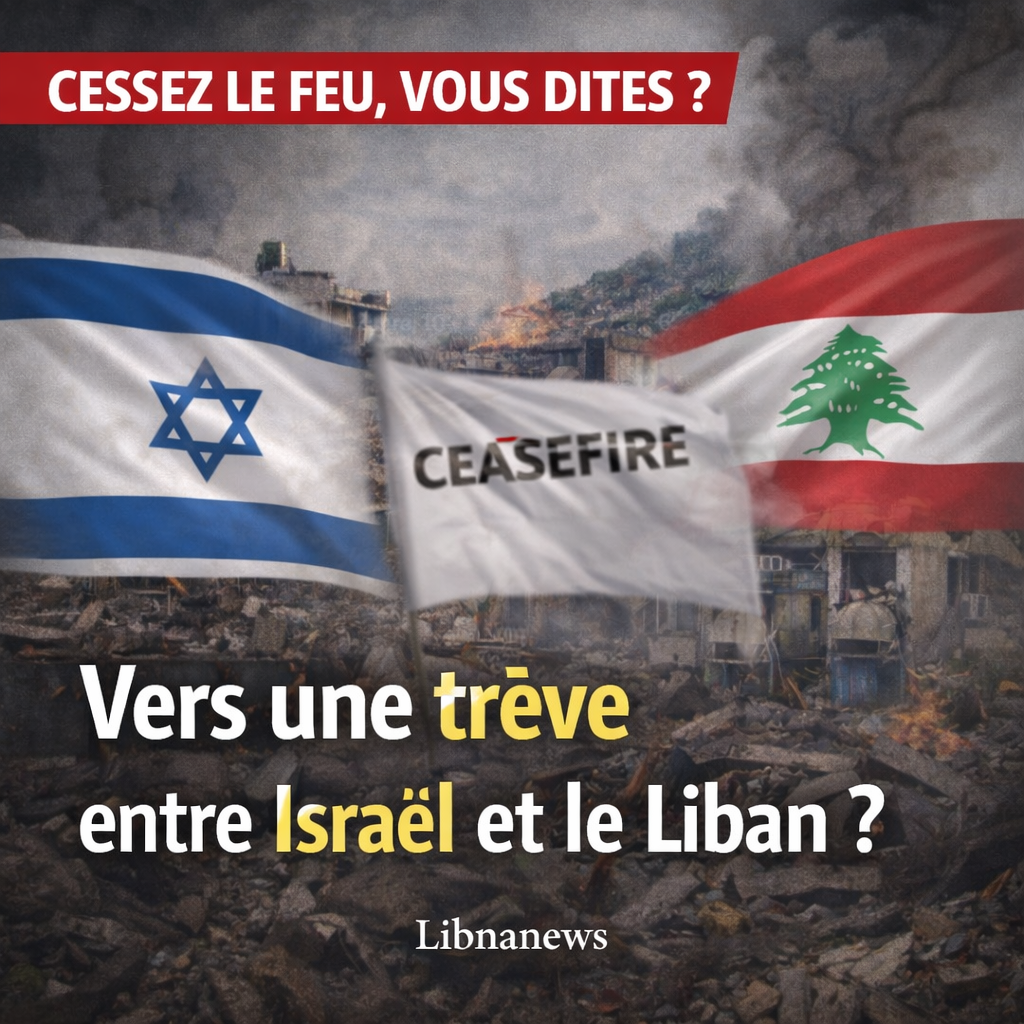
A new diplomatic sequence could open from tomorrow between Israel and Lebanon. According toIsrael Hayom« An immediate ceasefire between Israel and Lebanon » would be in preparation, with an announcement expected in the next few hours. Under this scenario, this announcement would then open a phase ofdirect negotiationsbetween Beirut and Tel Aviv on the full implementation of the conditions of the 2024 ceasefire, with the Lebanese demand for an end to Israeli violations. At this stage,precise termsSuch an arrangement is not public and there is still nothing to say if it is a formal agreement, a provisional political commitment or a simple window of de-escalation.
This blur is central. For several days, contradictory signals have accumulated. On the one hand, Benyamin Netanyahu allowed the opening of direct discussions with Lebanon, with Washington as a forthcoming framework. On the other hand, he also claimed thatno ceasefire in Lebanonuntil Israeli targets are achieved. This contradiction feeds the current uncertainty: Israel is talking about negotiations, but has so far refused to include the Lebanese front clearly in the Iranian-American truce dynamic. It is precisely for this reason that an announcement of a cease-fire, if it takes place, would mark an important political inflection.
What we know at this point
The strongest point is the existence of adiplomatic channel in preparation. Direct discussions between Israel and Lebanon are well discussed in Washington, D.C., against the background of the issue of Hezbollah, the southern border, the return of displaced persons and the implementation of previous commitments. But the contours remain blurred. No public text has been published. No detailed timetable has been formalized. And no guarantee mechanism was announced. In other words, the word « ceasefire » is circulating, but the real architecture of this possible agreement remains unknown.
The other important element is theLebanese position. Lebanon calls for a ceasefire to precede or accompany any serious negotiations. This requirement is not marginal. It responds to a simple political logic: Beirut refuses to enter into direct discussions as the strikes continue and the military power ratio remains fully structured by Israel. Lebanese officials presented the truce as a basic condition for making the talks credible.
The Lebanese condition, the cornerstone of Washington’s discussions
In today’s reading in Beirut, there can be no real negotiation if Lebanon remains under fire. That is why the prospect of an announcement tomorrow would be politically important: it would meet a fundamental Lebanese requirement:separating negotiation from immediate military coercion. As long as Israel struck while talking about discussions, the talks looked less like a diplomatic process than an extension of the military power ratio.
The problem is that this Lebanese demand comes up against a well-known reality: Israel wants the discussions to include the neutralization of Hezbollah and the security of its northern border, while the Lebanese State has neither the military nor the political latitude to impose rapid disarmament alone. This greatly reduces the concrete scope of the announced negotiations. Clearly, a ceasefire could open a discussion, but it alone would not resolve the core of the dispute.
Islamabad in the background: the Iranian condition
The other dimension, less visible but decisive, is played toIslamabad, where Iran’s trade with the United States must continue. Tehran has maintained for several days that credible de-escalation cannot exclude Lebanon. Iran, Pakistan and several capitals defended the idea that Lebanon should be included in the spirit, if not in the letter, of the regional truce. Conversely, Israel and Washington sought to treat the Lebanese front as a separate file.
In this context, an Israeli-Lebanese ceasefire would not only be a bilateral event. He would also become apolitical condition of sustainabilityfor the continuation of the Iranian-American canal. In other words, if Lebanon remained excluded, Tehran could argue that the truce was emptied of its regional substance. If, on the contrary, Lebanon is included in a de-escalation, even partial, it reinforces the logic of Islamabad. This gives the expected announcement a range far beyond Lebanon’s only southern border.
Why would this announcement be a turning point?
An announcement from tomorrow would first mean that Israel accepts, at least temporarily, what it still publicly refused a few days ago: the idea that we cannot permanently dissociate the Lebanese front from the rest of the regional sequence. It would then mean that diplomatic pressure produced a real, even limited, effect. Finally, it would open a new phase in which the question would no longer be that of stopping the strikes, but that ofApplicationa possible ceasefire: return of internally displaced persons, respect for the border, monitoring mechanisms, cessation of violations and status of direct negotiations.
But we must be careful. The immediate precedent calls for distrust. After the announcement of the Iranian-American truce, Israel continued its strikes in Lebanon, claiming that this theatre was not covered. This divergence of interpretation has already shown that between the political announcement and the military reality, the gap can be immense. A cease-fire proclaimed tomorrow will therefore be worth only in its actual modalities: a real halt to the strikes, acceptance by the parties, and a clear enough political framework to prevent an immediate return to escalation.
What is not yet known
At present, several key points remain unknown. Thedurationpossible ceasefire. It is not known whether this is a temporary truce or a broader mechanism linked to the Washington discussions. It is also not known whether Hezbollah is directly or indirectly involved in this arrangement, or whether the agreement would go only through the Lebanese State and international mediations. Finally, it is not known whether Israel would really agree to enter into negotiations without simultaneously continuing its military pressure.
That is why, at this stage, the most right thing is to speak not of an agreement acquired, but of awindow possible. A serious diplomatic window, potentially important, but still surrounded by ambiguity. If the announcement is confirmed tomorrow, it will mark a major political moment. If it is not accompanied by concrete and verifiable commitments, it may only be a fragile suspension in a war that has so far been constantly overflowing the announced cadres.




