

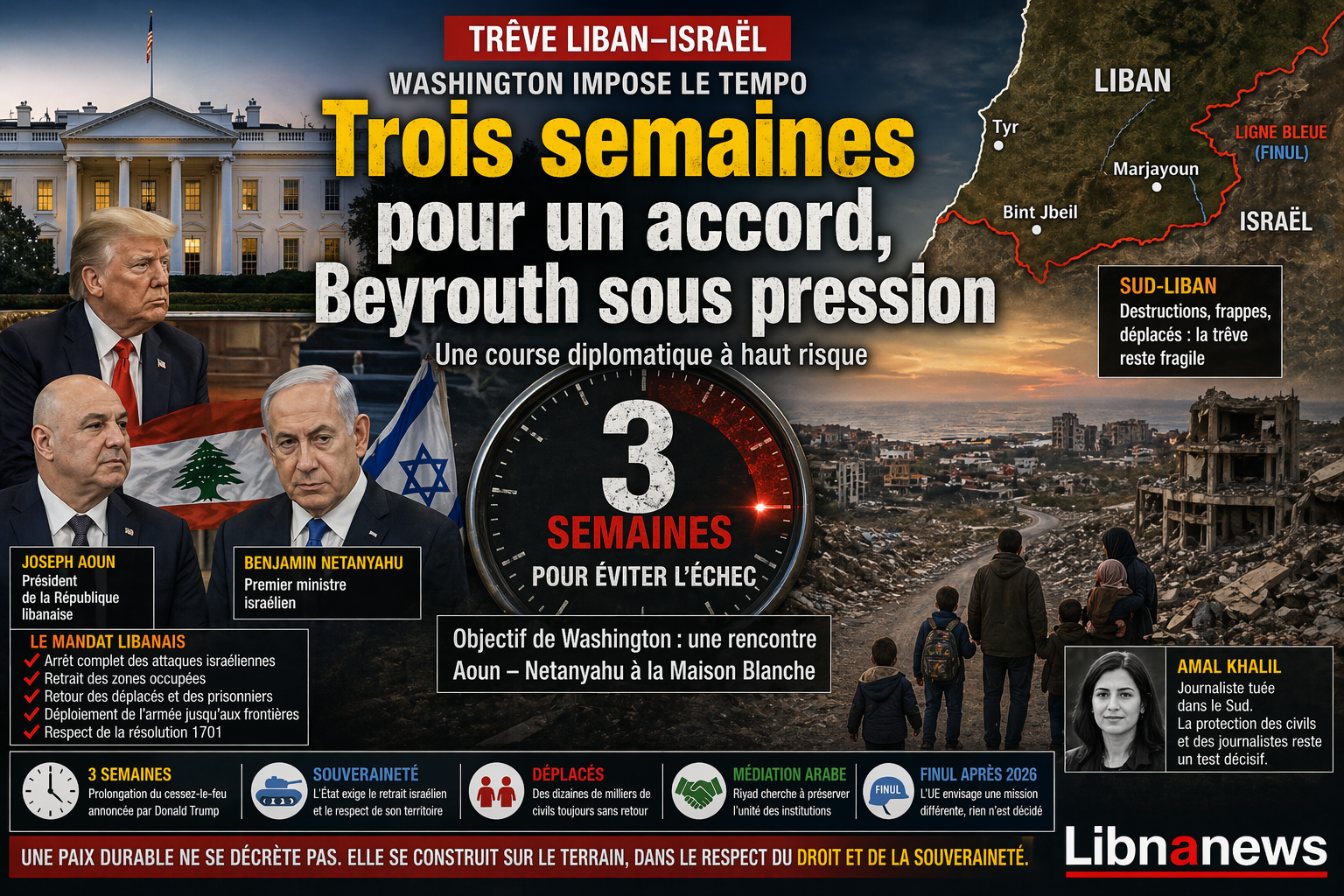
The extension of the three-week ceasefire placed Lebanon in a tight diplomatic sequence. The White House wants to turn a still fragile truce into a political process. The calendar is short. The signal is clear. Washington is no longer just trying to frame a military break between Lebanon and Israel. The US administration wants to create a dynamic that leads to a higher level meeting, with Joseph Aoun and Benjamin Netanyahu in Washington.
The second Lebanese-Israeli meeting in the White House marks this change of scale. Lebanon is represented by its ambassador in Washington, D.C., Nada Hamadeh Moawad. Israel is represented by its Ambassador, Yechiel Leiter. The meeting was attended by Donald Trump, Secretary of State Marco Rubio, Vice-President J.D. Vance and US officials involved in the case. The format remains that of an indirect or framed dialogue. Yet the direct presence of the US President turns the meeting into a major political sequence.
A Truce Changed Countdown
Donald Trump announces an extension of the three-week ceasefire. He also expressed the wish to receive Joseph Aoun and Benjamin Netanyahu during that period. This announcement creates a countdown. She gives Washington a central role. She also puts Beirut under pressure. Lebanon must quickly define what it accepts, what it refuses and what it wants to achieve before any higher stage.
The American phrase on a possible peace in a short time can seduce some of the chancelleries. It is not enough to reassure Lebanon. The country is not faced with a simple border dispute. It faces a crisis of sovereignty, destruction in the South, massive displacement, an Israeli presence in disputed or occupied areas, repeated attacks and an internal crisis over the very nature of the negotiations.
The risk is therefore to confuse speed and strength. A truce can be announced from Washington. It only becomes real if the people of the South can move around, go home, rebuild, work their land and live without strikes. The first criterion is not the holding of a summit. The first criterion is the verifiable cessation of violations.
Lebanese mandate remains defensive
The Lebanese position is not based on an immediate search for political peace. It starts with concrete requirements. Beirut calls for the complete cessation of attacks. Lebanon also wants an end to destruction in border villages, a halt to assassinations, the protection of civilians, journalists, rescue workers and medical teams. He also called for Israeli withdrawal from the occupied areas and the return of the displaced.
This defensive mandate is essential. It avoids the Lebanese presence in Washington being interpreted as an implicit acceptance of the facts imposed on the ground. Lebanese diplomacy cannot afford an image of weakness. She must show that she is participating in a discussion to protect the country, not to validate military pressure.
President Joseph Aoun seeks to maintain this line within a state framework. The points put forward by Baabda cover the cessation of fire, the withdrawal of occupied areas, the return of prisoners, the deployment of the Lebanese army to recognized borders and the consideration of outstanding points around the blue line. This approach gives the dossier an institutional basis. It also prevents negotiations from becoming an isolated channel, separate from government, Parliament and internal balances.
Sovereignty cannot remain abstract
Lebanese sovereignty is not limited to a diplomatic formula. It must take a concrete form in the South. It implies the end of Israeli operations. It implies the withdrawal of the occupied areas. It also demands that the Lebanese army be able to deploy effectively and that the State resume its role in border localities.
The reference to resolution 1701 remains useful in this context. It provides an international basis for discussion. It links the stabilization of the South to the role of the Lebanese army and that of the United Nations Interim Force in Lebanon. But this framework is not enough if it remains theoretical. It must be accompanied by safeguards and a monitoring mechanism capable of dealing with violations.
Lebanon therefore faces a difficult equation. He wants to strengthen state authority. It also wants to avoid a debate on weapons or internal security being imposed as Israeli attacks continue. The issue of the State monopoly of force cannot be separated from the State’s ability to protect the territory. Without withdrawal and security, the call to sovereignty loses its practical strength.
Washington wants a quick result
The White House is looking for a visible success. The regional context explains this urgency. The United States is engaged in a heavy confrontation with Iran. Tensions around the Strait of Ormuz, oil, the maritime blockade and trade routes are affecting the region. In this climate, Lebanon can become a land where Washington is trying to achieve rapid diplomatic progress.
An agreement or a meeting between Joseph Aoun and Benjamin Netanyahu would give Donald Trump a strong image. It would show that its administration can achieve a result in the Middle East despite regional instability. This logic of diplomatic victory can, however, create a gap with Lebanese priorities. Beirut cannot become the instrument of an American demonstration.
Peace is not made by calendar alone. It requires action. The stop of the strikes must precede the great words. The return of displaced persons must precede political photos. The Israeli withdrawal must precede any discourse on normalization. If chronology is reversed, the process may lose its legitimacy in Lebanon.
Saudi role seeks to avoid internal break-up
Saudi Arabia acts as a supervisory factor. Yazid bin Farhan’s visit to Beirut and Faisal bin Farhan’s contacts with Nabih Berri are part of an attempt to stabilize. Riyadh seeks to bring the three Presidencies closer together. The kingdom wants to prevent the American calendar from causing an internal crisis in Lebanon.
This mediation has two objectives. The first is to preserve institutional unity. The second is to place the Lebanese case in a wider Arab context. Lebanon does not want to be dragged into an isolated face-to-face with Israel under US supervision alone. Arab cover can strengthen its position. It can also reduce the risk of a fracture between Baabda, Ain al-Tinah and Serail.
The reminder of the Taif agreement has a direct political value here. It states that any evolution must respect the internal balance of Lebanon. He also pointed out that the Southern dossier could not be treated as a technical question. It affects the country’s political identity, its relationship with the Arab world and the balance between its institutions.
The truce remains suspended on the ground
The land remains stronger than the ads. In several villages in the South, the truce is not yet translated into a normal life. People remain displaced. Destruction continues to be reported. Roads, agricultural land and houses remain at the heart of uncertainty. Some people don’t know when they’ll be back. Another doesn’t know if she’ll find a village.
This situation feeds the critics against any quick negotiations. For part of the political scene, it is impossible to discuss as military pressure continues. This argument weighs heavily in the Lebanese debate. It is based on a simple idea: no negotiation can be stable if it takes place under bombs, under threat or in a climate of forced displacement.
The government must therefore show that its presence in the American process does not distance it from the people of the South. It must link every diplomatic step to concrete improvement. A meeting in Washington only makes sense if it reduces the dangers in Marjayoun, Bint Jbeil, Tyre, Nabatieh and border villages.
Amal Khalil and the civilian protection test
The death of journalist Amal Khalil weighs heavily on this sequence. It transforms the discussion on the truce into a question of protection of civilians and the press. A truce that does not protect journalists cannot inspire confidence. A truce that leaves the relief workers hampered cannot be considered as solid. A truce that allows families to seek their dead under the rubble remains an incomplete truce.
The case requires the State to document, characterize and prosecute violations. It also requires mediators to take into account the human cost of the conflict. Journalists are not military actors. Their targeting, endangering or obstructing their rescue cannot be treated as details. They concern the right to know, the right to inform and the ability of a company to understand what happens to it.
In the current sequence, this question becomes central. Washington talks about peace. Beirut must also talk about protection, investigation and international law. The credibility of the process depends on this articulation. A diplomatic agreement that ignores the victims would be politically fragile and morally challenged.
The three presidencies face the same constraint
Joseph Aoun, Nawaf Salam and Nabih Berri must move forward in the same framework, even if their roles differ. The presidency must bear sovereignty and ties with Washington. The government must manage the social, military and diplomatic consequences. Parliament must give political coverage to any national approach.
The main risk would be a public divergence between these three poles. Such a divergence would weaken the Lebanese position vis-à-vis Washington and Israel. It would also give more weight to those who refuse to negotiate. Institutional unity does not mean the absence of debate. It means that Lebanon must speak with a clear voice on the essential points.
These points are known. They concern Israeli withdrawal, the cessation of violations, the return of displaced persons, the protection of civilians, the role of the army and the refusal of any imposed buffer zone. As long as these elements remain common, Beirut can negotiate without division. If one becomes blurred, the process can turn against the state.
The risk of peace announced too soon
Peace can become dangerous if it is used before minimum conditions are met. It can create an artificial expectation. It can also give the impression that victims, displaced persons and destroyed villages become secondary. For Lebanon, the vocabulary must remain precise. The first step is a real truce. The second is a withdrawal. The third is a security mechanism. The fourth is reconstruction. Political discussion can only come after these guarantees.
Washington better go fast. Beirut better check every step. This lag does not make agreement impossible. It imposes a method. Lebanon must demand written commitments, international monitoring, a guarantee of violations and a clear timetable for action on the ground. Without this, the three weeks can become more pressure than a chance.
The window opened by Donald Trump can produce a breakthrough if it first consolidates the ceasefire. It can also exacerbate tensions if it pushes Lebanon towards a political meeting without real improvement in the South. The difference will be played in the details. The withdrawal of a position, the cessation of a strike, the return of a family, access to a medical team or the protection of a journalist will have more weight than a solemn declaration.
A calendar under regional surveillance
The Lebanese case remains linked to the confrontation between Washington and Tehran. The more tension rises around Iran, the more Lebanon becomes exposed. Regional de-escalation can strengthen the truce. Climbing in the Gulf or around Ormuz can, on the contrary, weaken any process in the South. Beirut must therefore negotiate in an environment that is not entirely dependent on it.
This reality makes Arab and international coverage more important. Saudi Arabia, Egypt, France and the United Nations can offer useful links. They can help Lebanon not to experience American tempo alone. They may also recall that the regulation cannot only be safe. It must deal with internally displaced persons, villages, reconstruction, sovereignty and law.
So the three-week period will not only be a test for Washington. It will be a test for the Lebanese state. She would say whether the institutions could defend a common position. She would say whether diplomacy could produce a real drop in violence. She will tell if the truce can pass from the press release to the field. Above all, she would say whether Lebanon could negotiate without losing control of its own mandate.




