

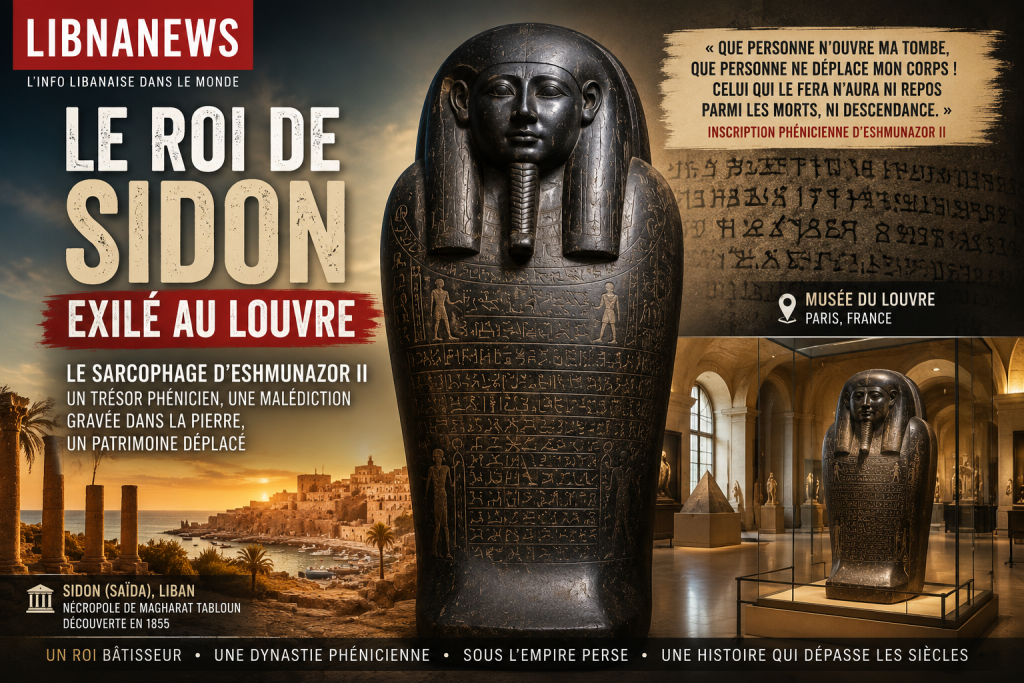
Discovered in Saïda in 1855, the sarcophagus of the Phoenician king Eshmunazor II is now preserved at the Louvre. Its inscription tells of a dynasty, temples, a Sidonian power under Persian rule, but also a curse against those who would disturb his rest.
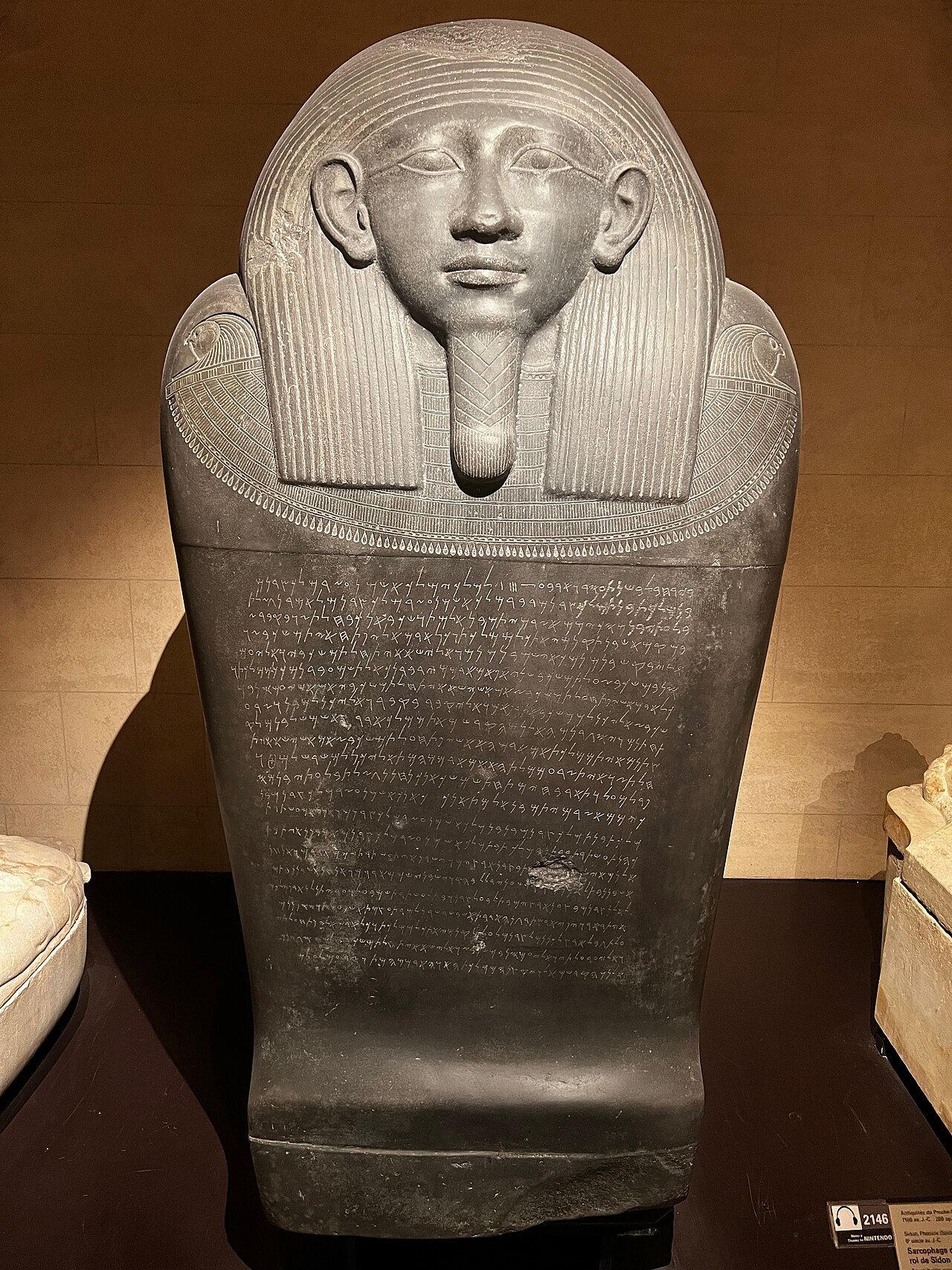
There are objects that go through centuries like works of art. And there are others that look like depositions. The sarcophagus of Eshmunazor II belongs to this second category. It is not only beautiful, rare or ancient. He’s talking. He speaks in the language of the Phoenicians. It gives a name, a dynasty, a city, gods, territory, fear and a threat. He tells Sidon in Persian times. He also tells, in spite of himself, the story of a Lebanese heritage moved away from its place of origin.
Discovered in Saïda in 1855, in the necropolis of Magharat Tabloun, the former funerary territory of Sidon, this anthropoid sarcophagus of Egyptian bill is today preserved in the Louvre, in the department of Oriental Antiquities. It bears inventory number AO 4806. Its date is placed by the Louvre between the end of the sixth and the beginning of the fifth century B.C.E., in the achenid context, i.e. that of the Persian Empire which then dominated the region.
The object is impressive. It is more than two metres high. It is carved in a dark stone, described by the Louvre as basalt, more precisely a black amphibolite from the quarries of the Hammamat Valley in Egypt. The shape of the sarcophagus is Egyptian: idealized face, tripartite wig, fake beard, ousekh necklace decorated with hawk heads. At first glance, one would almost believe a sarcophagus of Egyptian dignitary. But the inscription engraved on the lid changes everything. She’s in Phoenician. And she clearly identifies the deceased: Eshmunazor II, king of the Sidonians.
A king of Sidon, not a Pharaoh
One of the first surprises of this sarcophagus is precisely this mixture. The appearance is Egyptian, but the death is Phoenician. He’s not a Pharaoh. He’s not a Nile prince. He is a king of Sidon, one of the great Phoenician cities on the Lebanese coast. This combination says a lot of the ancient Eastern Mediterranean. The Sidonian elites did not live in a closed world. They traded, sailed, fought, borrowed artistic forms and adapted them for their own use.
Eshmunazor II belongs to a Sidonian royal dynasty whose inscription gives several elements. He stood as the son of Tabnit, himself king of the Sidonians, and grandson of another Eshmunazor, also king of Sidon. His mother is Amoashtart, queen and priestess of Astarté. This detail is fundamental. The inscription does not only speak of an isolated king. It features a royal house, dynastic legitimacy and religious authority.
The very name of Eshmunazor is theophore, i.e. it contains the name of a divinity. He refers to Eshmoun, the great healing god of Sidon. In the Phoenician world, the royal power is not separated from the religious. A king is not just a director or military leader. He is also the one who builds temples, serves the gods, guarantees divine favor and places his reign in the sacred order of the city.
The figure of Amoashtart, his mother, is almost as important as that of the king himself. The inscription presents her as a priestess of Astarté, queen and daughter of king. It is not relegated to the background. She appears as co-founder of the shrines mentioned in the text. The expression used by the inscription, according to the translation published in the notice of the Louvre, insists on a royal .
What Eshmunazar II did: temples, gods and royal prestige
The key question is, what did Eshmunazor II do? We could respond quickly: he ruled Sidon. But registration allows us to go further. It gives the actions by which the king wanted to be retained in the memory of his city.
First, with his mother Amoashtart, he built temples for the gods of Sidon. The text mentions Astarté, the great female deity of the Phoenician world, but also Eshmoun, the major god of Sidon, and Baal of Sidon. It also evokes a shrine of Eshmoun near a spring in the mountain. This is important because Eshmoun’s cult is deeply linked to the Sidonian region and its sacred landscapes, between coast, valleys, springs and shrines.
These constructions were not mere gestures of private piety. In ancient kingdoms, building a temple was a political act. This meant having resources, mobilizing labour, organizing the territory, placing oneself under divine protection and showing the population that the king guaranteed the balance between the city and its gods. Eshmunazor II therefore does not appear to be a warrior sovereign in the classical sense. He first presents himself as a building and religious king.
Then the inscription states that the Lord of kings has granted him Dor and Yapho, i.e. Dor and Jaffa, as well as rich wheat lands in the Sharon plain. The Lord of kings is most likely the great Achenimid king, in other words the Persian ruler. This puts Sidon in his imperial context. The city is powerful, but it is not independent in the modern sense. It is integrated into the Persian Empire, whose Phoenician kings are vassals, allies or local relays.
This territorial concession is one of the most political passages of registration. It means that Sidon had rendered services large enough to receive additional territories. Several historians associate this passage with the context of the Persian campaigns, especially towards Egypt, where the Phoenician cities, the leading naval powers, could play a decisive role. The fleet was one of the major assets of Phoenician cities. Sidon, along with Tyre and the other ports of the Levant, was in the military balance of the Empire.
In other words, Eshmunazor II was not only the young death of a beautiful sarcophagus. He was the representative of an active, religious, rich and integrated Sidon in the geopolitics of his time. His reign, or at least the memory that the inscription wants to preserve, combines three elements: the dynasty, the temple and the territory.
A dead king too soon
The inscription also gives a more intimate, almost tragic note. Eshmunazor II claims to have been ripped before his time. He presents himself as an orphan, son of a widow, a man of reduced days. This formula should not be read as a mere literary decoration. She builds the image of a king who died prematurely, deprived of a long life, and anxious that his rest be respected.
Some modern works portray Eshmunazor II as a very young dead king. The notice of the Louvre, on the other hand, retains what the inscription says: death before time, brevity of days, vulnerability of the deceased. The sarcophagus then becomes a double object. He is royal by his appearance, his titles and his inscription. But he is also deeply human. Behind the king of the Sidonians, there is a dead man who asks that he be left in peace.
This request is repeated with insistence. The text warns anyone who wants to open the grave, seek a treasure, move the sarcophagus or transport the body elsewhere. He claims that there is no money, no gold, no precious object to take. He threatens the desecrators not to have rest among the dead, not to be buried, not to have offspring. The curse targets the king as the simple individual. No one is above the forbidden.
That’s where history becomes almost ironic. The sarcophagus, which prohibits the removal of the person from his place of rest, has been removed. The text requiring that the deceased not be transported elsewhere is now visible in Paris. No novelist would have dared to write such a direct scene. The king of Sidon had engraved his refusal to move. Twenty-five centuries later, it was this trip that made his sarcophagus a famous piece of the Louvre.
The discovery of 1855: Sidon, consuls and antique dealers
The sarcophagus was discovered in 1855 in Saida, in the necropolis of Magharat Tabloun. At that time, modern Lebanon does not yet exist. Sidon is in the Ottoman Empire. The European powers are very present in the region through their consulates, agents, scholarly missions, merchants and collectors. The antiquities of the Levant attract increasing interest. They are sought after for their scientific value, but also for their museum prestige.
The Louvre notice mentions Aimé Péretié, Alphonse-Matthieu Durighello and the Duke of Luynes in the modern history of the object. Péretié is linked to the French consulate in Beirut. Durighello belongs to these intermediate and antique figures who play a major role in the circulation of objects. The Duke of Luynes, aristocrat and French scholar, was the one who finally gave the sarcophagus to the Louvre in 1855.
This route is not an administrative detail. It shows how Lebanese objects have often left their territory through networks that mingled diplomacy, archaeology, commerce, scientific ambition and national prestige. This is not a modern search conducted by a sovereign Lebanese State. It is an Ottoman moment, dominated by European collection and acquisition circuits.
The sarcophagus entered the Louvre very quickly after its discovery. France immediately understands the importance of the play. Phoenician inscription is exceptional. It offers a long, historical, religious and political text. It allows us to study the Phoenician language, the royal title, the cults of Sidon, the relations with the Persian Empire and the sacred topography of the city.
A capital inscription for Phoenician history
The value of the sarcophagus lies as much in its inscription as in its form. The Louvre points out that the lid bears the longest Phoenician inscription known from the Persian era. It is engraved in a linear Phoenician alphabet. She doesn’t just name the dead man. It tells of its filiation, its religious constructions, its territories and its will to prohibit any desecration.
For scholars of the 19th century, such an inscription was a major discovery. The Phoenician was known by scattered, often short inscriptions, but a text of this magnitude, discovered in Phoenicia itself, had considerable value. It allowed the Phoenician to be compared with other Semitic languages, including Hebrew. It also fueled European interest in Phoenicia, a space long evoked by Greek, biblical or ancient texts, but still little explored by systematic archaeology.
It is no coincidence that the discovery of the sarcophagus of Eshmunazor II helps to increase interest in archaeological missions in Phoenicia. A few years later, Ernest Renan led his Mission in Phoenicia between 1860 and 1861, in a context in which France wanted to document, understand, but also to include in its collections and publications a part of the history of the Levant.
So the sarcophagus is both an ancient source and a modern trigger. Antique, because he speaks of the kingdom of Sidon. Modern, because its discovery accelerates the construction of a European look at Phoenicia. It is this double story that makes it so important.
Sidon under the Persians: a local power in a world empire
To understand Eshmunazor II, one must come out of a vision too narrow. Sidon is not a small isolated city. In the sixth and fifth centuries B.C.E., it belongs to a Mediterranean and imperial network. The Ashemenid Persians dominate an immense territory, from Iran to Anatolia, from Mesopotamia to Egypt according to the periods. In this empire, Phoenician cities have a strategic function: they provide ships, sailors, port and commercial know-how.
The mention of Dor and Jaffa in the inscription is therefore essential. It shows that the Sidonian power could exceed the immediate limits of the city. Sidon receives, or claims to have received, land further south in the Sharon Plain. It’s not just a prestigious phrase. It’s a territorial declaration. It presents Sidon as a beneficiary of an imperial reward, integrated into the policy of the great Persian king.
This passage also sheds light on competition between Phoenician cities. Tyre, Sidon, Byblos and the other cities were not a unified nation in the modern sense. They shared a language, cults, cultural forms, commercial networks, but they remained separate political cities, often competing. To say that Eshmunazor expands the territory of the Sidonians is to affirm the prestige of one city in front of others.
The heritage paradox
Today, the sarcophagus of Eshmunazor II is visible in the Louvre. For the visitor, it is a magnificent piece of Oriental Antiquities. For Sidon, it is another thing: a piece of ancient sovereignty, a founding text, a royal voice extracted from Lebanese land.
Should we present him as a stolen object? The answer must be precise. The sarcophagus left Sidon in 1855, in an Ottoman context, before the creation of modern Lebanon. He entered the Louvre by donation from the Duke of Luynes, according to the official notice of the museum. Legally, therefore, the case is not that of a contemporary clandestine looting. Historically, however, it remains the product of an imbalance: a major object discovered in today’s Lebanon is transferred to a European capital, at a time when local people have no national state, no national museum, no real capacity for heritage decision-making.
That is where the real debate is. The question is not just whether a purchase paper exists. The question is how to honestly tell the story of the object. Should the Louvre keep this sarcophagus? Should Lebanon ask for its return? Should we imagine long loans, exhibitions in Saida or Beirut, high definition copies, enhanced scientific cooperation? These questions are not settled by slogan. But they can no longer be avoided.
The minimum would be that its Sidonian origin would always be put in the forefront. The sarcophagus of Eshmunazor II is not just an oriental object. It is a Sidonian object. It belongs to the history of the present Lebanon, even though it was produced in a world before the modern Lebanese state. It tells a city, a dynasty, a religion, a politics and a local memory.
The curse did not prevent the journey
The strongest anecdote remains that of the curse. Eshmunazor II had made a clear defense: not to open, not to search, not to move, not to transport his body elsewhere. He even claimed that there was nothing to take. This detail is upsetting. The king knew the graves were threatened. He knew that royal deaths attracted lusts. So he sought to protect his rest by words, by gods, by fear of the curse.
But words were not enough. The sarcophagus was extracted, transported, studied, exposed. The curse did not stop the men of the 19th century. On the contrary, she contributed to the celebrity of the object. The more the text prohibited displacement, the more striking it became for subsequent generations.
In this contradiction lies all the power of the object. The sarcophagus of Eshmunazor II is not only a witness to the death of a king. He is the witness of a second story: that of the scholarly, museum and political appropriation of the antiquities of the Levant. It tells Sidon in the fifth century B.C.E. It also tells the 19th century Europe.
A king, a city, a displaced memory
This first episode of the series on Lebanese objects preserved in museums of the world thus begins with an almost perfect piece, in the narrative sense of the term. There’s a king. There’s a powerful mother. There are gods. There are temples. There is a Phoenician city under Persian rule. There is an exceptional inscription. There’s a curse. There’s a discovery in Saida. There’s a transfer to Paris. And behind all this there is an open question: what about objects that tell the story of a country, but that are no longer in that country?
Eshmunazor II probably did not have the long reign he could claim. The inscription itself insists on a life interrupted. But his name survived better than that of many more powerful rulers. He survived because he was engraved in the stone. He survived because his sarcophagus was discovered. He also survived because this sarcophagus was moved to the Louvre.
This is a difficult paradox to accept. Without this displacement, the object might have had another destiny, perhaps forgotten, perhaps destruction, perhaps local conservation. With this displacement, it became world-famous, but at the price of a ripple. It is precisely this tension that must be told without sweetening. The Lebanese heritage kept abroad is not only a matter of windows. It is a matter of memory, power and narrative.
In Saida the king had asked that he be left in his rest. In Paris, he still talks. And what he says is more current than it seems: the dead can also remind the living that stones have a homeland.
Reference
- Subject matter:sarcophagus of Eshmunazor II, king of Sidon.
- Discovery site:Saida, the necropolis of Magharat Tabloun, ancient Sidon.
- Date of discovery:1855.
- Date:achaemenid period, late 6th-early 5th century B.C.E.
- Material:basalt / black amphibolite of egyptian origin.
- Language of registration:phoenician.
- Present Museum:Louvre Museum, Department of Oriental Antiquities, Sully wing, room 311.
- Inventory number:AO 4806.
- Mode of acquisition indicated by the Louvre:gift, 1855.
Sources
- Musée du Louvre, official notice of the sarcophagus of Eshmunazor, AO 4806.
- Wikimedia Commons, photograph of the sarcophagus of Eshmunazor II by Onceinawhile, license CC BY-SA 4.0.
- Reference work reported by the Louvre: Hélène Le Meaux and Françoise Briquel-Chatonnet,The Sarcophagus of Eshmunazor, Musée du Louvre / El Viso, 2019.




