

There are truths that are bypassed by fatigue, prudence or calculation. And then there are times when they impose themselves with such brutality that no detour is possible anymore. Lebanon is now at this tipping point, where words must regain their meaning and where responsibilities must be named.
For decades, a fundamental imbalance has been established in the heart of the state: an armed force, from a minority, imposes its will on a disarmed majority. This imbalance is not only military, it is political, institutional and moral. It is not a simple balance of power, but an inversion of the very principle on which all democracy rests: the primacy of the collective over the domination of a group.
Hezbollah, whatever its capacity or organization, does not represent the entire Lebanese people. Even assuming — an already questionable hypothesis — that the entire Shiite community is acquired from it, it is only a fraction of the country. Lebanon is, in essence, a fragile balance between various components, where none can claim to govern alone without breaking the national pact.
And yet it was this rupture that happened.
To understand this shift, we must go back to the beginning. The Lebanese Shia movement was not, in its early days, the bearer of a logic of domination. Under the impulse of Moussa Sadr, he embodied a claim of dignity and integration in the Lebanese context. His disappearance in Libya, on the eve of the Iranian revolution, opened a breach. This breach was not filled by national continuity, but by a radical redefinition of the project.
Very quickly, another vision was imposed: a transnational, ideological vision, where Lebanon became a link in a larger architecture. The decision centre has moved, and with it the very purpose of the action.
This slide was not without violence.
The 1980s were marked by massive attacks, particularly against Western forces in Lebanon. The attacks on American marines and French soldiers, including that of Drakkar, have profoundly affected the country’s contemporary history. These events contributed to the gradual withdrawal of the West, leaving a strategic vacuum whose consequences are still being felt today. This moment was a turning point: Lebanon ceased to be a sustained and framed space, to become an open ground for other influences.
Subsequently, violence did not disappear. She changed.
Within the country itself, a series of political assassinations has gradually redesigned the landscape. Major figures such as Rafik Hariri, Lokman Slim and Gebran Tueni were targeted. These murders were not just isolated acts, they produced a systemic effect: to install fear, deter opposition, and impose an invisible line that no one had to cross.
In this climate, democratic life has been emptied of its substance. The debate has become risky, dangerous dissent, and pluralism — though constituting Lebanese identity — has gradually been stifled.
At the same time, regional developments have strengthened this dynamic. The Israeli withdrawal in 2000 was seen as a total victory for Hezbollah, consolidating its internal and external legitimacy. Building on this position, the movement has expanded its influence beyond the military field to fully invest the political field.
The alliance with major political actors, particularly around Michel Aoun, completed this process. The state, already weakened, was gradually neutralised from within. Its institutions have been paralysed, its decisions constrained, and its ability to exercise its authority seriously undermined.
The consequences were heavy.
Lebanon’s traditional partners, Arab and Western alike, have distanced themselves from a state they no longer perceived as sovereign. The aid has dried up, investments have withdrawn, and confidence has collapsed. This rupture has accelerated an unprecedented economic crisis, taking with it the banks, deposits, currency and the very foundations of the system.
In this context, international resolutions calling for the disarmament of militias have remained unimplemented. Not for lack of clarity, but for lack of capacity. A coerced State, weakened and penetrated by asymmetrical power relations, cannot alone impose such a change.
This is where the question becomes inevitable.
Can we expect a state taken in vice to liberate itself by its own means? Can we ask a limited army in its resources and its margins of action to face a parallel structure that is firmly organized and sustained?
The answer, if one refuses illusions, is no.
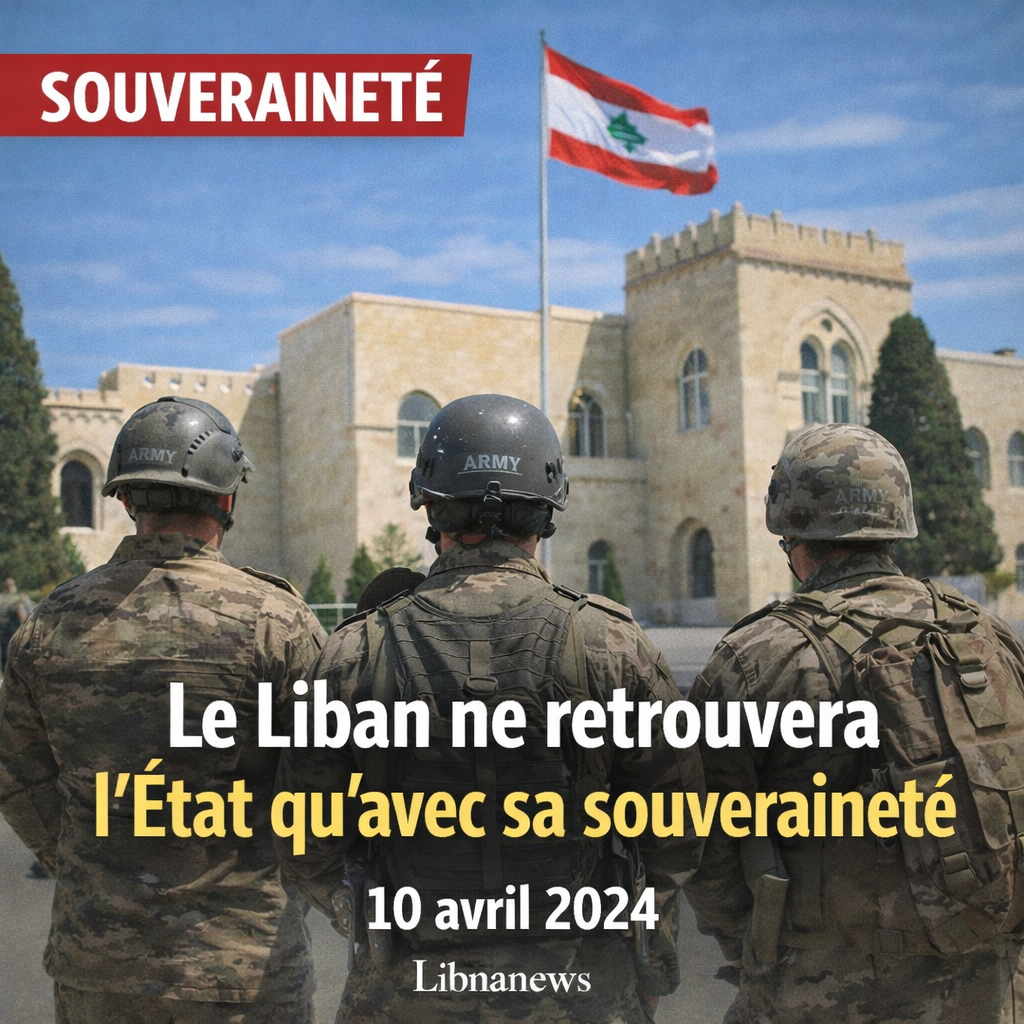
Restoring Lebanese sovereignty requires a real rebalancing of forces. And this rebalancing cannot be achieved without clear, structured and legitimate external support. It is not a question of replacing one guardianship with another, but of enabling the Lebanese State to become again what it must be: the sole holder of legitimate force in its territory.
International military assistance, legally supervised and coordinated with the Lebanese Armed Forces, therefore appears to be a strategic necessity. It would provide the means to implement existing resolutions, restore State authority and end the multiplicity of armed power centres.
The stakes go far beyond security.
The aim is to restore the possibility of Lebanon as a state. To restore the confidence of its citizens and partners. To reopen the economic outlook. Above all, to restore the fundamental right of the Lebanese to decide freely on their collective destiny.
For in essence, the question is simple.
Can a country survive when fear replaces debate, when weapons replace institutions, and when the minority imposes its law on the majority?
Lebanon has reached a point where ambiguity is no longer an option. Between sovereignty and its negation, between the state and its erasure, it is no longer a matter of commenting — it is a matter of choosing.
And this choice does not only concern the Lebanese.
If the West really claims democracy, then it cannot simply invoke it in principle while abandoning it in practice. It is up to him to help the peoples who aspire to live according to these principles to be able to exercise them effectively, to support the societies caught in line between the logics of minority domination and the systems of hostage-taking which are more mafia structures than states.
For a democracy that is not defended, concretely, always ends up being replaced.
In the case of Lebanon, this responsibility takes on a particular, almost exemplary, dimension. For it is not one country among others, but a space where diversity has long been experienced as a wealth and not as a line of fracture, where coexistence was not a slogan but a fragile reality, patiently constructed.
To abandon Lebanon to a logic of armed domination would be to endorse the idea that no pluralistic society can survive in the face of a structured and militarized organization. This would send a signal far beyond its borders: that force prevails over the law for a long time, that internal balances can be broken without consequence, and that the international community only intervenes when its immediate interests are directly threatened.
Conversely, supporting Lebanon in restoring its sovereignty would be a simple but fundamental principle: a State cannot be permanently confiscated by a parallel force, and a people cannot be deprived indefinitely of its capacity to govern itself.
This requires political courage, because any action involves a cost. This also implies lucidity, because inaction has another — often higher, but delayed, so easier to ignore.
Lebanon does not only need technical or economic support. It needs a return to balance that allows its institutions to function again. He needs legitimacy to stop being challenged by force. In short, it needs the state to become the state again.
For without this, no reform will hold. No economic recovery will be credible. No social pact can emerge.
It all starts with sovereignty.
And it all comes back.




