

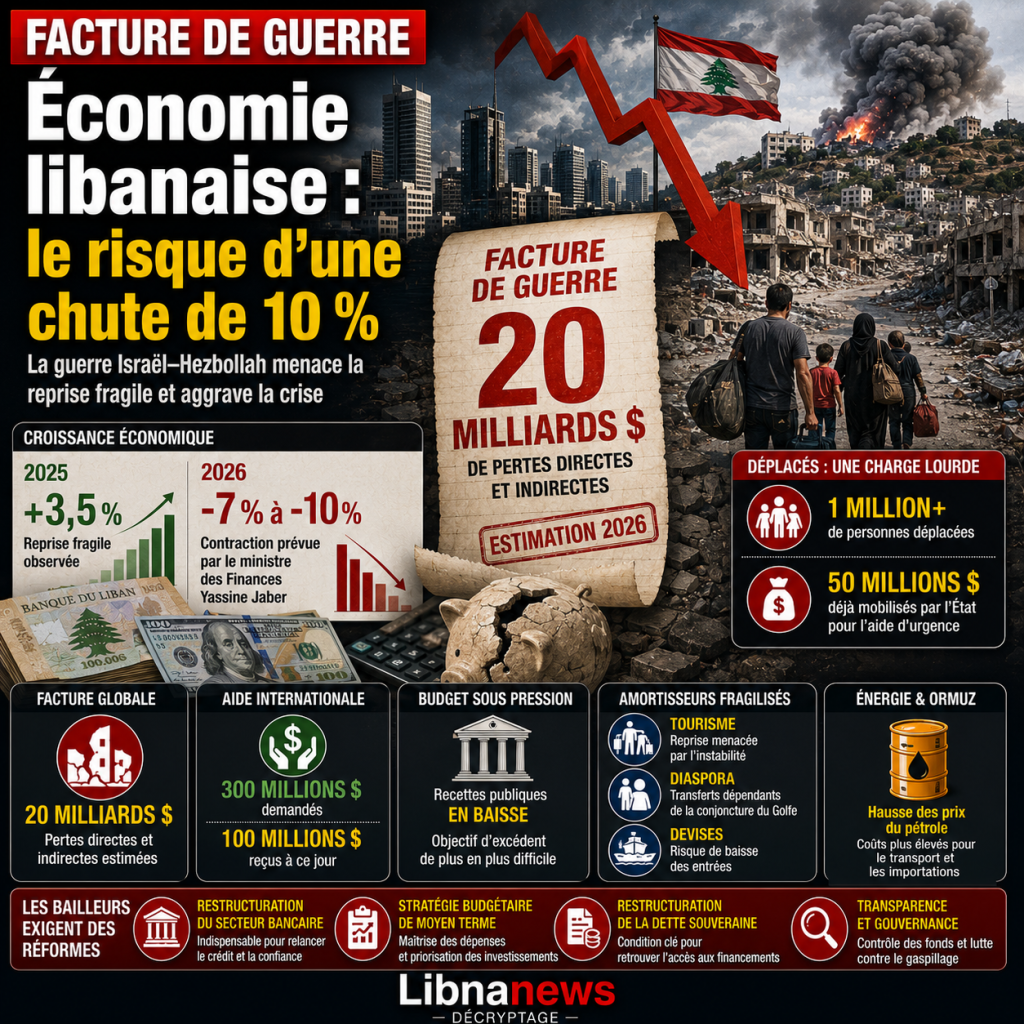
The Lebanese economy is entering a new phase of tension. The ongoing war between Israel and Hezbollah threatens to erase the fragile recovery observed in 2025 and to plunge the country back into a severe contraction. Finance Minister Yassine Jaber estimates that activity could decline by at least 7% in 2026, with a risk close to 10%, while the direct and indirect bill for the conflict could reach $20 billion. This estimate comes at a time when the State is already financing aid to internally displaced persons, public revenues are falling and donors are still demanding profound reforms in the banking sector and public finances.
A fragile recovery already compromised
Lebanon’s economic trajectory had begun to show signs of stabilization before the new war. According to one international institution, real gross domestic product grew by 3.5 per cent in 2025. This improvement remained modest, but it marked a change after several years of collapse. It was based on a partial return of tourism, diaspora spending, incomplete macroeconomic stabilization and some progress in reform. It did not mean that the 2019 crisis was resolved.
This recovery was therefore fragile in nature. It depended on an essential element: stability. The assumption of nearly 4 per cent growth in 2026 implied a relatively calm environment, continued reform efforts and Lebanon’s ability to attract some of the financing needed for reconstruction. The war reversed this scenario. The country no longer discusses an acceleration of recovery but a reduction in losses.
The contraction forecast advanced by the Minister of Finance changes the magnitude of the risk. A decline of at least 7% in 2026 would erase much of the previous year’s gains. A decline of close to 10 per cent would signal a new major macroeconomic shock. In an economy that has already lost a large share of its size since 2019, this decline would not start from a high level, but from an already weakened base. It would affect income, business and the ability of the State to finance essential services.
The 2024 war had already led to a 7.1% contraction in real GDP, according to the data cited by the press and institutions. It had also aggravated the cumulative decline in the Lebanese economy since the financial collapse. The new estimate shows that the country is likely to enter a sequence of repeated shocks. Each episode of war destroys capital, reduces confidence and delays the reconstruction of the previous one.
Lebanese Economy: An invoice valued at $20 billion
The $20 billion proposed by Yassine Jaber should not be read as a mere addition of destroyed buildings. It covers direct and indirect losses. Direct losses relate to homes, shops, roads, infrastructure, agricultural land, equipment and businesses affected by strikes or forced abandonment of exposed areas. They can be evaluated by field missions, satellite images, municipal declarations or sector surveys.
Indirect losses are more difficult to measure. These include lost working days, uncollected income, deferred investment, frozen goods, cancelled contracts, reduced tourism, increased insurance costs, loss of activity in emptied villages and psychological effect on households. They are often more durable than visible damage. A shop destroyed is rebuilt with funds. A broken economic circuit can take years to return.
The bill also spreads in private finance. Households must pay for temporary housing, help displaced relatives or replace lost property. Companies must absorb higher logistical costs, supply disruptions or the absence of employees. Farmers can lose an entire season if access to the fields is impossible. Craftsmen and traders see their customers disappear when residents leave a region.
This shock comes after an unresolved banking crisis. Enterprises do not have a normal credit to go through a business interruption. Families have often lost access to part of their deposits since 2019. The State cannot compensate largely for private losses. The war thus strikes an economy where the usual shock absorbers are worn out.
Internally displaced persons transform the budget into an emergency tool
The war caused the displacement of more than one million people, according to reports. The government has already mobilized $50 million in public funds to support them. This amount represents only part of the real need. It nevertheless gives an idea of the immediate pressure on the budget.
Displaced persons need temporary housing, water, food, care, hygiene, transport and education. Reception centres require regular expenditure. Municipalities and schools receiving displaced families bear additional costs. Host families spend more on feeding, heating, transporting and treating. This burden is not limited to State accounts. She’s going through society.
Displacement also has a negative economic impact on areas of origin. A empty village no longer consumes. An abandoned farm no longer produces. A closed trade no longer pays its suppliers. Employees who leave their place of work often lose part of their income. Aid expenditure maintains a minimum of survival but does not replace lost local activity.
The Minister of Finance indicated that the government was hoping for a budgetary surplus this year. This goal is becoming much more difficult. War increases spending and reduces revenues. The state must pay more as the activity that feeds the tax declines. This is one of the classic mechanisms of a war economy. Public needs increase when the tax base contracts.
Public revenue under pressure
The decline in public revenues can come from several channels. A contraction in consumption reduces VAT revenues. A decrease in imports reduces customs duties. The closure or slowdown of businesses is a tax burden on profits and contributions. The decline in tourism deprives the State of taxes and charges. Expatriate spending, which plays an important role in the local economy, can also decrease if travel is postponed.
This dynamic is dangerous for an already forced State. Lebanon must finance humanitarian aid, support public services, maintain security spending, preserve wages and prepare for reconstruction. It does not have normal access to international markets. Debt margins are limited by the legacy of the default and the still incomplete restructuring. Each new expenditure therefore raises the question of its financing.
The stability of the pound against the dollar is presented as a positive point. It reduces the risk of panic and limits the immediate transmission of the shock to prices. But this stability is not enough to restore growth. A bonded currency does not create tax revenues if businesses close. It does not replace donations. She doesn’t finance reconstruction. It gives a little predictability, in an environment where almost everything else becomes uncertain.
The risk would be to confuse monetary stability with economic health. Lebanon can maintain a relatively stable rate for some time, while seeing real activity contracting. The decisive measure remains the ability to produce, sell, export, welcome visitors and bring people back to the affected areas. On these points, war imposes a direct constraint.
Diaspora, tourism and foreign exchange: the three weakened shock absorbers
The Lebanese economy depends heavily on the diaspora. Expatriate transfers support families, finance consumption and bring currency. The Lebanese in the Gulf countries play a central role. They send money, sometimes invest in real estate, come back during holidays and support part of the service sector.
The Minister of Finance expressed concern on this point. If the regional war affected the Gulf economies, expatriates could reduce their support or postpone their travel. This is a major risk. A decline in transfers would affect households most dependent on family support. It would also reduce foreign currency liquidity in an already constrained economy. Finally, it could weaken fuel consumption, one of the last engines still visible.
Tourism is the other shock absorber. By 2025, the recovery had been driven in part by the return of visitors and the expense of the diaspora. In 2026, the image of a country at war threatens this dynamic. Although Beirut and some regions remain open, reservations depend on the perception of risk. Airlines, hotels, restaurants, taxis, shops and cultural venues are quickly receiving the slightest security alert.
The third shock absorber is international aid. However, according to the statements reported, it remains insufficient. The $300 million appeal would have resulted in only about $100 million at the time of reporting. A $200 million loan from the World Bank and a €45 million European grant provide partial support. But Lebanon receives mainly loans, less donations. This difference is important. A loan relieves cash flow but creates a future bond. A donation directly reduces the crisis load.
Donors always call for reforms
The war does not suspend reform requirements. The International Monetary Fund recalled that the return of sustainable growth requires comprehensive reforms. Discussions with the Lebanese authorities focused on the restructuring of the banking sector, a medium-term fiscal strategy, the restructuring of sovereign debt and the establishment of a tax framework capable of supporting investment expenditure. These do not disappear because the country is entering a security emergency.
On the contrary, war makes these reforms more difficult and necessary. The more losses accumulate, the greater the need for funding. But donors will be all the more cautious as the control mechanisms remain weak. They will demand guarantees on the use of funds, transparency, the hierarchy of expenditure and the ability of the State to avoid waste. Reconstruction can attract resources, but only if institutions inspire confidence.
The banking sector remains the main hub. Without clear restructuring, credit cannot resume normally. Without credit, small and medium-sized enterprises cannot repair, invest or rebuild their stocks. Without a deposit solution, household confidence remains fragile. The cost of war is therefore added to a financial crisis that has not been fully addressed. The risk is to finance the emergency without rebuilding the foundations.
The State will also have to arbitrate between immediate aid and investment. Assistance to internally displaced persons is essential. But if all resources go to emergency, the reconstruction of roads, schools, water systems, hospitals and productive infrastructure will be delayed. Conversely, investing in reconstruction without protecting displaced families would create a social crisis. The dilemma is fiscal, but also political.
Energy and Ormuz worsen the shock
The regional crisis around the Strait of Ormuz adds an external threat. Higher oil prices and shipping tensions can increase imports. For Lebanon, an energy-importing country, the effect can be rapid. More expensive fuel increases the cost of transportation, private electricity production, delivery of goods and some imported commodities. It reduces household purchasing power and business margins.
A news agency reported that the war in the Middle East has already raised the bills of global companies through insurance, logistics detours and energy costs. Lebanon is experiencing this type of shock with less protection than stronger economies. Lebanese companies cannot always pass on costs to already impoverished consumers. Nor can they absorb increases for a long time without reducing employment or hours.
Energy dependence also makes inflation more likely. Even if the pound remains stable, an imported fuel shock can be passed on to prices. Goods transported by truck, services using generators and imported products become more expensive. Inflation then erodes the benefit of monetary stability. Households see prices rise, even without further official depreciation.
Ormuz also weighs on the Gulf diaspora. If regional economies face increased risk, energy disruption or a slowdown in activity, Lebanese expatriate workers can suffer the consequences. Revenues sent to Lebanon could be affected. The global energy shock can therefore return to the Lebanese economy through two channels: import prices and expatriate transfers.
The most exposed sectors
Tourism is probably the sector most sensitive to security perceptions. It depends on bookings, flights, insurance, diaspora vacations and trust. A missed season results in lost revenue for hotels, restaurants, travel agencies, shops, drivers, guides and leisure venues. It also weighs on government revenues. Part of the Lebanese economy is affected by these summer expenses.
Agriculture and the rural economy are directly affected in exposed areas. Access to land may be interrupted. Crops can be lost. Roads can become dangerous. Local markets can disappear if people leave. The effects are not only immediate. Uncultivated land for a season, destroyed material or displaced livestock can reduce incomes over several cycles.
Urban trade and services are experiencing a more diffuse shock. Displaced families consume commodities, but reduce non-essential expenditures. Households who fear a worsening of the war postpone large purchases. Companies are reluctant to invest. Importers sometimes reduce their orders. This collective prudence amplifies contraction.
Construction is in a paradoxical situation. Reconstruction could create a significant demand. But this demand only becomes an activity with funding, permits, accessible materials, safe roads and a minimum of stability. As long as the strikes continue or the areas remain uncertain, construction sites do not advance. The recovery potential remains blocked.
An economic scenario suspended from the ceasefire
The range of contraction will depend mainly on the duration of the war. If the cease-fire stabilizes, if the Israeli withdrawal moves forward and the inhabitants gradually return to the villages, the losses can be contained. Tourism can save part of the summer. Transfers can remain strong. Donors can speed up some disbursements. The contraction would remain severe, but less destructive.
If the war continues, the scenario changes. Displaced persons remain dependent on assistance. Government revenues are falling further. Enterprises are reducing their activity. Donors are reluctant to commit new funds in an unstable environment. Expatriates postpone their trips. Energy costs remain high. In this case, the contraction could be close to the top of the range, or even create new funding needs.
The authorities will therefore have to follow several concrete indicators: monthly tax revenues, diaspora transfers, arrivals at the airport, tourist bookings, aid disbursements, fuel imports, transport prices and the number of displaced persons actually returned. These data will say more than speeches. They will show whether the economy sinks or stabilizes losses.
The next economic turn will also depend on political and security discussions. Progress on the southern front can reduce uncertainty and support confidence. A Pentagon blockage or a resurgence of strokes may instead aggravate contraction. The Lebanese economy is thus suspended from an equation that goes beyond the Ministry of Finance: security of the South, external aid, banking reform, regional energy and the capacity of the State to transform the emergency into a reconstruction plan.




