

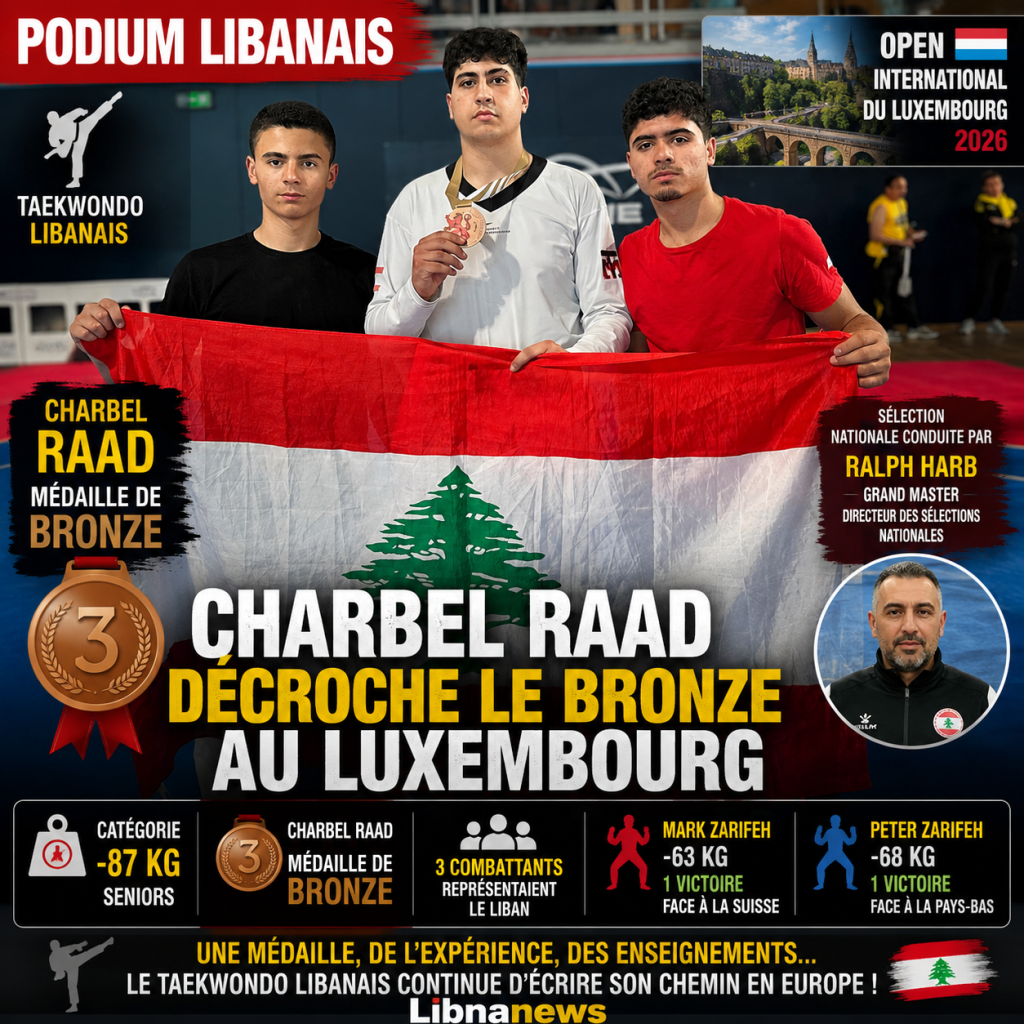
The Lebanese taekwondo signed a new presence on the European podium with the bronze medal won by Charbel Raad at the Luxembourg International Open. The result, obtained in the category of less than 87 kg, offers the national selection a positive benchmark in a competition that brought together opponents from several European countries. Around Raad, the Lebanese delegation also had the twins Mark Zarifeh, engaged in less than 63 kg, and Peter Zarifeh, aligned in less than 68 kg. Under the leadership of the great master Ralph Harb, director of the national selections and coach of the mission, Lebanon therefore leaves again with a medal, two additional victories and several useful lessons for the remainder of the season.
Lebanese Taekwondo Holds podium
Charbel Raad’s medal is first of all a sporty simplicity. In a small delegation, each fight weighs more. Lebanon had not engaged a broad collective capable of increasing the statistical chances of a podium. Only three fighters wore national colours. In this format, a bronze medal is not a result of presence. It reflects an ability to resist the pressure of an international picture, to manage distance, warming, arbitration, waiting times and tactical adjustments imposed by unknown opponents.
The result is also important by the category concerned. The less than 87 kg require a particular profile. Fighters combine power, mobility and fast distance reading. Any delay in entering or leaving the area is expensive. A podium in this weight therefore presupposes physical strength, but also combat maturity. Raad brings to Lebanon a result that confirms its competitiveness in a demanding division, where gaps are often built on a few decisive actions.
The dispatch does not detail Raad’s entire combat course. We must therefore be careful and not artificially reconstruct his picture. What is established, however, is clear: the Lebanese finished third and offered the country a bronze medal. This restraint is important. Combat sport is often told by gestures, turns and key moments. But when technical details are not available, the result itself must be placed in the center, without embellishment.
Mark and Peter Zarifeh, two useful victories
Around Raad, the performances of Mark and Peter Zarifeh complete the balance sheet. Mark Zarifeh, hired in less than 63 kg, won his first fight against a Swiss opponent before bowing in his second match against a Frenchman. Peter Zarifeh, in less than 68 kg, followed a nearby route. He won his first game against a Dutchman and then lost to a second Dutch opponent. The two brothers left Luxembourg without a medal, but not without a result. Everyone took a tour in an international tournament, which is still important for athletes under construction.
In the light and intermediate categories, the chain of fighting imposes a high demand for rhythm. The less than 63 kg and the less than 68 kg are often fast divisions, with athletes able to attack in gusts and change direction without losing balance. A win of entry allows you to build trust. A defeat in the next round immediately recalls the density of the European level. For Mark and Peter Zarifeh, the tournament therefore serves as a concrete test. It shows that they can enter the competition, but also that the passage to the last laps requires an extra margin.
Ralph Harb’s role also deserves to be emphasized. The presence of a director of national selections at the head of a three-athlete mission reflects a desire for close supervision. In an international competition, the coach does not just give instructions from the edge of the arena. It manages schedules, recoveries, video playbacks when available, tactical choices, potential claims and the mental balance of combatants. The Raad medal and the two victories of the Zarifeh brothers are part of this follow-up work.
A medal in a challenging sporting context
For the Lebanese Taekwondo, this type of displacement remains of particular value. The country is experiencing an economic and institutional crisis that directly affects sport. The federations work with forced budgets. Clubs often carry an important part of the training. Families bear high costs, between equipment, travel, internships and competitions. Under these circumstances, each international participation requires a heavy organization. Returning with a medal allows to justify the effort and maintain a dynamic around the athletes.
Performance also occurs at a time when Lebanese sport is looking for positive signs. Individual disciplines play an essential role in allowing high-level athletes to wear the flag in foreign competitions, even when collective means remain limited. The Taekwondo has already demonstrated this ability, notably through a network of active clubs, a strong technical culture and a regular presence in regional and international competitions. Raad’s medal adds to this continuity.
The choice of sending only three fighters can be read in two ways. It first reveals the financial and sporting prudence of a targeted delegation. It also shows that selection sometimes prefers to rely on profiles that are able to gain real benefit from international experience, rather than to multiply registrations. This approach can produce concentration. It gives each athlete a strong responsibility. It also further exposes the final balance, as one or two rapid defeats can erase the visibility of an entire mission.
Raad’s bronze as a support point
Raad’s bronze avoids this scenario. It gives an anchor point to the displacement. It allows you to talk about the tournament other than as a simple learning step. It also provides the group with an image of shared success. In combat sports, a medal won by a team member often feeds the entire collective. It validates a preparation, confirms a method and encourages beaten fighters to return with a more precise target. The psychological effect can be as useful as the accounting result.
Mark and Peter Zarifeh’s journeys deserve to be read without excessive severity. Elimination after a victory does not mean complete failure. Rather, it indicates a level reached and a threshold yet to be crossed. For Mark, beating a Swiss then yielding to a Frenchman gives a measure of continental competition. For Peter, defeating a Dutchman and then losing against another opponent in the same country offers an interesting reading: the national style, the technical density and the adjustments of one fight to another can weigh heavily. These elements must then feed the work during training.
A tournament like the Luxembourg Open also serves as a laboratory. Athletes face opponents whom they do not always know. They discover the rhythms of arbitration, different ways of fighting, strategies for managing scores and attitudes specific to European schools. Lebanon cannot be content with a local calendar if it wants to maintain its fighters internationally. He must multiply these confrontations, even when the immediate return is limited to a bronze medal and experienced combat.
Three categories, three technical readings
The management of categories will be another point to follow. Charbel Raad won his medal in less than 87 kg. Mark Zarifeh worked in less than 63 kg. Peter Zarifeh fought in less than 68 kg. These three weights cover different profiles. They allow management to assess several needs: power and control in heavier categories, speed of execution in intermediate divisions, ability to mark without exposure in lighter fighters. Reading the tournament should therefore not be limited to the podium. It is intended to be used to plan for future deadlines.
The Lebanese Taekwondo Federation can draw several lessons from this displacement. The first concerns the real competitiveness of its athletes. A medal and two first victories show that Lebanese fighters are not only present to learn. They can win outside. The second concerns the depth of the framework. Ralph Harb’s follow-up confirms the importance of active technical leadership. The third concerns continuity. Isolated performance is not enough. It must be followed by other outings, other internships and coherent preparation.
Athletes will also need to be protected from excessive waiting. An international bronze medal is a positive result, but it must not be transformed into an automatic promise of future titles. Taekwondo progresses in cycles. A fighter can climb on a podium one week, then fall early in another more raised tournament. The important thing is to measure trends: ability to pass the first laps, quality of tactical responses, stress management, fitness at the end of the day, ability to return after a defeat.
Transforming the result into progress
For Charbel Raad, the next step is precisely to convert this podium into stability. The bronze of Luxembourg can serve as a reference, provided that it does not become a point of arrival. It will be necessary to analyse the fighting, identify the situations that have made it possible to score and those that have prevented access to the final. In categories where power plays a major role, technical precision remains crucial. Spectacular shots are not enough. The management of penalties, carpet exits and low time often makes the difference.
For the Zarifeh brothers, the message is different. Their tournament shows an ability to enter a tableau and win a first international duel. It’s a base. The work will have to focus on the second fight, one where the opponent is often more experienced, better ranked or better adapted after observation. Going this course sometimes requires little: a better start, a more patient defense, a change of pace or a cooler management of the score. At this level, details become results.
The Lebanese medal in Luxembourg can also have an effect in clubs. Young athletes follow these performances. They know that international podiums remain rare and difficult. Seeing a Lebanese fighter on the third step in a European competition feeds the idea that the course is possible. This does not replace training rooms, years of discipline and financial sacrifices. But it gives direction. In a country where young athletes often face a lack of prospects, this dimension counts.
Valuable visibility for discipline
In the immediate future, the result also gives the federation concrete content to communicate. Lebanese sport often suffers from a lack of visibility, especially when national news is dominated by the political, economic or security crisis. An international medal, even modest in the world hierarchy, is a reminder that athletes continue to train, travel and represent the country. It can help attract support, convince private partners and keep attention to a discipline that depends heavily on the continuity of club work.
The media coverage of this outcome must therefore remain balanced. She should salute Charbel Raad, mention the work of Mark and Peter Zarifeh, recognize Ralph Harb’s leadership and recall the difficult context of Lebanese sport. It must also avoid the occurrence of the event. The bronze of Luxembourg is not a world title. Nevertheless, it is a useful international performance, achieved by a small delegation, in a discipline in which Lebanon continues to seek its place in the face of more equipped nations.
Lebanese sport needs these intermediate results. They don’t always do the front page, but they build a reputation. They allow federations to defend their programs, clubs to motivate their students and athletes to believe in their trajectory. In the case of taekwondo, regularity counts more than isolated radiance. A podium in Luxembourg, then another successful exit, then a progression in regional competitions can create a real dynamic.
The follow-up will depend on the timing of selection, the means available and the ability to transform experience into progress. Raad goes back with a medal. Mark and Peter Zarifeh leave again with a victory each and battles to analyze. Ralph Harb goes back with an exploitable balance sheet, both positive and demanding. The Lebanese Taekwondo, on the other hand, gains a new proof that its athletes can exist on the international stage when preparation, coaching and competitive exhibition meet.




