






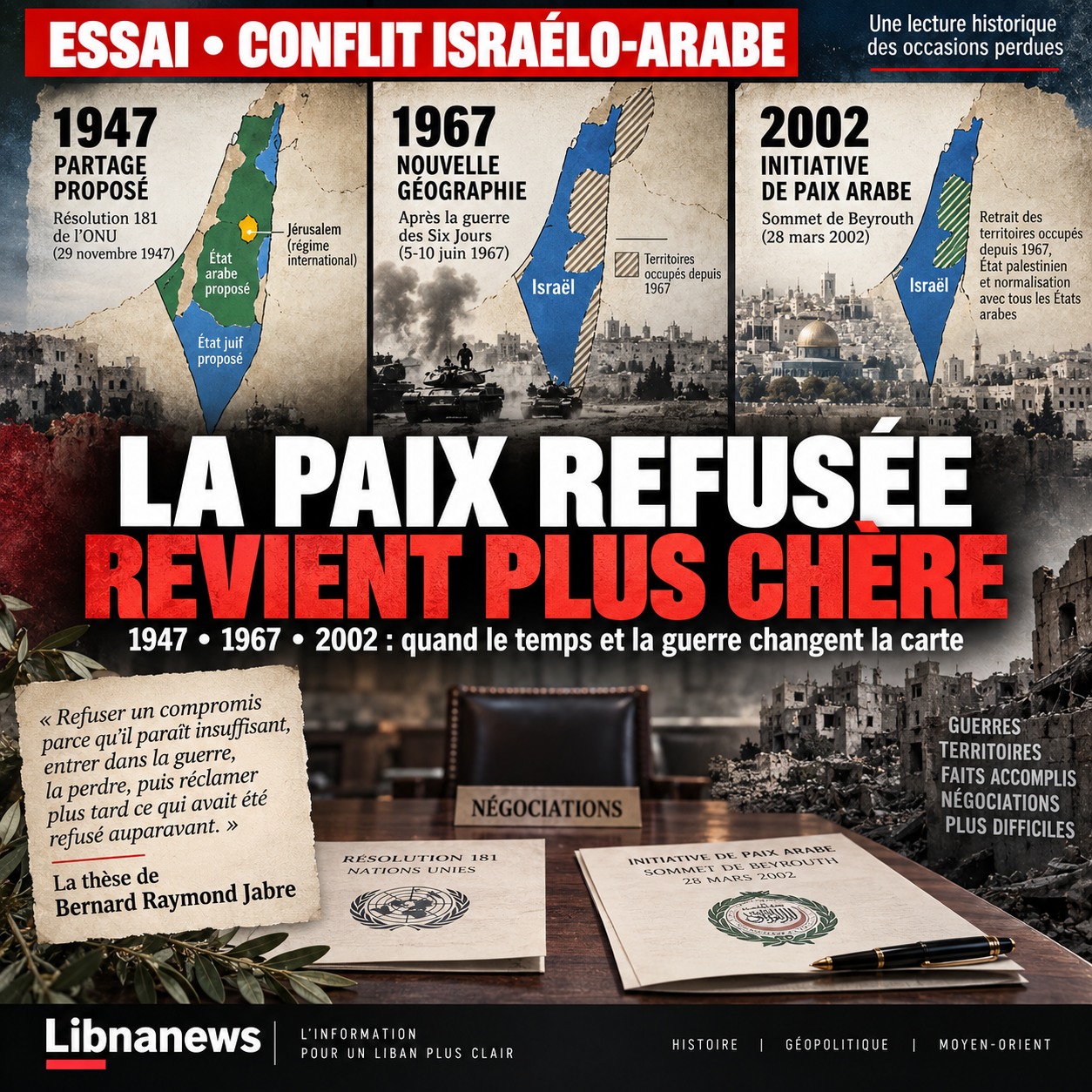
peace that was denied before the war
When the refusal of imperfection ends up opening the door to the worst
By Bernard Raymond Jabre
A historical reading of a recurring mechanism: to refuse a compromise deemed insufficient, to enter into war, to see the balance of power deteriorate, and to ask later what had been refused before. A reflection on time, territory, negotiation and danger of fait accompli.
There is a tragic mechanism in the history of the Arab-Israeli conflict that seems to be returning from generation to generation.
We refuse a compromise because it seems unfair. It is believed that time will allow for more. We prefer the balance of power to the imperfect arrangement. War’s coming. She’s lost. The territory is shrinking, positions are deteriorating, new realities are taking hold. And a few years later, we’re calling for a negotiating basis… what they had refused before.
« The art of claiming after the defeat the peace that was denied before the war. »
But we must immediately clarify something essential. It is not a characteristic of Arab peoples, as if there were a collective and immutable psychology. These are choices made, at different times, by governments, leaders, Arab political and military movements — choices that were also addressed by Israeli decisions, sometimes defensive, sometimes expansionist.
For the history of this conflict is never that of a single responsibility. It is a succession of lost opportunities, mutual fears, violence, erroneous calculations and, above all, a terrible geopolitical truth: time never retains intact the conditions for a refused peace.
1947: the first opportunity lost
On 29 November 1947, the United Nations adopted Resolution 181 proposing the division of Palestine into two states, one Jewish and the other Arab, with a special international status for Jerusalem. The management of the Jewish Agency accepts the principle of sharing, even if some Zionist currents refuse it; Palestinian Arab leaders and Arab States reject the plan, which they consider deeply unjust.
One can understand why the Arabs of Palestine considered him unjust. Understanding a historical decision, however, does not mean denying its consequences.
War breaks out. Then Israel proclaimed its independence in May 1948 and several Arab armies intervened. They fail to prevent the existence of Israel.
When the armistices were concluded in 1949, Israel controlled more territory than was attributed to it by the plan of division. A historical analysis by the US Department of State estimates that Israel then retained about 30% more territory than was attributed to it by the UN plan. The Palestinian Arab State planned for 1947 was not born: the West Bank was under Jordanian control and Gaza was under Egyptian control.
This is the first paradox. This was refused in 1947 because, after 1949, it was deemed insufficient to have been a much more favourable territorial situation for the Palestinians than the result of the war.
History had just given its first lesson. She wouldn’t be heard.
1967: six days that change geography
Nineteen years later the next disaster came.
After several weeks of regional escalation, military mobilization and crisis around the Strait of Tiran, Israel entered into war on 5 June 1967. In six days he defeated Egypt, Jordan and Syria and took control of Sinai, Gaza, the West Bank, East Jerusalem and the Golan.
The map of the Middle East is upset.
And a few months after this defeat comes a decision that perhaps symbolizes better than any other the logic we describe. At the Arab summit in Khartoum on 1 September 1967, the famous three refusals were formulated: no peace with Israel, no recognition of Israel, no negotiation with Israel.
The problem is not moral. He’s strategic.
For while one refuses to negotiate with the power that has just occupied these territories, this power settles there. The interim is beginning to become sustainable. The military line is becoming a political reality. Then a road appears. Then an implantation. Then a city. Then a whole generation is born on this earth. And one day we discover that we don’t negotiate on the same card anymore.
Egypt will demonstrate that the opposite is possible
Fortunately, there is a huge exception to this story. It is named after Anwar al-Sadate.
After the 1973 war, Egypt gradually understood that the Sinai problem would probably not be solved by an infinite succession of wars. Sadate then accomplished something revolutionary in the Arab world: he decided to speak directly to the adversary.
He goes to Jerusalem. He’s negotiating. The agreements of Camp David follow. Then the Egyptian-Israeli peace treaty was signed on March 26, 1979. Israel accepted the withdrawal of its forces and, in April 1982, Sinai returned under Egyptian sovereignty.
The negotiation did not lead to the loss of Sinai in Egypt. She allowed him to get it back.
Sadat understood something that many had not wanted to hear: making peace with his enemy does not necessarily mean accepting his victory. This may be a way of taking back politically what we have failed to recover militarily.
Then the Palestinians also end up recognizing Israel
It will take decades.
In 1993 the Oslo agreements arrived. The Palestine Liberation Organization recognizes Israel’s right to live in peace and Israel recognizes the PLO as representative of the Palestinian people. Both sides begin a process to deal with the main issues: borders, Jerusalem, refugees and security.
But it is 1993. Not in 1947. Not in 1949. Not even in 1967. Forty-six years have passed since the sharing plan. And in the meantime, the territorial reality has changed profoundly.
This is the whole problem of « too late ». In geopolitics, time is not neutral. Time produces facts. And the facts end up producing claimed rights, interests, infrastructure, populations and ideologies that make the following compromise more difficult than the previous one.
2002: the arab world finally proposes what it once refused
Then comes another extraordinarily revealing moment.
In Beirut, in March 2002, the Arab League as a whole adopted the Arab Peace Initiative. The principle is considerable: Israeli withdrawal from the territories occupied since 1967, the establishment of a Palestinian State in the West Bank and Gaza with East Jerusalem as its capital, a negotiated solution to the refugee question — and, in exchange, an end to the conflict and the establishment of normal relations between Israel and the Arab States.
In other words, thirty-five years after Khartoum and its three « no », the Arab world collectively says: yes to peace, yes to normal relations, yes to the existence of Israel — in exchange for a territorial settlement.
Historical evolution is immense. But in the meantime, a whole generation has passed. And especially geography has changed.
For every war lost didn’t just lose a war
She was changing the ground.
It is here that the link with what some call « Great Israel » appears.
The term must be used with precision. There is no single project called « Great Israel » to which all Israeli society or all Israeli governments would adhere. Millions of Israelis have defended or defended a negotiated territorial solution and two states.
But there is also, in religious nationalism and in part of the Israeli right, a current considering the West Bank — Judea and Samaria in Israeli terminology — as historically part of Israel’s land.
And from 1967 onwards, this current has one thing that it did not previously have: territory.
This is the tragic paradox. The war to reduce Israel has sometimes created territorial conditions for Israel’s most expansionist currents to demand more.
From military victory to fait accompli
The mechanics then become formidable.
A war gives control over a territory. Military control lasts. Civilian settlements appear. Roads and infrastructure are being built. An Israeli population settles. Then appears the argument: « How can we now abandon hundreds of thousands of people who live here? »
What was initially presented as a post-war situation gradually becomes a demographic and political reality.
The UN Security Council considers that the Israeli settlements in the Palestinian territories occupied since 1967, including East Jerusalem, are not legally valid and calls for their expansion to cease.
And this dynamic doesn’t just belong to the past. The report of the Secretary-General of the United Nations of 24 June 2026 continued the expansion of the settlements.
In September 2026, the E1 project in the West Bank was further expanded. Its importance is considerable because it affects the territorial continuity of a possible future Palestinian State. Israeli Minister Bezalel Smotrich explicitly presented this project as a means of preventing the creation of a Palestinian state.
This is where history becomes terribly ironic. The longer the political solution is delayed, the more difficult its geography becomes.
But it would be intellectually dishonest to explain everything by Arab mistakes
Here we must resist dangerous simplification.
A lost Arab war can explain how an Israeli army took control of a territory. It alone does not explain why an Israeli government decides, years or decades after the war, to develop civilian settlements or consider annexation. These are two different questions.
Arab leaders are responsible for their choices. Israeli leaders are responsible for their own. An opportunity for peace denied by some does not automatically give others unlimited rights over the conquered territories.
Similarly, terrorism against Israeli civilians cannot justify any territorial policy. Nor does occupation or colonization justify the killing of Israeli civilians.
An honest analysis must be able to hold these two truths together.
The real enemy: the illusion that tomorrow will still offer us the conditions yesterday
Perhaps that is, in the end, the great political disease in the Middle East.
Believing time is waiting. To believe that the denied offer will remain available. To believe that we can always return to the previous border. Believe that after the next war, after the next sacrifice, after the next death, the world will miraculously put all the pieces back on the chessboard as they were before.
But history has no « Undo » button. She never goes back exactly.
In 1947, there was a map. In 1949, it no longer existed. In 1967, there was another map. It too has gradually moved away. In 2002, the Arab world proposed a general peace based largely on the 1967 lines. But the more the years pass, the harder these lines themselves become to materialize on the ground.
That is the real danger.
The so-called « Great Israel » would therefore not simply be born of a large secret plan executed since 1948. History is more complex.
It can also progress by accumulating missed opportunities.
A war. A defeat. An occupation. A refusal to negotiate. Ten years. A colony. A road. Another war. A generation. Then, one day, what seemed provisional seems permanent.
You have to know how to make peace before you have to
The great lesson of this history should therefore not be « Israel is always right », nor « Arabs are always wrong ». It should be much more universal.
We must negotiate when we still have something to negotiate.
Perfect peace probably never exists. The great peace of history has almost always been imperfect compromises signed between peoples who had excellent reasons to hate each other.
Waiting for absolutely perfect justice before accepting peace can sometimes produce no more justice… but more war, more deaths, and finally less territory to exercise justice.
Egypt understood when it recovered Sinai by peace. The Arab world partially understood by proposing general standardization in 2002.
The Israelis, too, will have to decide whether real security is built by the indefinite enlargement of the territory or by a recognized border and political coexistence.
For the logic of fait accompli also possesses its trap. Israel’s desire for more land could one day be confronted with another contradiction: to control the territory without being able to resolve the issue of the millions of Palestinians living there in a sustainable manner.
Thus, the two peoples are facing the same clock. And this clock never stops.
The real question is no longer: « Who was right in 1948? She is: « How many more generations will have to pay for the decisions their leaders have not had the courage to make in time? »
For in the Middle East, for nearly eighty years, every peace repelled seems to come back a few years later. But it’s almost always more expensive. And sometimes with a smaller card.
Historical sources and benchmarks
Key references used for the dates, resolutions and diplomatic stages mentioned in the article:
•UN — Resolution 181 (sharing plan, 1947)
•U.S. Department of State — Arab-Israel War of 1948
•U.S. Department of State — Arab-Israel War of 1967
•UN – Khartoum Resolution, September 1967
•United States. Department of State — Camp David / Israeli-Egyptian Treaty
•U.S. Department of State — Oslo Agreements
•UN Arab Peace Initiative, 2002
•UN Security Council — Resolution 2334 on settlements
•UN – Report of the Secretary-General, 24 June 2026
•Reuters — West Bank, settlements and annexation debates
Note: This essay distinguishes the choices of governments and political movements from the peoples themselves. It does not portray Arab societies or Israeli society as homogeneous blocs.