

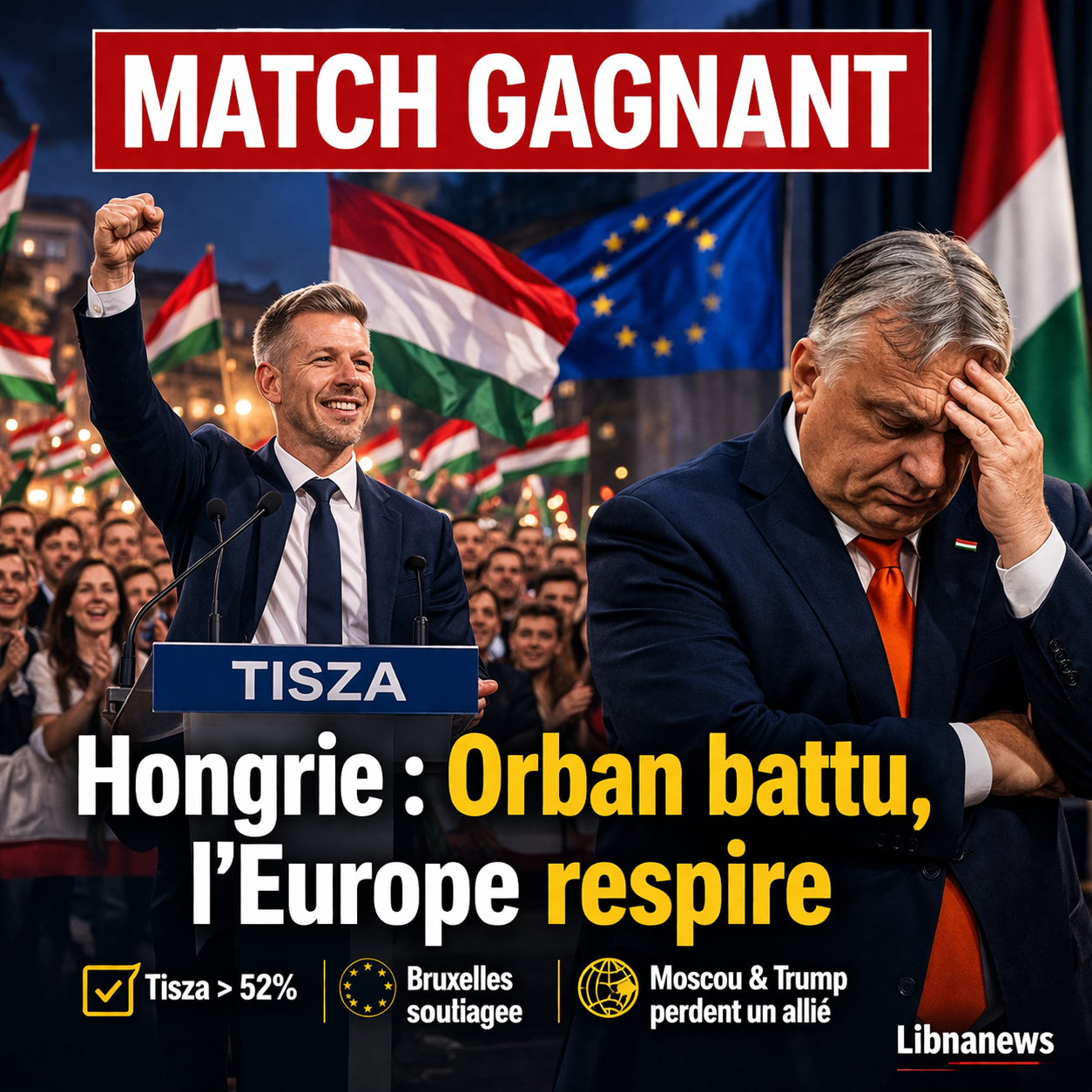
It took sixteen years, economic wear and tear, a credible opponent and record participation to bring down Viktor Orban. But the scope of the Hungarian election is far beyond Budapest. By losing power against Péter Magyar and the Tisza party, Orban not only suffered a national defeat. He set a political setback to the whole small bloc that had made Hungary a showcase: the trumpist camp, the European unliberal networks and, in the background, Moscow. The exact score will continue to be refined, but the dynamics are already clear: the Orban system has lost, despite reinforcements from elsewhere.
The partial results published in the night gave Tisza largely in front of Fidesz, with a participation of 77.8%, a new level in post-communist Hungary. Viktor Orban himself recognized a painful defeat and congratulated his opponent. After 16 years of almost uninterrupted power, this simple fact is enough to measure the earthquake. Orban had finally given the impression that he no longer governed Hungary only, but that he belonged a little to him. Voters recalled that a regime can lock a lot of things, except wear and tear.
Budapest stops being Brussels’ favorite puzzle
In Brussels, no one will delude himself about the difficulty of the post-Orban period. But it is obvious that this defeat will be read as a strategic relief. For years, Budapest has been a blocking point on Ukraine, sanctions, the rule of law and, more broadly, the Union’s ability to speak with one voice. Orban had succeeded in making Hungary, a medium-sized country, a lever of permanent nuisance within the European project. Its fall does not solve everything, but it removes from the Union one of its most constant internal saboteurs.
Perhaps the most symbolic of all, in this case, is that Péter Magyar did not win by presenting himself as an underground candidate, shaped to please Brussels. A former seral man, he spoke about corruption, public services, the rule of law, but also national dignity and efficiency. This is precisely what makes Orban’s defeat heavier: he cannot even explain that he was beaten by a simple anti-Hungarian coalition or by a liberal import product. He was beaten by a Hungarian from his own political world, who first understood that a country can get tired of being ruled as a besieged fortress.
U.S. relief was useless
It is also worth recalling an episode that the friends of Orban would already prefer to put in the closet. A few days before the vote, JD Vance went to Budapest to help him openly. The US Vice-President accused the European Union of interference in the Hungarian election and called on voters to reinvigorate Orban. During a rally, Donald Trump himself intervened by telephone to provide his support. It was a rather rare scene: the White House came down almost on the ground to save its favourite European ally. The message was clear. Hungary d’Orban was not just a partner. She was an ideological piece of the trumpist system.
And that is precisely what makes the result humiliating for this camp. Despite Vance’s visit, despite Trump’s blessing, despite the rhetoric about Hungarian sovereignty allegedly threatened by Brussels, Orban lost. The scene was almost perfect in its irony: Washington version Trump explained to Hungarians that it was necessary to vote against foreign interference, while ingesting himself in the most visible way possible. More robust consistency has been demonstrated. Voters were obviously not as impressed as they hoped.
The Russian perfume of the campaign also hovered over the election
The other dead angle that it would be absurd to ignore concerns suspicions of Russian interference. We must remain precise: at this stage, these are not judicially established facts from end to end, but rather serious allegations enough to trigger a European political alert. Several MEPs have asked the Commission to urgently consider a possible Russian role in the Hungarian campaign following press reports about an operation piloted since Sergei Kirienko’s entourage, with more direct help to the Orbanist camp. This sequence does not allow free statements, but it also prohibits naivety.
To this is added a much more documented element: research published before the election showed coordinated campaigns on Telegram pushing pro-Orban narratives, fed and amplified by Russian sources or affiliated with Russia. The mechanism described is classic: one injects a narrative into peripheral channels, then one lets it contaminate the wider public debate. The novelty is therefore not that Russia is interested in the Hungary of Orban. The new thing is that despite this added ecosystem, Orban has still lost. Moscow did not save its best partner in the Union.
Why Orban ended up falling
The answer is less drama than wear and tear. The Hungarian economy slowed down, the cost of living weighed, corruption became a central topic, and Orban’s story stopped being enough to absorb everything. His system was formidable as long as he appeared as stable, winning and without a credible alternative. Péter Magyar exactly broke this triangle. By leaving Fidesz, then building Tisza at high speed, he offered an exit to both historical opponents and conservative voters tired of power. It is often like this that long regimes end: not under the shock of a revolution, but at a time when the alternative finally ceases to seem imaginary.
We must also guard against the fairy tale. Orban lost the election, not the print he left on the Hungarian state. The media, institutions, administrative reflexes and part of the political architecture still bear its mark. Even with a large majority, Péter Magyar will not rule on a blank page. That is why the real meaning of the election is less that of instant purification than of a clear political break: Hungary has shown that it can still change course by the ballot box, despite a very uneven terrain. And in today’s Europe, it’s not nothing.
The real score of the evening
The title has something a little mocking, but it sums up quite well right now. Yes, the European Union is a clear political point. Yes, Viktor Orban has a historical defeat. Yes, the trumpist camp loses a symbol, and Moscow loses a convenient relay in the heart of Europe. This does not mean that illiberalism disappears, nor that the continent will suddenly speak with one voice. This means something simpler and more important: the idea that Orban had become unbreakable just crashed on a ballot paper. And for everyone who had invested in his eternity, the evening must have had a bitter taste.




