

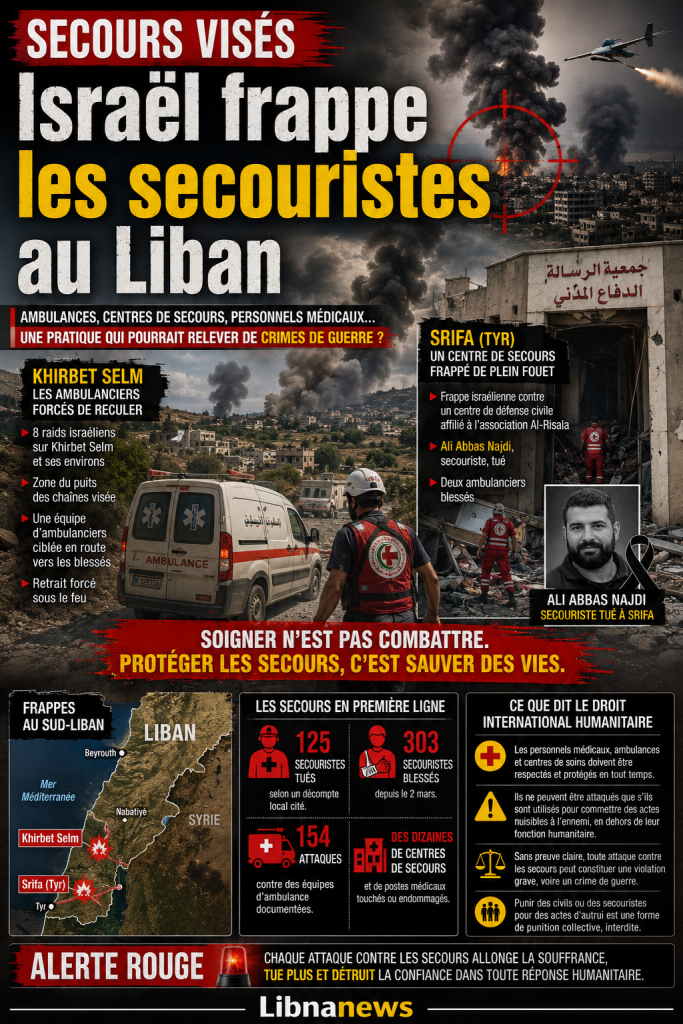
The new episode of Khirbet Selm and Srifa puts first aid workers at the centre of Israel’s war in Lebanon. According to a dispatch from the National Information Agency, eight raids targeted Khirbet Selm and its environs, including several strikes in the so-called chain well area. An ambulance crew that was on their way to the scene was targeted by a raid, which forced him to withdraw. On the same day, an Israeli strike hit a civil defence centre linked to the Al-Risala association in Srifa, Tyre district. First aid worker Ali Abbas Najdi was killed and two other paramedics were injured. These attacks add to a documented series of strikes against ambulances, rescue centres and medical personnel. They ask a central question: does Israel conduct operations compatible with international humanitarian law, or does it establish a practice of targeting relief that could be covered by potential war crimes?
In Khirbet Selm, paramedics forced to step back
The dispatch from the South describes a classic sequence of the days of war in Lebanon: several strikes in minutes, from the affected rural or semi-urban areas, and then the arrival of the relief. In Khirbet Selm, raids targeted the Dabsha area, the outskirts of Al-Amana station, the Al-Ain area and the chain well area. Repeating the strikes suggested an operation conducted on several points, not a single single shot. In this context, the intervention of ambulance workers is not a choice. It fulfils a basic humanitarian obligation: to verify the presence of injured persons, to extract the victims, to secure the premises and to transfer the affected persons to the nearest hospitals.
It was precisely when this team headed towards the chain well that a new raid targeted or struck in its immediate environment, according to the dispatch. The paramedics had to retire. This detail is essential. A strike that prevents rescue from accessing victims does not only create new risks for rescue workers. It prolongs the suffering of the injured, delays their evacuation and can turn surviving injuries into preventable deaths. In a war where the roads are monitored by drones and ambulances are under permanent threat, medical time itself becomes a battlefield.
Ali Abbas Najdi killed in a rescue centre in Srifa
In Srifa, the situation is even more serious. The strike directly affected a civil defence centre affiliated with the Al-Risala association. Ali Abbas Najdi, a rescuer, was killed. Two other paramedics were injured. The target location was not described as a combat position in the available information, but as a rescue centre. Israel did not, at the time of writing, provide any public evidence that the site had lost its protection due to military use. Under these circumstances, the strike raises a serious suspicion of a violation of the law of war. It must be documented, reviewed and placed on any independent investigation file.
International humanitarian law protects medical personnel, ambulances, health centres and relief units. This protection does not depend on the nationality, political opinion or administrative affiliation of the first aid workers. An ambulanceman may report to the Red Cross, the public civil defence, a local association, a party-affiliated organisation or a community structure. As long as he performs a medical or humanitarian mission, he must be respected and protected. This rule is one of the pillars of the law of war. It allows the wounded to be treated even when the fighting continues.
What the law of war says
This protection is not absolute in all cases. An ambulance, health centre or medical unit may lose its protection if it is used, outside its humanitarian function, to commit acts harmful to the enemy. But this exception is strictly regulated. It cannot be based on a general accusation, an alleged political affiliation or a presence in an area controlled by an armed group. It requires concrete elements. It also requires, where circumstances permit, a prior warning and a reasonable period of time before any attack. In the absence of clear evidence, the rule remains protection.
This is where the Lebanese case becomes worrying. Since the resumption of the war on 2 March, attacks on health workers have continued. Human rights organizations, international agencies and Western media have documented strikes against ambulances, rescue centres and medical facilities in the South. The figures vary according to the balance sheet dates. In March, the Lebanese health authorities had already reported dozens of rescue workers killed. At the end of May, a local count cited in the sequence evokes at least 125 rescuers killed, more than 303 injured and more than 154 attacks on ambulance teams since the beginning of the current Israeli offensive.
An accumulation that changes analysis
Even if each incident must be checked separately, accumulation changes the analysis. An isolated shot can be presented as an error, a bad identification or collateral damage. A series of strikes against ambulances and rescue centres in different locations require more scrutiny. It requires questioning whether Israeli targeting procedures actually protect medical services, whether allegations of military use are substantiated, and whether Lebanese relief workers are treated by the Israeli army as humanitarian actors or as hostile elements by default.
The case of Hanouiyeh and Deir Qanoun al-Nahr, a few days earlier, had already triggered the alarm. Israeli strikes killed several relief workers, including members of medical associations linked to Hezbollah or the Amal movement. Israeli authorities have claimed to be targeting Hezbollah infrastructure. The Lebanese Ministry of Health and humanitarian organizations reported attacks on protected personnel. The debate is not just about the political identity of associations. It covers the function performed at the time of the strike. A rescue worker who intervenes with injured persons does not become a military target because his organization maintains political ties with a party.
Fear of double strikes
The practice of double tap, or double tap, is particularly feared by rescue teams. It consists of hitting a site and then aiming at the same area after the arrival of first aid workers, relatives or residents. The testimonies gathered in southern Lebanon describe delayed interventions, ambulances kept at a distance and teams obliged to wait for a local permit or a decrease in drone overflight before proceeding. In Khirbet Selm, the ambulance crew had to withdraw after being targeted or under attack in the intervention zone. This situation creates a paralyzing effect. Rescue workers know that their arrival can be followed by a new shot.
The human effect is immediate. When ambulances no longer approach, the wounded stay on the ground longer. Families sometimes try to evacuate the victims themselves, using unequipped civilian cars. The roads are taken without coordination, under drones, in confusion. Hospitals received injuries later, in a more severe condition. The first aid workers live with constant anxiety. They must choose between their duty to intervene and the risk of dying at the same time as they perform a mission protected by international law.
A health system attacked in its ability to respond
This pressure also destroys the health system through exhaustion. Lebanon does not have a hospital apparatus capable of absorbing waves of wounded indefinitely while losing ambulances, outposts and trained personnel. Every rescuer killed represents a broken family, but also a lost skill. Each destroyed ambulance reduces the response capacity of an entire sector. Every civil defence centre hit extends the response time for the next attack. So war doesn’t just kill by explosion. She also kills by disorganizing emergency chains.
Israel generally contends that its strikes target Hezbollah, its infrastructure, its depots or its fighters. This argument cannot be rejected without examination. Hezbollah is an armed actor. It operates in civilian areas. It maintains political, social and health networks. It sometimes uses spaces mixed with local communities. But this context does not give Israel the right to strike medical services without clear evidence. The right to pursue a military objective does not allow any structure in a hostile environment to be neutralized in advance. The distinction remains mandatory. Proportionality remains mandatory. Precaution remains mandatory.
Why the classification of war crime is established
Strikes against rescue must therefore be analysed from three angles. The first is the distinction: was the target military or humanitarian? The second is proportionality: was the foreseeable harm to civilians and rescue workers excessive in terms of the military advantage expected? The third is that of precautions: did the army check the target, choose a less dangerous means and give a warning when possible? If these conditions are not met, a strike against paramedics or a rescue centre may amount to a serious violation or even a war crime.
The term war crime should not be used as a slogan. It refers to legal qualifications. Deliberate attacks against medical personnel, ambulances or protected health units may constitute war crimes. Indiscriminate or disproportionate attacks may also fall into this category. The final qualification belongs to investigators, prosecutors and competent courts. But the role of journalism is to name the elements that justify the initiation of investigations: repetition of the facts, the nature of the targets, the absence of public evidence of military use, the deaths of identified first aid workers, the obstruction of evacuations and official statements minimizing damage.
The Lebanese duty to document
The Lebanese Government is also responsible. Beirut must document every strike against the rescue with maximum rigour. The victims’ names, site coordinates, raid hours, damage images, ambulance tracks, radio communications, survivors’ testimonies and medical reports must be kept. These elements must be centralized by the Ministry of Health, civil defence, military or civil justice and humanitarian law agencies. Without a solid record, accusations remain vulnerable to denials and competing narratives.
Lebanon must also protect first aid workers immediately. This involves secure routes, coordination protocols, protective equipment, communications and early warning. But no technical measure is enough if ambulances are considered possible targets. International partners must therefore demand concrete guarantees from Israel on respect for medical services. A truce that does not protect paramedics is not a humanitarian truce. It leaves the wounded dependent on the courage of teams sent to areas where they can be struck in turn.
Alerts already launched by NGOs
Humanitarian organizations have already alerted the danger. Amnesty International called for an end to attacks against caregivers, medical facilities and first responders. Human Rights Watch spoke of Israeli attacks on caregivers and health facilities that could constitute apparent war crimes in previous cases. The World Health Organization also reported attacks that killed paramedics and forced the closure or reduction of activity of many healthcare facilities. These alerts form a background that makes the events in Khirbet Selm and Srifa even more serious.
The choice of words matters. To say that the first aid workers were killed is not enough. It must be said where, how, under what circumstances and with what consequences. Ali Abbas Najdi is not only a name added to a list. It was a vital function in a hit area. The two rescue workers injured in Srifa are not only collateral victims. They belong to a relief chain that residents call when missiles fall. The team forced to withdraw in Khirbet Selm embodies the most concrete fear: that of an ambulance that can no longer reach the wounded.
When ambulances become an indicator of war
The war in Lebanon is therefore also played in this silence after the strikes, when the sirens hesitate to approach. The inhabitants know that the first minutes are decisive. They also know that rescuers cannot save lives if they themselves become the target. The repetition of these episodes creates a deadly grey zone where the victims wait and the ambulances calculate the risk of a second strike. It is this grey area that humanitarian law seeks to prevent.
The next test will be the reaction test. If the strikes of Khirbet Selm and Srifa are treated as ordinary incidents, the protection of relief will continue to erode. If they result in independent documentation, diplomatic procedures and requests for accounts, they can become documents in a larger file on the Israeli conduct of the war in Lebanon. For the rescuers of the South, the issue is even more immediate: whether their uniform, ambulance and mission still protect them, or whether each departure to a bombed area puts them at the same risk as the victims they are trying to save.




