

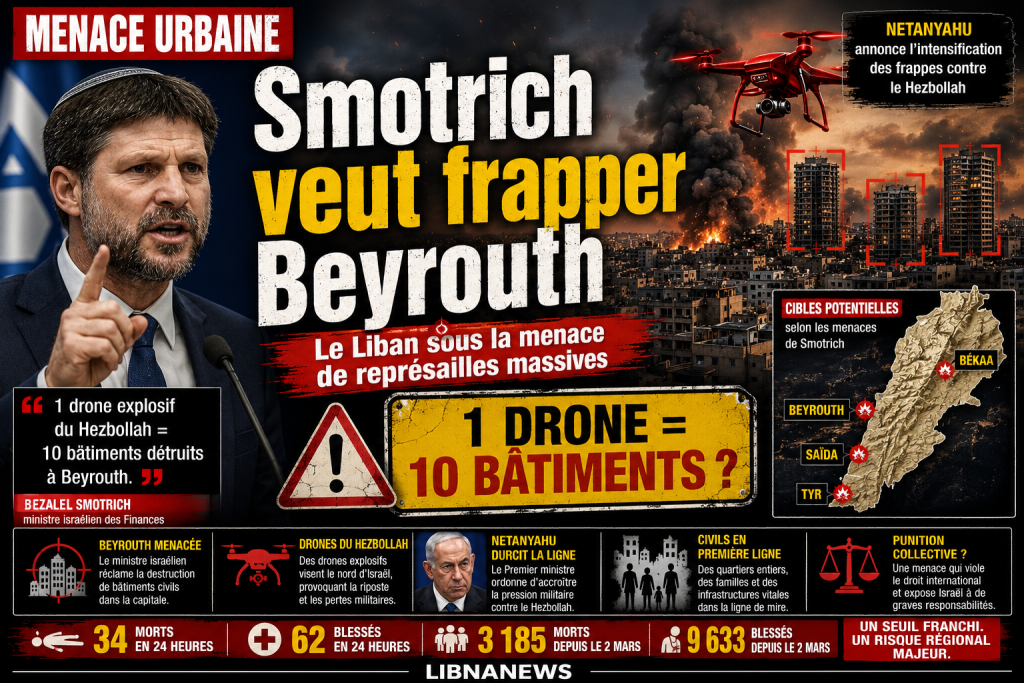
Israeli Finance Minister Bezall Smotrich again placed Beirut at the centre of the Israeli military threat. By calling for the destruction of ten buildings in the Lebanese capital for every explosive drone launched by Hezbollah, the far right leader crossed a verbal threshold that goes beyond deterrence rhetoric. His remarks were made as Benyamin Netanyahu announced an intensification of the strikes against Lebanon, the Israeli army increased bombings in the South and the Bekaa, and the prolonged truce under American mediation appeared to be more fragile every day. The immediate risk is not just military. It concerns the civilian population, the legality of the planned strikes and the possibility of a regional escalation around a country already suffering from a heavy human impact.
Smotrich assumes a numerical threat against Beirut
Bezalel Smotrich’s words are calculated brutality. The Israeli Minister of Finance, also Minister within the Ministry of Defence for West Bank-related issues, said the Hebrew state should not respond to Hezbollah drones by defence alone. According to him, the answer should be to drop ten buildings in Beirut for each explosive drone. The formula was reported by Israeli and international media, in a context of growing tensions within the Israeli security cabinet.
It’s not an isolated phrase. According to the Israeli press, Smotrich defended the same logic in a tense exchange with Benyamin Netanyahu around Hezbollah drones. The Prime Minister would have asked him about the consequences of such a rule, asking him if Israel should destroy ten buildings at every drone launched from any front. Smotrich reportedly replied in the affirmative. This sequence gives the threat a wider scope: it is not just a matter of targeting Hezbollah, but rather of establishing a rule of mass, publicly announced reprisals against urban spaces.
In his most relayed statements, the minister goes further than a targeted response. Smotrich’s comments suggest the idea of moving to Tyre, Saida and the Bekaa Valley if Beirut was no longer enough to provide the targets of this punitive policy. These passages circulate in excerpts relayed on the networks and by regional media. They should be read with caution until a full official transcript is available. But they fit into an already documented line: Smotrich defends a disproportionate and claimed escalation, thought as a means of changing the rules of the conflict.
A disproportionate price
The important word, in its confirmed statement, is that of a disproportionate price. The minister is not just asking for a response. He assumes that the price imposed on the enemy must be higher, visible and dissuasive. In military language, deterrence aims to prevent the adversary from acting. In legal language, striking urban buildings according to an automatic ratio, without any proven link to a specific military target, immediately raises the issue of collective punishment and the protection of civilians. This makes the sequence so serious for Lebanon.
Beirut is not a military base. It is a dense capital, divided by districts, roads, hospitals, schools, shops, administrations and residential areas. The southern suburbs are home to a political and security presence of Hezbollah, but it is also home to hundreds of thousands of civilians. Transforming a drone into a quota of destroyed buildings eliminates the distinction between a military infrastructure, a residential building, an office, a gas station, a medical centre or a service facility. Such a logic would put civilians directly at the heart of the response.
This threat comes after several days of Israeli intensification in Lebanon. The Israeli army claims to have hit dozens of Hezbollah targets in the South, the Bekaa and the Tyre area. Evacuation notices were issued in several locations. Families left neighbourhoods in the southern suburbs of Beirut for fear of further bombing. The Lebanese Ministry of Health announced a total of 34 deaths and 62 injuries in 24 hours, bringing the total to 3,185 deaths and 9,633 injuries since 2 March. This increase shows that the truce did not end the war experienced by the inhabitants.
Hezbollah drones as a political trigger
The sequence was triggered on the Israeli side by the rise of the threat of Hezbollah’s explosive drones. The Israeli army announced the death of a 19-year-old soldier in southern Lebanon killed by an explosive drone attributed to the Shiite movement. Another soldier was seriously injured. For Israel, these attacks show that Hezbollah retains offensive capability despite strikes, ground operations and diplomatic pressure. For the Israeli government, they are also an internal political problem, as northerners and families of soldiers are asking for visible answers.
Smotrich is trying to occupy this political space. He does not only speak as Minister of Finance. He speaks as leader of a nationalist religious movement that has been calling for tougher decisions against Lebanon, Gaza and the West Bank for months. He had already called for expanding Israeli control towards the Litani and maintaining a logic of security expansion. His comments on Beirut are part of this vision. Lebanon is not only presented as a neighbouring territory from which attacks start. It becomes a space from which some cities could be struck to transform the regional balance in a sustainable way.
This rhetoric joins that of Itamar Ben Gvir, Minister of National Security, who calls for a more intensive resumption of the war in Lebanon. Ben Gvir called on Netanyahu to stop normalizing drone attacks and announce a return to a broader war. Other Israeli officials mentioned the need for a response against infrastructure, urban areas or crossing points. The cumulative effect of these statements is dangerous. It establishes in the Israeli public debate the idea that a foreign capital can become a lever of pressure proportional to the number of drones launched by an armed organisation.
Netanyahu also hardens the line against Lebanon
Benyamin Netanyahu advances with a more institutional line, but it remains offensive. The Prime Minister announced that the army should step up attacks against Hezbollah. He spoke of increasing pressure and not letting Israel be passively attacked. This position does not necessarily reflect the ratio proposed by Smotrich. However, it does frame a strategy of hardening. When the head of government promises to speed up the strikes, and its ministers ask to shave buildings in Beirut, the signal received in Lebanon is a direct threat to civilian areas.
International humanitarian law is based on a few simple principles. Warring parties must distinguish between combatants and civilians. They must aim for military objectives. They must avoid indiscriminate attacks. They must respect the proportionality between the expected military advantage and the foreseeable damage to civilians. An automatic rule of destruction of buildings according to the number of drones does not in itself meet these criteria. It makes urban damage a political message. It makes the civilian structure an instrument of military communication.
That is why Smotrich’s formula raises the accusation of a threat of war crime, and among some officials or observers, that of a speech with genocidal scope. The term genocide, however, has a precise legal definition. It implies the intention to destroy, in whole or in part, a national, ethnic, racial or religious group as such. A journalistic article must therefore handle this qualification with caution. What can be established at this stage is that the Minister publicly calls for a policy of massive and disproportionate urban destruction against Lebanon. The criminal qualification is a matter for competent judicial bodies.
Beirut must document the threat
For Lebanon, it is urgent to document these statements and bring them to international fora. Beirut may refer the matter to the United Nations, the ombudsmen and humanitarian law organisations. The Government may also request that threats against the capital, Tyre, Saida or Bekaa be considered as risk signals to civilians. Public statements by government officials have political value. They can also become elements of appreciation when a strike occurs on residential areas.
The Lebanese difficulty is known. The state denounces the bombings and demands respect for its sovereignty, but it does not control military tempo alone. Hezbollah continues to launch drones, rockets and fire against Israeli forces. Israel maintains operations in Lebanon and affirms its freedom of action. The United States seeks to preserve a negotiating framework while supporting Israeli security. In this fragmented space, the Lebanese population becomes the least protected part. It suffers strikes, displacements, destruction and uncertainty.
The threat against Beirut is all the more significant as it is part of an expanded regional war. Iran states that any agreement with Washington must include the cessation of Israeli attacks in Lebanon. Israel refuses to link its freedom of action to a regional negotiation that could protect Hezbollah. The United States is trying to maintain the discussion with Tehran, while supporting Israel against armed groups allied with Iran. In this context, a major strike on Beirut could go beyond the Lebanese-Israeli framework. It could push Iran to tighten its position and provoke new American or Israeli reactions.
A word that prepares the war thresholds
So Smotrich’s words come at a time when every word weighs. A threat of urban destruction can be read in Lebanon as psychological preparation for new bombings. It can be used by Hezbollah to justify the continuation of its attacks. It can put the mediators who try to consolidate the truce in difficulty. It can also reinforce fear in neighbourhoods already marked by past bombings. Political language is not outside the war. It prepares opinions, defines acceptable thresholds and sometimes renders it unacceptable.
The reference to Gaza in Israeli discourse worsens this perception. Smotrich and other far-right leaders have already mentioned the state of destruction of the Gaza Strip as a warning for other fronts. When the same leader claims that the Middle East is being transformed and that Lebanon is already bearing its mark, it is not a mere image. It describes a force strategy that assumes destruction as a regional remodeling tool. For the Lebanese, this reading awakens the memory of 2006, the bombings of the southern suburbs, the destroyed bridges and the massive displacements.
Lebanese society first looks at the immediate risk. The Beirut families want to know if a new wave of strikes is possible. The people of Tyre and Saida hear their city named as a potential target in reports. The villages of La Békaa see drones and aircraft moving closer to their roads, dams, lands and urban centres. Hospitals are preparing for new influxes. Schools, shops and municipalities operate under stress. The already exhausted local economy absorbs a new layer of fear.
Israel’s allies face their responsibility
The international response will be decisive. If Smotrich’s words only cause an awkward silence, they can help to move the threshold of the permit. If Israel’s partners merely recall the right to defence without explicitly condemning the threat against civilian buildings, the distinction between response and collective punishment may further erase. The United States, in particular, is facing a contradiction. They support Israel’s security, but they also present themselves as mediators of the truce in Lebanon. They cannot claim to stabilize the front while allowing a rhetoric of urban destruction to flourish.
Israel can respond that Hezbollah places its assets in civilian areas, uses drones against soldiers and threatens the northern population. This argument exists and must be taken into account. Hezbollah is carrying out attacks that also expose civilians to the response. But this argument does not give a blank card. The right to defend itself does not remove the obligation to choose military targets, limit damage to civilians and refuse indiscriminate reprisals. The problem with Smotrich’s sentence is precisely that it does not start with an identified target. It starts with a calculation of destruction.
Israel’s policy in Lebanon now seems to lie between two logics. The first seeks defensive solutions against drones, with budgets, technologies, interceptions and protective devices. The second is to impose greater fear on the adversary by destroying cities or neighbourhoods. Smotrich considers the first insufficient and pushes the second. Netanyahu tries to preserve the appearance of a controlled military decision, but he governs with ministers who publicly radicalize the goals. This internal tension can produce tougher decisions, especially after every Israeli military loss.
Lebanon caught between Israeli threat and internal fracture
For Beirut, the challenge is to turn this threat into a diplomatic issue. It is not enough to denounce a sentence. It must be archived, translated, sent to chanceries, linked to past strikes and asked for concrete guarantees on the protection of civilians. Lebanon can also call for any meeting on the truce to explicitly address threats against cities. A truce that tolerates words calling for the razing of serial buildings offers no real security to the inhabitants.
Hezbollah, for its part, can benefit politically from this threat. Every Israeli statement aimed at Beirut reinforces its discourse on the need to retain its weapons. The movement claims that Israel understands only force and that the Lebanese State cannot protect the territory alone. Lebanese opponents of Hezbollah will reply that its drones attract the strikes and give Israel the pretext of escalation. This internal divide is widening as Israeli threats become more explicit. The population is caught between an armed movement that decides on the response and an enemy State that threatens entire neighbourhoods.
The Smotrich episode thus summarizes the danger of the current phase. The war in Lebanon is no longer just a succession of strikes and responses. It becomes a battle over the rules themselves. Can the destruction of civilian buildings be publicly announced as a deterrent? Can we designate Beirut as a counter for retaliation? Can we talk about Tyre, Saida and Bekaa as next steps in a punitive logic? These questions are not theoretical. They concern residents who sleep under drone trajectories and foreign decision makers who still claim to contain the escalation.
The next signal will come from acts as much as words. If Israel again strikes the southern suburbs or expands its operations towards urban buildings, Smotrich’s remarks will be read as a warning. If Netanyahu blocks this line, the minister will still have helped to trivialize the idea of an urban price imposed on Lebanon. In both cases, Beirut, Tyre, Saida and Bekaa are deeper into the vocabulary of the Israeli war. The truce will not be measured by Washington’s communiqués, but by the fact that these cities remain, or not, out of destruction accounts.




