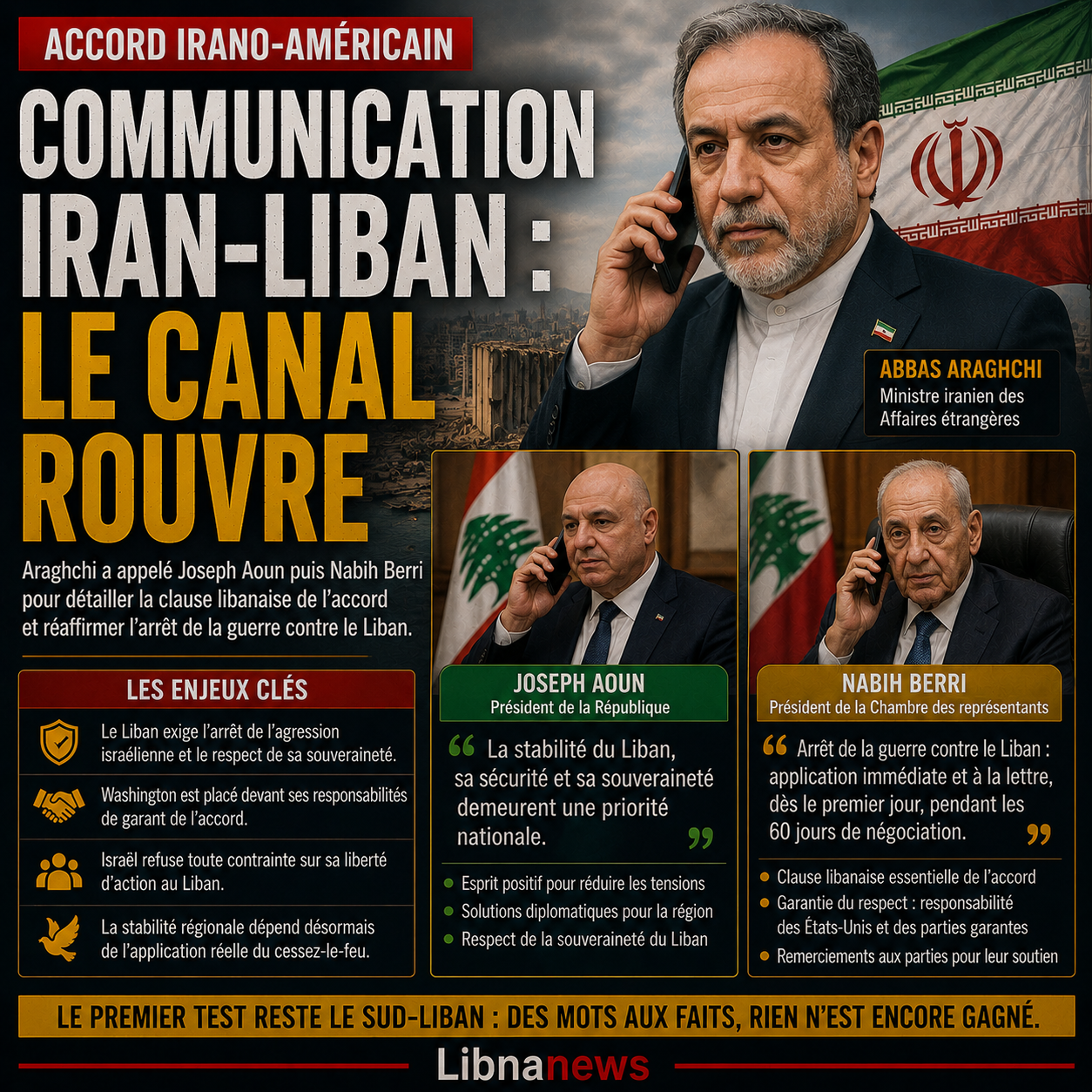
Iran-Lebanon communication resumes at the highest level. Abbas Araghchi called Joseph Aoun and then Nabih Berri to detail the Lebanese scope of the agreement between Tehran and Washington. The official comments stress the sovereignty of Lebanon, the immediate cessation of the war against the country and the responsibility of the United States in guaranteeing the text.
Iran-Lebanon communication resumed at the most political level, with two separate appeals from the Iranian Foreign Minister, Abbas Araghchi, to the President of the Republic, Joseph Aoun, and then to the President of the Parliament, Nabih Berri. This renewed contact comes at a time when the agreement between Iran and the United States places the Lebanese issue at the heart of its implementation. It also intervenes after a period of diplomatic tension between Beirut and Tehran, marked by the hard line adopted by the Lebanese Foreign Minister, Youssef Raji, around the Iranian ambassador’s file. However, the focus of the sequence is no longer this bilateral crisis. It is now in the exact content of the messages exchanged by the highest Lebanese authorities with Iranian diplomacy.
Aoun and Araghchi: the content of the call
According to the official communiqué, « the President of the Republic, General Joseph Aoun, received this evening a telephone call from the Minister for Foreign Affairs of the Islamic Republic of Iran, Mr. Abbas Araghchi, during which the current regional developments and a number of issues of common interest were discussed ». This first sentence sets the framework. This is not a conversation limited to diplomatic courtesy. It covers regional developments and shared issues. Lebanon is therefore not only informed. He was placed in a discussion that directly affected his security, territory and place in the current arrangement between Washington and Tehran.
In the course of the appeal, President Aoun welcomed the agreement between the Islamic Republic of Iran and the United States of America, expressing the hope that it would be a positive step towards reducing tensions and pave the way for diplomatic solutions contributing to the strengthening of security and stability at the regional and international levels. The presidential formulation is cautious. Joseph Aoun does not speak of a definitive solution. He talks about a positive step. He doesn’t give the protocol a blank. He sees it as an opportunity to lower tensions and a space for diplomatic solutions. This nuance is essential.
The same communiqué added: « The importance of continuing political and diplomatic efforts to consolidate lasting stability in the region was also stressed, in a way that has a positive impact on its States and peoples. This sentence expands the word. It places Lebanon in a regional environment where no lasting stabilization can be isolated. The cessation of the war in Lebanon, the relaxation with Iran, the Ormuz Strait issue, the American guarantees and Israel’s behaviour are now part of the same whole. The Lebanese Presidency does not present the country as a separate actor from the rest of the region, but as a State whose security depends on a broader regional framework.
The most political passage in the presidential communiqué is as follows: « The President of the Republic has stressed that Lebanon’s stability, security and sovereignty remain a national priority. This sentence gives the line of Baabda. She said that the resumption of communication with Iran did not mean a delegation of the Lebanese decision. It also states that the Iran-American agreement cannot be translated into an arrangement over the Lebanese State. Sovereignty is not presented as a slogan. It becomes the condition for any Lebanese reading of the protocol. It is also an indirect response to all parties wishing to reduce Lebanon to a secondary front in the confrontation between Israel, Iran and the United States.
The press release finally states the Iranian position during the exchange with Aoun: « Minister Araghchi, for his part, stressed the importance of respect for the sovereignty of Lebanon and the unity of its territories by all parties, expressing his hope that the positive climate created by this agreement will help to support stability in Lebanon and to strengthen the prospects for recovery and prosperity in the country. This sentence allows Tehran to publicly affirm its commitment to respect Lebanese sovereignty. It responds to a recurring criticism in Lebanon that Iran would sometimes act more through its allies than through official institutions. It also gives Beirut an argument: Tehran states that all parties must respect Lebanese territorial integrity.
Berri and Araghchi: the detailed Lebanese clause
The call with Nabih Berri is formulated in a more detailed and operational register. The official record states: « An appeal took place this evening between the President of the House of Representatives, Nabih Berri, and the Minister for Foreign Affairs of the Islamic Republic of Iran, Abbas Araghchi, during which they examined the latest developments, the situation and developments in Lebanon and the region, as well as the clauses of the agreement between Iran and the United States of America, which includes an essential clause providing for the cessation of Israeli aggression against Lebanon. This formulation is direct. It states that the Lebanese clause exists and is essential. It does not present it as a secondary interpretation of the text.
The same report goes on: « Araghchi informed President Berri of the details of the terms of the agreement, in particular the cessation of the war against Lebanon, saying that this clause must enter into force and be applied immediately to the letter, from the first day, and throughout the planned sixty-day negotiation period. This sentence is the heart of the exchange. It specifies three elements: immediate application, literal application and 60 days duration. Thus, in the Iranian reading to Berri, it is not a formula of principle. It is an obligation which is expected to produce effects from the beginning of the trading period.
The press release adds: « Araghchi stated that ensuring compliance with this clause is the responsibility of the United States of America and the parties to the Memorandum of Understanding. This sentence moves part of the pressure to Washington. If the United States is a guarantor, it cannot only celebrate the agreement with Tehran. They must also be held accountable for its implementation in Lebanon. This point is important at a time when Israel is already refusing to accept any reading limiting its freedom of military action against Hezbollah and claims to maintain positions in the border area.
The report concludes with Nabih Berri’s reaction: « President Berri reiterated his thanks to the Islamic Republic of Iran, as well as to the regional and international parties for their support and support for Lebanon in this phase. The President of Parliament therefore states the agreement in a logic of support for Lebanon. Its formula is not limited to Iran. It includes regional and international parties. It reflects a desire not to lock the Lebanese clause into an exclusive relationship between Beirut and Tehran. The central message, however, remains clear: Lebanon wants the cessation of war to be implemented, not just mentioned.
A resumption of communication more political than protocolary
These two communications give a precise picture of the diplomatic moment. With Aoun, Iran talks sovereignty, stability and recovery. With Berri, he speaks clause, immediate application, American responsibility and sixty-day period. The difference in tone is not contradictory. It corresponds to the institutional roles of the interlocutors. The President of the Republic places the file within the framework of the State. The President of Parliament follows the political mechanics and guarantees relating to the southern front. Together, the two exchanges re-establish an Iran-Lebanon channel that had been weakened by the tensions of recent months.
Raji point remains in the background. The crisis opened around the Iranian ambassador gave the image of a blocked bilateral relationship. The Minister of Foreign Affairs wanted to impose a reminder on the diplomatic order and signify that any relationship with Lebanon must go through the official institutions. The appeals of Araghchi to Aoun and Berri do not entirely contradict this principle. They’re reorienting him. Iran speaks well to Lebanese institutions. But it does so at the presidential and parliamentary level, where the crisis exceeds the ministry’s sole protocol competence.
This development has an internal political significance. Raji isn’t at the center of the sequence. He is not necessarily publicly disavowed. But its breaking line appears secondary to the resumption of a strategic channel. Lebanon cannot request the application of an Iran clause in the agreement with the United States while refusing any exchange with Tehran. Lebanese sovereignty requires limits. It also requires talking to actors who can influence the cessation of war. It is this distinction that Araghchi’s calls make visible.
Iran-Lebanon communication: sovereignty and diplomatic leverage
The Lebanese Presidency is thus trying to transform the resumption of communication into a state approach. It accepts dialogue, but it places sovereignty as a national priority. This position avoids two traps. The first would be to let Iran speak alone about Lebanon and its interests. The second would be to lock up in a position of refusal that would deprive Beirut of a useful lever at the time when the ceasefire must be implemented. Aoun chooses an intermediate route: hosting the agreement, asking for stability, preserving the national decision.
Berri takes a more offensive approach. It highlights the binding nature of the clause and receives a very clear statement from Araghchi that the cessation of the war against Lebanon must apply immediately and to the letter. This clarification serves Parliament and the political forces who want to make the protocol a tool of pressure on Israel. It also allows the United States to clarify its role. If Washington is a guarantor, it must say what it means to stop the war in Lebanon when the Israeli army maintains a buffer zone or conducts operations against fighters it says to be threatening.
The risk of divergence of interpretation remains high. Israel claims to want to maintain its freedom of action in Lebanon. The Israeli government presents this freedom as a guarantee for the people of northern Israel. Lebanon sees this as a permanent threat to its sovereignty and the return of the displaced. Iran states that the clause must apply immediately. The United States will therefore have to choose between demanding application of the protocol and tolerance of the Israeli position. It is on this point that Iran-Lebanon communication can become a diplomatic lever for Beirut.
South Lebanon as first test
The land also imposes its own limits. The Lebanese army asked the inhabitants not to return too quickly to the border villages. She referred to the danger of Israeli violations, attacks and unexploded ordnance. This caution shows that the agreement has not yet produced real safety. Displaced families cannot be content with a statement. They expect safe roads, inspected houses, stop strikes and clear instructions. The words exchanged between Araghchi, Aoun and Berri must therefore be judged to their practical effects.
The resumption of communication with Iran can help Lebanon if it is used to obtain verifiable commitments. It would be less useful if it remained at the level of statements. The challenge is to transform the sentences spoken into mechanisms: a timetable for implementation, monitoring of violations, the role of UNIFIL, coordination with the Lebanese army, the gradual return of displaced persons and clarification of the border area. Without these elements, the Lebanese clause could become a battle of interpretation between Tehran, Washington, Tel Aviv and Beirut.
The economic dimension mentioned by Araghchi also deserves attention. The Iranian minister talks about recovery and prosperity. These words can only become real if security returns to the South and Lebanon achieves a minimum of regional stability. The reconstruction of the affected villages, the return of agricultural activities, the normal reopening of schools and the resumption of public services require a lasting cessation of hostilities. The link between diplomacy and daily life is therefore direct. A poorly applied ceasefire will not help neither the sovereignty nor the economy.
A Lebanese Line Still to Stabilize
This sequence gives Beirut a margin of manoeuvre, but it requires coherence. The President of the Republic, the President of Parliament, the Government, the Ministry of Foreign Affairs and the army cannot send contradictory signals. Lebanon must say that it speaks with Iran because the case demands it, not because it renounces its sovereignty. He must say that he thanked the mediators and guarantors, but that he demanded their results. He must say that the cessation of the war in Lebanon is not a diplomatic supplement, but a condition of regional stability.
The message from Araghchi to Aoun and Berri indicates that Iran wants to place Lebanon in the heart of the agreement. Aoun’s response indicates that Lebanon wants to preserve its sovereignty in this inscription. Berri’s response indicates that Beirut wants immediate implementation, not a delayed promise. It is now around these three lines that the next phase will be played: restored communication with Tehran, demand of sovereignty in Baabda, demand of execution in Ain al-Tinah. The first test will remain in South Lebanon, where residents expect statements less than concrete signs of security.
Previous Raji placed in the background
The resumption of contact with Tehran comes after a phase of tension caused by the hard line of the Lebanese Foreign Minister, Youssef Raji, in the Iranian ambassador’s file. This sequence gave the image of a Lebanese diplomacy seeking to reaffirm its sovereignty in the face of the interference attributed to Iran. But Abbas Araghchi’s calls to Joseph Aoun and Nabih Berri show that the management of the relationship with Tehran cannot be reduced to a protocol crisis.
Internally, Raji therefore appears to be in a less central position. His demand for sovereignty remains present in the Baabda speech, but it is now framed by a broader need: to maintain a channel with Iran to obtain the application of the Lebanese clause of the Iran-American agreement. The presidency and Ain al-Tiné do not disavow the minister in front of them. However, they are taking over a matter that has become strategic, where diplomatic disruption is no longer enough to defend Lebanese interests.
This development does not mean alignment with Tehran. Rather, it reflects a return to diplomatic realism. Lebanon can challenge Iranian interference while speaking with Iran when it comes to stopping the war in the South. Sovereignty is not only measured by the ability to punish an ambassador. It also measures the ability to secure concrete guarantees for the territory, civilians and institutions.