

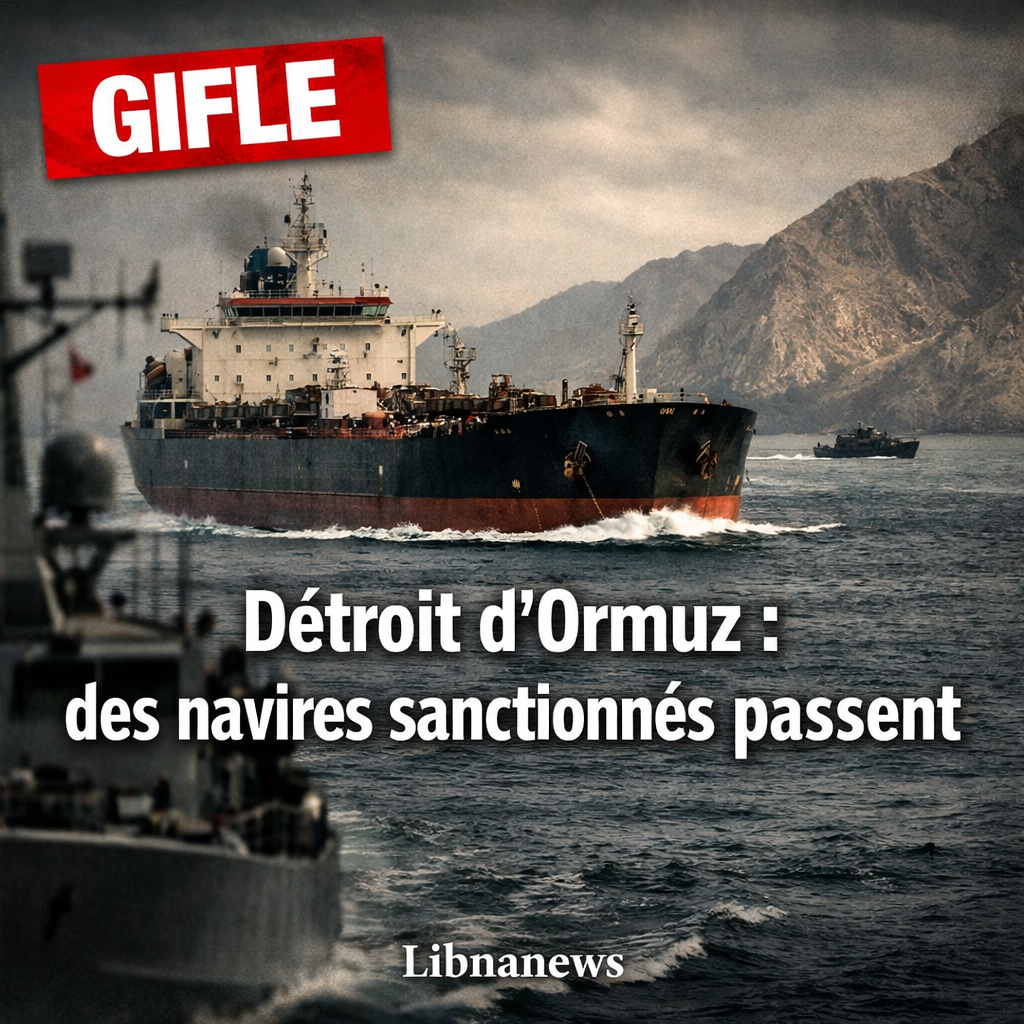
According to news agencies and navigational data, a first American oil tanker finally crossed the Strait of Ormuz on Tuesday and left the Gulf, despite the new arrangement announced by Washington. The ship, the Rich Starry, appears to be the first vessel sanctioned to pass this passage since the entry into force of the American blockade against trafficking in Iranian ports. The movement does not resolve the substantive issue, but it places the American administration at the outset before a credibility test in one of the most monitored maritime corridors on the planet.
A first crossing that tests the device
The Rich Starry’s passage wasn’t anything unusual. Since the day before, commercial traffic around the Strait of Ormuz has evolved under extreme tension, fuelled by military uncertainty and sometimes conflicting Washington messages. The vessel was spotted out of the Gulf by several monitoring bases, even though the U.S. system had just been put in place. At the time of reporting, no public boarding had been announced, and the crossing seemed to have taken place without visible interception. This only sequence is already sufficient to inform the questions of shipowners, brokers and insurers about the real scope of the blockade.
The available data describe a medium-sized tanker loaded with about 250,000 barrels of methanol. The cargo was shipped to Hamriyah, United Arab Emirates, at its last known stopover. The monitoring bases consulted also indicate that the vessel is linked to a Chinese company, Shanghai Xuanrun Shipping, and was sailing with a Chinese crew. For the market, this combination is important. It shows that a vessel placed for several years on the American radar continues to trade in the most sensitive area of the moment, without the passage of Ormuz being physically prevented.
The case of Rich Starry also refers to a history of sanctions already documented. The US Office of Foreign Assets Control registered Shanghai Xuanrun Shipping on its blacklist in 2023 under the Iran-related sanctions regime. That same year, the vessel then identified as Full Star, bearing the same IMO number as the Rich Starry, was attached to that entity on the U.S. lists. In other words, Washington already knew the building and its business environment before this new sequence in Ormuz. The passage of Tuesday does not reveal an administrative dead angle. Rather, it highlights the difficulty of matching a sanctions architecture, a moving naval theatre and operational decisions taken almost in real time.
What we know at this point
| Ship | Status | Situation Tuesday | Cargo or future operation |
|---|---|---|---|
| Rich Starry | Linked to a Chinese entity sanctioned by Washington | Crossing the Strait of Ormuz exiting the Gulf | Approximately 250,000 barrels of methanol loaded in Hamriyah |
| Murlikishan | Ship also sanctioned by the United States | Headed towards the strait on the same day | Empty according to data, heavy fuel oil loading planned in Iraq on April 16 |
Synthesis based on monitoring data and public information available Tuesday.
A blockade with narrower contours than announced
The heart of the debate lies in the exact definition of the American blockade. In its official communication, the United States Central Command did not present the device as a total closure of the Ormuz Strait. The text covers ships entering or leaving Iranian ports and coastal areas. It also states that United States forces should not prevent the freedom of navigation of vessels transiting through Ormuz to non-Iranian ports. This shade changes a lot. Politically, the White House has shown a gesture of power against Tehran. Operationally, the US Army described a narrower mechanism, targeted at Iran-related trafficking.
This difference in interpretation explains in part why the Rich Starry’s passage is symbolically greater than its own cargo. Had the U.S. system been understood as a general closure of the Strait, crossing the vessel would be a spectacular breach. If it is, as the Pentagon has officially indicated, a blockade of Iranian ports and not an absolute interruption of transit between non-Iranian ports, then the episode mainly points to the difficulty of separating on water authorized flows, suspicious flows and sanctioned flows. In practice, the sea is not divided into simple categories. Roads change quickly, pavilions change, and property chains overlap with often opaque commercial operations.
Another point that deserves attention is that the American system has been accompanied by advice to the sailors and radio contact instructions, proof that the military dimension is not limited to a political declaration. The U.S. authorities have asked vessels in the Gulf of Oman and Ormuz approaches to monitor navigation notices and to speak with U.S. naval forces on the planned canals. At the same time, British shipping agencies reported that transit to non-Iranian destinations was not officially prevented, even if crews were to expect increased military presence, controls and possible inspections. This chain of messages creates a paradoxical environment: the road is not legally closed to all, but it becomes tactically much heavier to take.
It is also for this reason that the passage of a sanctioned vessel is not an administrative detail. US financial sanctions do not have the same logic as a naval blockade. The first aims to cut off access to services, payments, insurance and commercial counterparties. The second involves an ability to identify, track and possibly intercept when the vessel enters the area concerned. When an oil tanker already known to the US authorities succeeds in crossing, even in an ambiguous legal framework, the signal sent to the market is strong. It suggests that the deterrent effect is not automatic and that operators will quickly test the limits of the new device.
Murlikishan takes his turn
The second name appeared on Tuesday, Murlikishan, reinforces this impression of testing. According to navigation data, this sanctioned vessel was also heading towards the Strait of Ormuz. Unlike Rich Starry, he was not carrying cargo at the time of follow-up. The specialized bases were waiting for him in Iraq on 16 April to load heavy fuel oil. The movement deserves to be closely monitored, as it takes place less than 24 hours after the first successful passage of a US-sanctioned vessel. Clearly, the market is not content to observe. It is already starting to circulate buildings with a sensitive profile in the friction zone.
The Murlikishan file is also known to the US authorities. The Treasury Department announced in December 2025 sanctions against the vessel then identified as M K A, explaining that since 2024 it had carried Iranian cargoes, including bitumen, fuel oil and naphtha, and that it had also transported petroleum products of Russian origin. Commercial bases and maritime registers now link the Murlikishan to the same IMO number as the former MK A. Again, the central point is not only the destination of the day. It is due to the fact that a building already pinned up for its links with Russian and Iranian flows can again approach without detour one of the most militarized passages in world trade.
This grey area also weighs on the volume of traffic. Data provided by news agencies indicate that the number of commercial crossings has already declined sharply since the beginning of regional clashes, with traffic well below the pre-war pace. For companies, the difficulty is not only the risk of interception. It is also due to the cost of delay, the management of crews and the uncertainty of the course to be held if a ship is required to divest at the last moment. It is in this context that the case of the two sanctioned tankers should be read. Their movement does not necessarily announce a quick return to normal. Rather, it reveals that even under military pressure, the energy trade immediately seeks passages, exceptions and room for manoeuvre.
Why the Strait of Ormuz remains the central issue
The Strait of Ormuz remains a decisive crossing point even when volumes slow down. According to the U.S. Energy Information Administration, about 20 million barrels per day passed through the city in 2024, equivalent to about one-fifth of the global consumption of petroleum liquids. The Agency also recalls that a large part of these flows did not provide a simple alternative. Some land infrastructure exists in Saudi Arabia or the United Arab Emirates, but it does not fully compensate for a lasting disturbance of the Strait. In 2024, around one fifth of the world’s liquefied natural gas trade also crossed this route, mainly from Qatar. At the market level, each movement visible in Ormuz therefore exceeds the mere fate of two ships.
Asia is at the forefront of this dependency. The EIA estimates that 84% of the crude and condensate transiting through Ormuz, as well as 83% of LNG, took over Asian markets in 2024. China, India, Japan and South Korea are among the main destinations. This figure directly informs the Rich Starry case. When a ship linked to a Chinese company crosses the Strait, it is not just a bilateral episode between Washington and Beijing. This is a concrete reminder of the gap that may exist between the US maximum pressure strategy and Asia’s persistent energy needs, which remains the final purchaser of reference for a significant portion of Gulf flows.
What the market is now looking at
For shipping operators, the question is not just whether the US wants to block, but how they intend to do so over time. Shipowners reason in hourly windows, contracts, crew safety and insurance costs. A device announced on a Sunday can change the routes for a few hours, then be reinterpreted by the market as soon as the first passage takes place without major incident. That’s what seems to happen. Some vessels have already changed their course or were hesitant as they approached the Strait, but the Rich Starry crossing shows that some of the actors are already trying to distinguish between the political threat and the operational reality. This adjustment phase is often the stage where real commercial arbitrations are held.
It is all the more important that the ships concerned belong to this universe of the so-called fleet of shadows, or at least to its margins, where intertwine name changes, flags of circumstance, fragmented property chains and geopolitically sensitive routes. The Rich Starry, ex-Full Star, and Murlikishan, former M K A, illustrate precisely this administrative plasticity. In this environment, sanctions remain powerful on paper, but their effectiveness depends on the cooperation of insurers, ports, suppliers and flag States. As soon as an actor considers that a transit is still possible, or that a risk of interception remains low, the economic calculation can take over even in an area where each reading error can cause energy prices to rise.
Markets react first to uncertainty. After the U.S. announcement, crude oil prices reached around $100 a barrel before partially ebbing, indicating that operators continuously assess the actual level of traffic disruption. As long as the Strait of Ormuz is not completely closed to non-Iranian flows, the prevailing scenario remains that of reduced, more expensive and risky traffic, rather than a complete stop. But this intermediate situation is sufficient to increase war insurance, complicate charter decisions and increase the risk premium on each cargo. The crossings of Rich Starry and perhaps Murlikishan thus weigh less by volume than by the question they pose to the market: where exactly does the American red line begin?
At this point, the episode tells a battle of credibility. Washington wants to show that it can tighten maritime pressure around Iran without completely closing one of the major arteries of global energy trade. The operators are already trying to measure the gap between the advertisement, the written rule and the practical application. The Rich Starry passage offers a first element of response, but it is not enough to stabilize the situation. In the coming days, the focus will be less on political statements than on the succession of AIS trajectories, the choices of captains, the reactions of insurers and the American ability to deal, one by one, with the most sensitive vessels in the Strait of Ormuz.




