

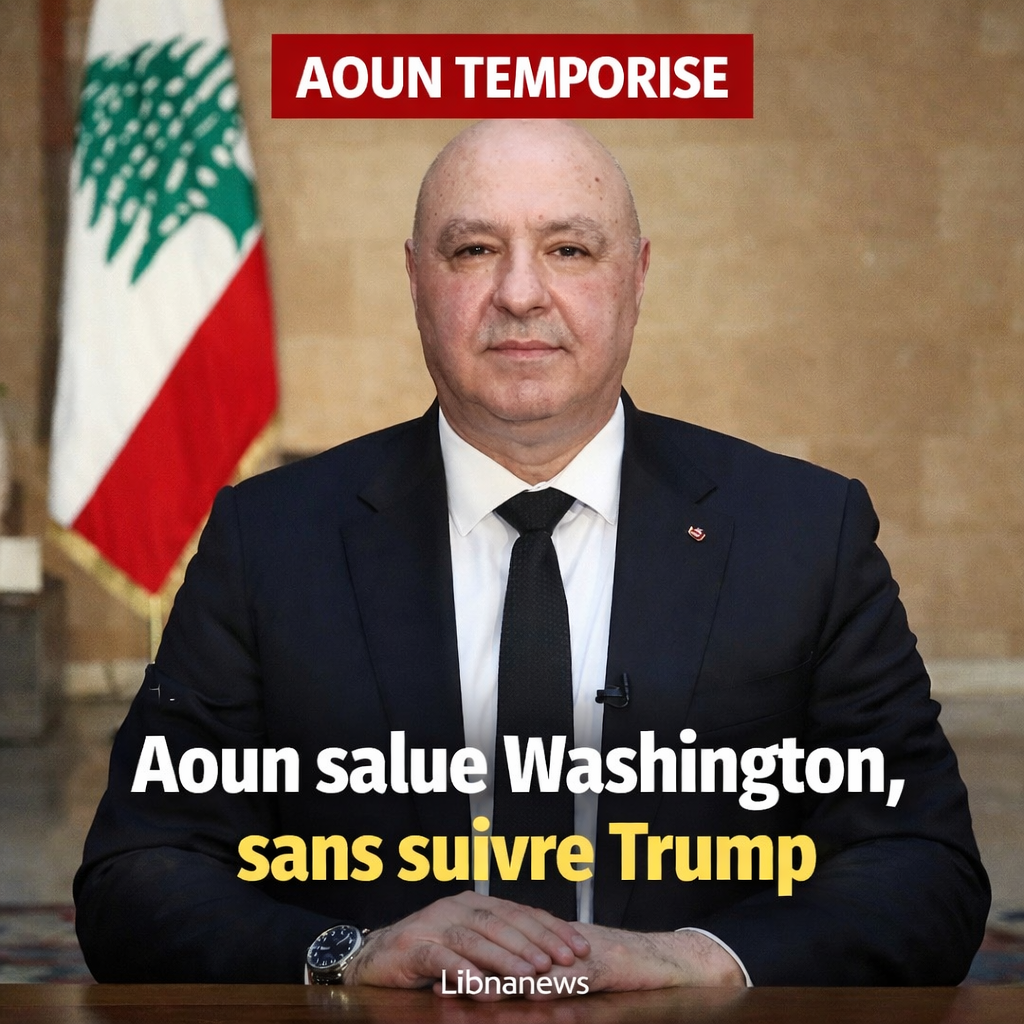
The telephone call received on Thursday by Lebanese President Joseph Aoun from US Secretary of State Marco Rubio produced a double signal. The first is diplomatic. The Head of State thanked Washington for his efforts towards a ceasefire with Israel, confirming that Beirut continues to rely on American mediation to obtain a suspension of strikes and to open a more political sequence. The second is more subtle. In the Presidency’s report, no mention is made of the announcement made almost at the same time by Donald Trump that Israeli and Lebanese leaders should speak on Thursday. This absence has nothing to do with anecdotal. It illuminates Baabda’s caution in a phase in which every word, every leak and every promise of diplomatic breakthrough can cause both internal and regional turmoil.
Lebanon is indeed in a delicate position. The country is seeking an immediate ceasefire, a reduction of military pressure on the South, humanitarian relief and, ultimately, a return of State sovereignty to the most exposed areas. But it advances in a diplomatic landscape saturated by contradictory announcements. Washington wants to appear as the main mediator. Israel continues its operations while saying that it remains open to contacts. Iran claims that there is no credible de-escalation without the inclusion of the Lebanese front. Hezbollah rejects the ongoing direct talks and refuses to recognize the results in advance. In this context, Joseph Aoun’s gesture towards the United States translates less of an alignment than a calculation. The Lebanese president needs American intercession, but he does not want to appear as validating a diplomatic setting that would go faster than the Lebanese internal consensus or further than the mandate he sassits.
Ceasefire as a political line
The content of the appeal, as reported by the Presidency, is brief. Joseph Aoun thanked Marco Rubio for his efforts towards a ceasefire with Israel. Taken in isolation, the statement may seem agreed. In fact, it sets a very clear hierarchy. The core of the Lebanese position remains the ceasefire, above all the rest. For several days, Baabda and the government of Nawaf Salam have reiterated that the priority issue is neither normalization nor a comprehensive settlement nor an abstract debate on regional peace. The immediate subject is the cessation of the war on Lebanese soil, the protection of civilians and the creation of a framework that then makes possible a discussion on Israeli withdrawal, the return of displaced persons and the restoration of a more readable public authority in the South.
This lexical choice counts. By thanking Washington for its efforts towards a ceasefire, and not for a comprehensive peace, historic dialogue or reconciliation initiative, Joseph Aoun remains on a ground compatible with the internal balances of Lebanon. It avoids feeding the accusations of hasty normalization that are already going up in part of the camp close to Hezbollah. He speaks of de-escalation, sovereignty and humanitarian necessity, not of strategic change. In today’s Lebanon, this nuance is decisive. The word ceasefire is used to maintain a political space that is still manageable. The word peace would immediately trigger a much harsher internal confrontation.
The Lebanese President is therefore not merely thanking the United States. It guides the sense of their role. Baabda recognizes Washington’s practical usefulness: to exert pressure on Israel and open channels. But official Lebanon does not give the Americans a political blank on the definition of the outcome. This point emerges all the more strongly that the direct discussions held in Washington two days ago did not lead to any concrete progress towards an immediate truce. Israeli representatives continued to prioritize the disarmament of Hezbollah and sustainable security. The Lebanese representatives handed over the ceasefire to the centre. The thanks to Rubio thus go in this direction: yes to American mediation, but provided that it serves first the cessation of hostilities.
A Presidency that won’t be ready
The other highlight of the day is precisely that the Presidency did not say. Donald Trump announced that leaders of Israel and Lebanon should talk to each other on Thursday, in what would be a first at this level in decades. On the Israeli side, officials and several media have suggested that Benjamin Netanyahu and Joseph Aoun may be involved. However, Baabda’s statement on the Rubio-Aoun call makes no room for this perspective. This restraint deserves to be read as a political choice.
In the Lebanese context, confirming direct contact at the highest level with Israel would have had an immediate cost. Such an announcement would have fed criticism of Hezbollah and its allies, who already denounce Washington’s discussions as a slope towards unaccepted normalization. She also put Joseph Aoun under pressure on a subject where institutional legitimacy is not enough. In Lebanon, even when a president acts in the course of his or her duties, he must take into account a system where war, peace and relations with Israel cross community, partisan and regional lines. By remaining silent on Trump’s announcement, the Presidency therefore avoids adopting a scenario which it may not yet fully control, or which it prefers to maintain in a zone of diplomatic discretion.
This caution also has an external function. Public announcements often play a tactical role in a negotiation phase. An overoptimistic American statement can raise the idea of a near breakthrough. An Israeli leak can give the image of an opening without suspending operations on the ground. On the other hand, Lebanese silence can be used to keep a grip on the pace, to avoid media flagging and not to validate discussion frameworks that are not yet stabilized. The Lebanese Presidency seems to have chosen this third path: not to deny frontally, but not to confirm either. This method allows Baabda to stay in the game without appearing driven by Donald Trump’s communication.
Nor should the institutional dimension of this reservation be underestimated. If an exchange between leaders really were to take place, it would be far-reaching in the contemporary history of Lebanon. Such a step could not be treated as a mere sequence of improvised communication. It would require political scoping, public justification and very fine management of internal impacts. By not mentioning anything, the Presidency is saving itself time. She avoids the story of the day being dictated from Washington rather than from Baabda.
What Washington is looking for in Lebanon
For the United States, Lebanon has become a case that is no longer possible to leave behind. Direct contacts between Lebanese and Israeli representatives in Washington on 14 April showed this. Marco Rubio wants to appear as the man who has reopened a channel frozen for decades and who can, without immediate peace, get at least one breath on the Lebanese front. This American ambition is part of a broader framework. Washington is also seeking to consolidate the fragile truce with Iran and to prevent a prolonged confrontation in Lebanon from compromising any regional de-escalation effort.
But the American position remains crossed by a contradiction. On the one hand, the Trump administration says it wants to encourage a solution in Lebanon. On the other hand, it did not impose a halt on Israel in its campaign against Hezbollah. The United States supports the discussions, but has not yet turned this support into a clear ceasefire requirement. This ambiguity explains how Joseph Aoun expresses his gratitude. By thanking Rubio for his efforts, he values American utility without concealing the fact that these efforts still have to produce results. The implicit message is transparent: Beirut recognizes mediation, but now awaits tangible proof of its effectiveness.
This expectation is all the stronger as Lebanon is under persistent military and humanitarian pressure. Fighting in the South continues. Movements are continuing. Reconstruction has no credible horizon as long as the bombing continues. In such a context, American diplomatic actions cannot be assessed by their only symbolic value. They are judged to be a very simple question: do they or do they not lead to an end to the war? By choosing the word « efforts », Joseph Aoun salutes an unfinished approach. He does not speak of agreement, guarantee, or breakthrough.
Joseph Aoun imposes the lexicon of the state
Since the opening of the Washington Canal, the Lebanese Head of State has endeavoured to maintain language consistency. Three words go back to his entourage and Baabda’s accounts: ceasefire, withdrawal, sovereignty. This trilogy is not decorative. It is used to build a state narrative in a time when Lebanon may be read only through the prism of Hezbollah, Israeli pressure and Iran-American arbitration. By thanking Marco Rubio, Joseph Aoun does not leave this line. On the contrary, it reinforces it. It gives the United States a functional place in the search for a ceasefire, but it maintains the Lebanese framework based on the end of hostilities, the Israeli withdrawal and the restoration of public authority.
This strategy responds to an internal need. The president knows that a significant part of Lebanese opinion, even beyond partisan divisions, does not want a settlement that would appear to be imposed from outside or negotiated under Israeli military pressure alone. The idea of a pre-ceasefire makes it possible to defend the diplomatic path without giving the impression of political surrender. It also justifies contact with Washington. Lebanon does not surrender to American diplomacy because it adheres to its regional vision. He does so because he needs an intermediary who can speak to Israel and weigh, as far as possible, on his military choices.
At the same time, Joseph Aoun sought to distinguish his action from that of Hezbollah. It is one of the most important springs of the current sequence. The Lebanese power wants to show that there is a State way, even a limited one, to deal with the war with Israel. This demonstration remains fragile, as Hezbollah retains a major military, social and political weight. But it clearly structures the Presidency’s communication. Every time Baabda insists on ceasefire, withdrawal and sovereignty, it also seeks to create a Lebanese decision-making centre that is not absorbed by the language of armed resistance or that of regional confrontation alone.
Trump announces, Baabda temporise
The contrast between Donald Trump’s announcement and the silence of the presidential communiqué alone tells much of the story. Washington works on visibility, staging and creating an acceleration effect. Baabda works on the precaution. Trump better show that he is moving the lines, that he gets new contacts and that he is able to create respite. Joseph Aoun has an interest in preventing the scene from being read in Lebanon as a fast shift towards direct dialogue with Israel at the top of the state.
This style shift also reflects a shift in objectives. For Trump, an announced conversation between leaders is already a political success in itself. For the Lebanese President, such a conversation is of value only if it is part of a useful ceasefire sequence and compatible with the internal red lines. In other words, Washington values the gesture. Baabda values the framework. This difference explains why official Lebanon avoids running behind every American ad. He knows that in Lebanon, a step of communication can be very expensive if it is poorly absorbed by the internal scene.
It must also be seen as a way of protecting the presidential function. Joseph Aoun came to the presidency with an image of man of institution, sobriety and discipline. Overexposure on a dossier as flammable as direct contact with Israel could quickly weaken it if it were not backed up by concrete results. By letting Trump speak without immediately repeating his story, Baabda retains the possibility of adjusting his own position. Silence here becomes a tool for political control.
The land still commands diplomacy
This whole sequence would be different if the terrain really calmed down. This is not the case. Fighting continues in the South. Israel continues to affirm that it will maintain pressure until a lasting change in the military configuration of the front is achieved. Hezbollah still refuses to consider itself bound by the ongoing talks. This reality weighs heavily on the presidential speech. Joseph Aoun can thank the United States, support diplomatic openness and seek a state logic. It alone cannot transform the real balance of power that still structures war.
That is why the issue of the ceasefire remains so central in his speech. The ground is setting its priorities. As long as the strikes continue, any more ambitious discussion remains politically toxic and diplomatically bleak. The Lebanese President knows that. The Americans, too. In a way, the thank you to Marco Rubio reminds Washington that the credibility of his initiative will first be measured here: in his ability to obtain a halt, even temporary, of military logic.
This relationship between terrain and diplomacy also explains why Baabda’s communication remains so closely calibrated. In Lebanon, any verbal package can turn against its perpetrator if the military events contradict it within hours. By avoiding excessive announcements, remaining on the ceasefire register and not openly validating the idea of a direct summit exchange with Israel, Joseph Aoun reduces this risk. It maintains a line compatible with what the terrain still permits.
A gratitude without illusion
The call with Marco Rubio therefore produced a precise message. Joseph Aoun does not close any door to American mediation. On the contrary, it encourages and values it. But he does it in a strictly utilitarian way. The United States is thanked for its efforts towards a ceasefire, not celebrated as architects of an already acquired historical turning point. This difference is essential. It shows that the Lebanese presidency seeks to take advantage of the diplomatic moment without yielding to the logic of the announcement.
There is a form of sober realism in this posture. Baabda knows that Washington remains the most able external interlocutor to speak to Israel and to exert a limited influence on the conduct of war. But Baabda also knows that Trump’s America works by bursts, quick announcements and sometimes more ambitious scenarios than real. By keeping his own tempo, Joseph Aoun tries to protect both the Lebanese position, the internal balance and the credibility of the presidency.
For Lebanon, the immediate challenge is not to produce a spectacular picture of rapprochement. It is a question of tearing up a cease-fire, reducing destruction, avoiding a deepening of internal crime and resuming a bit of state initiative in a war that others largely continue to define. It is in this narrow space that the thanks to Marco Rubio are expressed. A diplomatic gesture, of course, but above all a way to recall that Baabda will now judge Washington less on his announcements than on his ability to convert this mediation into a real respite on the ground.




