

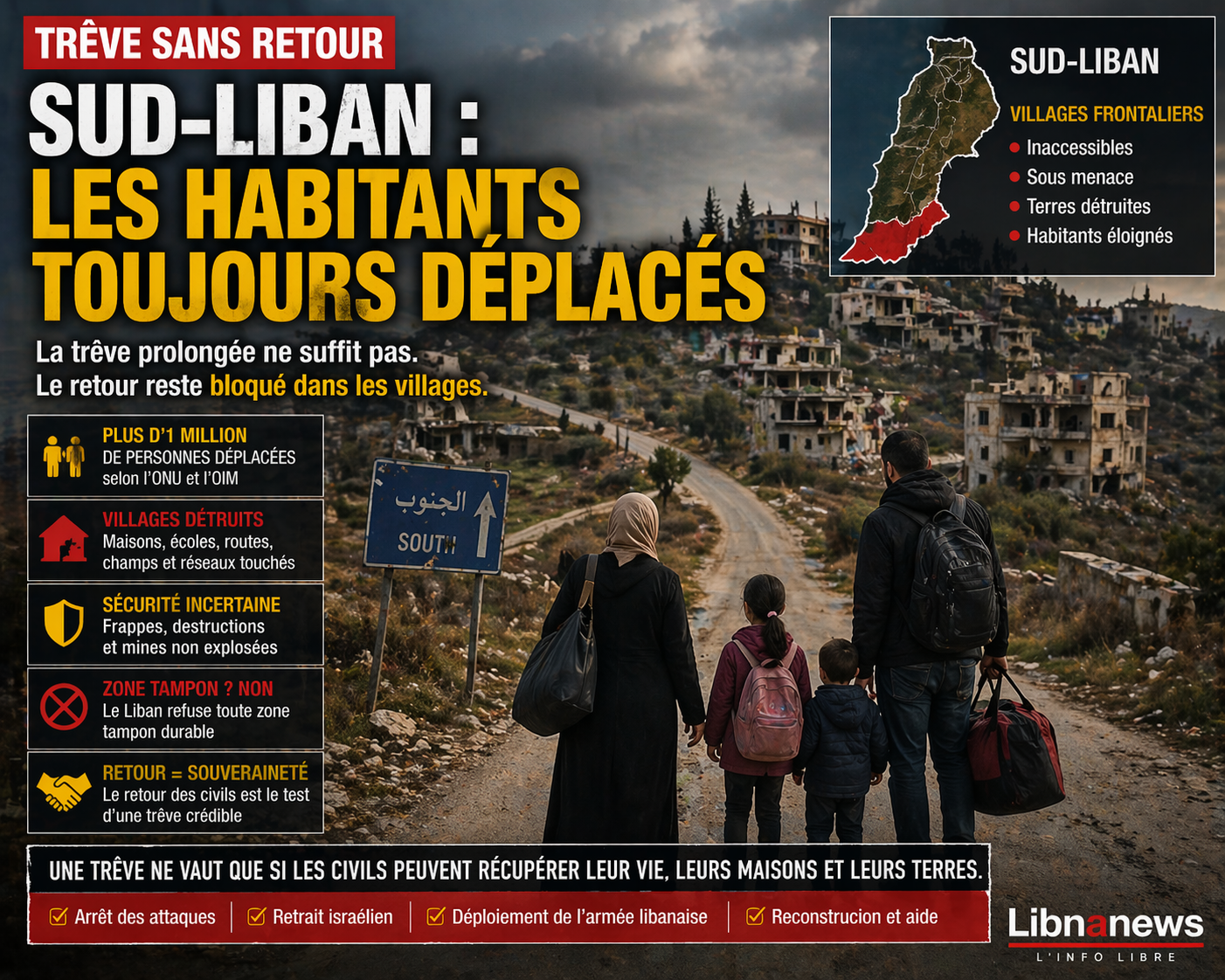
The three-week extended truce does not resolve the most concrete issue in southern Lebanon: the return of the inhabitants. Families stay away from their homes. Villages remain inaccessible. Agricultural land is destroyed or too dangerous. Whole areas live under the threat of further strikes. The ceasefire exists in diplomatic language. It remains partial in the daily lives of the displaced.
A truce still separated from the ground
The core of the problem lies in the gap between the political announcement and the local reality. Washington talks about a diplomatic window. The mediators want to turn the military break into a negotiation process. But in the South, the first demand remains simpler. The locals want to know when they can come back. They also want to know if they will find a house, a road, a field, a school and a minimum of safety.
The extension of the ceasefire therefore puts Lebanon at a contradiction. The discussion progressed in Washington, while the return remained blocked in several localities. A truce that does not allow the return of civilians is not yet a complete truce. It suspends part of the war. It doesn’t fix its effects. It does not give the inhabitants control of their lives.
This situation weighs on the Lebanese position. Beirut cannot treat the truce as a mere diplomatic success. It must be linked to concrete criteria. The first is stopping attacks. The second is the Israeli withdrawal from the occupied areas. The third is the end of destruction. The fourth is the return of the displaced. The fifth is the effective state presence in border villages.
Return as a test of sovereignty
The return of the inhabitants is not only a humanitarian issue. It is a test of sovereignty. An empty village, inaccessible or exposed to fire remains a suspended space. The state is losing its presence there. Families lose their daily lives there. Farmers lose their income there. Schools lose their students there. Municipalities lose their functions there.
Therefore, the refusal of a durable buffer zone is central to the Lebanese line. Such an area does not only mean military space. It means the ban on living. It means the postponement of reconstruction. It sometimes means the gradual removal of ties between the inhabitants and their lands. For the villages of the South, the risk is clear: the truce can become a prolonged separation if it is not accompanied by withdrawal and guarantees.
Lebanon must therefore defend a simple formula. Security cannot be built on the forced removal of the inhabitants. It must be based on withdrawal, respect for the blue line, the deployment of the Lebanese army and an international monitoring mechanism. Without these elements, the truce can become a vacuum management tool.
Villages between destruction and prohibition of return
The war has transformed several border localities into areas of ruins, fear and military control. Houses were destroyed. Roads were damaged. Land burned. Families left their villages without knowing whether their departure would last a few days, weeks or months. The return no longer depends solely on their will. It depends on the state of the place, security orders, the presence of the army and Israeli behaviour.
In several villages, residents cannot assess the damage themselves. They depend on the images, stories, calls and information transmitted by those who may have approached. This distance worsens the trauma. The displaced person doesn’t just lose his roof. He also loses the opportunity to check what’s left of his house.
This uncertainty creates a form of prolonged internal displacement. Families live with relatives, in temporary housing, in collective centres or in precarious conditions. They keep keys to houses sometimes destroyed. They retain documents, title and photos, but cannot regain possession of their space.
A lasting humanitarian crisis
The number of internally displaced persons shows that the crisis far exceeds the most vulnerable villages. More than one million people have been displaced to Lebanon since the escalation of March 2026, according to available international and national humanitarian data. Some live in collective sites. Another is located with relatives or in rented accommodation. Many are out of formal shelters, making it more difficult to organize.
Prolonged displacement is exhausting families. Savings are decreasing. Children change school or lose weeks of classes. The elderly lack regular care. Chronic patients must find treatments in places they do not know. Households hosting displaced relatives are also under strong pressure. Family solidarity remains vital, but it has limits.
The truce does not therefore remove the humanitarian emergency. She’s transforming it. Until families return, assistance must cover housing, food, hygiene, care, transport and education. But needs increase when displacement lasts. What was a few days’ response becomes a survival organization.
Agricultural land as second front
South Lebanon is not only a residential area. It is also an agricultural area. Olive trees, orchards, fields and rural roads are part of the local economy. When the land burns, when the trees are cut or when access to the fields becomes dangerous, the return loses some of its meaning. A family can find a home, but lose their income.
White phosphorus attacks and reported fires in several areas have added a lasting threat. The damage is not just about buildings. They affect soils, crops, pastures and production cycles. Farmers cannot always assess the quality of their land. They don’t know if the plots are safe. They also don’t know if they can resume the next season.
This dimension is essential for reconstruction. Repairing a house is not enough. There is also a need to rehabilitate agricultural roads, irrigation systems, power grids, wells, hangars and local markets. The return of the inhabitants will therefore also depend on the ability to revive a rural economy. Without income, the return becomes fragile.
Displaced children pay a heavy price
The children of the South live a deep break. They lose their room, school, friends, landmarks and sometimes family members. Distance learning does not always replace school. It requires a stable connection, a suitable device and a quiet environment. Many displaced families do not have these conditions.
Pupils living in accommodation centres or with relatives follow irregular rhythms. Some lack classes. Others do not have access to digital tools. Parents must choose between immediate needs and school continuity. In an displaced family, the urgency of housing, food or health often comes before homework.
Returning to villages is therefore also an educational issue. A closed, damaged or inaccessible school prolongs the movement of children. Even if parents want to go home, they hesitate if school can’t resume. Reconstruction must therefore include schools from the early stages. It cannot wait for the complete end of the political process.
Security cannot rest on fear
One of the major risks is the installation of a safety based on fear. If the inhabitants do not dare to return, an area emptys without official decision. If the fields become too dangerous, the land is abandoned. If the roads remain exposed, the villages retreat. This dynamic creates a de facto buffer zone, even without text.
To avoid this, Lebanon must demand visible guarantees. The first is the end of the shots and strikes. The second is the removal of obstacles to return. The third is the deployment of the Lebanese army to the areas concerned. The fourth is the oversight role of international forces. The fifth is the establishment of a clear mapping of destruction, mines, unexploded ordnance and risk areas.
The return must be organized, not improvised. Families cannot be forced to return safely. Nor can they be kept away from their villages without a calendar. The State must therefore act as an arbitrator. He must say where return is possible, where it remains dangerous and what measures are being taken to reopen the localities.
The International Force and the Lebanese Armed Forces in front of a central mission
The role of the United Nations Interim Force in Lebanon and the Lebanese Armed Forces remains decisive. Their presence must be used to verify the truce, support the return, reduce incidents and prevent the installation of a security vacuum. The international mandate related to resolution 1701 is still important here. It provides a framework for monitoring hostilities and supporting the Lebanese State in the South.
But this framework is subject to severe constraints. International forces cannot replace a political decision. They cannot rebuild the villages alone. They cannot guarantee return if violations continue. Their role therefore depends on a clear agreement between the parties and effective international support.
The Lebanese army is at the centre of sovereignty. Its deployment in the South can reassure the inhabitants. It can also provide an institutional response to security requests. But the army needs resources, political coverage and a stable environment. If it deploys to an area where the strikes continue, its mission becomes almost impossible.
Displaced persons facing the social cost of waiting
Waiting destroys low noise families. It clears the savings. She’s tired of parents. She disorients children. It isolates the elderly. It aggravates diseases. It creates conflicts between the needs of internally displaced persons and the capacities of host families. It also weighs on municipalities that receive people from other villages.
A prolonged truce without return can therefore produce a lasting social crisis. The displaced no longer live in war at the front. They live in uncertainty, cost and dependence. Rent payments, food, medicines and transportation become heavy burdens. Many do not know if the aid will last. Many do not know when schools, clinics and services in their village will reopen.
This situation can also transform local balances. The host villages find themselves under pressure. Public services are more popular. Associations must meet multiple needs. Solidarity fatigue may appear. The slower the return, the more fragile social cohesion becomes.
Reconstruction must start with data
Before we rebuild, we have to measure. Lebanon must have a precise record of the houses destroyed, the infrastructure affected, the damaged roads, the burnt agricultural land, the schools affected, the water and electricity networks damaged. Without reliable data, aid may be slow, uneven or contested.
This assessment should include municipalities, relevant ministries, the army, international agencies and local representatives. It must also take into account the needs of the inhabitants. A family does not only demand financial compensation. It often requires an open road, a safe school, a clinic, an electrical connection and the possibility of working.
The reconstruction of the South cannot therefore be a simple building site. It must be a return plan. It must link security, housing, agriculture, school, health and public services. If one of these elements is missing, the return will remain partial.
Washington needs to hear the return priority
American mediation wants to speed up the political process. But she cannot ignore the priority of returning. The envisaged meeting between Joseph Aoun and Benjamin Netanyahu can only make sense if it deals with the concrete conditions in the villages. A summit that would speak of peace without a withdrawal schedule and a return mechanism would be difficult to defend in Lebanon.
Beirut must therefore bring a simple request to Washington: the truce must be measured by the number of families who can return safely. It shall be measured by lowering the impact. It shall be measured by emergency access. It shall be measured by reopening the roads. It must be measured by the end of destruction.
This language allows to move the debate. It prevents the discussion from being limited to Israeli security assurances. It recalls that Lebanese security also exists. It begins with the protection of civilians and the return of the inhabitants. It can’t be secondary.
Return as a condition for credible peace
A peace that does not bring the inhabitants back to their villages will remain abstract. It can be announced from Washington. It can be hailed by foreign capitals. But it will not change the reality of families if houses remain destroyed, land is banned and roads remain dangerous.
Lebanon must therefore make return a non-negotiable point. This return must be safe, dignified and verifiable. It must be under state protection. He must be accompanied by reconstruction aid. It must also respect the right of the inhabitants to recover their property and land.
The three-week truce can be useful if it opens this path. It will be insufficient if it is only used to prepare a political photo. In southern Lebanon, people are asking not only for an end to the fighting. They’re asking for the right to go home. As long as this right remains suspended, the truce remains unfinished.




