

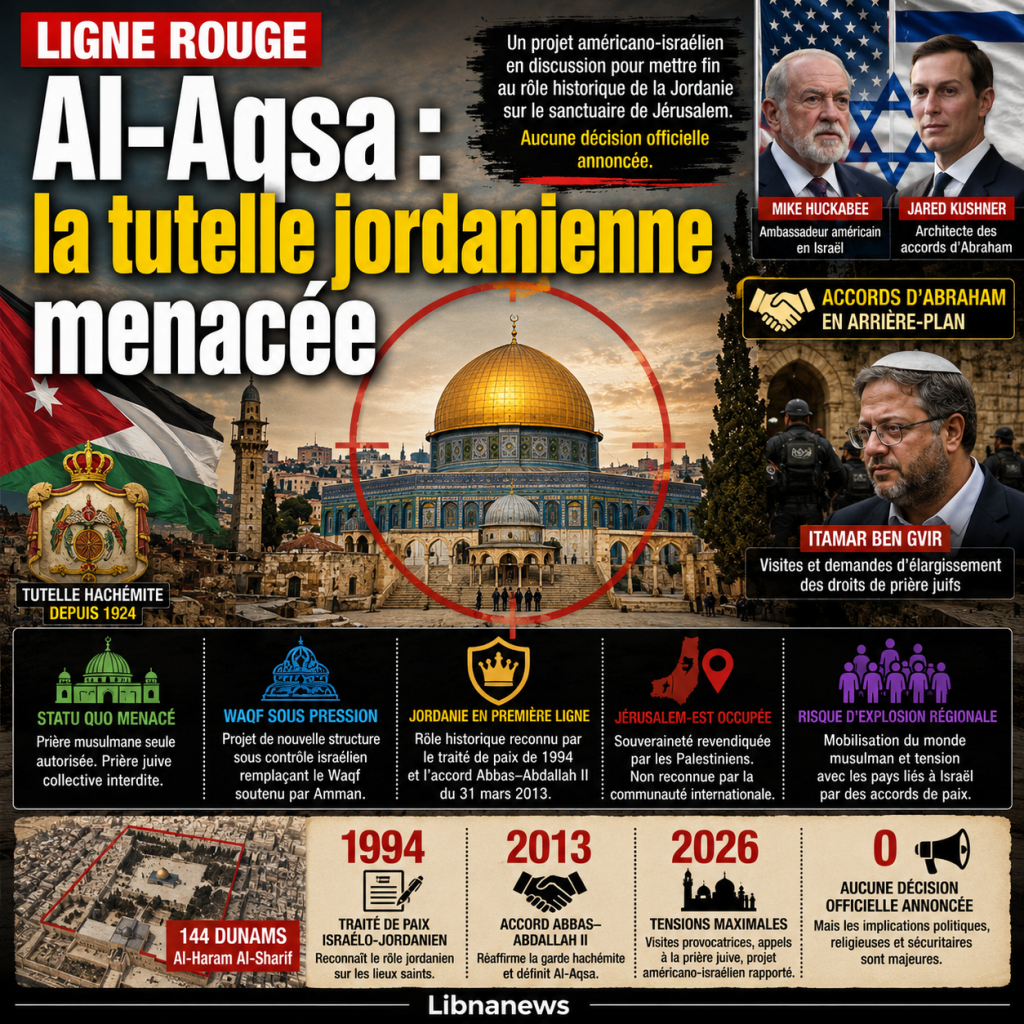
The debate around Al-Aqsa took on a new dimension following reports of an American-Israeli project to withdraw Jordan’s historic role in the Jerusalem sanctuary. The case concerns one of the most sensitive places in the Middle East. It concerns both the claimed Palestinian sovereignty over East Jerusalem, the Israeli-Jordanian peace treaty, the religious role of the Hashemites and the American strategy of regional recomposition around the Abraham agreements. At this stage, no official announcement confirms a formal change in the status quo. But the assumption of a challenge to Jordanian guardianship is enough to revive a political, religious and security red line.
Al-Aqsa at the heart of a disputed project
According to a survey published by a British media specialist in the Middle East, US, Jordanian, Palestinian, Western and Gulf officials describe discussions aimed at creating a new arrangement for the esplanade. This would end the central role of the Islamic Waqf supported by Amman. It would install a structure created under Israeli control and present the site as a multi-faith centre. The same media reported that the project would give Jewish faithful equal access and allow Jewish collective prayers in the enclosure, which the current status quo prohibits. These elements remain attributed to anonymous sources. They must therefore be treated as reported information, not as an act.
The stakes go far beyond the administration of a holy place. Al-Aqsa is the third holy place of Islam and the most sacred site of Judaism under the name of Temple Mount. Its management is based on a fragile balance. Muslims pray there. Non-Muslims can visit according to specific rules, but organized Jewish prayer remains prohibited within the traditional framework of the status quo. Any change in that balance could lead to demonstrations, violence in Jerusalem, wider Palestinian mobilization and a reaction by Arab States linked to Israel through peace or normalization agreements.
Jordan facing a red line
Jordan ranks first among the countries concerned. His monarchy founded part of its regional legitimacy on the custody of the Muslim and Christian holy places in Jerusalem. This role dates back to 1924 in the Hashemite reading. It was maintained after Jordan’s disengagement from the West Bank in 1988, and subsequently recognized in the peace treaty signed with Israel in 1994. In 2013, Palestinian President Mahmoud Abbas and King Abdullah II signed an agreement that reaffirms the Hashemite Guard and defines Al-Aqsa as the Al-Haram Al-Sharif complex, with 144 dunams, buildings, courts and outbuildings.
The information reported occurs in an already flammable climate. For several years, Israeli far-right officials have been increasing visits to Al-Aqsa and demanding more rights for Jewish visitors. Israeli minister Itamar Ben Gvir visited the esplanade in April 2026, claiming to expand Jewish access and prayer rights. Jordan and the Palestinian Authority have denounced a provocation and violation of the status quo. Benyamin Netanyahu’s office often replied in similar episodes that Israel was not changing its official policy. But the repetition of these actions gives rise to doubts about the government’s real ability to contain its most radical wing.
Washington in a sensitive position
The role lent to Washington makes the case even more sensitive. The United States has long expressed support for the status quo and Jordanian role. An American inflection, even indirect, would therefore have considerable weight. The media behind the revelations claimed that the project would be carried out by the US ambassador to Israel, Mike Huckabee, and by Jared Kushner, Donald Trump’s son-in-law, although he did not hold an official office in the administration. This refers to the diplomacy of Abraham’s agreements, which had sought to transform regional relations around normalization with Israel and an economic and religious reading of conflicts.
The presence of Mike Huckabee on this issue feeds Arab concerns. By February 2026, the American ambassador had already provoked a heated controversy after saying that Israel would have biblical rights over a large part of the Middle East. Several Arab countries and regional organizations had condemned those statements. Although the U.S. embassy then attempted to relativize their scope, the episode reinforced mistrust of its vision of the Israeli-Palestinian conflict. In this context, any initiative concerning Al-Aqsa is read not as a simple administrative adjustment, but as a possible ideological shift.
Amman, between diplomacy and internal pressure
For Amman, the question is existential. Jordan is not only an external diplomatic actor. It administers, finances and politically defends the Waqf of Jerusalem. It employs or supports part of the religious and administrative staff of the sanctuary. It regularly recalls that Israel does not have sovereignty over East Jerusalem, a territory occupied since 1967 according to the Jordanian, Palestinian and largely international position. A challenge to his guardianship would not only threaten a religious prerogative. It would weaken a pillar of the Israeli-Jordanian peace treaty and expose the monarchy to strong internal pressure.
Jordanian society follows Al-Aqsa with particular intensity. A majority of the population is of Palestinian origin or has family ties with the West Bank and Jerusalem. The parties, trade unions, Islamist movements and professional organizations have long denounced Israeli officials’ visits to the esplanade. If Jordan were publicly excluded, the kingdom should choose between a limited reaction, at the risk of being powerless, and an open crisis with Israel and Washington. In both cases, the political cost would be high.
The Palestinian Authority also weakened
The Palestinian Authority is also at risk. The 2013 agreement recognizes the role of King Abdullah II as guardian of holy places, while reaffirming that future sovereignty over Jerusalem belongs to the Palestinian state. This diplomatic sharing enabled Ramallah and Amman to coordinate their position vis-à-vis Israel. If a new Israeli structure replaced the Waqf, the Palestinian Authority would lose an essential institutional link in East Jerusalem. She would also be accused by her rivals of not protecting the symbolic heart of the Palestinian cause.
The religious dimension gives the file an immediate regional scope. Al-Aqsa does not concern only Palestinians or Jordanians. It mobilizes Muslim public opinion, from Turkey to Pakistan, from the Gulf to the Maghreb. Governments that have normalized their relations with Israel or are in dialogue with Washington should then answer a simple question: can they accept a change in the status quo on a Muslim holy site in the name of a new regional architecture? This pressure would be particularly strong for the countries associated with Abraham’s agreements or asked to join them.
Control of sermons, the most explosive point
The report contains another explosive point: the alleged Israeli control over religious appointments and the content of Friday sermons. If this element were confirmed, it would represent a major rupture. Friday preaching is not only a religious practice. In Al-Aqsa, it carries a political, identity and national dimension. Giving Israel a right of control over the imams, preachers or site officials would be seen as a direct takeover of an Islamic institution in occupied territory. Few subjects can provoke such a rapid reaction in the Muslim world.
Israel, for its part, generally presents its policy in Jerusalem as a guarantee of freedom of access and security. The Israeli authorities claim to prevent violence and control a site where tensions can escalate rapidly. They also underline the importance of the Temple Mount for Judaism. But this argument comes up against the Palestinian and Jordanian perception, which sees in every extension of the police presence, every restriction of Muslim access and every visit of the far right minister a gradual erosion of the status quo. The gap between claimed security and contested sovereignty therefore continues to widen.
A possible regional accelerator
The regional calendar accentuates the gravity of the moment. The war in Gaza, the tensions in Lebanon, the strikes involving Iran and the American discussions on the recomposition of the Middle East create an atmosphere of permanent crisis. In such an environment, Al-Aqsa can act as an accelerator. An apparently limited administrative decision can become a political rallying point. A ministerial visit may trigger clashes. A rumor of changing the status quo can produce mobilizations even before the chancellies publish their denials.
Recent history confirms this sensitivity. Restrictions on access, searches, security gates, police intervention and visits by Israeli nationalist leaders have already provoked protests, sometimes beyond Jerusalem. The site crystallises the Palestinian question because it condenses three conflicts at once: the religious conflict around prayer, the national conflict around East Jerusalem and the diplomatic conflict around international recognition. It is precisely this superposition that makes any attempt at unilateral change dangerous.
Abraham’s Agreements in the Background
The American strategy appears ambiguous. Donald Trump recently called on several countries in the region to join the Abraham Accords, citing Arab and Muslim states that have not normalized their relations with Israel. At the same time, discussions with Iran, the war in Gaza and tensions in Lebanon complicate any major regional initiative. Transforming Al-Aqsa into a symbol of abrahamic coexistence could seduce some of the architects of standardization. But such an approach, if it involves the weakening of Waqf and Jordan, would probably have the opposite effect: a broader religious and political challenge.
The concept of a multi-faith centre carries an explosive charge. Presented by its potential promoters as a gesture of openness, it would be perceived by its opponents as a denaturation of the site and a legalization of collective Jewish prayer in a Muslim enclosure. For Palestinians, this would not be a balanced sharing, but a step towards the temporal or spatial division of the sanctuary, along the dreaded pattern of other disputed holy places. For Jordan, this would be a direct challenge to the definition of Al-Haram Al-Sharif in the 2013 Agreement.
Netanyahu caught between his allies and Amman
Benyamin Netanyahu’s margin of manoeuvre remains uncertain. The Israeli Prime Minister depends on far right allies committed to the expansion of Israeli sovereignty over Jerusalem and the West Bank. It must also preserve relations with Jordan, which are essential for regional security, stability of the eastern border and discreet cooperation on several issues. This tension explains the contradictory messages from Israel over the past few years: official maintenance of the status quo, but increased tolerance for political or religious actions that test its limits.
For Jordan, the answer cannot be merely verbal. Amman has diplomatic tools, including convocations of ambassadors, démarches to Washington, Arab and Islamic meetings, and recourse to the United Nations. But every tool has its limits. Breaking or suspending certain aspects of cooperation with Israel would have a security and economic cost. Just protest would expose power to internal criticism. It is this asymmetry that makes Jordanian guardianship both central and vulnerable.
Jerusalem remains the node of the Palestinian issue
The Palestinian question thus returns to the most sensitive place. For years, international diplomacy has been trying to circumvent the political impasse through economic, security or regional arrangements. Al-Aqsa recalls that Jerusalem cannot be bypassed. No plan of normalization can be sustained to ignore the status of holy places, Palestinian rights and recognition of the Jordanian role. The slightest change perceived as imposed by Israel or the United States can revive a political solidarity that the Palestinian and Arab divisions had weakened.
The next few days will tell whether the revelations remain at the stage of a discussed project or whether they announce a more structured initiative. The signals to be monitored are precise: an official American reaction, a detailed Israeli denial, a Jordanian diplomatic mobilization, a statement by the Palestinian Authority, or an urgent meeting of the Organization of Islamic Cooperation. In Jerusalem, the test will also take place on the ground, in the access of the faithful, the behaviour of the Israeli police, visits by political leaders and the ability of Waqf to continue to administer Al-Aqsa without further restrictions.
SEO and editorial elements
Exact number of body words, hat included:2,011
Keyword:Al-Aqsa
Keywords Secondary SEO:jordan, East Jerusalem, Islamic Waqf, status quo, Abraham, Mike Huckabee, Itamar Ben Gvir
Description:
Al-Aqsa: A reported project to challenge Jordanian guardianship is rekindling tensions around Jerusalem.
Extract:
Al-Aqsa is in the centre of a new regional tension following reports of an American-Israeli project to reduce or even abolish Jordanian guardianship in the Jerusalem sanctuary. The issue concerns the religious status quo, the peace treaty between Israel and Jordan, the claimed Palestinian sovereignty over East Jerusalem and the American strategy around the Abraham Accords. No formal decision has been announced, but the political implications are major.
Five alternative titles:
- Al-Aqsa: Washington and Israel under tension
- Jerusalem: Jordanian Guardianship Contested · Global Voices
- Al-Aqsa: a project that worries Amman
- Al-Aqsa: the status quo in the face of a breakdown
- Jerusalem: Jordan defends its historic role
References and links
Middle East Eye, a reported investigation into an American-Israeli project to withdraw Jordan’s historic control over Al-Aqsa; Summary of the main elements by the British press.
The Hashemite Royal Court, official page on the Hashemite Guard of Islamic and Christian Holy Places in Jerusalem, its historical origin, the maintenance of the Jordanian role after 1988, recognition in the 1994 peace treaty and the 2013 agreement.
Jordan-Palestinian Agreement of 31 March 2013 on the Holy Places of Jerusalem, reaffirming the role of King Abdullah II and defining Al-Aqsa as the whole of Al-Haram Al-Sharif, with its 144 dunams.
Jordanian Department of Palestinian Affairs, official position on East Jerusalem, Hashemite guardianship and the status of Islamic and Christian holy sites.
Reuters, dispatch of 12 April 2026 on the visit of Itamar Ben Gvir to Al-Aqsa, his requests for the expansion of Jewish prayer rights and the Jordanian and Palestinian condemnation.
Associated Press, February 2026 article on the controversy provoked by Mike Huckabee after his remarks on Israel’s biblical rights and Arab and Muslim condemnations.
The Guardian, followed on 26 May 2026 on the regional context, discussions on Abraham’s agreements and the resumption of information on the project reported on Al-Aqsa.




