

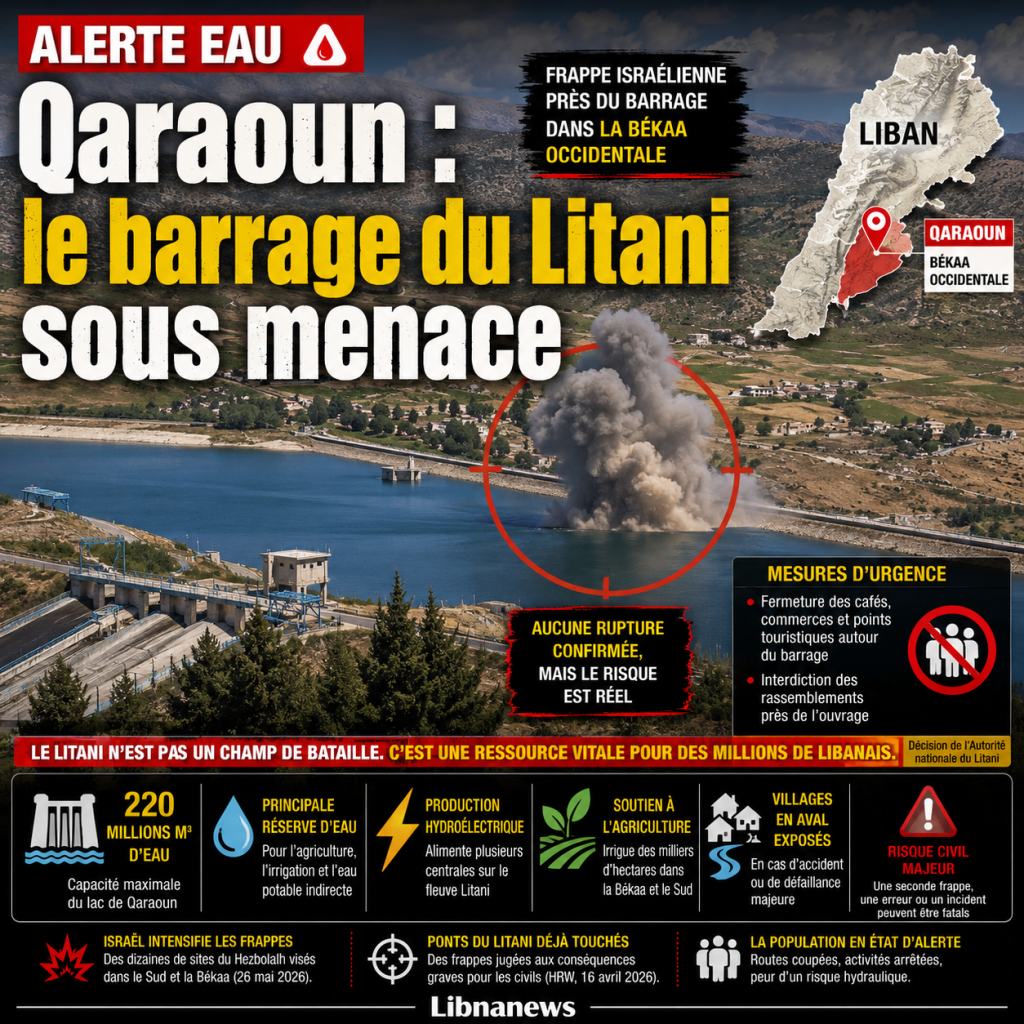
The Israeli bombardment reported in the perimeter of the Qaraoun dam and lake places Lebanon at a risk that military communiqués do not summarize. It is not a cut-off road, a destroyed house or a targeted vehicle. It is a structure that holds water from the Litani River, supplies hydroelectric facilities, is used for irrigation and dominates entire localities downstream. The Litani National Authority has already requested emergency measures around the dam after targeting in its environment. No public information at this stage confirms a major structural failure or damage to the dam. But the Israeli strike was sufficient to recall that a war waged near a hold of 220 million cubic metres can never be treated as an ordinary episode.
Qaraoun, a high-risk Israeli strike
In Western Bekaa, Qaraoun is not a simple name on a map. The lake is visible from a distance between villages, agricultural land and secondary roads. Cafes and relaxation points run along its borders. Families, workers and technicians are involved. When the war reached that perimeter, the population no longer looked only at the sky to see if a drone was approaching. She also looks at water, dikes, exit roads and authorities’ instructions. Fear changes in nature. It’s not just the explosion anymore. It includes the question of what might follow.
The reaction of the Litani National Authority shows that concern is taken seriously. After the recent targeting around the dam, she asked the governor of La Békaa to close the cafes, shops, institutions and tourist points located within the perimeter. She also called to prevent human gatherings near the work. This decision is not an administrative formality. It aims to keep civilians away from a site where a second strike, a targeting error or flashes could turn a crossing area into a trap.
This measure also says something else. The Litani officials consider that the protection of the dam is now a matter of immediate public safety. They are not just talking about technical equipment. They talk about a strategic infrastructure for national water. In a country already hit by power cuts, the economic crisis, river pollution and population displacement, exposing Qaraoun to war amounts to touching a point of collective vulnerability.
Israel Expands War Around Litani
The Israeli strike comes in a climate of general intensification. Israel claims to have targeted dozens of Hezbollah sites in the South and Bekaa in recent hours. Benyamin Netanyahu announced that he wanted to increase military pressure against the Shiite movement. The Israeli army presents its operations as strikes against depots, command centres, means of observation or positions used to attack northern Israel. But the Lebanese terrain shows a larger reality: strikes are approaching bridges, roads, hydraulic infrastructure and inhabited areas.
Qaraoun is thus found at the intersection of two logics. For Israel, the Litani is a military line, linked to Hezbollah, its movements and the security of the northern border. For Lebanon, Litani is a national resource. It crosses the country, irrigates land, generates electricity and forms part of the agricultural economy. This divergence makes every strike near the river more explosive. The same place can be seen by an army as an axis of war and by a population as a condition of survival.
A dam, villages and millions of cubic metres
The site’s danger lies primarily in its function. The Qaraoun dam is the largest in Lebanon by its capacity. It forms the largest artificial lake in the country. Its hold can reach about 220 million cubic metres. The structure is approximately 60 metres high and is one of the essential assets of the National Litani Authority. It provides water for agriculture and supplies a hydroelectric system that remains valuable, even if it is not enough to solve the national electricity crisis.
These figures give the measure of risk. A dam is not just a concrete wall or a rock. It’s a system. It includes valves, galleries, pipes, electrical equipment, road accesses, control instruments and monitoring teams. A strike near the site may not break through the structure, but it may prevent access by engineers, damage a road, cause a fire, cut power, or make a maintenance intervention dangerous. In a war, these indirect effects count as much as the point of impact.
For villages located downstream, concern is immediate. The authorities have not announced a risk of rupture. Nor did they call for a massive evacuation linked to the dam structure. But the public knows that an accident on a restraint of this size would have rapid consequences. The inhabitants therefore ask for simple information: has the dam been inspected? Do the valves work? Are the accesses clear? Have the municipalities received any instructions? In a crisis, silence often feeds more fear than the facts.
The urgent need for a clear word
The situation requires clear public communication. It is not enough to say that the site is being monitored. What has been affected, what has not been affected, what remains to be verified and which areas must remain closed. Rumors circulate quickly, especially when people hear explosions near a lake they have known since childhood. A technical, regular and understandable word becomes part of the security response. It avoids panicked departures, crowds and false alarms.
The previous bridge on the Litani reinforces fears. In recent weeks, Israeli strikes have targeted or damaged important passages on the river. Human rights organizations have found that some of these attacks can have serious consequences for civilians, as they isolate entire areas and complicate the delivery of aid. Israel argued that the bridges were used for military purposes by Hezbollah. But even when a work has mixed use, the question of proportionality remains central.
With Qaraoun, this issue becomes even more sensitive. A destroyed bridge cuts a road. A threatened dam poses a risk to water, electricity, agriculture and the safety of entire communities. Humanitarian law provides special protection for the property essential for the survival of the civilian population. Water installations fall into this category when they condition access to water or the prevention of a danger. Therefore, a strike near the lake cannot be evaluated solely through the military prism.
Environmental and economic risk
The environmental dimension adds an additional alert. Lake Qaraoun has been suffering for years from pollution, wastewater, industrial discharges and agricultural pressures. Clean-up campaigns and control operations attempt to limit damage. War complicates this work. Debris, fires, oil leaks, closed roads and the impossibility of access to some banks can aggravate an already fragile situation. Again, the damage is not only measured on the day of the strike. They may appear in water quality, agricultural season or public health.
The economic impact can also be rapid. Farmers depend on irrigation networks linked to Litani. Municipalities live in services, small activities around the lake and crops fed by available water. Strikes reduce movement, close establishments, block workers and disrupt maintenance work. Every day of uncertainty costs money to families who already have little margin. The war then affects income before even touching the house directly.
In nearby villages, fear is also social. The inhabitants know that they are not all equal in the face of an alert. Families with cars can leave faster. Older persons, the sick and poor households remain at greater risk. Municipalities, often short of means, must respond to calls, coordinate relief, reassure and check the condition of roads. A strike near Qaraoun therefore requires local authorities to manage both a military risk, a hydraulic risk and a risk of panic.
Israel’s responsibility at the centre of the case
The Lebanese government cannot treat this episode as a secondary issue. It shall request a full technical assessment of the dam and associated facilities. It must make the essential conclusions public, without waiting for rumours to occupy space. He must also refer the case to international mediators for recognition of the Qaraoun perimeter as a strictly protected area. The war against Hezbollah cannot justify endangering an infrastructure that engages thousands of civilians.
Israel’s responsibility is at the centre of the case. Even though the army claims to be targeting Hezbollah, it knows that Qaraoun is not an empty area. She also knows that the dam and the lake have a major civil function. The choice to strike within this perimeter therefore creates a foreseeable risk. The question is not just whether the dam concrete has been affected. She wondered why a military operation was being conducted close enough to a vital structure so that the Litani authority would have to ask for the closure of places frequented by civilians.
Hezbollah is also a part of the security environment. The movement uses the geography of the South, Bekaa and Litani in its face-to-face with Israel. His drone, rocket and artillery fire fueled the Israeli response and kept the population in a war without a clear end. But this does not reduce Israel’s obligation to distinguish military targets from civilian infrastructure. Nor does it reduce the responsibility of the Lebanese State to protect its strategic structures and keep the inhabitants informed.
A truce that moves away from the ground
The Qaraoun case shows above all that the announced truce in Lebanon is moving away from the daily lives of the population. On paper, discussions should help consolidate a ceasefire, address Israeli withdrawal, Hezbollah disarmament and security in northern Israel. On the ground, the strikes reach the Bekaa, the South and near the Litani. The inhabitants do not judge the truce to be the duration of the press releases. They consider it to be the noise of drones, the opening of roads, the operation of hospitals and the safety of infrastructure.
Regional risk is not absent. Lebanon is already caught in an equation that goes beyond its borders. Iran wants any agreement with the United States to include stopping Israeli attacks in Lebanon. Israel wants to maintain its freedom of action against Hezbollah. The United States seeks to maintain regional negotiations while supporting Israeli security. In this context, a strike near a dam can become a diplomatic argument, a political symbol and a reason for verbal escalation.
Qaraoun thus gives the conflict a simple and fearsome image: that of a country whose vital points are within reach of a missile. The lake is not a distant theater. It is linked to taps, fields, turbines and village security. By targeting the perimeter of the dam, Israel brought water into the language of war. Even without rupture, even without immediate disaster, the psychological threshold is crossed. An infrastructure that should remain outside the military field is under emergency surveillance.
This confidence is all the more fragile as the site had already been placed under technical supervision before the current escalation. The Litani Authority announced in February an underwater inspection of sensitive points of the dam and claimed that the observations made did not indicate any structural danger. This information reassures us about the previous condition of the work. On the other hand, it is not sufficient to avoid the new risks created by strikes and the possible impossibility of responding quickly to incidents.
The next few hours will have to provide precise answers. The Litani Authority will have to state whether new inspections have been carried out and whether the work remains fully safe. Local authorities will have to maintain the restrictions around the site as long as the risk of further strikes persists. The government will have to ask the mediators to put dams, water stations, essential bridges and irrigation networks out of any targeting logic. Around the lake of Qaraoun, war no longer threatens only armed positions. It threatens the minimum confidence that allows a population to live under a dam without fear of the sky.




