

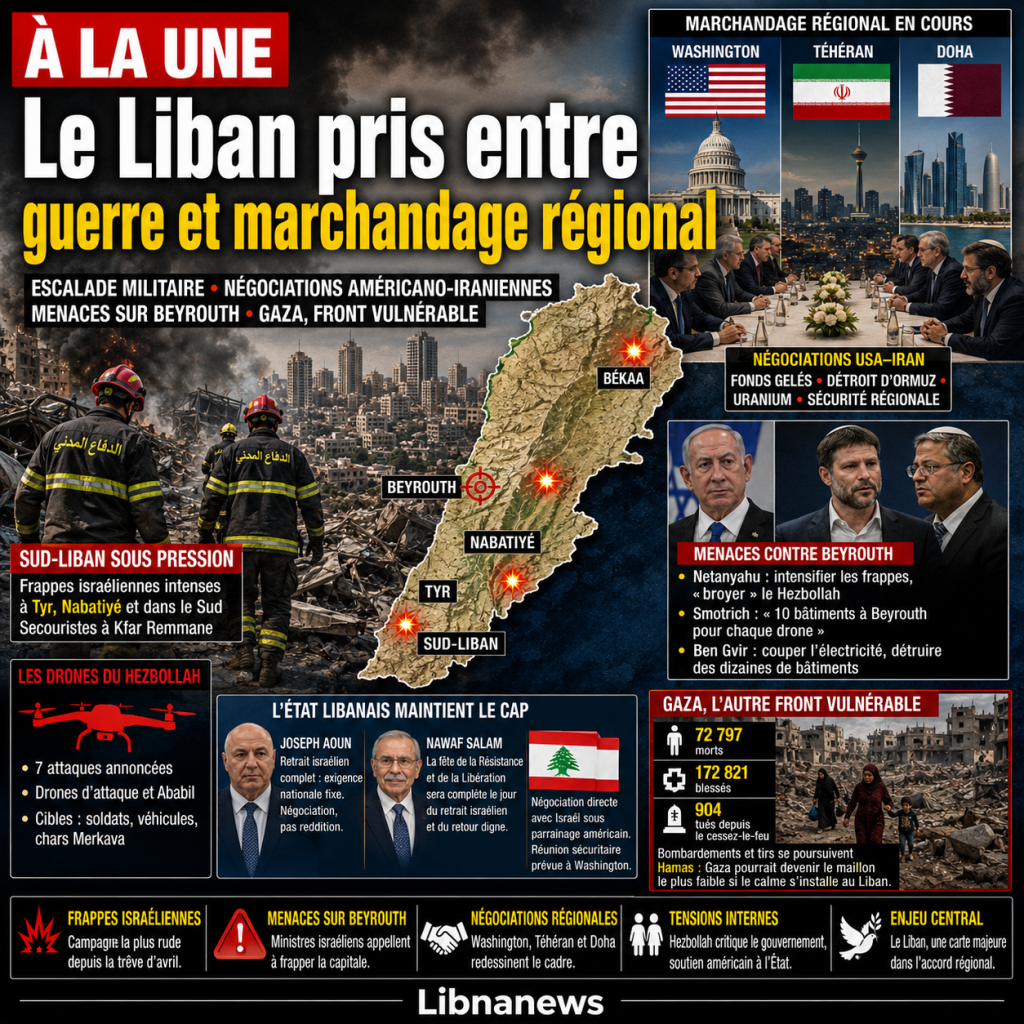
South Lebanon under pressure, Beirut again threatened
In its edition of 26 May 2026,Annaharplaces Lebanese tension at the forefront of the news. The first aid and fire watch in Kfar Remmane, Nabatiyah district, after an Israeli strike. The main title emphasizes the escalation of Hezbollah and the Israeli threats against the southern suburbs of Beirut. The newspaper therefore presents the day as a turning point. The South is no longer just a wear front. It becomes the starting point for a wider risk, which can affect Beirut and the Bekaa.Annahar26 May 2026, writes that the effects of an agreement not yet concluded between the United States and Iran are already having an impact on Lebanon. According to the newspaper, Hezbollah seems to rely on expected Iranian gains, while Israel threatens to return to a denser war after the fall of Hezbollah drones in northern Israel.
This reading is reinforced byAl Sharq Al Awsatwho wrote on 26 May 2026 that the Israeli army had carried out its most brutal campaign against Lebanon since the April truce. The newspaper states that the strikes targeted mainly Tyre and Nabatiyah. He added that Israeli Prime Minister Benjamin Netanyahu had asked his army to step up attacks on Lebanon, promising to « crush » Hezbollah. At the same time, two far-right Israeli ministers, Bezall Smotrich and Itamar Ben Gvir, called for attacks on Beirut in response to Hezbollah drones.Al Sharq Al AwsatOn 26 May 2026, Smotrich also reported that he had requested the destruction of ten buildings in Beirut for each drone launched north of Israel.
The threat is therefore not limited to military language. It affects civil infrastructure and the capital.Al Quds Al Arabion 26 May 2026, reports that Ben Gvir and Smotrich called for cutting electricity in Lebanon and destroying dozens of buildings in Beirut. The newspaper links these calls to Hezbollah’s use of drones. He also writes that Hezbollah claims to respond to the daily Israeli violations of the ceasefire agreement announced on 17 April and extended until early July. Thus, the battle of narratives accompanies the strikes. Israel speaks of a response to drones. Hezbollah speaks of a response to violations and attacks against villages in the South.
Hezbollah drones change Israeli alert level
In its edition of 26 May 2026,Al Quds Al Arabidetails the military impact of this sequence. The newspaper reports that Hizbullah announced seven attacks against Israeli vehicles and soldiers in several locations in southern Lebanon. According to the press releases of the party, these operations targeted gatherings of soldiers and vehicles in Quuzah, Rhaf and a new military site in Bint Jbeil. The newspaper also reports that Hizbullah used drones to attack Israeli soldiers near Aadayse and an Israeli artillery position. It also refers to the attack of two Merkava tanks in Debel.
This is important because it explains the harshness of Israeli reactions.Al Sharq Al Awsat26 May 2026, writes that Hezbollah announces daily attacks against Israeli soldiers by suicide drones. The newspaper adds that the party launched Ababil-type drones into Israeli depth. Israeli media reported explosions in Western Galilee and Upper Galilee. According to the same source, the Israeli army issued evacuation notices targeting more than 15 localities, including Tyre and the Palestinian camp in Rachidiyah, south of Tyre. According to the newspaper, this is the first such alert for this camp since the beginning of the war.
This geographical extension gives a more severe tone to the day. War is no longer described as a succession of limited strikes. It takes the form of a confrontation with several thresholds. There’s the southern threshold, already ravaged. There is the Beirut threshold, again mentioned by Israeli officials. There is also the threshold of the Bekaa, thatAnnahar26 May 2026, presented as an area now observed with concern following the intensification of Israeli strikes outside the South. The newspaper discusses questions about a possible new Israeli phase, especially in areas where Hezbollah has influence and an enabling environment.
Lebanese state defends negotiation against war logic
Faced with this increase in risk, the newspapers give a central place to the Lebanese official position.AnnaharOn 26 May 2026, President Joseph Aoun said that the road to complete Israeli withdrawal would remain a fixed national requirement. He added that the State was working towards that goal through the choice of negotiation, which would not be a concession or surrender. This formula installs a clear official line. Lebanon does not recognize the Israeli fait accompli. But it places the answer within the framework of the state, the army and political channels.
Al Quds Al Arabion 26 May 2026, resumed a close position. The newspaper reports that Joseph Aoun considers full Israeli withdrawal as a non-negotiable national requirement. The negotiations must confirm Lebanon’s exclusive right to defend its land, sovereignty and the authority of its State through its legitimate army and security forces. This wording directly contrasts two ways. The first is Hezbollah, based on the continuation of confrontation. The second is power, based on the institution’s assumption of sovereignty.
In the same vein,Al Sharq Al Awsaton 26 May 2026, writes that Prime Minister Nawaf Salam called for the Day of Resistance and Liberation to be a day of solidarity with the families of the killed, the wounded, the prisoners, the displaced and the inhabitants of the South. He adds that the festival will only really be found on the day of the complete Israeli withdrawal and the safe and dignified return of the inhabitants. The newspaper also points out that the state is taking the path of direct negotiation with Israel under American sponsorship, with a security meeting planned in Washington.
This contrast nourishes internal tension.Al Quds Al Arabion 26 May 2026, reports that Naim Kassem accused the government of failing to face Israel and spoke of the right of the people to go down the street to bring down the government. The newspaper then quotes the reaction of US Secretary of State Marco Rubio, according to which Naim Kassem’s comments show that Hezbollah is trying to bring Lebanon back to chaos and destruction. This American response gives an international dimension to the Lebanese debate. It places the government in a camp supported by Washington and Hezbollah in a more isolated position.
Washington, Tehran and Doha redesign regional framework
The Lebanese case cannot be separated from the negotiations between Washington and Tehran.Al 3arabi Al JadidOn 26 May 2026, Donald Trump established a link between the agreement with Iran and the expansion of the Abraham agreements. The newspaper writes that Trump asks Saudi Arabia, Qatar and other countries to join these agreements, otherwise they would not be part of the deal with Iran. The same newspaper states that Mohammad Baqer Qalibaf, Abbas Araghchi and the governor of the Iranian Central Bank are in Doha to discuss details of the memorandum of understanding, including frozen assets, the Strait of Ormuz and highly enriched uranium.
In its edition of 26 May 2026,Al Quds Al Arabiconfirms that the visit of Qalibaf and Araghchi to Doha placed mediation between Washington and Tehran at the centre of news. The newspaper notes that discussions are about a possible agreement with the United States to end a three-month war. He adds that the Iranian Central Bank Governor’s presence is intended to discuss the release of Iranian funds frozen by American decision. The file is therefore not only military. It is also financial, energy and diplomatic.
Annahar26 May 2026, gives a political reading of the Trump method. The newspaper writes that the US President is trying to use the time of negotiation with Iran to produce a large transaction that goes beyond the end of the war. This transaction would give Washington an opportunity to restore its regional influence after months of military tension in the Gulf and around the Strait of Ormuz.Annahartrump suggested that countries refusing to join Abraham’s accords might show bad intentions.
In this context, Lebanon appears to be a ground of consequence.Al 3arabi Al Jadid26 May 2026, writes that Israel’s choices are difficult. If Israel wants to retain its freedom of action in Lebanon in any ceasefire agreement, it risks upsetting Donald Trump, who wants to close the war with Iran as soon as possible. If it accepts that the agreement includes Lebanon, this may mean a step backwards from the declared objective of dismantling Hezbollah. The newspaper therefore presents Lebanon as a sensitive element of regional negotiations, even when the official centre of discussions remains Iran.
Gaza remains the other vulnerable front
The regional one of 26 May 2026 is not limited to Lebanon. Gaza remains the largest humanitarian front.Al 3arabi Al Jadid26 May 2026, reports the continuation of Israeli attacks in the Gaza Strip. The newspaper writes that a camp of internally displaced persons west of Khan Yunes was targeted, killing a Palestinian woman and a child, and wounding several. He also cites medical sources according to which there were 72,797 deaths and 172,821 injuries since 7 October 2023.
Al Quds Al Arabion 26 May 2026, gives additional figures on the violations of the ceasefire in Gaza. The newspaper reports that since the entry into force of the agreement, 904 Palestinians have been killed, 2,713 have been injured and 777 bodies have been removed from the rubble. He adds that shooting, bombing and attacks continue in several areas, including Khan Yunes, Maghazi camp, eastern Gaza and the coast. The same source cites the organization Al Dameer, which accuses Israeli forces of continuing systematic violations against civilians despite the announcement of the ceasefire.
Finally,Al Sharq Al Awsat26 May 2026, reports that Hamas sources do not expect Gaza to be included in the future agreement between the United States and Iran. According to a source living in Gaza, the territory could become the weakest link if calm stabilizes in Lebanon. This source believes that Israel could then increase pressure on Gaza. This hypothesis gives a dark consistency to the day. Lebanon is under threat of an extension of the war. Gaza remains under siege and under strike. And the regional agreement under discussion can redistribute risks rather than reduce them.
Local policy: the Lebanese State facing the challenge of arms and sovereignty
A festival of liberation without a feeling of victory
In its edition of 26 May 2026,Al Sharq Al Awsatdescribes a Lebanese political scene dominated by a paradox. Lebanon commemorates the twenty-sixth anniversary of the liberation of the South in 2000. However, this date does not take the form of a full celebration. The newspaper writes that Israel again occupies about forty-two southern localities and villages. He adds that a cordon of fire pushed the inhabitants of about twenty villages to leave almost completely. The national symbol thus becomes a reminder of fragility. The memory of liberation encounters a reality of war, displacement and incomplete sovereignty. This contradiction weighs on power. It obliges President Joseph Aoun, Prime Minister Nawaf Salam and the Speaker of the House Nabih Berri to speak about unity, the return of the inhabitants and the restoration of state authority, rather than to be limited to the usual language of the national holiday.
In this context, Joseph Aoun sets an institutional line.Al Sharq Al Awsat26 May 2026, reports that the President states that there will be no waiver of the Israeli withdrawal requirement. It states that the State is working towards this goal through the choice of negotiation. This choice is presented as a necessary path, not as a concession. The President added that the liberation of the South was a duty assumed by the State with the support of its citizens. The subject is aimed at two audiences. It is addressed first to the people of the South, who are waiting for real protection. It also addresses the political forces that are challenging the diplomatic path, especially Hezbollah, whose Secretary-General Naim Kassem accused the state of impotence. The Presidency therefore seeks to use the vocabulary of sovereignty. It asserts that the defence of the Territory can no longer be separated from the legitimate institutions, army and security forces.
Prime Minister Nawaf Salam adopts a complementary tone.Al Sharq Al Awsat26 May 2026, quotes his message published on the occasion of the Feast of Resistance and Liberation. It calls for this day to be a moment of solidarity with the families of the killed, the wounded, the prisoners, the displaced and the inhabitants of border villages. He claims that the festival can only be fully recovered after Israel’s complete withdrawal and the return of the people in safety and dignity. The formula is sober, but it is politically heavy. It avoids excitement. It brings the date back to the human cost of war. It also sets the government’s action in a logic of protecting civilians. Nawaf Salam does not deny the historical value of liberation. However, he refused to make it a slogan detached from the present situation. The message therefore puts the State before a concrete obligation. It must obtain withdrawal, restore security and allow families to return.
Naim Kassem’s speech opens a political crisis
The main political shock comes from Naim Kassem’s speech.Al Quds Al Arabion 26 May 2026, reports that the Hizbullah Secretary General accused the government of failing in defending the country against Israel. He claimed that the people had the right to go down the street to bring down the government. He added that if the government was unable to impose sovereignty, it had to leave. These comments change the level of the debate. They are not just about military strategy. They seek the very legitimacy of the firm. They intervene at a time when the issue of the limitation of arms to the State is at the centre of public decisions. The newspaper points out that this statement cannot pass as an ordinary sentence, especially in a time when a draft understanding between Washington and Tehran is being prepared, with a possible part on the cessation of the war in Lebanon.
Annaharon 26 May 2026, gives this exit a wider reach. The newspaper writes that Naim Kassem’s threats to kill the government in the street opened up a new political reality. According to the newspaper, this sequence provoked an immediate response from US Secretary of State Marco Rubio, who warned that the time when Hezbollah could turn Lebanon into a hostage was coming to an end.Annaharhe added that the Lebanese Government enjoyed the full support of the United States. This external reaction weighs on the internal scene. It gives the government international support, but it also increases polarization. Hezbollah can denounce American guardianship. On the contrary, its opponents can present this answer as proof that the state is no longer alone against the party. The local debate thus becomes a direct extension of the regional confrontation.
The Sunni religious reaction also takes a prominent place.Annaharon 26 May 2026, writes that the Mufti of the Republic, Abdel Latif Derian, responded directly to the threats of Naim Kassem. The newspaper points out that he strongly defended the choice of state and negotiations. He has also implicitly but firmly criticized Hezbollah’s policies. This position is important because it leaves the debate out of the partisan realm alone. It gives institutional and religious support to the government line. It also strengthens Nawaf Salam, whose action depends on his ability to hold together the defence of sovereignty, internal stability and the refusal of civil confrontation. In a country where community balance remains crucial, the support of the mufti to the state option adds political pressure on Hezbollah. He points out that the threat of the street is not received as a mere mobilization posture. It is seen as a risk to civil peace and institutions.
Hezbollah weapons at the heart of the internal power relationship
The issue of Hezbollah’s armament structure the entire sequence.Al Quds Al Arabi26 May 2026, reports that Naim Kassem ‘ s comments are read on two tracks by Lebanese sources. The first would be a threat to the executive if it continued to implement the agenda related to the withdrawal of the party’s weapons. The second would be a conditional provision to surrender weapons when the state is able to defend the South. This reading shows the political node of the moment. Hezbollah does not only deny the calendar that its opponents want. He also challenged the very definition of national defence. For him, the State is not yet in a position to protect the territory. For its opponents, this reasoning keeps the state in an endless weakness, since the presence of a parallel armed force prevents the full restoration of its authority.
In its edition of 26 May 2026,Al Sharq Al Awsatquoted MP Mark Daou, who believes that the concept of deterrence attributed to Hezbollah weapons has never really existed in the form promoted in years. It distinguishes the period of resistance, linked to the Israeli occupation and the withdrawal of 2000, from the period opened after 2005. According to him, after the Syrian withdrawal, the Iranian influence gradually imposed itself on the Lebanese state through political and security steps. He referred in particular to the period following the assassination of Rafic Hariri, followed by the 2006 war and the long-term opening of the front with Israel. This analysis serves as a central argument. Weapons would no longer be a tool for national liberation, but a factor of political control. The border between resistance and internal domination then becomes the heart of the Lebanese debate.
The same articleAl Sharq Al AwsatOn 26 May 2026, Mark Daou, who states that the essential transformation between 2000 and 2026 is the transfer of weapons from the status of resistance to that of tool into the hands of Iran. According to him, these weapons have become a permanent pretext for Israel and a factor blocking the Lebanese state. The newspaper also quotes political journalist Ali Al Amine, for whom the deterrent formula promoted by Hezbollah is more of a built concept than a real system. He claims that the recent war and developments since 2023 have revealed a gap between the narrative defended by Hezbollah and the reality of power relations. These opinions are not neutral. They belong to a critical party camp. But they show the progress of a political discourse that seeks to remove weapons from their national legitimacy and present them as a danger to Lebanese society.
Negotiation becomes a test for state authority
The line defended by Joseph Aoun rests on a bet. The negotiations must allow Israeli withdrawal while avoiding a wider war.Al Quds Al ArabiOn 26 May 2026, the President quoted the Israeli withdrawal as a fixed and non-negotiable national requirement. He added that the Lebanese State was working towards that goal through the talks, which were neither concession nor surrender. The President insists on Lebanon’s exclusive right to protect its land, sovereignty and authority by the army and legitimate security forces. He also claims that the army remains the only guarantor of national security and territorial integrity. This vocabulary responds directly to Hezbollah. He doesn’t deny the past of resistance. He placed him in an institutional suite. According to this logic, fidelity to liberation no longer depends on the proliferation of weapons, but on the construction of a strong State.
AnnaharOn 26 May 2026, however, this route was difficult. The newspaper admits that Naim Kassem can have some reason when he criticizes Israeli behavior in the negotiation process. It notes that Israel has not yet given sufficient good faith signals. He adds that the government can give the impression of running around without getting any visible gains. But the paper draws a clear limit. He claims that Naim Kassem has no right to turn against the State, to regain control of public decisions or to confiscate decision-making power as in the past. The text also accuses the Secretary-General of Hezbollah of having introduced Lebanon into the wars of others and of having made it an arena of settlement of regional accounts. This analysis reflects a major political concern. The government needs results to justify the negotiation. Without results, Hezbollah can exploit the impatience of the South. But the threat of the street further weakens the state framework.
American pressure adds to this equation.Al Sharq Al Awsat26 May 2026 published an analysis according to which the challenges go beyond the issue of weapons alone. The problem also affects a state structure with deep obstacles that block the execution of government decisions and reveal the persistence of Hezbollah’s influence within institutions. The article also refers to American sanctions, which included two senior officers on duty. According to this reading, this is a political and security signal designed to remove obstacles to the implementation of Council of Ministers decisions. This is a sensitive point. He places the Lebanese institutions under a stricter external look. It also shows that the credibility of the Lebanese negotiator depends on his ability to enforce the decisions of his own Government.
Nabih Berri and the search for minimum cohesion
In this climate, Nabih Berri tries to maintain a balanced discourse.Al Quds Al ArabiOn May 26, 2026, the Speaker of the House was placed as part of the commemoration of liberation. The newspaper states that it focuses on the common capacity of Lebanese to liberate and rebuild the country. He also calls for freedom from hatred. This register contrasts with the harsher terms used by Naim Kassem and Hezbollah’s opponents. Nabih Berri seeks to preserve a margin of mediation. It remains close to the political environment of resistance, but it is also one of the institutional hubs of the system. Its role is therefore to prevent the conflict on arms and the negotiation from turning into a complete break between the institutions and the Hezbollah camp.
The local political scene thus appears to be caught between three requirements. The first is military and territorial. It requires Israeli withdrawal, the protection of southern villages and the return of the inhabitants. The second is institutional. It requires that government decisions not be suspended by the threat of the street or by an armed force outside state control. The third is social. It requires avoiding an internal divide while the country remains weakened by the war, displacement and economic effects of the conflict.Al Quds Al Arabi26 May 2026, reports that Joseph Aoun also exchanged with King Abdullah II of Jordan, who reaffirmed his country ‘ s support for Lebanon ‘ s efforts to restore security, stability and sovereignty over its entire territory. This Arab dimension gives additional support to the presidential line. It confirms that Lebanese sovereignty has once again become a regional issue, but it also shows that the State will only be able to transform this support into a result if it retains minimum cohesion within it.
Quote and speech by political figures: Lebanese sovereignty, threat of war and regional bargaining
Joseph Aoun places negotiation at the centre of sovereignty
In its edition of 26 May 2026,Al Quds Al Arabireports a speech by Joseph Aoun built around a central idea: complete Israeli withdrawal remains a fixed national objective. The President said that Lebanon could not accept the return of the occupation to the South. He describes negotiation as a tool of sovereignty, not a form of weakness. According to the wording cited by the newspaper, this choice is neither concession nor surrender. Instead, it confirms Lebanon’s exclusive right to protect its land, sovereignty and authority through its legitimate army and security forces. The Head of State therefore links the memory of the liberation of 2000 to one present demand: to rebuild a public authority capable of speaking on behalf of all Lebanese.
In the same statement, Joseph Aoun stressed the role of the army.Al Quds Al ArabiOn 26 May 2026, the president quoted the military as the only guarantor of national security and territorial integrity. This sentence directly refers to the debate on Hezbollah’s weapons. It does not only appoint an institution. It marks a border between the state and the partisan armed forces. It also refers to a broader collective memory. Joseph Aoun claims that those who have liberated the South by blood, soldiers, resistors and citizens deserve a strong State, united by its civil and military institutions. This rhetoric makes it possible not to deny the past of resistance, while seeking to integrate it into a state framework. The President thus avoids the symbolic rupture with the memory of the South, but he refuses that this memory serves as a justification for shared or fragmented sovereignty.
AnnaharOn 26 May 2026, the same sentence was retained as a major political landmark. The newspaper points out that Joseph Aoun considers the Israeli withdrawal as a constant national demand, without possible renunciation, and that the State wants to obtain it through negotiation. The context makes this formula stronger. The South is hit. Localities are displaced. Israel threatens Beirut. And Hezbollah affirms its right to maintain its weapons. The presidential speech therefore tries to replace the logic of armed response with that of legitimate authority. He speaks to the internal opinion, but also to the foreign sponsors of the negotiations. He told them that official Lebanon wanted a total withdrawal, while keeping its public decision under control.
Nawaf Salam turns the festival into a day of solidarity
Prime Minister Nawaf Salam adopts a more social and soberer speech.Al Sharq Al Awsat26 May 2026, reports his message published for the Feast of Resistance and Liberation. It calls for this day to be a moment of solidarity with the families of the killed, the wounded, the prisoners, the displaced and the inhabitants of the South. He adds that the festival can only be truly found after the complete Israeli withdrawal and the return of the inhabitants in safety and dignity. This formula avoids any triumphal celebration. It puts the date in the present pain of border villages. It turns a political symbol into a reminder of the duty of protection.
Al Quds Al Arabi, 26 May 2026, echoes the same message from Nawaf Salam and shows that he is part of a tense sequence. The newspaper recalls that the Prime Minister’s speech comes after the words of Naim Kassem on the right to go down the street to demand the fall of the government. In this context, Nawaf Salam’s speech does not respond with a frontal attack. It opposes Hezbollah’s mobilization vocabulary with a language of national cohesion. The head of government refuses to make the party an auction site. He talks about the dead, the wounded, the prisoners and the displaced. It places civilians in the centre. This approach also broadens the debate. The question is not just who resisted. It is about who can guarantee the return of the inhabitants and the sustainable security of the South.
The Nawaf Salam formula is also institutional in scope. By saying that the festival will only be found after the complete withdrawal and the return worthy of the inhabitants, he sets a criterion of result. It is not enough to invoke liberation. It must be made real in the villages. Families have to come back. Roads, houses and services must be restored. This speech avoids heavy words, but it puts concrete pressure on the government. The latter will have to prove that the negotiation has effects. Otherwise, Hezbollah will be able to present its own discourse as more direct and effective. The Prime Minister’s sentence is therefore prudent, but it is not neutral. It defends sovereignty measured by the protection of the inhabitants, not by the ability alone to threaten Israel.
Naim Kassem hardens the tone against the government
The most conflicting discourse is that of Naim Kassem.Annaharon 26 May 2026, reports that the Secretary General of Hezbollah accuses the state of being a tool of the Israeli-American project. The daily also cites its rejection of the handing over of arms. According to the wording reported, Naim Kassem claims that disarmament would amount to extermination and that he cannot accept it. He adds that resistance will defend the earth, the people and honor, and that anyone who confronts him alongside Israel will be confronted like Israel. The declaration transforms the debate on weapons into an existential debate. She’s not just talking about defense. It places Hezbollah’s internal opponents in an area of political and national suspicion.
In its edition of 26 May 2026,Annaharconsiders that these statements threaten the State entity and weaken its positions within and outside the State. The newspaper reads Naim Kassem’s formula as a direct pressure on Lebanese partners. Hezbollah’s Secretary General claims that his weapons will remain in his hands until the State is able to assume its duty in a clear, programmed and measurable national strategy. This condition defers any surrender of weapons to an undefined stage. It gives Hezbollah the power to judge itself if the state is ready. It therefore reinforces the central disagreement. For the party, the state cannot demand the arms monopoly until it has proved its ability. For its opponents, this logic prevents the state from becoming capable.
Al Quds Al Arabi26 May 2026, reports another sentence by Naim Kassem, more directly shot against the firm. He claims that the people have the right to go down the street and bring down the government. He added that if the government was unable to impose sovereignty, it must leave. This declaration opens a political crisis because it goes beyond military debate. She questions the legitimacy of Nawaf Salam and her team. It also comes at a time when Washington and Tehran are discussing a possible regional agreement. The words of Naim Kassem seem to be twofold. She talks to the Hezbollah public, worried about a negotiation that could limit her weapons. It also warns the power that any decision on sovereignty will have an internal cost.
Marco Rubio supports the government and targets Hezbollah
Marco Rubio’s response gives an international dimension to the crisis.Al Quds Al Arabi26 May 2026, reports that US Secretary of State Naim Kassem harshly criticizes after his remarks on the right of the Lebanese people to rise up against the government. According to the newspaper, Marco Rubio believes that these statements show that Hezbollah is trying to bring Lebanon back to chaos and destruction. This is a brief formula, but it places Washington in the Lebanese government camp. It describes the street threat not as an ordinary political practice, but as a risk of destabilization.
AnnaharOn 26 May 2026, this American reaction was extended. The newspaper writes that Marco Rubio warned Hezbollah that the time when the party could turn Lebanon into a hostage was approaching its end. He added that the Lebanese Government enjoyed the full support of the United States. This sentence has a double effect. It strengthens Nawaf Salam and Joseph Aoun in the face of Hezbollah pressure. But it can also feed the party’s argument, which accuses its opponents of joining an American project. The American word therefore supports the state, while risking tightening internal polarization. It confirms above all that the Lebanese question is no longer only Lebanese. It is now integrated into American calculations of Iran, regional weapons and stability on Israel’s northern front.
Marco Rubio also intervenes on the Iranian issue.Al Quds Al Arabi26 May 2026, reports that he claims that a nuclear decision cannot be taken in a few days on the basis of a provisional plan. He said that the straits must first be reopened, then that very serious discussions must begin on enrichment, highly enriched uranium and Iran’s commitment never to possess nuclear weapons. This statement shows the American method. Washington wants a quick agreement on regional emergencies, but postpones the heaviest nuclear points to a next step. For Lebanon, this means that the fate of the southern front may depend on a broader timetable between the United States, Iran and the mediators.
Israeli officials threaten Beirut
The Israeli words reported by the sources are among the most aggressive.Al Sharq Al Awsaton 26 May 2026, writes that Benjamin Netanyahu asked the Israeli army to intensify the strikes against Lebanon, promising to crush Hezbollah. The newspaper also reports that Bezalel Smotrich and Itamar Ben Gvir called for the targeting of Beirut in response to Hezbollah drones. Ben Gvir asks to cut electricity in Lebanon, to take over the Zahrani River and resume intense fighting. Smotrich, for his part, demands the destruction of ten buildings in Beirut for each drone launched north of Israel.
These statements give the crisis a threat dimension to civilians and infrastructure. They are not limited to Hezbollah’s military positions. They evoke electricity, Beirut and massive destruction.Al 3arabi Al Jadid, 26 May 2026, also reports Smotrich’s proposal and notes that Netanyahu did not mechanically validate this logic. According to the newspaper, the Israeli Prime Minister reportedly asked him whether ten buildings should be destroyed with each drone launched, regardless of the front concerned. This response does not mean strategic moderation. Rather, it shows that the Israeli debate is about the level of response and its usefulness. Lebanon therefore remains exposed to a heavy threat, even when Israeli leaders diverge in the form of punishment.
Donald Trump connects Iran to regional agreements
Donald Trump’s speech further expands the framework.Al 3arabi Al Jadid26 May 2026, reports that the U.S. President urged states to sign the Abraham Accords. He claims that if Iran signs his agreement with him, it would be an honour for these States to be part of a new regional gathering. It also calls on its representatives to start and successfully conclude the process of signature by the countries concerned. The tone reported by the newspaper is imperative. This is not just a diplomatic invitation. This is an attempt to link the settlement with Iran to a regional political reorganization favourable to Israel.
Annaharon 26 May 2026, analyses this exit as an attempt to produce a large transaction that goes beyond the cessation of the war. The newspaper writes that Donald Trump is seeking to use negotiations with Iran to restore American influence in the region after months of tension in the Gulf and around the Strait of Ormuz. He also notes Trump’s suggestion that countries refusing to join Abraham’s agreements could display bad intentions. This American word indirectly weighs on Lebanon. If the agreement with Iran serves to revive regional normalization, the place of Hezbollah, Gaza and South Lebanon will become a point of tension in the implementation of this transaction.
Diplomacy: Doha at the centre of the trade between Washington, Tehran and regional fronts
Accelerated mediation around a still fragile agreement
In its edition of 26 May 2026,Annaharpresents the diplomatic sequence as a moment of acceleration between the United States and Iran. The newspaper recalls that this is not the first time that information has announced a close agreement between Washington and Tehran, before a return to threats. But the climate described this time seems different.Annahar26 May 2026, refers to the intense displacement of Pakistani officials and the entry of Qatar into mediation. According to the newspaper, these elements gave the impression that signing a memorandum of understanding between the two parties could be a matter of hours, not days. The core of the proposal would be a two-stage division of the Rules of Procedure. First, a 60-day truce, accompanied by Iran’s reopening of the Strait of Ormuz and the lifting of the American naval blockade on Iranian ports. Secondly, negotiations on Iran’s nuclear programme.
This diplomatic architecture shows a willingness to deal with urgency before the substance of the dispute. The Strait of Ormuz becomes the first test. It is not just a sea pass. It becomes a key to de-escalation. Its reopening would signal markets, Gulf States and the powers involved in mediation. In return, the lifting of the US naval blockade would offer Tehran a first visible compensation. However, there is a risk associated with this method. She postponed the tough questions to later. Nuclear, highly enriched uranium, safeguards and long-term commitments would not be settled from the outset. So diplomacy is trying to create a security lock. But this airlock can also become a tense waiting period, if one of the parties considers that the other does not comply with the first commitments.
Al Quds Al Arabi26 May 2026, describes the same caution. The newspaper reports that the sudden visit to Doha by Mohammad Baqer Qalibaf, President of the Iranian Parliament, and Abbas Araghchi, Iranian Foreign Minister, has propelled mediation between Washington and Tehran to the forefront. The daily adds that the Iranian delegation met with Qatar’s Prime Minister and Foreign Minister, Mohammed bin Abdelrahmane Al Thani. The presence of the governor of the Iranian Central Bank, Abdelnasser Hemmati, gives another dimension to the discussions. According toAl Quds Al Arabion 26 May 2026, this part concerns the possible release of Iranian assets frozen by American decision, as part of an economic, financial and naval blockade against Iran.
Doha, Islamabad and Muscat in a mediation chain
Qatar’s role appears central, but it is not isolated.Al 3arabi Al Jadid26 May 2026, writes that attention turned to Doha with the arrival of Qalibaf, Araghchi and Hemmati. The newspaper states that discussions are based on available information on the most sensitive points of the memorandum under preparation. These are Ormuz Strait, highly enriched uranium and frozen Iranian accounts, some of which are in Qatari banks. The same article also mentions telephone contacts between Qatari and Omani officials. He reports that the emir of Qatar, Tamim ben Hamad Al Thani, received a call from the Sultan of Oman, Haitham ben Tarek, while Mohammed ben Abdelrahmane Al Thani spoke with his Omani counterpart Badr Al Busaidi.
This mediation chain gives a clear picture of regional diplomacy. Pakistan acts as an official mediator or initial engine. Qatar is becoming a possible platform for negotiation and implementation. Oman remains a useful channel, due to its experience in discreet exchanges with Iran and the United States. Thus, the regional powers seek to avoid a long war that would affect the Gulf, the energy roads and Iran’s allied fronts.Al Quds Al Arabi26 May 2026, indicates that Doha would have assumed a more visible role in the implementation arrangements for an end-of-war agreement in recent weeks. The newspaper also recalls a precedent deemed unencouraging by Iranian sources: an old agreement on assets frozen in South Korea, then transferred to Qatar, without Iran’s access to these funds being guaranteed.
This diplomatic memory weighs on trust. For Tehran, a written agreement is not enough. It must be checked that the funds can be used, that the blockade is really lifted and that the American commitments are not theoretical. Iranian Foreign Ministry spokesman Esmaeil Baghaei, quoted byAl Quds Al Arabi26 May 2026, presents the participation of countries such as Qatar, in addition to Pakistan, as a positive role that can help resolve certain issues. But the formula remains cautious. It states that mediators do not replace guarantees. They help build a mechanism. They do not suppress mistrust between Washington and Tehran.
Abraham’s Accords as an American Pressure Lever
The diplomatic surprise comes from Donald Trump.Al 3arabi Al Jadid26 May 2026, reports that the US President linked the final agreement with Iran to the expansion of the Abraham Accords. He called on Saudi Arabia and Qatar to quickly sign peace agreements with Israel, or else to be excluded from the agreement with Tehran. The newspaper quotes a long statement in which Trump claims to have spoken with Mohammed bin Salmane, Mohammed bin Zayed, Tamim ben Hamad Al Thani, Mohammed bin Abdelrahmane Al Thani, Asim Munir, Recep Tayyip Erdogan, Abdel Fattah Al Sissi, Abdallah II and Hamad bin Issa Al Khalifa. According to the account ofAl 3arabi Al JadidThe US President said that after the efforts of the United States to solve this complex problem, the countries concerned should sign the Abraham agreements at the same time.
Annaharon 26 May 2026, analyses this approach as an attempt to transform negotiations with Iran into a large regional transaction. The newspaper writes that Trump wants to go beyond the mere cessation of the war. He would seek to offer Washington an opportunity to restore his influence after months of military tension in the Gulf and around Ormuz. The same article notes that Trump suggests that countries refusing to join Abraham’s agreements could show bad intentions. This sentence changes the tone of mediation. It moves the dossier from a safety agreement to a standardisation pressure.
This approach can create resistance. It adds a heavy political condition to an already complex negotiation. Qatar acts as a mediator with Iran and has some financial leverage. Saudi Arabia remains linked to the Palestinian question. Turkey, Egypt and Jordan each have their own balances. By linking all this to Abraham’s accords, Washington is seeking wider political gain. But this method can also complicate the truce, forcing regional capitals to respond to a demand linked to Israel at a time when Gaza remains under pressure and Lebanon is being hit.
Lebanon as an indirect front of negotiations
Lebanon is not the official centre of the Doha talks. However, it appears to be one of the areas most exposed to the effects of the agreement.Al Sharq Al Awsat26 May 2026, writes that the US and Iranian negotiations are advancing cautiously as a senior Iranian official arrives in Doha to discuss a possible agreement with Washington. The newspaper states that the files on the table are Ormuz, highly enriched uranium and Iranian assets frozen. On the same page, he reports that the ceasefire in Gaza remains violated and that Hamas sources fear that Gaza will be separated from any regional agreement.
Logic can also apply to Lebanon. If the agreement between Washington and Tehran stabilizes certain lines without treating all fronts, each theatre can be subjected to a different calculation. Lebanon can benefit from relief if Iran chooses to reduce regional pressure by Hezbollah. But it can also become a pressure card if discussions fail or if Israel wants to maintain military freedom in the South.Al Quds Al ArabiMoreover, on 26 May 2026, Marco Rubio criticized Naim Kassem after his comments on the right to go down the street against the Lebanese government. The US Secretary of State said Hezbollah was trying to drag Lebanon to chaos and destruction. This comment shows that Washington does not completely separate diplomacy from Iran from the Lebanese question.
The Lebanese government then seeks to defend its own path. The statements of Joseph Aoun and Nawaf Salam, cited in the previous sections, take on a diplomatic meaning here. They say that the Lebanese State wants Israeli withdrawal, but through negotiation and institutional authority. This position becomes more sensitive as the United States supports the government and Hizbullah challenges its ability to defend sovereignty. Official Lebanon is trying not to become a mere appendage of the bargain between Washington and Tehran. But its space remains narrow. It depends on Israeli decisions, American posture, Iranian calculations and the internal capacity to contain face-to-face between the government and Hezbollah.
Gaza, Ormuz and energy in the same regional calculation
The Gaza file shows the possible limitations of the ongoing diplomacy.Al Sharq Al AwsatOn 26 May 2026, quoted a source of Hamas in Gaza that even the previous ceasefire agreement between Iran and the United States had not guaranteed the end of the war in the enclave. The same source claims that there is an Israeli and American will to separate Gaza from other fronts, including Lebanon, despite Hizbullah’s intervention in the name of support for the Palestinian territory.
This separation of fronts is at the centre of diplomatic calculation. For Washington, it would allow Ormuz, energy flows and Iran to be treated without linking each agreement to Gaza or Lebanon. For Israel, it can give greater military margin against Hamas or Hezbollah. For Iran, it can become a difficult compromise to sell to its allies.Al Sharq Al AwsatOn 26 May 2026, also quoted a source of Hamas that, if the agreement is reached, Gaza could become the weakest link. This source believes that Israel could increase pressure on Gaza if calm stabilizes with Lebanon.
The global economy adds another pressure.Al Quds Al Arabi26 May 2026, states that energy and supply risks are pushing the international powers towards a speedy diplomatic settlement. The newspaper also refers to Washington’s choice, expressed by its Secretary of State, to give political channels a chance despite the obstacles related to nuclear enrichment and navigation in the Strait of Ormuz. He also mentioned Pakistan’s mediation, Chinese support and the efforts of Saudi Arabia, the United Arab Emirates and Qatar to postpone a strike that was allegedly scheduled for 19 May 2026.
A step-by-step agreement, but without complete confidence
The draft memorandum was therefore based on step-by-step diplomacy.Al Quds Al ArabiOn 26 May 2026, based on information provided to an Iranian official, reports that the expected text would not include an immediate nuclear agreement. It would be limited to a commitment to enter into later talks on the nuclear issue. The same passage refers to the gradual reopening of the Strait of Ormuz, with a first phase involving demining, the lifting of the US blockade and the release of 12 billion dollars for Iran.
This method can reduce immediate risk. Yet it does not resolve the core of the disagreement.Al Quds Al Arabi26 May 2026, recalls that details on Iranian nuclear disarmament would be discussed for the next sixty days. The newspaper notes that Iran would have agreed to dispose of its stock of highly enriched uranium, but that it would not yet have accepted Trump’s request to return this material to the West. Solutions would be considered, such as reducing the level of enrichment or sending to a third country, with verification by the International Atomic Energy Agency.
The diplomacy of 26 May 2026 thus advances between urgency and distrust. The mediators are looking for a break. Washington is looking for a regional victory. Tehran is seeking concrete guarantees. The Gulf countries are seeking the stability of maritime routes and energy. Israel wants to preserve its freedom of action. Lebanon wants to avoid paying the price of an agreement that would be above it. In this configuration, Doha becomes the visible place of negotiation, but the result depends on actors who do not all pursue the same objective.
International policy: protracted wars, fragile states and recompositions of power
Gaza remains isolated despite regional negotiations
In its edition of 26 May 2026,Al Sharq Al Awsatwrites that Hamas sources do not expect Gaza to be integrated into the future agreement between the United States and Iran. The newspaper reports that four sources of the movement, inside and outside the territory, claim that they did not receive guarantees about Gaza’s inclusion in this diplomatic process. According to these sources, the Gaza Strip remains separate from the arrangements between Washington and Tehran, as had already been the case during the June 2025 war agreement. This separation gives Gaza a vulnerable front. The territory suffered the effects of war, but it did not necessarily benefit from the de-escalation mechanisms discussed elsewhere.
The humanitarian situation therefore remains at the centre of the news.Al 3arabi Al Jadid26 May 2026, reports that the Israeli offensive against Gaza reached 72,797 dead and 172,821 wounded since 7 October 2023. The newspaper also refers to strikes against Khan Yunes, Maghazi camp and Palestinian fishermen injured by Israeli fire.Al Sharq Al Awsaton 26 May 2026, stresses that the ceasefire concluded in October 2025 under American and regional sponsorship remains marked by repeated violations. According to the newspaper, more than 900 Palestinians have been killed since its entry into force. Thus, the formal agreement does not yet produce real security for civilians.
This fragility feeds a wider fear. If the Lebanese front calms down as part of regional bargaining, Gaza could become the main ground of Israeli pressure.Al Sharq Al AwsatOn 26 May 2026, Hamas sources refer to a blockade in the ceasefire consolidation negotiations because of Israeli intransigence. The newspaper refers to a new meeting that was expected in Cairo after Eid al-Adha in an attempt to reconcile views. Yet the dominant logic remains that of waiting. Local actors are subject to the choices of the regional powers. Civilians remain vulnerable to strikes, blockades and lack of assistance.
Russia threatens Kiev and broadens confrontation threshold
On the Ukrainian front,Al Sharq Al Awsat26 May 2026, reports that Moscow threatens to target decision-making centres in the Ukrainian capital. The Russian Ministry of Foreign Affairs called on foreign nationals, including diplomats and employees of international organizations, to leave Kiev as soon as possible. According to the newspaper, this threat comes as Ukrainian strikes killed six people in the Russian regions of Belgorod and Briansk, as well as in Moscow-controlled areas. At the same time, two people were killed by a Russian strike in the Kharkiv area.
The Russian message aims to create a political effect even before military action. He pointed out that the Ukrainian capital could become a direct target again, with consequences for foreign representations. The vocabulary of decision-making centres is stronger than that of military positions. It designates the heart of power. It also involves a threat to command points, institutions and coordination networks. Thus, war is entering a new phase of psychological pressure. Moscow is not just trying to respond to Ukrainian strikes. It seeks to recall its ability to impose a cost on Kiev and its partners.
Al Quds Al Arabion 26 May 2026, also evokes the maritime and security dimension of this confrontation. The newspaper reports a Russian investigation into magnetic mines discovered on a ship, with accusations indirectly targeting an Atlantic Alliance country. This information remains separate from the land front, but it shows the extension of suspicions in port areas and maritime routes. The war is no longer limited to the front lines. It affects ports, ships, energy circuits and transport infrastructure.
Syria between promise of citizenship and Kurdish protest
In Syria, newspapers describe a contrasting situation.Annaharon 26 May 2026, reports that Syrian Kurdish parties reject the results of the process of selecting representatives of Kurdish-majority regions to the People ‘ s Council. According to the newspaper, twenty-one Kurdish political parties and movements, including the Democratic Union Party, which runs the autonomous administration, told Qamichli that the chosen people represented only themselves. They denounce a logic of exclusion and marginalization, as well as selective appointments.
Al Sharq Al Awsaton 26 May 2026, gives more details on this institutional mechanism. The newspaper recalls that in October, local bodies formed by a commission appointed by President Ahmad Al Charaa elected two thirds of the members of a Council of 210 seats. This procedure did not provide for a direct vote of the population. The areas controlled by Kurdish forces in the north-east and the Druze regions in the south had been excluded from representation in the context of tensions with Damascus. The Kurdish parties believe that this method reproduces a centralizing mentality. They call for a national political approach capable of ensuring fair representation and free will for all Syrians.
At the same time,Al 3arabi Al Jadid26 May 2026, deals with the Syrian presidential decree granting nationality to Kurds deprived of citizenship. The newspaper recalls that these Kurds had been deprived of passports, property, employment, political rights, and sometimes even the possibility of registering marriages and births. Decree No. 13 of 2026 is therefore intended to redress an old injustice. But the challenge to the representation process shows that administrative citizenship alone does not resolve the political issue. Syria has yet to respond to a demand for recognition, participation and guarantees against the return of a closed central power.
Iraq caught between Iranian pressure, disarmament and prison crisis
Iraq appears as another land of interlocking tensions.Al 3arabi Al Jadid26 May 2026, reports that Iran is stepping up its pressure on Baghdad over the opposition Iranian Kurdish groups in the Iraqi Kurdistan region. The newspaper writes that Tehran asks for their removal from all Iraqi territory, considering that the security agreement concluded in 2023 is no longer sufficient. Iran also threatens to conduct military operations against their camps. According to the same source, drone attacks continue against sites linked to these groups, including a recent operation against the Iranian Kurdistan Workers’ Party near Erbil.
This pressure joins another dynamic, evoked byAl Sharq Al Awsat26 May 2026. The newspaper states that five Iraqi armed factions would not oppose the deposit of their weapons with the authorities under US pressure, while two factions would refuse this option. Even if the details remain sensitive, the political reading is clear. Iraq lies between two constraints. On the one hand, Washington wants to limit the capabilities of allied groups to Iran. On the other hand, Tehran asks Baghdad to neutralize Kurdish opponents on its soil. The Iraqi government must therefore manage its sovereignty under cross-pressure.
The Iraqi crisis is not limited to the security field.Al Quds Al Arabion 26 May 2026, cites a report by the Iraqi Human Rights Observatory according to which at least 400 detainees and prisoners died in Iraqi prisons and detention centres in 2025. The report speaks of a serious increase in violations, with overcrowding, torture, medical negligence and lack of transparency. The newspaper states that some prisons exceed 300 per cent of their capacity and that the total number of detainees would reach about 67,000, with a real capacity of 25,000 places.
Al Quds Al Arabion 26 May 2026, also reports accusations of torture, electric shocks, prolonged suspension, deprivation of sleep and deprivation of care. The report links these violations to the decline in public freedoms and restrictions imposed on journalists and human rights defenders. Iraq thus has three crises. He faced the issue of arms, pressure from neighbouring powers and the sinking of his prison system. These files appear to be separate. Yet they refer to the same problem: the real capacity of the State to control violence, to enforce the law and to protect rights.
Turkey between Kurdish process and opposition crisis
In Turkey,Al Quds Al Arabi26 May 2026, reports a new speech by Abdullah Ocalan, who calls for a legal framework for a democratic transition. According to the newspaper, a legal framework would pave the way for real positive developments. He also stated that democracy was an urgent need and that the success of that process would bring the country closer to that goal. This declaration comes at a time when the Turkish government wants to ensure that the Kurdistan Workers’ Party will complete its disarmament before any legislative progress is made.
At the same time, Turkish political life is experiencing strong tension.Al Quds Al Arabion 26 May 2026, reports that security forces stormed the seat of the People ‘ s Republican Party after the judicial annulment of the internal election of its leader Ozgur Ozel, elected in 2023. The former leader of the party, Kemal Kilicdaroglu, was appointed temporary leader. Ocalan denounced this intervention by linking it to the absence of democracy. The newspaper therefore presents a double crisis. On the one hand, Ankara talks about a possible solution to the Kurdish question. On the other hand, the opposition accuses the power to use justice and law enforcement to neutralize a political rival.
Al Quds Al Arabion 26 May 2026 also published an analysis according to which the judicial decision against the main opposition party provides an opportunity for the government to strike its competitor in a politicized judicial environment. The stake goes beyond the fate of a partisan leader. It affects the institutional balance of Turkey. If the Kurdish process moves forward without real political pluralism, it risks remaining a security arrangement. If the opposition is weakened by contested decisions, the democratic transition requested by Ocalan loses part of its national framework.
Africa, Caucasus and Asia: other fracture lines
On the African continent,Al Quds Al Arabi26 May 2026, reports that the war in Iran creates a new risk for crops in Sudan. Sudanese farmers claim that the global rise in fuel and fertilizer prices will force them to reduce cultivated areas during the summer. This expected decline in production threatens a country already hit by civil war and a serious food crisis. The newspaper also cites farmers in western Kordofan who talk about lack of funding, lack of agricultural machinery and the insecurity created by looting.
In Libya,Al Sharq Al AwsatOn 26 May 2026, reports the appeal of Baghdadi Al Mahmoudi, the last prime minister under Muammar Gaddafi, to open a new page based on fraternity and unity. This first comment comes after his release, on 18 May 2026, with 30 other officials of the former regime, in a case related to the repression of demonstrators in February 2011. The newspaper reports that there were many reactions to this statement. It refers to a central question for Libya: the possibility of reconciliation without obliterating responsibilities.
In the Caucasus,Al Sharq Al Awsaton 26 May 2026, describes Armenia as facing a difficult choice between its traditional link with Russia and European attraction. The newspaper reports Russian warnings that Yerevan would repeat Ukraine’s mistakes. Experts close to Moscow warn that Armenia could lose part of its sovereignty or national wealth if it moves away from Russia-dominated executives to European projects. This rhetoric shows that the Ukrainian war has transformed alignment choices throughout the post-Soviet space.
Finally,Al Quds Al Arabi, 26 May 2026, analyses the meeting between Vladimir Putin and Xi Jinping in Beijing after a visit by Donald Trump to China as a sign of recomposition of the international system. The newspaper estimates that the centre of the world is no longer only in Washington, but also in Beijing. This reading joins the other folders. In Ukraine, Iran, Syria, Iraq, Turkey, Sudan or Armenia, local crises are becoming less and less local. They become scenes where the ambitions of the great powers, the fragility of the states and the demands of societies faced with war, repression or insecurity intersect.
Economy: Lebanon between war recession, financial blockade and social housing crisis
War erases hopes for recovery
In its edition of 26 May 2026,Al Sharq Al Awsatdevotes its economic page to the expected sharp decline of the Lebanese economy. The newspaper quotes the rating agencyMoody, which forecasts a 14 per cent contraction in the Lebanese economy during the current year. This fall is attributed to the local war and the effects of the regional conflict. The same source indicates that a return to positive growth of 5 percent would be possible the following year. But this potential rebound will start from a weakened base. It does not mean a real recovery. It can only translate a mechanical effect after a deep shock.Al Sharq Al AwsatOn May 26, 2026, Minister of Finance Yassine Jaber estimates the decline in gross domestic product between 7 and 10 per cent, with direct and indirect damages totalling $20 billion.
This assessment confirms that the Lebanese crisis is no longer limited to imbalances arising from the financial collapse of 2019. The country is now facing a composite crisis. It combines debt, the weakness of the state, the war in the South, the destruction of infrastructure, the displacement of the inhabitants and the fall of tourist activity.Al Sharq Al Awsat26 May 2026, writes that the conflict created a major shock to the economy as a result of population displacement, the collapse of tourism, the blockade of agriculture and industry, and the damage to infrastructure. The newspaper adds that the decline in public revenues, in the face of rising social needs and reconstruction expenditure, may increase pressure on public finances.
The decline is all the more noticeable as the Lebanese economy had just recorded a slight improvement.Al Sharq Al Awsaton 26 May 2026, recalls that gross domestic product had reached $33 billion at the end of the previous year, with an increase of 3.8 per cent according to quantified updates attributed to the Bank of Lebanon. But this improvement remained limited. The newspaper also recalls that the economy had already lost nearly 60 percent of its highest level, which was close to $53 billion before the economic collapse. Thus, the war came to strike an economy that had not regained its balance. It breaks a still fragile recovery, without a solid budget net and without a fully restored banking system.
The International Monetary Fund remains cautious
The use of external financing appears to be necessary. But he’s still uncertain.Al Sharq Al Awsaton 26 May 2026, reports that discussions with the International Monetary Fund are focused on emergency funding of up to $1 billion. This amount could provide temporary financial support. It could also contribute to urgent social and humanitarian expenditures. But the newspaper states that this support would not suffice to address the structural weaknesses of the Lebanese economy. He adds that the Fund management’s response was not positive, according to sources from the Ministry of Finance, due to Lebanon’s continued default on its sovereign debt.
This prudence of the International Monetary Fund illustrates the deep blocking of the Lebanese case. The country needs cash to deal with the immediate damage of the war. But its creditors and partners are demanding reforms. These reforms remain linked to a number of sensitive issues: debt restructuring, banking reform, loss distribution, governance of public finances, transparency of institutions and the real capacity of the State to implement its decisions. War adds a degree of urgency. It does not remove trust conditions. On the contrary, it makes them more difficult to assemble. The government must therefore act on two fronts at once. It must finance the social emergency and prepare a reconstruction. But he must also convince donors that money will not only be used to fill an additional deficit.
The link between political sovereignty and economic credibility becomes clear here. Discussions on arms, war and the State’s ability to negotiate with Israel are not separated from the financial issue. A country that does not fully control its war decisions is struggling to reassure investors. A State whose decisions are challenged by an internal armed force struggles to convince creditors.Al Sharq Al Awsaton 26 May 2026, notes in a political analysis that obstacles are not limited to weapons, but also affect a state structure that is plagued by blockages that prevent the execution of government decisions. Although this is a matter of political analysis, its economic impact is direct. Without clear public authority, reconstruction, aid and investment remain exposed to doubt.
Housing becomes an economic and social crisis
The rent crisis gives another picture of economic unease.Annaharon 26 May 2026, placed in one file the law on rents and asked about a possible rise of the street between tenants and owners. The subject is economic, but also social. It affects families, small businesses, artisans and middle classes. The newspaper reports that protestors gathered on Hamra Street under the slogan of refusal of eviction laws and social policies. They affirmed their commitment to the right to housing, the right to work and social stability. They also refused that houses and shops become a commodity in the hands of a real estate cartel, speculators and intermediaries, in a context of economic and social crisis.
The Chairman of the Tenant Rights Committee, Castro Abdallah, quoted byAnnahar26 May 2026, claims that the tenants in Lebanon will not be displaced and will not surrender. He describes the defence of housing and work as a battle of dignity and existence. This formula reflects the depth of the crisis. Rent is not just a monthly charge. It becomes the place where the survival of an urban lifestyle is played out, especially for poor households, limited incomes, middle classes and small businesses. The activists quoted in the newspaper denounce a project of social displacement aimed at these categories. They question an alliance between political money and real estate interests.
The conflict over rents also shows the flaws in law enforcement.Annahar26 May 2026, reports that the Commission rejects judicial decisions which, in its view, ignore the catastrophic economic and social reality. She wondered about the application of laws deemed expulsive in the absence of commissions, funds and enforcement mechanisms. The debate therefore goes beyond the only opposition between owners and tenants. It refers to the inability of the State to operate the devices intended to cushion the effects of the reform. In a normal economy, a change in rental arrangements may be accompanied by aid, recourse, deadlines and public funds. In today’s Lebanon, the State lacks resources. Households lack income. The owners want to recover a lost value. The real estate market then becomes a field of social tension.
Regional war raises costs
The Lebanese economic situation also depends on the regional environment. The Ormuz Strait file illustrates this dependency.Al Quds Al Arabi26 May 2026, reports that the passage has almost been closed since the beginning of the war on 28 February. Only a limited number of vessels operate there, while daily traffic was previously between 125 and 140 vessels. The newspaper adds that the closure caused oil prices to rise and a global energy crisis. This has led to higher fuel, fertilizer and food costs.
For Lebanon, these figures are of immediate significance. The country imports most of its energy and depends heavily on external prices. An increase in fuel is quickly passed on to transport, generators, bakeries, hospitals, agriculture and commerce. It increases household and business spending. It also reduces the State’s margin of manoeuvre, already weakened by declining revenues.Al Quds Al ArabiOn 26 May 2026, oil prices fell by more than 4 per cent Monday, to their lowest level in two weeks, due to optimism linked to a possible agreement between the United States and Iran. But the newspaper also states that Iran wants to maintain a form of control over the strategic passage. The return to normal therefore remains uncertain.
Al 3arabi Al JadidOn 26 May 2026, the Strait of Ormuz was described as a corridor with successive effects. The newspaper explains that the threat not only produces an energy shock. It spreads from the fuel sector to fertilizer production chains, agricultural inputs, fish, seafood and food systems in general. This reading is essential to understand the pressure on importing countries. A maritime crisis becomes a food crisis. An oil crisis becomes a consumer basket crisis. A regional crisis becomes local inflation.
The same journal gives figures on international effects.Al 3arabi Al Jadid26 May 2026, reports that the Iranian blockade of the Strait of Ormuz disrupted world oil shipments and raised crude oil prices by more than 40 per cent from pre-war levels. It also indicates that the price of sulphur has increased from $150 per tonne to $1000 per tonne, leading fertilizer companies to reduce their production. The newspaper adds that Asian and African countries are beginning to limit the use of phosphates, in a context of fear of falling crops and global food prices. These data show that Lebanon is not only affected by strikes in the South. It is also affected by world prices that this war is moving.
Tourism and services under threat
Tourism, already fragile, remains one of the most exposed sectors.Al Sharq Al Awsat26 may 2026Moodycombining economic contraction with the collapse of tourism. This mention is short, but it weighs heavily. Lebanon relies on visitors, expatriates, restaurants, hotels, services and seasonal expenses to support part of its activity. But the war in the South, the threats against Beirut, the air uncertainty and the risk of the conflict spreading reduce the country’s attractiveness. Even when unaffected areas remain open, the general picture of risk is sufficient to curb bookings and expenses.
Al 3arabi Al JadidOn 26 May 2026, however, the existence of domestic tourism in several Arab countries, including in certain tourist areas of Lebanon, began to attract more local visitors. The newspaper places this trend in a context of uncertainty about airport closures and military tensions. This movement can help some institutions. But it does not compensate for the loss of more expensive external tourism. Rather, it reflects a crisis adaptation. Households travel less. They are looking for places that are close, cheaper and safer. For Lebanon, this can support a few mountain or seaside areas. But this cannot replace a normal tourist season.
The Lebanese services therefore remain caught in a contradiction. They are necessary to maintain income and jobs. But they depend on trust, circulation and stability. A strike, a threat to Beirut or a road closure can cancel in a few hours weeks of commercial effort. Small businesses, already affected by the rent issue and the decline in purchasing power, then bear the heaviest part of the shock. They pay increasing expenses, sell to a more prudent clientele and do not always have access to credit. The economic crisis is therefore reflected in the indicators. It is also available in windows, apartments, workshops, taxis, restaurants and hotels.
The Gulf trade agreements draw a contrast
In the rest of the region, the sources show a contrast with the Lebanese situation.Al Sharq Al Awsaton 26 May 2026, deals with the trade agreement between the Gulf countries and Great Britain. The newspaper quotes UK data that the current trade between the two sides is around £52.9 billion, or $72 billion, with expectations of an increase of 20 per cent, equivalent to £15.5 billion per year. The text also states that the agreement should facilitate Gulf exports to the UK market, support services and trades, and simplify visa and business visit procedures.
This information is not Lebanese. But it illuminates the regional gap. While Lebanon is seeking urgent financing and facing a contraction of war, the Gulf economies are seeking to secure legal frameworks for trade, investment and financial services.Al Sharq Al AwsatOn 26 May 2026, Raja Al Marzouqi, the general coordinator of the negotiations and leader of the Gulf negotiating team, also mentioned that trade between the Gulf and Great Britain currently reached the equivalent of $80 billion and could increase by more than 60 per cent depending on the experience of similar agreements.
The same official believes that free trade agreements promote foreign investment and technology transfer.Al Sharq Al Awsaton 26 May 2026, reports that international experience has shown an increase of more than 30 percent in foreign investment flows after comparable agreements. Again, the contrast is clear. Stable economies use trade agreements to attract capital. Lebanon must first reduce political and military risk, restore financial confidence and rebuild its economic institutions.
Technology: artificial intelligence, digital sovereignty and new fracture lines
Platforms seek local trust
In its edition of 26 May 2026,Annahardevotes an article to the development ofJodelin Saudi Arabia. The newspaper presents this platform as a different model from conventional social networks. It is not based first on personal accounts, nor on the race for subscribers. It bases the exchange on geographical proximity, neighbourhoods, cities and local communities. According toAnnaharthe founder ofJodelAlessio Avellan Borgmeyer, says trust has become the basis of user experience. He explained that the platform had launched a trust centre to make reporting rules, review mechanisms and remedies more readable. This choice responds to a wider crisis of digital platforms, often accused of lack of transparency in content moderation.
The same articleAnnahar26 May 2026, shows that artificial intelligence is not only used to recommend content. It also becomes a tool for control, sorting and prevention. Borgmeyer indicates that moderation is based on two levels. The first uses artificial intelligence-supported security systems capable of detecting certain dangerous content before it appears to users. The second depends on community reports, then examined according to their degree of urgency. Threats or risks to the safety of children are given priority. Cases of harassment, unwanted messages or false information are also handled. This architecture gives a more concrete picture of artificial intelligence in platforms. It is not just an engine of growth. It becomes a surveillance and protection infrastructure, with editorial and social choices integrated into technical systems.
Annaharon 26 may 2026, finally stressed thatJodeladapted its systems to Saudi dialects and local cultural specificities. This detail is important. It shows that global technologies need to learn from national and regional contexts. Automatic moderation cannot work in the same way in all languages and cultures. Words, allusions, jokes and forms of violence change according to usage. The platform therefore presents its local anchor as an advantage. It claims that its users are not brought together by age or occupation, but by belonging to the same local community.Annaharthus describes the transition from an app initially linked to students to a wider space, covering jobs, services, transport, events, daily advice and quality of life.
Chips become a land of sovereignty
The file of semiconductors is processed byAnnaharfrom the standpoint of Washington-Beijing rivalry. In its May 26, 2026 edition, the newspaper writes that China is looking for an exit that does not go through the factories of its opponents. The example chosen isHuaweipresented as a symbol of this cold technological war. The company announces in Shanghai an ambitious goal: to achieve, over the next five years, a transistors density equivalent to the 1.4 nanometer manufacturing techniques.Annaharstates that this level corresponds to the objective prepared by taiwanese societyTSMC, the world’s leading producer of advanced chips, for a commercial launch in 2028.
The issue is not just the number.Annahar26 May 2026, insists on the method. Rather than pursue the classic reduction of transistors, limited by American restrictions on advanced engraving machines,Huaweipick another way. The company puts forward a technical principle called the Tao law of staggering. According to the article, this principle is intended to reduce the travel time of signals and data within chips and computing systems. The aim is to improve processing density and performance, even when industrial means are limited. This strategy shows that geopolitical constraint can lead to an innovation of circumvention. It does not remove industrial delay, but it seeks to make it less decisive by architecture and design.
The same article states thatHuaweiplans to launch a new generation of chipsKirinthis year, with an architecture designed to shorten internal connections and improve efficiency.Annahar, 26 may 2026, also links this evolution to fleasAscend, whose role is growing in the operation of Chinese models of artificial intelligence. This expands the file. Semiconductors are no longer just an industrial sector. They determine a country’s ability to train and use its own artificial intelligence systems. They also condition military, commercial and scientific autonomy. In this reading, the Chinese-American rivalry moves to the heart of digital matter: the chip, the calculation, the transfer speed and the ability to produce without depending on the other side.
Data centres become a strategic base
In its edition of 26 May 2026,Al Sharq Al Awsatfocuses on the race for data centres in Saudi Arabia. The newspaper writes that the location of large data centres is a cornerstone for creating the technical and regulatory environment necessary for complex models of artificial generative intelligence. He added that this dynamic accompanied the establishment of strict rules on governance and information security. The objective is clear: to build an infrastructure that is not only fast, but also compliant with local rules and able to accommodate sensitive uses.
Al Sharq Al Awsat26 May 2026, quotes Abdullah Al Khurmi, leader of the corporate affairs sectorEtihad Salam, which asserts that the location of cloud data centres is the real engine and the forced transition to the success of the artificial intelligence revolution in local companies. The same official explained that theVision 2030has created a new technological reality, in which digital infrastructure becomes a decisive factor in attracting the regional headquarters of global companies. The newspaper also reports that Saudi Arabia wants to become the first digital centre linking data lines between Asia, Europe and Africa.
This approach shows that digital competition is less played in visible applications than in deep layers. The data centre becomes a power infrastructure. It houses data, calculations, services, artificial intelligence tools and critical business functions.Al Sharq Al AwsatOn 26 May 2026, telecommunications operators sought to build partnerships with major international actors to offer managed solutions, compatible with local regulatory frameworks and capable of protecting the digital assets of large national projects. Technology therefore becomes a mixture of private power, public sovereignty and international cooperation.
Cybersecurity becomes a central use of artificial intelligence
Artificial intelligence is also presented as a defence tool.Al Sharq Al Awsat26 May 2026, reports that Abdullah Al Khurmi sees artificial intelligence as the first line of defence for the development of cybersecurity systems. In his view, its ability to identify abnormal data behaviour and detect faults in a preventive manner ensures continuity of operations and strengthens infrastructure against complex attacks. This reading reflects a major change. Digital systems can no longer wait for the attack to respond. They have to predict, spot and neutralize earlier.
Al 3arabi Al Jadidon 26 May 2026, gives a financial illustration of this risk. The newspaper reports that the European Central Bank has called the large banks in the euro area to an urgent meeting to discuss cybersecurity risks revealed by advanced models of artificial intelligence. He cites Frank Elderson, Vice-President of the Supervisory Board, who said that the rapid evolution of these models has shown dangerous flaws in the technical systems of banks. He therefore called for speeding up electronic protection and urgently updating software.
The link between banks and artificial intelligence shows that risk is not theoretical. Financial institutions have sensitive data, payment systems and connected networks. A technical weakness can turn into a crisis of confidence.Al 3arabi Al Jadid, 26 May 2026, thus places artificial intelligence in a double position. It can strengthen the detection of attacks. But it can also reveal or exploit flaws if institutions delay in modernizing their systems. Technology does not work alone. It depends on the level of preparation of banks, the pace of updates, the quality of teams and the ability of authorities to impose common rules.
General public devices integrate intelligent computing
Technology is not confined to infrastructure. It also enters everyday appliances.Al Sharq Al Awsat26 may 2026, presents the laptopAcer Predator Helios Neo 16 AIas a new generation of devices based on the integration of neural treatment units. The newspaper indicates that this computer targets players and content creators. It combines a powerful processor, a modern graphics card and generative artificial intelligence functions to speed up work, play and video streaming online.
The same test ofAl Sharq Al Awsaton 26 May 2026, highlights the use of artificial intelligence to improve image and sound. The computer uses a function that improves the camera image and automatically frames the face. It also uses a noise reduction system around three built-in microphones, in order to get a clearer sound during the online collective game sessions. These details show how artificial intelligence becomes less visible, but more present. It is no longer limited to producing text or images. It adjusts the camera, cleans the voice, optimizes the video and supports daily usages.
This evolution changes the very definition of the personal computer. The device is no longer just an execution tool. It becomes a system of assistance. It anticipates, corrects, adapts and optimizes. This trend can improve user experience. But it also raises questions about locally processed data, the confidentiality of exchanges, the dependence on manufacturers and the lifetime of devices. Smart functions require more expensive components and updated software. They can therefore widen the gap between users equipped with new machines and those who remain on older devices.
Technology becomes an instrument of global power
In its edition of 26 May 2026,Al Quds Al Arabiartificial intelligence in the global rivalry between the United States and China. The newspaper writes that artificial intelligence is no longer just a promising economic sector. It has become, in American strategic thinking, a tool for recomposing global power relations. The US has the most advanced companies, much of the global digital infrastructure, advanced electronic chips, large servers, data centres and cloud computing networks. They also have powerful universities and research centres that can attract expertise from around the world.
Al Quds Al ArabiOn 26 May 2026, the American military power also restructures around the technological revolution. The newspaper quotes drones, command systems, cyber warfare and the use of artificial intelligence in military operations and intelligence. Technological competition thus becomes military, economic and scientific at the same time. It is not just about market shares. It concerns the ability to decide faster, to monitor more widely, to produce more efficiently and to conduct operations with autonomous or semi-autonomous systems.
This reading joins the message of Pope Leo XIV, reported byAl Quds Al Arabi26 May 2026. The paper writes that the pope asked for strict regulation of artificial intelligence and called on its developers to work for the common good rather than for profit. He published his first letter, entitled « Humanitas Magnifica », in which he presented artificial intelligence as the greatest challenge facing humanity today. It denounces a culture of force that pushes the technological race, especially in the development of more advanced methods of remote warfare.
The contrast is clear. States, companies and armies see artificial intelligence as a lever of power. The Vatican also sees this as a moral, social and human risk.Al Quds Al Arabi26 May 2026, thus shows two readings of the same phenomenon. The first is strategic: the one who controls chips, data, models and computing centres controls part of the future. The second is ethical: if this power is not framed, it can produce new forms of domination, surveillance, war and inequality. So the day’s technological debate is not just about machines. It focuses on the rules, limits and place of human beings in an increasingly powerful digital system.




