

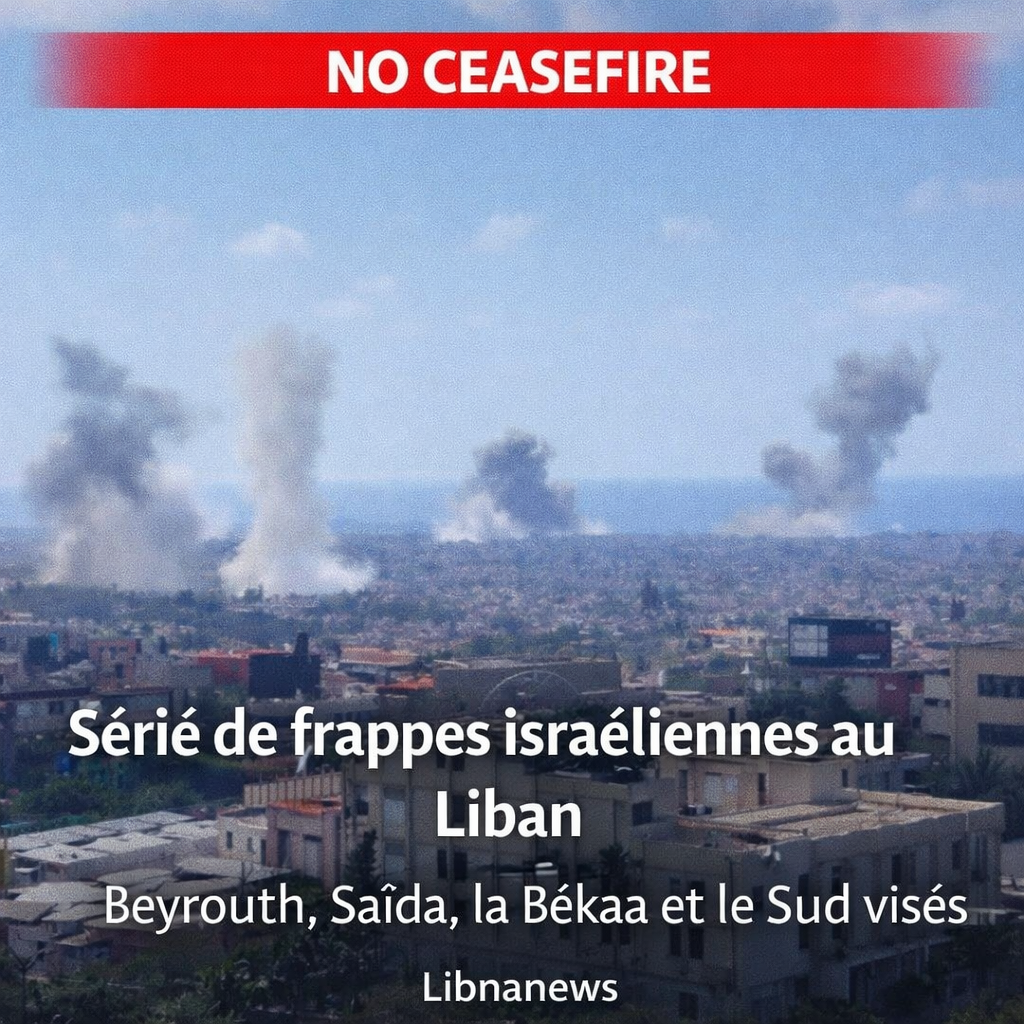
Israel conducted a new wave of strikes on several Lebanese regions on Tuesday afternoon, confirming that the Lebanese front remains fully active despite the announced truce between Washington and Tehran. According to reports, bombings targeted Saida, Hey al-Sellom in the suburbs of Beirut, the southern suburbs of the capital, the heights of Shamshtar in the Bekaa, as well as a number of localities in southern Lebanon. At the same time, the Israeli army confirmed that it had conducted a major operation against Hezbollah. This sequence further reinforces the idea that Lebanon remains the main dead end of the regional ceasefire.
A massive strike claimed by Israel
The Arab-speaking spokesman for the Israeli army, Avichay Adraee, claimed that a large-scale operation had been carried out in Lebanon. According to the statement,Approximately 100 Hezbollah military sites and infrastructurewere beatenin about ten minutestoBeirut, inthe Bekaaand inSouthern Lebanon. The objectives announced include:Headquarters,command and control centres, infrastructure related toFire systemsandmaritime capacity, as well as positions attributed to the elite forceRadwanand air unit127.
According to the Israeli army, the operation was based on accurate intelligence and several weeks of preparation with the intelligence services and the air force. Israel also claims that some of the infrastructure was located in civilian areas and accuses Hezbollah of using these areas as cover. This communication clearly aims to present the sequence not as a series of scattered strikes, but as a coordinated, planned and assumed operation on several Lebanese fronts.
Saida, Hey el-Sellom and the southern suburbs of Beirut affected
Among the information reported in the afternoon, strikes were reported onSaidaand onHey el-Sellomon the outskirts of Beirut. Other air strikes also targetedthe southern suburbs of Beirut, already under evacuation warning earlier in the day. The neighbourhoods mentioned in previous alerts includedHaret Hreik,Ghobeiry,Lailaki,Hadath,Bourj el-Barajneh,Tahwitat al-GhadirandChiyah.
The reference toHey el-Sellomand several sectors of the Dahiyé confirm that the residential areas of the Beyrouthin agglomeration remain under immediate threat. The resumption of strikes on Beirut, or its immediate suburbs, increases pressure on a population already displaced several times and reinforces the idea that the Lebanese capital remains exposed despite speeches about regional de-escalation. Similar strikes on Beirut and its suburbs had already been reported in recent days.
A « fire belt » in the Bekaa
According to information received in the afternoon,an intense fire dam, described as a« Fire belt », has targetedthe heights of ShamshtarIn the Bekaa. Air strikes have also been reported on other areas of the eastern part of the country, indicating that the wave of bombings has not been limited to Beirut or southern Lebanon.
This extension to the Bekaa is important. It shows that Israeli operations are no longer limited to a single border axis, but are aimed at several depths of Lebanese territory at the same time. Such geographical dispersion of strikes mechanically increases the feeling of national insecurity and further complicates the return of displaced persons to their areas of origin. Israeli strikes in the Bekaa and eastern Lebanon had already been documented in this war.
Arab Salim, Tiri, Jouya, Qlaouiyah, Kounine and Majdal Selm also targeted
According to information relayed over the afternoon, Israeli aviation also struckArab SalimSouth. Other raids were reported onTiri,JouyaandQlaouiyah, and a strike onKunine. In parallel, artillery fire was reported onMajdal Selm. The set draws a very wide map of the affected areas: Beirut and its suburbs, Bekaa, Saida, and several villages in southern Lebanon.
At this stage, we must be careful about the detailed human balance of each of these strikes, as the information still goes back fragmentary. On the other hand, the geographical consistency of the reports shows the same sequence of escalation:southern suburbs of Beirut, Saida, Bekaa and several southern localities were affected almost simultaneously. In the present war, this type of multiple salve corresponds to a logic of military saturation and demonstration of force.
A Lebanese Front Still Excluded from the Truce
This new wave above all confirms a major political fact:Lebanon remains outside the ceasefire in Israeli reading. News reports on 8 April report that Israel is supporting the pause with Iran while repeating that the Lebanese front is not involved and that operations against Hezbollah continue. The massive strike claimed by Avichay Adraee gives this position an immediate military translation.
In other words, the de-escalation between Washington and Tehran did not freeze the Lebanese theatre. On the contrary, the afternoon raids show that Israel is trying to maintain its maximum freedom of action on the northern front. This gap between declared regional truce and actual Lebanese bombing continues to weaken the political credibility of the ceasefire.
An immediate threat to civilians and the stability of the truce
The problem is not only military. A series of strikes touchingSaida,Hey el-Sellom,the southern suburbs of Beirut,the heights of Shamshtar,Arab Salim,Tiri,Jouya,Qlaouiyah,KunineandMajdal Selmmeans that civilian populations remain exposed on several fronts at once. In a context where returns of internally displaced persons are already suspended from fear of further strikes, this sequence may further prolong uncertainty and exacerbate the humanitarian crisis. News agencies had already reported more than 1,500 deaths and over 1.2 million displaced persons in Lebanon since the resumption of hostilities in early March.
It also raises a broader question: how far can the American-Iranian truce hold if Lebanon continues to absorb the shocks of escalation? As long as the Lebanese front remains active, each additional raid can produce a new cycle of reprisals, and make Lebanon not the beneficiary of de-escalation, but its main blind spot.




