

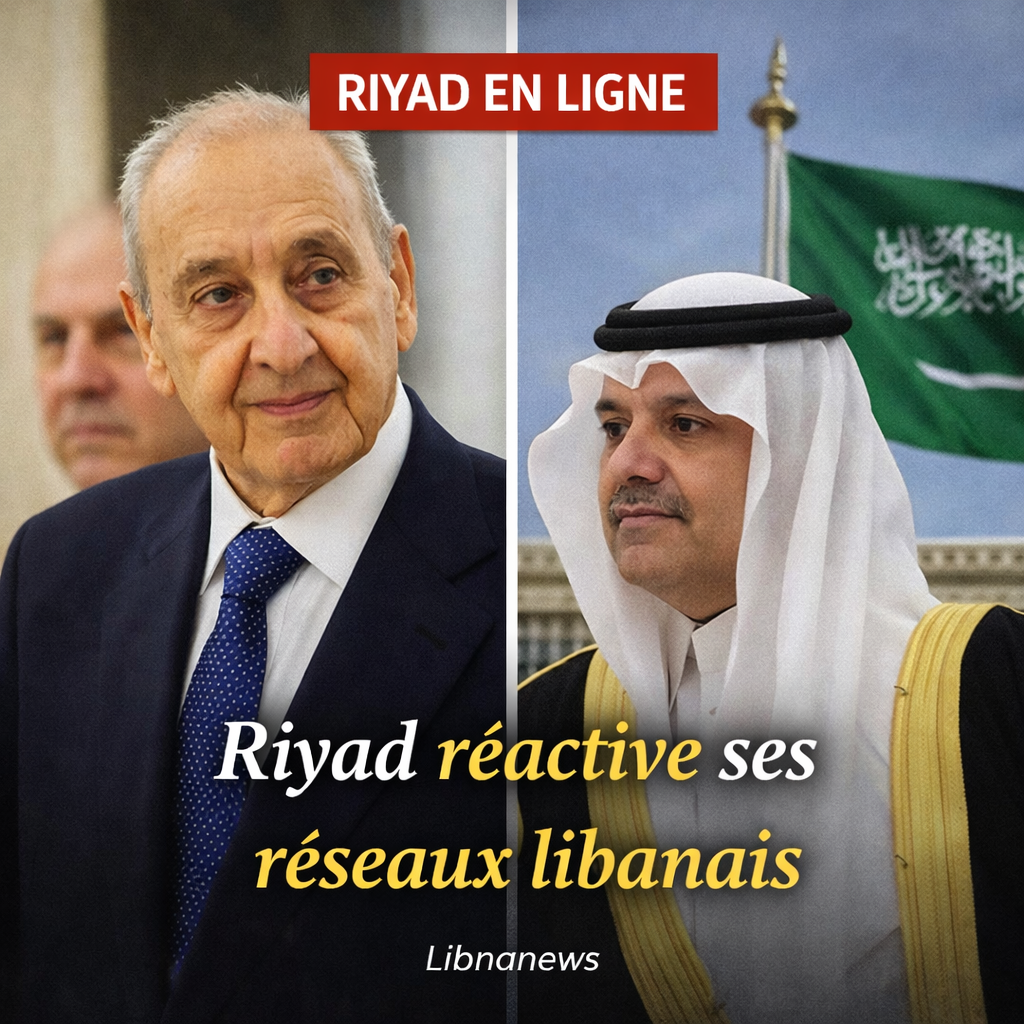
Saudi return does not go first through press releases
The most interesting movement, in the current sequence, is not just from Washington or the southern front. It also comes from Riyadh, but in a very different form. Saudi Arabia did not seek to occupy the front of the stage with great statements. She preferred to restart her Lebanese networks, political relays and contact channels, with a more similar method: little noise, a lot of signals, and a special attention to men able to hold several doors at once.
This is what gives its true meaning to Ali Hassan Khalil’s visit to Saudi Arabia. The former minister is not an official diplomat, but he is not merely a partisan intermediary. He is one of Nabih Berri’s closest political advisers. The fact that Riyadh asked to see him already says a lot. The kingdom is not just talking to visible institutional heads. He also wants to talk to one of the men who care about the practical management of the Lebanese system, to the precise point where the presidency of the House joins, the Shiite scene, the internal balances and the issue of the ceasefire.
The meeting with Prince Yazid ben Farhan is not a protocol detail. This choice of interlocutor shows that the file is treated as a major political subject, not as a mere exploratory exchange. Saudi Arabia does not seek to reconnect symbolically with Lebanon. It seeks to weigh on a precise sequence: how to prevent the war in the South from leading to both a deeper humanitarian disaster, a further destabilization of power in Beirut and an uncontrolled rise in internal tensions.
In other words, Riyadh returns through the real Lebanese policy. Not by slogans. Not by nostalgia. Not by simply displaying state support. The kingdom returns by men able to transmit, alert, calm, lock or relay. It’s a structural diplomacy, not a picture.
Why Berri is so interested in Riyadh
To understand this movement, it is necessary to start from an obvious fact often poorly read: Nabih Berri is not only the Speaker of the House. He is also one of the few Lebanese actors able to speak to several worlds at the same time. He talks to the institutions. He talks to the Shiite camp. He talks to Arab partners. He talks to a system that remains through fractures, but continues to function through a few central mediators. It is this function that explains Saudi interest.
Riyadh knows nothing about the Shiite tandem’s reservations about open negotiations under American sponsorship. The kingdom knows that, in this climate, any impression of too direct external pressure on Hezbollah could radicalize the interior scene rather than stabilize it. He also knows that no serious de-escalation can be thought of against Berri, or by ignoring, if the discussion on the ceasefire is not to turn into a regime crisis in Beirut.
The choice of Ali Hassan Khalil as a channel is therefore perfectly consistent. It allows Saudis to speak to Berri without theatricalization, without direct contact with Hezbollah and without going exclusively through the presidential tandem. It is a flexible, useful, politically dense channel. It allows us to convey a concern about the war, but also a message about the need to contain the street, to avoid any internal deflagration and to preserve the minimum of institutional cohesion.
That is essential. Riyadh does not only intervene on the military issue or on the diplomatic sequence between Lebanon and Israel. The kingdom also intervenes on the management of Lebanese risk itself. He understood that a ceasefire would not have any depth if he launched a parallel internal battle over the legitimacy of power, the role of Hezbollah or the place of the state. In other words, Saudi diplomacy does not only look at the southern front. It also looks at the possibility of a political shock in Beirut.
A kingdom that doesn’t want to leave Washington alone
It is also necessary to see the Saudi gesture for what it is: a way to refuse that the Lebanese file be completely absorbed by the American initiative alone. The United States has opened the most visible sequence. They have the most direct mediation between Beirut and Tel Aviv. They have the only credible leverage on Israel at this stage. But this does not mean that other capitals agree to get out of the game.
Saudi Arabia has neither the interest nor the diplomatic tradition to completely erase when a Lebanese case enters a critical area. She knows that the current war is not limited to the border. It affects the regional balance, the relationship with Iran, the stability of the Lebanese Sunni scene, the future of the Shiite tandem, the role of President Joseph Aoun and the credit of the government of Nawaf Salam. Allowing Washington alone to regulate the sequence would be tantamount to accepting that the next is drawn without a truly structuring Arab presence.
That’s why Riyadh chooses another place. Not that of the chief mediator. Not the payer’s. An actor who ensures that no one can close the file without counting with him. The kingdom thus retains a double margin. He can support a de-escalation. But it can also affect how this de-escalation will be received in Lebanon. It’s not about competing frontally with Washington. The aim is to prevent an American-Israeli, even indirect, face-to-face from producing a politically untenable result in the Arab world and part of Lebanon.
This strategy is all the more logical as Riyadh has found, for several months, a much more active way of working on regional issues. The kingdom no longer thinks only in terms of covenant or confrontation. It explains in terms of stability, sequence control and the ability to prevent a crisis from spilling over the whole region. In this context, Lebanon is once again becoming a ground where we must speak, not only to the conventional allies, but also to those who can avoid the worst even when they do not belong to the same camp.
Saudi intervention on two floors
The current Saudi approach seems to be working on two distinct floors. The first one is outside. It concerns the ceasefire, the ongoing negotiation, the pressure to be exerted, the messages to be transmitted and the wider link with other capitals, including Washington, Islamabad and indirectly Tehran. The second is inside. It concerns the Lebanese scene itself, its fragility, its lines of rupture, its street reflexes and its blocking mechanisms.
It is this second floor that gives all its value to the open canal with Berri. The kingdom does not only seek to know the status of the discussions. He also seeks to measure how much the anger of the Shiite camp can go, how much suspicion can rise against the presidential tandem, and how the tension over negotiation could turn into a wider conflict over the very nature of power in Lebanon.
Saudi computing is realistic. If the current sequence closes to a fragile ceasefire but leaves behind it a more divided Lebanese system than before, then diplomatic gain will be limited. If, on the contrary, the front calms and the main poles of power manage to avoid internal implosion, then Riyadh can say that it has contributed not only to the de-escalation, but to the stabilization of the country. It’s much more valuable to him.
It is then understandable why Saudi communication remains measured. The kingdom does not want to turn its initiative into a public gesture too visible, because too much exposure could make it counterproductive. On the Lebanese case, efficiency often depends on discretion. Too loud a message freezes positions. A discreet channel, on the contrary, allows to test intentions, calm some reflexes and prevent overflows without pushing the actors to overplay in front of their own camp.
Riyadh and the Aoun Salam tandem: support without automatic alignment
The Saudi return does not mean a mechanical alignment on the line of Joseph Aoun and Nawaf Salam. The kingdom obviously sees with a good eye the attempt of the executive tandem to place the state in the centre. It can hardly be hostile to a logic that emphasizes institutions, the pre-ceasefire, the government authority and the refusal of administrative collapse. But this support has limits. Riyadh knows that Lebanon does not govern itself by wish, and that any too brutal acceleration against internal equilibrium could produce the opposite effect of that sought.
This is where Saudi diplomacy stands out. It does not reason solely in terms of ideological preference. It reasons in terms of political feasibility. Yes, the kingdom can support the strengthening of the Lebanese state. Yes, he may consider the period to be conducive to institutional refocusing. But he also knows that Hezbollah remains a central data of the country, that the Shiite tandem retains a high blocking capacity, and that no sequence of exit from war will be tenable if it is experienced by a part of the country as an attempt to remove sponsored from the outside.
This lucidity explains why Riyadh speaks to both the official power and its deeper regulatory channels. The kingdom does not abandon Baabda or the Great Seral. But it does not reduce Lebanon to these poles alone. He gives himself a more complete map of the system. It is a way of saying: we support the state, but we know that in Lebanon the state never advances alone.
The link with Tehran: speaking in Lebanon, speaking also to the region
Reactivation of Saudi networks in Lebanon cannot be isolated from the broader regional framework. The kingdom knows that the Lebanese issue does not close in a simple bilateral relationship with Beirut. It is connected to the indirect dialogue between Washington and Tehran, to Pakistan’s role as a channel of messages, and to a fundamental regional question: how far can a de-escalation go without too brutally changing the balances resulting from the war?
In this context, Lebanon becomes for Riyadh a space of observation but also of transmission. Talking to Berri is not just talking to a Lebanese actor. It is also speaking to one of the poles by which the state of mind of the Shiite camp is measured at a time when Iran itself is engaged in a delicate phase of discussions, signals and calculated prudence.
The Saudi message therefore seems to obey a very precise logic. It is not a question of short-circuiting Iran, nor of pretending that it no longer exists as an actor structuring the file. Rather, it is a question of making it clear that the kingdom intends to influence the way in which balances are reorganized. In other words, Riyadh does not only want to be informed. It wants to be consulted, taken into account and recognized as one of the possible architects of regional stability.
This also explains the growing role of cross-channels, sometimes indirect, between Riyadh, Islamabad, Tehran and Washington. In this moving architecture, Lebanon is neither the only dossier nor a mere secondary ground. He serves as a teller. What plays in it indicates how far a wider relaxation can go, and what conditions it can be politically absorbable.
Saudi diplomacy returns to reality
For a long time, discussions on the Saudi role in Lebanon have been trapped in a binary vision. Either Riyadh was supposed to come back in force and reorder everything. Either it was presented as absent, disengaged or tired. The current period shows something else. The kingdom does not return as a tutelary power or as a retired actor. He comes back by concrete.
The concrete here are names, routes, canals, warnings, targeted encounters. These are exchanges with Ali Hassan Khalil. These are contacts at the level of Prince Yazid bin Farhan. These are signals to Berri. These are efforts to understand the margin of the Aoun-Salam tandem without ignoring the response thresholds of the Shiite camp. They are also actions designed to prevent negotiations on the front from blowing up the centre.
This method is more realistic than the previous spectacular Saudi return scenarios. It assumes that Lebanon is no longer a land where a line is imposed from a single capital. It is a country of networks, locks, blockages and intermediaries. In order to weigh it, we must reactivate the right attachments. That’s exactly what Riyadh does.
The kingdom seeks less to win than to prevent a bad outcome
Basically, the Saudi approach may say something even more important. The kingdom does not necessarily seek a visible political victory. He first tries to prevent a bad outcome. A bad outcome for Riyadh would be a ceasefire imposed without Arab depth and internal absorption. It would be a sequence where Washington and Israel would move forward with Beirut, while part of Lebanon would enter into a logic of growing rupture. It would also be a process that seems to refocus the state but would eventually destabilize the entire Lebanese political building.
By talking to Berri, reactivating its networks, maintaining its links with the institutional poles and inserting into the wider regional web, Riyadh therefore pursues a rather simple objective: to prevent Lebanon from emerging from the war with a fragile agreement in the South and an even more serious crisis in the centre. It’s less spectacular than a big conference. It’s probably more useful.
The real novelty is therefore not that Saudi Arabia is again interested in Lebanon. She is always interested as soon as the country approaches a tipping point. Newness is the way. The kingdom is no longer simply supporting its traditional partners by far. He returns his complete networks to work, including where the Lebanese scene is most sensitive. This does not mean that he already holds the solution. This means that he has understood where the real test will be played: not only in stopping the fighting, but in Lebanon’s ability to politically absorb this stop without tearing itself further.




