

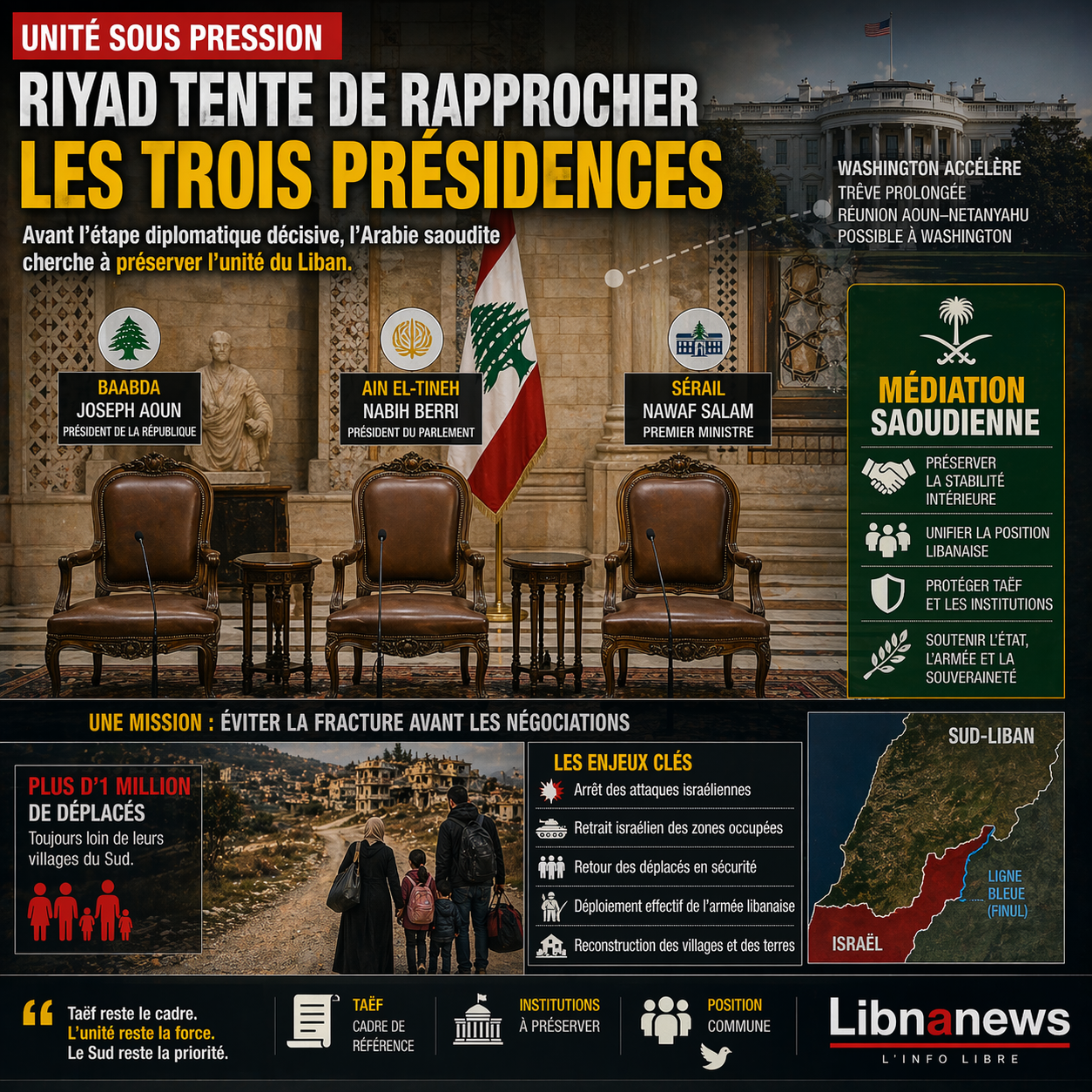
Yazid bin Farhan’s visit to Beirut comes at a time when the Lebanese case is moving into a short and risky diplomatic phase. The extension of the truce, the Lebanese-Israeli meeting in Washington and the American will to speed up the process put the Lebanese institutions under pressure. In this context, Saudi Arabia seeks to prevent a fracture between Baabda, Ain al-Tinah and Serail. The immediate objective is to preserve a common Lebanese position before any new stage of negotiations.
Saudi mediation at the heart of Lebanese power
Yazid ben Farhan does not arrive in Beirut for a protocol visit. Its movement targets the real decision-making centres. He met President Joseph Aoun in Baabda. He also visited the Speaker of the Parliament, Nabih Berri, in Ain al-Tinh. The issue also concerns Prime Minister Nawaf Salam, whose government must stand in a period of military, social and diplomatic pressure.
The Saudi message is based on two simple ideas. The first is the preservation of internal stability. The second is the unification of the Lebanese position in the face of negotiations. These two objectives are linked. Lebanon cannot negotiate effectively if its three presidencies give contradictory signals. Nor can he defend his demands if the government appears fragile or threatened.
The Saudi approach is therefore aimed at reducing the risk of bursting. It comes as Washington pushes for acceleration. Donald Trump wants to turn the truce into a political process. He also wishes to receive Joseph Aoun and Benjamin Netanyahu within a short time. Such a sequence can create an internal shock if it is not prepared by a common national line.
Three presidencies, three constraints
Joseph Aoun bears the sovereignty and external representation of the State. He must defend Lebanese demands with Washington. These requests concern the cessation of attacks, the Israeli withdrawal, the protection of civilians, the return of displaced persons and the deployment of the Lebanese army. Its margin depends on its ability to appear as the president of a national position, not as the actor of an isolated channel.
Nabih Berri wears another weight. He remains a central player in the South and in Parliament. It also has a liaison capacity with the political forces most sensitive to any negotiations with Israel. His adherence to the framework for discussion, even cautious, was indispensable. Without it, the Lebanese line would quickly be challenged in the name of parliamentary legitimacy and representation of the South.
Nawaf Salam bears the governmental responsibility. It must maintain the executive, manage the social emergency, monitor international issues and defend a line of state over the army, weapons, the buffer zone and international law. His Government could not afford a major crisis when Lebanon had to speak with one voice. Riyadh seems to have understood that the stability of the executive has become a condition of diplomatic stability.
Riyadh seeks to avoid vacuum
Saudi Arabia does not only want to bring those responsible closer together. She wants to avoid a political vacuum at the most dangerous time. A fall in government or an open break between the presidencies would weaken the Lebanese position in Washington. It would also give more weight to external actors. In asymmetric bargaining, internal disorder becomes a strategic cost.
Saudi fear also concerns the post-war period. Once fighting slows down, internal tensions can rise. The issue of weapons, the role of the army, the status of Hezbollah, security guarantees and reconstruction can become explosive. Riyadh therefore wants to prevent a sequence where the relative cessation of hostilities would open a Lebanese political crisis.
The continuation of the government of Nawaf Salam is part of this logic. It is not just about defending a ministerial team. The aim is to maintain a structure capable of negotiating, receiving assistance, speaking to international partners and managing the consequences of war. A weakened or contested government would be unable to carry these files.
Taif as a common language
The reminder of the Taif agreement occupies an important place in the Saudi process. Taef is not just a historical reference. It remains the framework that organizes the Lebanese institutional balance since the end of the civil war. The fact that the document was negotiated in Saudi Arabia gives Riyadh a special legitimacy when it presents itself as a guarantor of Lebanese stability.
In the current sequence, Taef also serves as a guard. He pointed out that any solution must go through the institutions. It prevents negotiations with Israel from being treated as a technical arrangement separate from the Lebanese political system. He argues that sovereignty, unity of the State and internal balance must remain interrelated.
The message sent to Nabih Berri is therefore twofold. Saudi Arabia supports the cessation of Israeli attacks and the stability of Lebanon. But it also expects Lebanese actors to remain within the Taif framework. This avoids two opposing risks. The first would be a diplomatic adventure without national coverage. The second would be an internal blockage which would deprive the State of any negotiating capacity.
Arab cover against American tempo
American mediation is fast, visible and focused on Washington. Saudi mediation is more discreet, but it targets internal foundations. This difference in method counts. The United States wants to achieve a result within a short time. Riyadh seeks to prevent this delay from breaking Lebanese balance.
For Beirut, Arab coverage is essential. It avoids Lebanon appearing alone in the face of American mediation that is strongly linked to Israeli security. It gives political depth to the Lebanese position. It also reminds us that any developments with Israel must take into account the regional framework and the Arab peace initiative.
This coverage does not replace the American role. Washington remains central to the current sequence. But it can correct its effects. It can slow down pressure too brutal. It can push for more concrete guarantees. It can also help the three Presidencies to defend a common line without giving the impression of suffering an imposed timetable.
The South as a priority of the approach
The Saudi approach is not limited to institutional balance. It also concerns South Lebanon. Contacts with Nabih Berri include continued Israeli attacks, destruction in border villages and efforts to achieve a complete cessation of hostilities. Riyadh knows that Lebanese political stability depends first on what is happening on the ground.
As long as the villages remain at risk, no truce can permanently stabilize the country. Until the internally displaced return, the social crisis will continue. As long as destruction continues, the forces hostile to negotiation will retain a strong argument. The rapprochement of the Presidencies cannot therefore be separated from the return to calm in the South.
The Saudi priority is also to strengthen the State. Support for Lebanon’s stability requires support for its institutions. This involves the Presidency, the Government, Parliament, the army and the administrations responsible for aid and reconstruction. The truce will have value only if the State can translate it into an effective presence in the villages.
Berri in the centre of the junction between Riyadh and the South
Nabih Berri occupies a key position in the sequence. He is the President of Parliament. He is also one of the main interlocutors on issues related to the South, internal balances and the political line against Israel. Faisal ben Farhan’s contact with him aims to consolidate this junction. The aim is to link Saudi support to the cessation of attacks and respect for the Lebanese framework.
Berri reaffirmed Lebanon’s commitment to Taif and the rejection of any threat against Saudi Arabia. This formulation is regional in scope. It points out that Lebanon does not want to become an area of threat to the kingdom. It also points out that relations with Riyadh remain a component of Lebanese stability.
This line can help reduce tension. It can also allow Berri to defend a cautious position: to accept diplomatic cover without yielding over Lebanese rights. Stopping attacks, Israeli withdrawal, the return of displaced persons and sovereignty remain the hard points.
Nawaf Salam under indirect political protection
The government of Nawaf Salam is exposed. It must manage the conflicting expectations of international partners, local political forces and war-affected populations. It must talk about sovereignty, international law, the role of the army and reconstruction. It must also prevent the issue of arms from becoming an immediate internal crisis.
Saudi mediation offers a form of indirect political protection. It does not resolve differences. It recalls that the stability of the government is necessary. In a phase in which Washington accelerates and the terrain remains unstable, Lebanon needs an executive capable of following the cases. A government crisis would give the image of a country unable to make its own demands.
Nawaf Salam must, however, turn this margin into action. It must coordinate international efforts, document violations, organize assistance to internally displaced persons and maintain ministerial cohesion. Stability cannot only be an external demand. It must become a governmental practice.
Joseph Aoun facing a decisive sequence
Joseph Aoun is in the centre of the next stage. If Washington confirms the will of a meeting with Benjamin Netanyahu, the Lebanese President will have to decide how to respond. It will have to do so taking into account Riyadh, Berri, Salam, the army, the displaced and the political forces that refuse any normalization.
Saudi mediation can help consolidate a mandate. It may make it possible to say that a possible approach in Washington is not a personal initiative, but rather a national position. It can also set limits: no constant discussion of attacks, no summit without guarantees, no formula that bypasses Taif.
The Lebanese President must therefore use Saudi support to strengthen the state’s position. It’s not about adding an outside sponsor. The aim is to build an internal line strong enough to withstand external pressures.
The risk of divergent reading of the truce
The actors do not read the truce in the same way. Washington sees a window for a deal. Israel can see this as a period for securing security assurances. Lebanon sees it first as a test of withdrawal and protection of civilians. Saudi Arabia sees this as a time to prevent the collapse of the Lebanese political framework.
This divergence makes Saudi mediation useful. It recalls that the truce cannot only be an American calendar. It must become a basis for internal stabilization. This implies a common language between the three Presidencies. This also requires verifiable commitments from Israel.
If the truce remains blurred, each camp will use it to its advantage. The United States will talk about progress. Israel will talk about security. The Lebanese opponents will talk about concessions. Displaced people will talk about abandonment. Riyadh is precisely trying to avoid this scenario, pushing the institutions to clarify their position.
The conditions for lasting reconciliation
The rapprochement of the three Presidencies cannot be based solely on a visit. He has to produce a method. This should include a formal meeting between Joseph Aoun, Nabih Berri and Nawaf Salam. It should establish a document of principles. It should define the mandate of any Lebanese delegation. It should specify the field demands and the political red lines.
The document should include the complete cessation of Israeli attacks, the withdrawal of occupied areas, the refusal of an imposed buffer zone, the return of displaced persons, the deployment of the Lebanese army, the protection of civilians and the reconstruction of destroyed villages. It should also provide for permanent coordination between the Presidency, the Government and Parliament.
Riyadh can facilitate this framework. But it is up to Lebanese officials to formalize it. An external mediation cannot replace a national decision. She can help make it possible.
An attempt to stabilize before the most difficult stage
The Saudi approach takes place before the most sensitive stage. The three weeks of truce can lead to a meeting in Washington, a new phase of negotiation or an impasse. In all three cases, Lebanon will need a strong institutional front. A division between the presidencies would lose weight at any Lebanese request.
Riyadh therefore tries to prevent rather than repair. The kingdom knows that Lebanon is entering an unstable political zone. He also knows that regional war, American pressure and internal tensions can join. Its movement aims to prevent these fracture lines from becoming an open crisis.
The success of this approach will depend on its concrete translation. If the three presidencies agree on a clear mandate, Saudi mediation will strengthen the state. If they remain in parallel positions, the visit will only have been a signal. In such a short sequence, the signals are no longer sufficient. Lebanon needs a written position, assumed and carried by all its institutions.




