

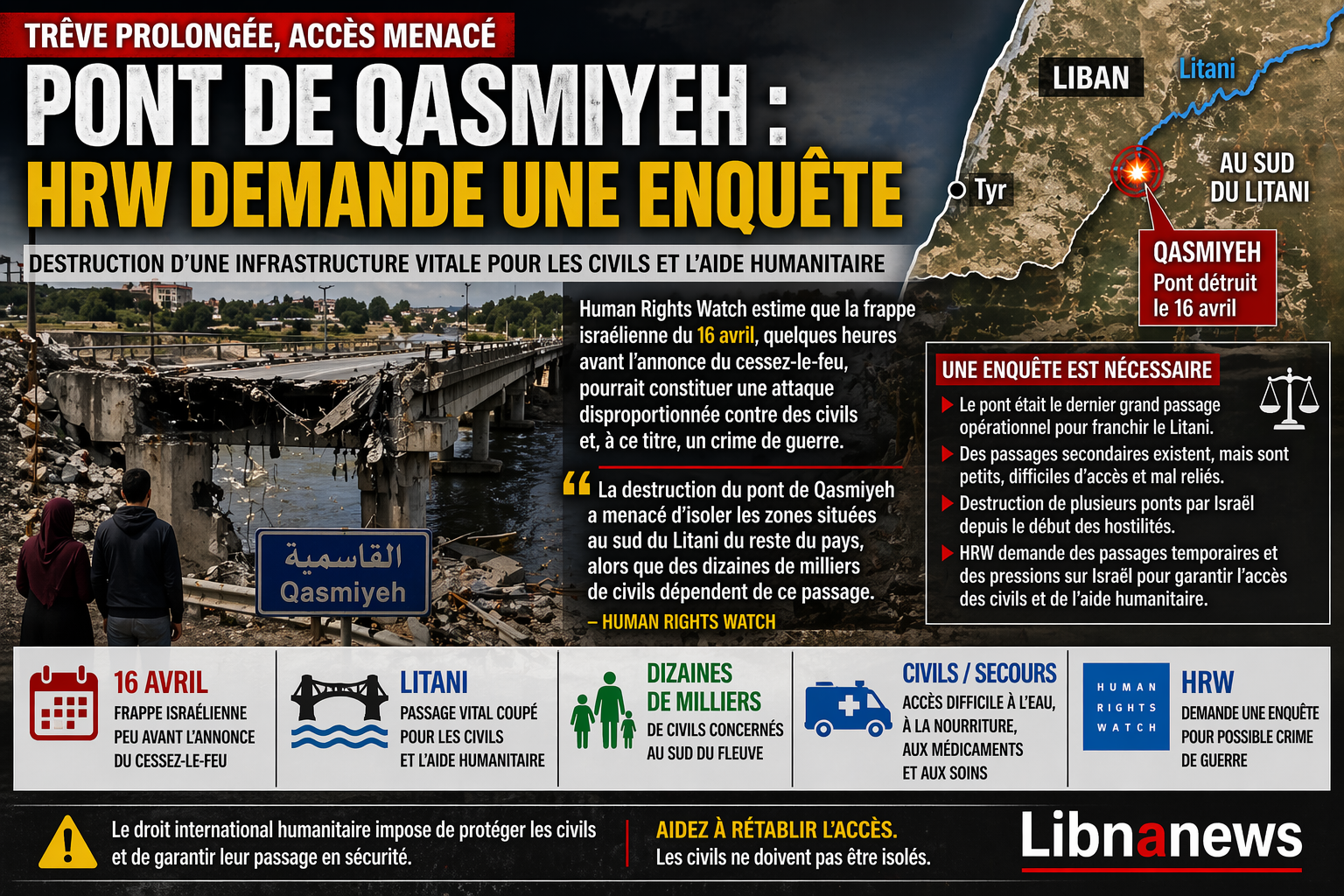
The Human Rights Watch report on the destruction of the Qasmiyeh bridge puts the truce in Lebanon in a humanitarian and legal dimension. The organisation believes that the Israeli strike of 16 April, carried out a few hours before the announcement of the ceasefire, should be investigated as it could constitute a disproportionate attack on civilians and, as such, a war crime.
The Qasmiyeh bridge, located near Tyre, was presented by the organization as the last major passage still operational over the Litani for civilians and humanitarian aid. Its destruction threatened to isolate areas south of the river from the rest of the country, while tens of thousands of people still lived there.
The alert comes as the cessation of hostilities was extended by three weeks under American sponsorship. This extension is not enough to address the issue of civilian access. Previous bombardments, destruction of roads and bridges, as well as traffic restrictions, continue to affect residents, relief workers, hospitals and humanitarian organizations.
Qasmiyeh Bridge: what HRW claims
Human Rights Watch claims that the Israeli army destroyed the Qasmiyeh bridge on 16 April, shortly before the announcement of a ceasefire between Israel and Lebanon. The organisation presents this infrastructure as the last main passage for civilians and convoys to help cross the Litani River and connect the south of the river with the rest of the country.
In its communiqué, HRW believes that this attack should be considered under international humanitarian law. The organisation does not say that a court has already qualified the facts. She requested an investigation into whether the bridge was a military objective and, in that case, whether the foreseeable damage to civilians was excessive in relation to the military advantage expected.
The organisation stresses that secondary passages may still exist. However, it states that they are smaller, located in difficult terrain and sometimes poorly connected to the road network. This situation makes evacuation of civilians more complex and also complicates the safe delivery of water, food, medicine and relief.
The wording chosen is therefore precise. HRW talks about a possible disproportionate attack and a potential war crime. It calls for documenting the facts, securing temporary passages and exerting pressure on Israel to guarantee the passage of civilians and humanitarian aid during the truce.
A vital infrastructure before the truce
The Qasmiyeh bridge had already been damaged prior to its destruction. Human Rights Watch reported a strike on 8 April that had hit the area, without rendering the passage completely unusable. Nevertheless, the bridge remained one of the few routes still linking Tyre and the localities south of the Litani to the further north.
The organization reports that, by 16 April, the Israeli army had destroyed or severely damaged the main bridges linking the areas south of Litani to the rest of Lebanon. It mentions attacks on at least nine bridges on the Litani River and on one of its tributaries, as well as on a section of road leading to the Khardali Bridge.
This accumulation of attacks had already reduced civilian displacement. It had also limited the capacity of public institutions, humanitarian organizations, hospitals and health services to transport patients, medicines, fuel and essential goods. The Qasmiyeh bridge therefore appeared as a last major crossing point.
On 16 April, its destruction changed the nature of coercion. It was no longer just a weakened road network. The risk was that of wider isolation from the southern Litani area, at a time when part of the population was seeking to move to safer areas and other residents were considering returning after the announcement of the truce.
Tens of thousands of civilians involved
Human Rights Watch reports that local officials reported the presence of tens of thousands of civilians in areas south of Litani. These residents depend on the passageways to receive assistance, access care, transport basic necessities or leave exposed areas.
The problem is not just people who want to leave. It also affects those who want to stay. When bridges are destroyed, aid becomes slower, more expensive and more dangerous. Ambulances must take longer or unsuitable routes. Supply trucks can be blocked. Humanitarian teams reduce their movement when roads no longer guarantee safe access.
Local officials in the Tyre region had already alerted the population to their dependence on this passage. Food and medical stocks were described as limited. Local institutions had to manage both local residents, internally displaced persons, injured persons and families trying to assess the damage in their villages.
The destruction of a bridge can therefore produce civil effects beyond the moment of the strike. It changes the survival capacity of a population, especially in the context of war, power cuts, fuel shortages and the fragility of health services. It is this cumulative effect that HRW places at the centre of its alert.
Israeli position on bridges
The Israeli army accused Hezbollah of using bridges on the Litani River for military purposes. In particular, it referred to the transport of combatants, equipment and means of combat to areas south of the river. In her previous communications, she presented the strikes against the passages as operations designed to prevent the delivery of reinforcements.
Human Rights Watch notes, however, that the Israeli army had not issued any specific justification immediately after the destruction of the Qasmiyeh bridge on 16 April. The organisation therefore accepts the general explanations already given by Israel on the Litani bridges, while requesting an investigation into the proportionality of the strike.
International humanitarian law does not exclude a bridge from becoming a military objective if it does contribute to military action. But this qualification is not enough to make any attack lawful. The attacker must also take into account the expected damage to civilians and verify that they are not excessive in relation to the concrete and direct military advantage expected.
This is what HRW’s criticism is about. According to the organization, the importance of the bridge to civilians was known or foreseeable. If the passage was the last major route to be used, the humanitarian impact should be integrated into the decision to strike. This assessment is an inquiry, but it determines the possible legal qualification.
The proportionality criterion at the heart of the case
The concept of proportionality is central to HRW’s alert. An attack on a dual-use target may be prohibited if the expected civilian casualties, injuries, damage to civilian property or effects on the survival of the population are excessive compared to the anticipated military advantage.
In the case of the Qasmiyeh bridge, the organization insists on the cut-off effect. Infrastructure was not only used for ordinary traffic. It allowed civilians access to safer areas north of Litani and humanitarian organizations to deliver essential goods to the south. Its destruction could therefore affect the entire civilian population.
HRW also poses a second hypothesis. If the bridge was not a military objective at the time of the strike, the attack could be considered as directed against civilian property. In that case, the legal qualification would be different, but the gravity would remain high, as deliberate attacks on civilian property were prohibited by the laws of war.
The organisation does not replace the work of a court. It establishes a cluster of elements and requests an independent investigation. This shade is important. The definition of a war crime requires a precise examination of the facts, intent, status of the target, information available at the time of the attack and measures taken to limit civilian damage.
Calls for temporary passages
Human Rights Watch calls on donor countries to immediately support the establishment of temporary crossings during the ceasefire. The aim is to ensure sustainable and predictable access to water, food, medicines and other property necessary for the survival of the inhabitants of the southern Litani.
This request also applies to civilians who choose to leave. Humanitarian law requires the protection of civilians and their safe passage when they seek to leave an exposed area. The destruction of the main axes does not remove this obligation. On the contrary, it makes it more urgent to organise safe and identifiable routes.
Temporary passages can only work if the parties to the conflict respect them. They require technical coordination, security assurances, minimum demining, rapid repair capacity and humanitarian monitoring. They must also be known to the inhabitants, relief workers, municipalities and organizations that distribute aid.
HRW’s request is therefore addressed to several actors. It targets donor states, Lebanese authorities, Israel and countries with influence over the Israeli army. It transforms the destruction of the bridge into an immediate issue of civil protection, not just a matter of future legal responsibility.
The link with the prolonged truce
HRW’s alert comes in a particular period. The truce between Israel and Lebanon was extended for three weeks after discussions in Washington. This diplomatic period should avoid a general resumption of hostilities and prepare for wider negotiations. But the extension does not repair the destroyed infrastructure.
The Qasmiyeh Bridge illustrates this boundary. Even when weapons are partially silent, civilians can remain trapped by destruction. A truce does not automatically produce humanitarian access. It must be accompanied by practical roads, guarantees of passage, authorized rescue and teams capable of restoring essential connections.
For Lebanon, the question of the bridge joins the broader demand for Israeli withdrawal, cessation of destruction and return of displaced persons. A ceasefire that leaves areas cut off from the rest of the country remains incomplete. It does not allow residents to return sustainably or municipalities to assess the damage.
For Israel, the issue remains linked to security in the face of Hezbollah. The Hebrew state claims to want to prevent the Shiite movement from moving fighters and weapons south of the Litani. United States mediation must therefore address simultaneously the freedom of movement of civilians, the security of humanitarian convoys and the military concerns raised by Israel.
Direct consequences for Tyre and southern villages
The Tyre region is at the centre of this constraint. The Qasmiyeh bridge connects essential roads for traffic between the coast, the villages of the South and the rest of Lebanon. Its destruction obliges the inhabitants to use detours, improvised passages or secondary roads. These solutions may suffice for limited travel, but they remain insufficient for regular humanitarian traffic.
Following the entry into force of the initial ceasefire, makeshift passages were introduced to allow vehicles to cross the Litani River. While some returns and movements have been permitted, they do not replace a main deck for heavy convoys, ambulances, fuel trucks or organized evacuation operations.
The villages of the South face several simultaneous difficulties. Houses are destroyed. Roads are off. Public services are interrupted. Areas remain dangerous due to strikes, unexploded ordnance or military restrictions. In this context, each destroyed bridge further reduces the flexibility of civilians.
The return of displaced persons therefore depends on a complete network. It is not enough to suspend the bombings. Access to villages, emergency relief, road repairs, the entry of reconstruction equipment and the resumption of basic services must be allowed. The Qasmiyeh bridge became one of the symbols of this material condition of the truce.
Previous UN warnings
Human Rights Watch recalls that the United Nations had already alerted the consequences of the strikes on the bridges in Lebanon. The Office for the Coordination of Humanitarian Affairs had reported that the destruction of transport infrastructure was disrupting movements and limiting humanitarian access. The Office of the High Commissioner for Human Rights had also warned against the isolation of the inhabitants of the South.
These warnings preceded the complete destruction of the Qasmiyeh bridge. They already showed that the subject was identified by humanitarian actors. The issue concerned not only a particular bridge, but the general capacity of civilian populations to remain connected to the rest of the country.
The HRW report is therefore a continuation. He did not discover the vulnerability of the South after 16 April. It documents the outcome of a process of gradual cutting of the axes. The strike against Qasmiyeh is presented as the moment when the last major operational passage was destroyed.
This chronology is important for legal assessment. If the effects of the previous attacks were known, the consequences of the destruction of the last major passage must also be known. This is one of the elements that any investigation will have to examine: what the Israeli army knew, what it could foresee and what measures it has taken to avoid or limit the effects on civilians.
An investigation requested, not a judicial conviction
The term war crime must be handled with precision. HRW states that the strike could constitute a war crime. It does not say that a court has already established it. Difference is essential. The organisation is requesting an investigation to verify the nature of the target, the circumstances of the attack and the assessment of foreseeable civil damage.
An investigation should also examine military information available at the time of the strike. It should determine whether combatants, weapons or means of combat were using the bridge. It should assess the existence of alternatives, choice of ammunition, time of attack, possible warnings and immediate effects on civilians.
It should finally measure the humanitarian consequences after the strike. The destruction of a bridge can cause indirect damage: delays in evacuation, disruption of supplies, impossibility of access to care, isolation of vulnerable populations. These effects form part of the proportionality assessment when they are foreseeable.
For Lebanon, this request for investigation is in addition to other cases of responsibility related to recent hostilities. For humanitarian organizations, it emphasizes an immediate priority: to restore the passages, to secure the routes and to prevent the truce from becoming a prolonged isolation of the inhabitants south of Litani.
Next emergency: reopening civilian access
The extension of the truce offers a limited window for action. Donor States can finance temporary bridges, bypass routes, emergency repairs, coordinated convoys and humanitarian crossings. Lebanese authorities can map needs, prioritize the axes and coordinate municipalities, the army, civil defence and aid agencies.
Israel remains called upon to ensure the safe passage of civilians and relief. Countries that influence his army are urged by HRW to exert concrete pressure. The issue is immediate: allowing residents to receive essential goods, the injured to join hospitals and families to leave or to return to their villages without any additional risk.
The Qasmiyeh bridge thus becomes a test of the truce. If safe passages are established, the extension can have a concrete effect on civilians. If roads remain closed and aid blocked, the prolonged ceasefire will not be enough to improve the situation south of Litani.
The next step will therefore not only be taken in diplomatic declarations. It will depend on the ability to reopen axes, document destruction and protect civilian movements. The legal qualification of the attack will follow its own path, but the humanitarian emergency begins with the passage of people, water, food and medicine.




