

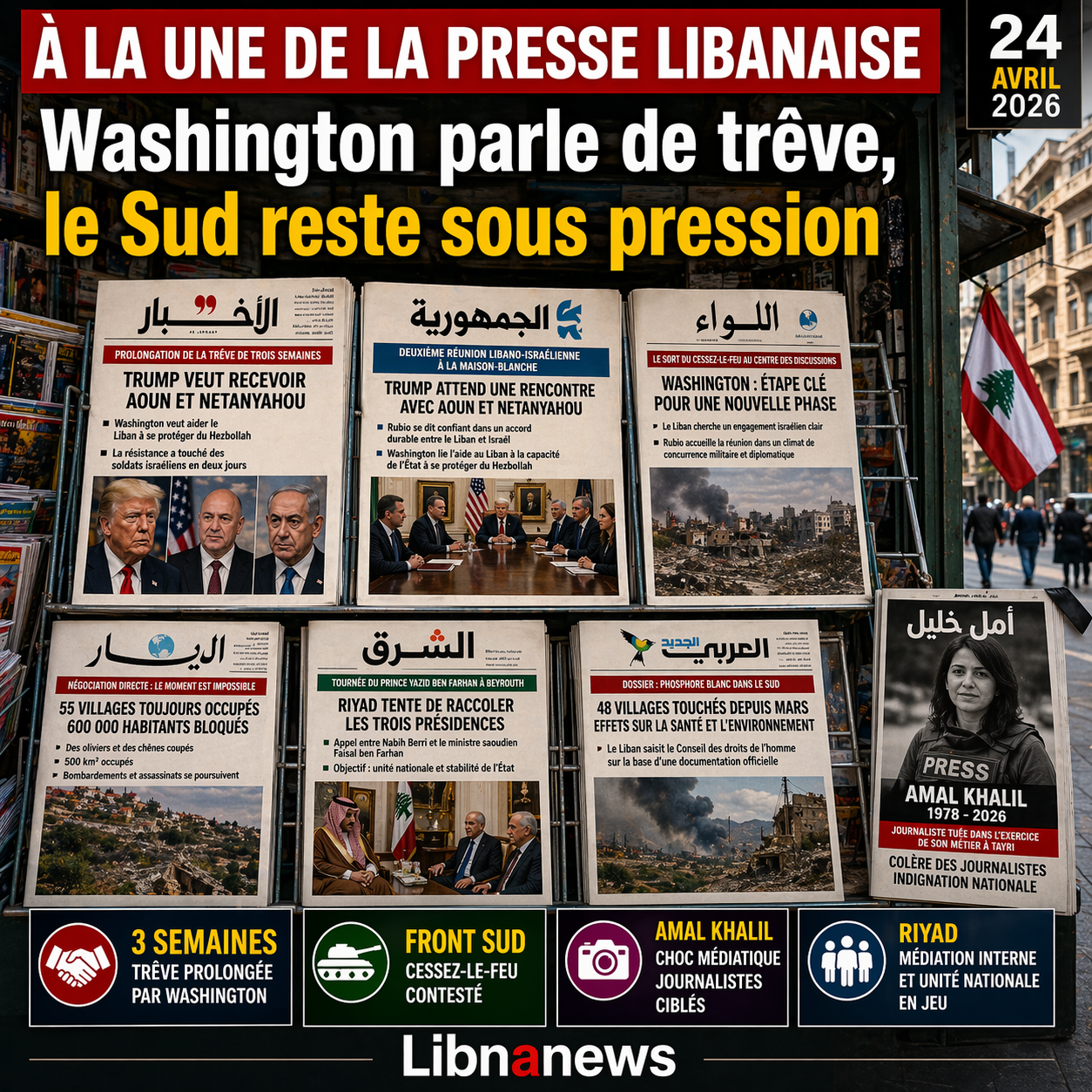
White House puts Lebanese file at the centre of the game
In its April 24, 2026 edition,Al Akhbara three-week extension of the truce. The newspaper reports that Donald Trump wants to receive Joseph Aoun and Benjamin Netanyahu during this period. The same account states that Washington wants to help Lebanon protect itself from Hezbollah. According to the same source, Marco Rubio is confident in the possibility of a lasting agreement between Lebanon and Israel. The tone is therefore that of an acceleration desired by the United States. But this is not just a gesture of mediation.Al Akhbarpresents this sequence as an attempt to turn a fragile truce into a political gain. The news added that the ceasefire was still absent on the ground. It also claims that the resistance affected Israeli soldiers in two days. The contrast is clear. On the one hand, Washington talks about peace. On the other hand, the South remains caught in a military logic.
Al Jumhouriya24 April 2026 describes the second Lebanese-Israeli meeting in the White House as a formal step in the process. The newspaper reports that the Lebanese side was represented by the Lebanese ambassador in Washington, Nada Hamadeh Moawad. The Israeli side was led by Israeli ambassador Yechiel Leiter. Donald Trump, Marco Rubio and American officials were present. After the meeting, Trump said he was waiting for a meeting with Joseph Aoun and Benjamin Netanyahu. He also said that the Lebanese file seemed easier than other files. This sentence weighs heavily in the local climate. It gives the Lebanese file diplomatic test status. However, it also reduces the crisis to a security equation. According toAl JumhouriyaWashington links aid to Lebanon to the state’s ability to protect itself from Hezbollah. This approach places Beirut in a delicate position. Lebanon first calls for the cessation of attacks, Israeli withdrawal and stability in the South.
A announced truce, but still unstable terrain
Al Liwa24 April 2026 presents the Washington meeting as a stage related to the fate of the ceasefire. The newspaper states that the first ten-day phase was coming to an end. According to that reading, the Lebanese delegation was seeking a clear Israeli commitment. The aim was to prepare a new phase of dialogue on stability arrangements. This formulation shows that Beirut does not only want a break. Lebanon wants a framework. He also wants the violations to stop. The same newspaper insists on Marco Rubio’s role in welcoming the meeting. He also cited the climate of military and diplomatic competition between Lebanon and Israel. This point is central. Negotiations take place as the pressure on the ground continues. So the truce has not yet produced normalization. Rather, it becomes an instrument. Each part uses it to set the next discussion threshold.
Ad Diyarof 24 April 2026 gives a darker reading of the possibility of direct negotiation. The newspaper believes that the moment is impossible, because Lebanon remains divided. It refers to the occupation of fifty-five villages after their evacuation. He also mentioned the announcement that six hundred thousand inhabitants could not return quickly to their villages.Ad Diyarit added that old trees, including olive trees and oak trees, would have been cut. The newspaper talks about five hundred square kilometres occupied. Finally, he cites the continuation of the bombings and assassinations. This material alters the sense of truce. In this account, it does not yet protect civilians. Nor does it guarantee the return of displaced persons. Thus, the real one is not just the Washington meeting. It is also the gap between diplomatic language and life imposed on the South.
Riyadh is trying to get the three presidencies back together
The US file is accompanied by a visible Saudi movement.Al Sharqapril 24, 2026, reports a tour of Prince Yazid bin Farhan in Beirut. The newspaper reports that he conducted a political evaluation before the second negotiating session in Washington. He adds that an appeal took place between Nabih Berri and Saudi Foreign Minister Faisal bin Farhan. The exchange focused on developments in Lebanon and the region. It also concerned the continuation of Israeli attacks. Saudi interest is therefore aimed at two plans. The first is external, with the cessation of attacks. The second is internal, with the need to unify the Lebanese position. In this context, the strength of the state becomes an immediate issue. Joseph Aoun, Nabih Berri and Nawaf Salam are placed under the same constraint. They must defend a national line while avoiding an internal political rupture.
Al Akhbar24 April 2026 talks about a Saudi initiative to reconcile the three presidencies and protect the government. The newspaper says Riyadh wants to avoid a fall of the executive led by Nawaf Salam. He presents the visit of Yazid bin Farhan as a message addressed to Baabda, Ain al-Tinah and Serail. The newspaper adds that the aim is to preserve stability and unify the Lebanese position in the face of negotiations. This reading gives the Saudi movement a guard function. This is not just mediation. It’s also about preventing emptiness. In today’s press, this dimension often returns. The external truce cannot stand if the executive becomes fragile. Moreover, Lebanon needs a clear mandate to negotiate. Without this mandate, every concession or refusal risks becoming an internal crisis.
Amal Khalil turns the truce into a case for protecting journalists
The death of journalist Amal Khalil occupies a major place in the newspapers of 24 April 2026.Al Akhbardevotes his front page and interior pages to his funeral procession. The newspaper talks about a ceremony to the tune of activists and a candle that doesn’t turn off. He also reports a mobilization of his colleagues in front of the newspaper’s offices in Beirut. The text evokes the anger of journalists at the targeting of press teams. He claims that these attacks violate the guarantees granted to journalists in times of conflict. The fact becomes a political fact. It obliges the government to qualify violations. It also places the issue of impunity at the centre of the debate. The truce is no longer evaluated solely from military lines. It is judged on the safety of civilians, first aid workers and journalists.
Al Binaof 24 April 2026 reports that Amal Khalil was buried in Bissariyeh after being touched during his work in Tayri. According to the newspaper, she first escaped a first strike. She then took refuge in a house, before another strike on the building. The newspaper claims that she remained under the rubble for seven hours. He adds that the rescue was prevented from arriving.Al Sharqof 24 April 2026 quotes Nawaf Salam. The Prime Minister calls the targeting of journalists and the hindrance to war crimes relief. He claims that Lebanon will monitor these cases before the relevant international bodies. This position adds a legal aspect to the front page. It turns national emotion into a possible procedure. It also puts the government in the face of a test. It must document, seize and follow.
Iran’s shadow and the human cost of war
Annaharof 24 April 2026 summarizes the background with a formula on the impasse between war and peace. The newspaper links the Lebanese scene to the face-to-face between the United States and Iran. It also places Trump’s direct sponsorship of the Lebanese-Israeli route in one. This layout shows that Lebanon is not isolated. His case is moving forward in a heavy regional moment.Ad Diyaron 24 April 2026 Pakistani efforts to bring Washington and Tehran together were mentioned. He talks about ideas related to the Strait of Ormuz and the maritime blockade. The message is clear. The truce in Lebanon also depends on regional temperature. The higher the tension around Iran, the more sensitive the Lebanese case becomes. Conversely, any opening between Washington and Tehran can widen the Beirut margin.
Al 3arabi Al Jadidof 24 April 2026 further expands the table. The newspaper devotes a file to white phosphorus used in the South. He mentions more than 48 affected villages since the offensive resumed in March. He also recalls that the previous war had already counted two hundred and fifty attacks on white phosphorus. The journal describes effects on health, the environment, agriculture and natural resources. This brings the debate back to its core. The Lebanese priority remains the protection of the territory and the inhabitants.Al Sharqof 24 April 2026 also reports a Lebanese approach to the Human Rights Council, based on documentation from the Ministry of Information. This movement complements the Washington negotiations. It shows that Beirut is looking for two ways at the same time. A political path, to stabilize the truce. An international way to document violations.
Local politics: the three poles of power in the face of the test of truce, internal unity and the negotiating mandate
Baabda sets the official framework
In its April 24, 2026 edition,Annaharreports that President Joseph Aoun briefed the Council of Ministers on the framework for contacts with Washington. According to the newspaper, Joseph Aoun explained that the discussions with Donald Trump and Marco Rubio, as well as the follow-up of the first meeting in the US State Department, focused on the cessation of fire, the opening of a negotiation process, the end of the state of war with Israel, the withdrawal of the occupied areas, the return of the prisoners, the deployment of the Lebanese army to international borders and the consideration of outstanding issues around the blue line. Institutional precision is central. It allows Baabda to recall that the Lebanese line is not a personal step, nor a parallel channel. It passes through a state mandate. Joseph Aoun also reported that Nabih Berri and Nawaf Salam had been kept informed of the proceedings. The message therefore aims to reduce internal suspicions. It means that the three poles of power are informed, even if their political sensitivities remain different.
In its April 24, 2026 edition,Al Binathe Council of Ministers reiterated the same passage and insisted on a precise denial. Joseph Aoun claims that the idea of direct contact with Benjamin Netanyahu had not been envisaged by him. This development responds to a sensitive media sequence. In a country where the report to Israel still forms a large part of the public debate, the form counts as much as the substance. The Presidency seeks to affirm that it is not outside the Lebanese framework. It also wants to dissociate the idea of US-led negotiations from direct political standardisation. The same report indicates that Joseph Aoun hopes to travel to Washington to detail the Lebanese situation to Donald Trump. He felt that a simple telephone call was not enough to explain the complexity of the case. He adds that Trump was, according to him, well disposed towards Lebanon. This sentence provides guidance. Baabda wants to exploit American interest, but without losing control of the official position.
Government seeks a margin between security and sovereignty
In its April 24, 2026 edition,Al Sharqreports that the Council of Ministers met in Baabda under the chairmanship of Joseph Aoun, in the presence of Prime Minister Nawaf Salam and ministers. The meeting began with a minute of silence for martyrs, including journalists and soldiers of the United Nations Interim Force in Lebanon. This gesture inscribed the meeting in the shock caused by the attacks on the South and on information professionals. It also shows that the executive places the protection of civilians at the heart of his speech. In the same report, Joseph Aoun states that he will take any course that can stop the aggression against Lebanon. This sentence expands the action register. It covers diplomacy, international pressure and the preparation of a negotiating framework. But it does not erase the central Lebanese condition: the Israeli withdrawal and the end of attacks against civilians.
Al Sharqon 24 April 2026, Nawaf Salam also reported on two major internal issues. The first concerns the buffer zone. The Prime Minister states that Lebanon cannot live with such an area, especially if it involves an Israeli presence, the prohibition of the return of displaced persons and the impossibility of rebuilding the destroyed villages. The second concerns the monopoly of force. Nawaf Salam believes that the withdrawal of weapons from the State is of Lebanese interest and that the strengthening of the army is the only way to achieve this. The wording is conservative, but clear. It does not turn the subject into a slogan. She puts him in a state logic. Thus, the government is trying to meet two requirements at a time. He refuses a sustainable settlement of occupation. He also claims that the army must be the tool of sovereignty. In the local political scene, this double line aims to reassure external partners and avoid an internal explosion.
Nabih Berri, Riyadh and the consolidation of the Lebanese line
In its April 24, 2026 edition,Annaharreports that the Saudi visit is part of a regional, international and then internal approach aimed at stabilizing the ceasefire agreement between Lebanon and Israel. The newspaper notes that Yazid bin Farhan met with the three presidents, Joseph Aoun, Nabih Berri and Nawaf Salam. He also states that Nabih Berri then spoke with Saudi Foreign Minister Faisal bin Farhan. According to the official information cited byAnnaharBerri thanked Riyadh for his efforts to stop Israeli aggression against Lebanon, its security, sovereignty and stability. He also affirmed the refusal of anything that threatens Saudi Arabia and affects its security. Finally, he recalled Lebanon’s commitment to the Taif agreement. This sequence gives Berri a hinge place. He remains the main parliamentary relay on the southern issue, but he is also part of an Arab stabilization line.
In its April 24, 2026 edition,Al Liwapoints out the same axis, stressing that Berri confirms the attachment to Taef and the refusal of all that threatens the kingdom. The newspaper also presents the Washington negotiations as linked to the fate of the ceasefire, the end of its first period and the need to open a new stage on the stability arrangements and the causes of the war. The link between Taef, Riyadh and the truce is not secondary. It refers to the idea that Lebanese internal stability cannot be separated from institutional balance. Taif remains the framework for political representation and the legitimacy of the State. By reminding him at the time of the negotiations, Berri points out that any discussion on the South or weapons cannot circumvent the Lebanese political system. This reminder addresses both outside and local actors.
The debate on direct negotiation goes through the camps
In its April 24, 2026 edition,Al Jumhouriyadescribed the local debate on negotiation as a split between two readings. On the one hand, some see the current discussion as a painful but necessary passage to recover rights and loosen the ladder. On the other hand, circles close to Hezbollah believe that the approach remains risky, as it takes place under exclusive American cover. The newspaper recalls that the situation remains one between two, neither total war nor real peace. This formula summarizes the political state of the country. The institutions talk about a negotiated framework. The field maintains a high level of violence. The parties therefore wonder whether the American table can produce protection, or whether it might impose concessions. The debate is not theoretical. It deals with the modalities of representation, the mandate entrusted to the Lebanese delegation and the nature of the guarantees required from Washington.
Ad Diyarof 24 April 2026 adopts a more critical line. The newspaper believes that direct negotiation is impossible under the current circumstances, as Lebanon is divided at the popular, political and social levels. It refers to the villages evacuated, the inhabitants prevented from returning home, the continuation of the bombings, the destruction and the assassinations. This reading gives weight to the camp that refuses any acceleration. It relies on a simple argument: no negotiation can be perceived as legitimate if it takes place while military pressure continues. The newspaper also reports that Patriarch Al Rahi believes that negotiations should not involve any abandonment of rights. This position introduces a nuance. It does not necessarily close the door to a political framework, but it sets a clear limit. Negotiation cannot become an assignment. It must be judged on the basis of withdrawal, the return of the inhabitants and sovereignty.
Parliament, blocs and red lines
In its April 24, 2026 edition,Al Sharqreports also the reactions of the resistance camp. MP Hassan Fadllallah, a member of the Resistance Loyalty bloc, calls on the Lebanese authority to leave what he describes as a route of concessions. He calls for the cessation of any form of direct contact with the enemy. He accused Israel of deliberately killing civilians, destroying and murdering them. He also referred to the case of Tayri, where aid was reportedly prevented from reaching the persons concerned. This speech is part of an internal pressure strategy. It seeks to limit the government’s room for manoeuvre and to prevent negotiations from being presented as a natural path. It places defence of the South and civilians before any diplomatic architecture. At the same time, this position complicates the work of the executive, which must negotiate without giving the impression of bypassing the forces that weigh in the country.
Al Binaof 24 April 2026 brings another framework to the debate by opposing the Taif agreement with the agreement of 17 May. The newspaper recalls that Taif talks about Israeli withdrawal, the deployment of the Lebanese army to recognized borders, the strengthening of the role of the United Nations Interim Force in Lebanon and the restoration of State sovereignty. He contrasts this logic with the 17 May agreement, which set a very different framework for relations with Israel. This comparison feeds into internal controversy. It is used to prevent any shift towards a formula perceived as standardization. It also allows opponents of rapid negotiation to claim institutional, not just partisan, vocabulary. The local question therefore becomes the following: what mandate can the State carry without cutting itself off from a part of the country, and without giving up its central request for full withdrawal?
The executive also seeks to maintain the social front
Local politics is not limited to negotiations and balances between presidencies. In its April 24, 2026 edition,Al Binajoseph Aoun also mentioned to the Council of Ministers the possibility of raising the transport allowance for public officials because of the rise in oil prices due to current developments. There was also talk of a unique exceptional aid. This social point seems secondary to the challenges of the South, but it is not. War and regional tensions affect prices, travel and public services. The government knows that political stability also depends on the minimum capacity of the state to relieve its agents. In opening this file, Baabda tries to show that the military crisis does not suspend the country’s administration. On the contrary, it obliges the State to maintain even limited social responses.
In the same report,Al Binanawaf Salam informed the Council of Ministers of his recent visits to the European Union and France. He presented Lebanese positions and noted the European interest in Lebanon’s stability, security and increased aid.Al Sharqsalam also explained the results of his meetings in Paris and his interview with Emmanuel Macron. These evidences show that the government seeks to articulate the internal front, the diplomatic front and the reconstruction front. The Lebanese request is not only about stopping the aggression. It includes support for the army, humanitarian aid, reconstruction of southern villages and institution-building. Local government is thus faced with a heavy equation: to obtain a withdrawal, to protect the displaced, to contain the social crisis and to prevent external negotiation from becoming an internal crisis.
Quote and speech by political figures: truce, sovereignty and red lines around Washington
Donald Trump imposes the tempo of the sequence
In its April 24, 2026 edition,Al Jumhouriyadonald Trump spoke after the second Lebanese-Israeli meeting in the White House. The US president said he was waiting for a meeting with Joseph Aoun and Benjamin Netanyahu. He also claimed that the ceasefire between Lebanon and Israel was extended by three weeks. Trump’s formula sets the political pace. It turns a meeting of ambassadors into a prelude to a presidential summit. The U.S. President said he wanted the leaders of both countries to come to Washington within that time. He therefore presented the truce as a useful period, not as a mere suspension. His speech puts the White House at the centre of the case. It also gives Lebanese officials a short deadline. This pressure on Baabda, the government and Parliament. It reduces the time for internal debate. It obliges Lebanon to define quickly what it accepts, what it refuses and what it seeks as a priority.
The same reportAl Jumhouriya, dated April 24, 2026, also quotes Donald Trump on Israel’s security. According to the newspaper, the US president claims that Israel must defend itself in the event of rocket fire, but that it must do so with caution. The sentence is double. It recognizes Israeli freedom of action. But she adds a verbal limit. For Lebanon, this nuance is insufficient if it does not result in the cessation of bombings, destruction and assassinations. Trump adds that the issue of peace in Lebanon seems to him relatively easy compared to other cases. This assessment can be read in two ways. It can signal a will to go fast. It can also betray an underestimation of Lebanese complexity. The country still lives with destroyed villages, displaced people, dead people and a deep internal debate on negotiation. So the American word does not erase the weight of the ground.
Rubio and Vance give an optimistic tone
In its April 24, 2026 edition,Al Akhbarreports that Marco Rubio expressed optimism after the Washington meeting. The US Secretary of State said he thought that a lasting peace agreement could be reached within a few weeks. The sentence is strong. It gives a quick perspective to an old conflict. It also incorporates American diplomacy into a logic of outcome. Yet the announced speed contrasts with the gravity of the moment. Lebanese sources on the same day described a fragile ceasefire, continued destruction and a strong anger after the death of journalist Amal Khalil. Rubio’s speech seeks to make a positive expectation. But he also exposes Washington to a test. If the truce does not protect civilians, American optimism may seem disconnected.
Al Jumhouriyaof 24 April 2026 also reports the words of J.D. Vance. The US Vice President describes the sequence as an important historical moment for the world. This formula raises the scope of the meeting. She suggested that the Lebanese case go beyond the bilateral framework. Washington wants to show that peace in Lebanon can become a regional signal. But this speech can also create a gap. Lebanese actors are not just talking about history. They talk about sovereignty, withdrawal, the return of residents and the protection of journalists. American rhetoric focuses on the greatness of the moment. Lebanese rhetoric remains linked to concrete evidence. The contrast structures the entire political day of 24 April.
Joseph Aoun wants to keep the file within a state framework
In its April 24, 2026 edition,Al Binareports that Joseph Aoun presented to the Council of Ministers the discussions with Washington. The President of the Republic states that Donald Trump is willing to Lebanon and loves the country. He added that this provision should serve as a basis for the future. The sentence seeks to transform the relationship with Washington into a lever. Joseph Aoun is not just describing a contact. He proposes a method. He wants to use the American opening to defend Lebanese demands. But he also knows that this land is sensitive. Any proximity to the White House can be criticized, especially if Israeli attacks continue. The President therefore tries to keep an institutional line. He speaks before the Council of Ministers. It places the process in an official framework.
Al Binaof 24 April 2026 also states that Joseph Aoun denied having considered direct contact with Benjamin Netanyahu. This development is a central concern. In Lebanon, the form of negotiation is as important as its content. A direct discussion with the Israeli Prime Minister would have an explosive political effect. The presidential denial therefore seeks to avoid an internal crisis. It separates US-sponsored negotiations from direct political contact. According to the same newspaper, Joseph Aoun also wants to go to Washington to explain to Trump the details of the Lebanese case. He believes that an appeal is not sufficient. This sentence reveals a strategy. The president wants to speak at the highest level, but he also wants to regain control of the Lebanese story.
Nawaf Salam connects sovereignty, army and international law
In its April 24, 2026 edition,Al Sharqreports Nawaf Salam’s statements on the buffer zone. The Prime Minister claims that Lebanon cannot live with such an area. Its main objective is the assumption of a lasting Israeli presence, an prevented return of the displaced and a blocked reconstruction of the destroyed villages. The sentence summarizes the government line. She said that security cannot be built on the exclusion of the inhabitants. It also refused to allow the truce to become a de facto occupation. Nawaf Salam therefore places the return of the Lebanese from the South at the centre of the debate. His speech is not limited to borders. He talks about houses, villages and reconstruction. It thus recalls that sovereignty is also a social reality.
Al Sharqof 24 April 2026 also reports that Nawaf Salam presents the withdrawal of weapons from the State as a Lebanese interest. He added that strengthening the army was the way to achieve that. The formula is conservative, but clear. The Prime Minister avoids the tone of direct confrontation. He puts the subject in the logic of the state. This choice aims to reassure the outside, but also to contain the inner tension. In the same context,Al Binaof 24 April 2026 reports that the government has discussed a possible use of international mechanisms for war crimes and crimes against humanity committed on Lebanese territory. Nawaf Salam thus connects two axes. The first is internal, with the role of the army. The second is international, with documentation of violations.
Nabih Berri inscribed the Lebanese word in Taif
In its April 24, 2026 edition,Al Liwareports that Nabih Berri asserts his attachment to the Taif agreement. The President of Parliament also rejects everything that threatens Saudi Arabia. This statement comes after contacts with Riyadh and when the truce enters a new phase. Taef’s recall is not formal. It is used to place discussions within the Lebanese constitutional framework. It recalls that stability cannot be limited to the southern border. It also depends on internal balance. Berri speaks to two audiences. He speaks to Riyadh, stressing the importance of the Saudi relationship. He also talks to Lebanese actors, recalling that any solution must remain compatible with Taif.
In its April 24, 2026 edition,Annaharalso reports that Nabih Berri thanked Saudi Arabia for its efforts related to the cessation of Israeli aggression against Lebanon. The President of Parliament highlights the sovereignty, security and stability of the country. This word gives the dossier an Arab dimension. It also shows that Berri does not want to leave mediation in Washington alone. The Saudi movement allows him to balance the scene. It provides regional coverage to the Lebanese position. It also helps to prevent discussions from being perceived as one-to-one under American pressure. Berri’s speech therefore seeks to link institutional resistance, Taif agreement and Arab support.
Al Rahi sets the limit on Lebanese rights
In its April 24, 2026 edition,Ad Diyarhighlights the position of Patriarch Al Rahi. The newspaper reports that negotiations must be devoid of any abandonment of rights. This sentence is short, but it marks a red line. It does not close the door to political action. She warns against the price of this approach. Al Rahi is addressing a troubled country. Part of the opinion fears that US and Israeli pressure will lead to an unbalanced agreement. The patriarch thus formulates a moral and national condition. Negotiations are acceptable only if they protect Lebanese rights. The right word here covers withdrawal, borders, lands, inhabitants, prisoners and sovereignty.
The same edition ofAd Diyarof 24 April 2026 also publishes a reading according to which direct negotiation is impossible under the present circumstances. The newspaper refers to a divided Lebanon, occupied villages, residents prevented from returning and the continued bombing. This editorial line gives a background to the words of Al Rahi. The formula on duties is not isolated. It responds to a tense national scene. The patriarch does not adopt military vocabulary. He speaks in terms of guarantees and limits. His intervention recalls that peace cannot be merely an image in Washington. It must be checked in the villages of the South.
Parliamentary resistance refuses direct contact
In its April 24, 2026 edition,Al Sharqreports the words of MP Hassan Fadllallah, member of the Resistance Loyalty Block. He calls on the Lebanese authority to get out of a path described as concessions. It also calls for the cessation of any form of direct contact with the enemy. His statement is part of the debate on Lebanese representation in Washington. It is intended to prevent the current process from being interpreted as a path to standardization. The deputy accused Israel of continuing murder, destruction and murder. He also mentioned the obstacles to rescue after the strikes. His speech places negotiation under permanent accusation. For him, no process can be considered valid if violence continues on the ground.
Al Binaof 24 April 2026 gives a close ideological framework by comparing Taëf and the agreement of 17 May. The newspaper recalls that Taif talks about Israeli withdrawal, state sovereignty and army deployment to recognized borders. This comparison feeds the words of opponents to any direct negotiation. It allows them to say that refusal is not only based on a partisan position. It is based on a reading of the national framework. In this speech, good negotiation is the one that imposes withdrawal and restores sovereignty. The bad is the one that turns the truce into political recognition. This tension crosses the entire local scene.
Speaking around Amal Khalil becomes a political act
In its April 24, 2026 edition,Al Akhbarreports the mobilization of Amal Khalil’s colleagues in front of the newspaper’s offices in Beirut. Several figures spoke, including the president of the order of editors Joseph Kosseifi, journalists and politicians. Interventions express anger at targeting media teams. They also recall that journalists are protected in times of conflict. This word goes beyond the professional sphere. It becomes a political accusation. She says the truce is worthless if it does not prevent the killing of civilians and journalists.
In its April 24, 2026 edition,Al 3arabi Al Jadidreports that Amal Khalil’s death dominated the Lebanese scene. The newspaper recalls that she had already been threatened because of her field cover. He also claims that the attack caused widespread anger against Israeli practices targeting civilians and the media. Public speaking then changes in scale. It no longer comes only from presidents, ministers or deputies. It also comes from the editors, families and inhabitants of the South. On the 24 April political day, this word weighs as much as Washington’s announcements. It imposes a simple question on leaders: how to negotiate a truce without protecting those who tell the story of war?
Diplomacy: Washington accelerates, Riyadh frames and Beirut seeks a guarantee of truce
Washington wants to turn a military break into a political agreement
In its April 24, 2026 edition,Al Jumhouriyareports that the second Lebanese-Israeli meeting was held in the White House in the presence of Donald Trump and Marco Rubio. The Lebanese side was represented by the Lebanese Ambassador in Washington, Nada Hamadeh Moawad. The Israeli side was led by Israeli ambassador Yechiel Leiter. The newspaper reports that Donald Trump announced the extension of the ceasefire for three weeks. He also said he wanted to receive Joseph Aoun and Benjamin Netanyahu within that time. American diplomacy is therefore moving towards a more visible stage. It is no longer limited to technical mediation. It sets up a calendar, a scene and political pressure.
The same story ofAl Jumhouriya24 April 2026 shows that Washington links the Lebanese file to two objectives. The first is to obtain a quick peace. Marco Rubio says he is optimistic about the possibility of reaching a lasting agreement in a few weeks. The second is Israel’s security. Donald Trump says Israel must be able to defend itself in case of rocket fire, while acting with caution. This dual approach creates tension for Beirut. The United States wants to speed up negotiations. But Lebanon first calls for the cessation of violations, Israeli withdrawal and the protection of civilians. The truce thus becomes an uncertain diplomatic tool. It can open negotiations. It can also serve as a cover for increased pressure.
The Lebanese mandate remains focused on the ceasefire and withdrawal
In its April 24, 2026 edition,Al Sharqreports that official Lebanon prepared a series of conditions before the Washington meeting. According to the newspaper, the instructions given to Ambassador Nada Hamadeh Moawad covered several points. Lebanon was to request an extension of the ceasefire for a period of 20 to 40 days. It was also expected to demand a halt to the destruction of villages and houses in the occupied areas. The file also included the cessation of attacks against civilians, first aid workers, the Red Cross and journalists. The list shows that Beirut does not want to enter into a political discussion without guarantees on the ground.
Al Sharqof 24 April 2026 adds that a later phase would only be opened if the Israeli commitment to those requests was confirmed. The details of the negotiations, including the venue and timing, would then be discussed later. This method reflects Lebanese prudence. Beirut seeks to avoid a diplomatic trap. Power does not want the mere presence in Washington to be interpreted as a concession. He wants to get a real stop to military acts. Thus, Lebanese diplomacy presents itself as gradual. It does not reject dialogue. But she wants to condition him with visible acts. This posture also responds to internal pressure. The streets, displaced persons and political forces judge diplomacy from the South.
Riyadh seeks to unify the Lebanese internal front
In its April 24, 2026 edition,Al Akhbardescribed a Saudi initiative to bring the three Presidencies closer together. The newspaper reports that Prince Yazid bin Farhan went to Beirut and met officials in Baabda and Ain al-Tinh. The movement was accompanied by a contact between Saudi Foreign Minister Faisal bin Farhan and Nabih Berri. According toAl AkhbarThe Saudi message focused on two main points: preserving internal stability and unifying the Lebanese position in the face of negotiations. Riyadh therefore seeks to act as a political guarantor. Its role is not limited to external assistance. It directly affects the cohesion of the State.
In its April 24, 2026 edition,Al Sharqreports that Yazid ben Farhan arrived in Beirut after a series of contacts in Paris. He was received by Joseph Aoun in Baabda, where discussions focused on recent developments and the role of Saudi Arabia in helping Lebanon through this difficult phase. The same newspaper then reports the contact between Nabih Berri and Faisal ben Farhan. The exchange focused on the continuation of Israeli attacks, in particular the systematic destruction in border villages. Saudi diplomacy appears here as support for stabilization, but also as an attempt to restore an Arab framework around the Lebanese issue.
Taif and the Arab initiative remain diplomatic landmarks
In its April 24, 2026 edition,Al Liwahighlights the role of Faisal bin Farhan in efforts to stop Israeli attacks and stabilize Lebanon. The newspaper also reports that Nabih Berri has reaffirmed the commitment to the Taif agreement and the refusal of anything that threatens Saudi Arabia. This reminder has diplomatic significance. It means that Lebanon does not want to discuss the South outside its institutional framework. Taef remains the foundation of internal legitimacy. It is also related to the relationship with Riyadh. In the context of Washington, this reference makes it possible to counterbalance American pressure with Arab cover.
Ad Diyarof 24 April 2026 adds a sharper angle. The newspaper states that, for the Saudis, no peace process with Israel can take place outside the Arab path and the Arab peace initiative. He also reports that Nabih Berri would have been clear on one point: Lebanon would not go towards peace before Saudi Arabia. According to the same text, the Saudi mediator called for a calmer political tone in order to prepare for a peaceful dialogue. This reading gives Riyadh a brake and frame role. Saudi Arabia does not simply push for negotiation. It also seeks to prevent an isolated Lebanese-Israeli head-to-head, under American pressure and without regional coverage.
Egypt and France complete regional coverage
In its April 24, 2026 edition,Al Sharqstates that Nabih Berri also received a call from the Egyptian Foreign Minister, Badr Abdelatty. The contact is part of a sequence where Cairo follows developments in Lebanon and the region. This Egyptian involvement complements the Saudi role. It shows that the Lebanese case cannot be reduced to American mediation. There remains an Arab subject. Egypt seeks to maintain regional balance, especially at a time of tension with Iran and instability around Gaza, southern Lebanon and maritime corridors.
The French role also appears in the background.Al Sharqof 24 April 2026 reports that Yazid ben Farhan conducted contacts in Paris prior to his arrival in Beirut.Ad Diyaron 24 April 2026, for its part, evokes a diplomatic dynamic where French support accompanies the Saudi and Egyptian effort. France therefore remains present in the context of the case. She’s not in the forefront like Washington. But it is involved in the search for a stronger Lebanese position. This presence allows Beirut to multiply the relays. It can also prevent the folder from being captured by a single power.
Iran weighs on the Lebanese table without sitting there
In its April 24, 2026 edition,Annaharputs Donald Trump’s direct sponsorship of the Lebanese-Israeli route into one, while pointing to the American impasse against Iran, between lack of total war and lack of real peace. This juxtaposition is important. Lebanon is treated in Washington as a separate matter. But it remains caught in a wider regional sequence. The US-Iran arm of war influences the Lebanese margin. It also changes Washington’s calculation. If the US administration wants to show rapid diplomatic success, Lebanon can become a demonstration ground.
In its April 24, 2026 edition,Al Akhbarreports that Tehran has not yet decided to participate in a new phase of negotiations with Washington. The newspaper quotes the spokesman for the Iranian Foreign Ministry, Esmail Baghai, according to which experience has shown that policies of maximum pressure lead to similar responses. The same text states that Iran has begun to levy duties on vessels authorized to cross the Strait of Ormuz. This information broadens the crisis. The Lebanese file is linked to the sea, oil, sanctions and threats of war. Thus, a truce in the South can be weakened by an escalation in the Gulf.
Islamabad tries to mediate between Washington and Tehran
In its April 24, 2026 edition,Ad Diyarreported that Pakistan was making efforts to bring the delegations of the United States and Iran together to continue a second phase of negotiations. According to the newspaper, Islamabad could transmit new ideas, including a partial lifting of the Washington maritime blockade against Iran, in exchange for the reopening of the Strait of Ormuz. The newspaper speaks of cautious optimism about the possibility of a breakthrough, while noting that the Iranian response had not yet arrived. This mediation shows that the Lebanese file is only a front in a larger map.
This Pakistani attempt has a direct bearing on Beirut. If Washington and Tehran find a de-escalation formula, pressure on Lebanon can decrease. The truce in the South would then be more likely to be consolidated. Conversely, if the maritime blockade, the Strait of Ormuz and the sanctions remain at the centre of the arm, Lebanon can once again become a space for indirect confrontation.Al 3arabi Al Jadidof 24 April 2026 describes the Strait of Ormuz and the American blockade against Iran as a major axis of the confrontation between Washington and Tehran. The newspaper also reports the American announcement of the control of a ship carrying Iranian oil in the Indian Ocean.
Lebanese diplomacy seeks international protection
In its April 24, 2026 edition,Al Binareports that the Lebanese government has discussed approaches before international forums. The text refers to the transmission of a report to several competent bodies. He also mentioned a request for a special session of the Human Rights Council in Geneva. According to the same newspaper, the High Commissioner for Human Rights was to send a mission to Lebanon to investigate war crimes, crimes against humanity and violations of international humanitarian law. Lebanese diplomacy is therefore not limited to Washington. It also seeks a legal and multilateral space.
The same articleAl Binaof 24 April 2026 states that an idea has been discussed in the Council of Ministers: to accept the jurisdiction of the International Criminal Court for a specified period, in order to examine crimes committed on Lebanese territory. No decision was taken, in particular because of the absence of the Minister of Justice. But the debate exists. It shows that Beirut is seeking to transform attacks on civilians, journalists and villages into documented files. This path completes the American channel. It allows Lebanon not only to depend on Donald Trump’s mediation. It also puts Israel in the face of legal pressure, even if the path remains long and uncertain.
A trading table under risk of burning
In its April 24, 2026 edition,Ad Diyarbelieves that the military situation in the South remains close to the explosion. The newspaper refers to an Israeli military and diplomatic tightening. He claims that Israeli requests to Lebanon are considered impossible to meet. He also noted an imbalance in the representation of the two camps in Washington, with a Lebanese presence qualified as limited and an Israeli delegation described as harsh. This reading insists on sequence asymmetry. Beirut negotiates while its territory remains affected. It must therefore avoid the transformation of diplomacy into validation of the facts achieved.
Al Liwa24 April 2026 presents the Washington meeting as the beginning of a new stage related to stability arrangements and the causes of war. The newspaper points out that Lebanon is seeking a stop to fire and a clear Israeli commitment in order to prepare for a higher phase of discussion. Today’s diplomacy is therefore based on a fragile equation. Washington wants to go fast. Riyadh wants to supervise. Paris and Cairo accompany. Tehran weighs remotely. Islamabad is attempting regional de-escalation. Beirut, on the other hand, seeks a minimum guarantee: that the truce becomes real before being political.
International Policy: Ormuz, Ukraine and the Red Sea in a World Hardening Sequence
Washington and Tehran move crisis to sea
In its April 24, 2026 edition,Al 3arabi Al Jadidpresents the Strait of Ormuz as the main axis of the confrontation between the United States and Iran. The newspaper reports that the American maritime blockade against Iran was imposed as the heart of the diplomatic and military battle. The Pentagon also announces the control of a ship carrying Iranian oil in the Indian Ocean. This is an extension of the crisis. The dispute is no longer limited to sanctions or negotiations. It affects maritime routes, energy and trade flows. The newspaper also states that both sides remain committed to their conditions and return to the discussion table. Thus, the sea becomes a space of pressure. Washington is trying to strangle Iranian revenues. Tehran seeks to show that the control of sea crossings can turn against its opponents.
In its April 24, 2026 edition,Ad Diyarreports that Donald Trump gave orders to the U.S. Navy to fire on any ship laying mines in the Strait of Ormuz. The newspaper adds that Trump has ordered to triple the activity of the mine dredgers in the Strait. This statement raises the level of threat. It gives the crisis a direct military tone. However, the same sequence remains linked to an attempt to negotiate.Ad Diyarpakistan is seeking to bring American and Iranian delegations together. Islamabad could propose a partial lifting of the maritime blockade in exchange for a reopening of the Strait of Ormuz. The contrast is strong. On the one hand, Washington hardens the rules of engagement. On the other hand, Islamabad tries to preserve a political channel.
Iran focuses on crossing control and economic pressure
In its April 24, 2026 edition,Al Akhbarreports that Tehran has not yet decided to participate in a new phase of negotiations with Washington. The spokesman for Iranian diplomacy, Esmaïl Baghai, claims that policies of maximum pressure lead to similar responses. The same newspaper reports that Iran has begun to collect duties on vessels authorized to cross the Strait of Ormuz. This gives a financial form to the balance of power. Tehran is not just challenging the blockade. He claims a power of passage. This puts economic actors at direct risk. Ships, insurers, exporters and importers are affected by uncertainty.
Al Binaon 24 April 2026, he stressed the effect of the crisis on energy markets. The newspaper states that the price of the barrel has increased from $96 to $106 in three days, with expectations of a new increase if there is no political signal to reassure markets. According to the same reading, US policy has not yet succeeded in calming prices. This increase places war at the centre of world economic life. It affects transport, imports, industrial costs and public finances. The Ormuz crisis is therefore becoming a price crisis. It concerns not only the United States and Iran. It affects consumers, businesses and central banks.
Ukraine gets massive European support
In its April 24, 2026 edition,Al 3arabi Al Jadidreports that the European Union has approved a EUR 90 billion loan to Ukraine, as well as a twentieth series of sanctions against Russia. The newspaper states that Hungary and Slovakia withdrew their veto, which allowed the agreement. The President of the European Council, Antonio Costa, says that the search for a just and lasting peace requires building capacity in Kiev and increasing pressure on Moscow. The President of the European Commission, Ursula von der Leyen, also welcomes the agreement. It believes that Russia continues its aggressive line, while the European Union strengthens its support for Ukraine.
The same newspaper reports that Volodymyr Zelensky hopes to receive the first tranche of the loan in late May or early June. He went to Cyprus to participate in a European summit as the attacks continued to cause deaths in Russia and Ukraine.Al 3arabi Al Jadidreported deaths and injuries following Russian attacks in the Ukrainian areas of Dnipropetrovsk and Jytomyr. He also mentions a death in the Russian region of Samara following the fall of drone debris. Thus, European financial support comes at a time when the front is still active. The loan doesn’t settle the war. It aims to allow Kiev to last, finance the military effort and resist Russian pressure.
Drones change the scale of war in Europe
In its April 24, 2026 edition,Al 3arabi Al Jadidan analysis of the role of drones in the war between Russia and Ukraine. The newspaper reports that Ukrainian operators stepped up the deep strikes against Russian territory in the first quarter of the year. For the first time since the beginning of the war, Ukraine has reportedly launched more cross-border offensive drones in a month than Russia. According to the figures cited, the Russian Ministry of Defence claims to have shot down 7,347 Ukrainian drones in March 2026, an average of 237 per day. The same article states that the Ukrainian air force recorded 6,462 Russian drones and 138 missiles during the same month.
This technical change changes the logic of the battlefield.Al 3arabi Al Jadidexplains that the range of drones gives Ukraine a chance to protect its lines by hitting the Russian rear. The article also cites a strong strategic idea: wars are decided not only in trenches, but in the area ten or forty kilometers behind the contact line. Ammunition, fuel, drone operators and transport lines therefore become central targets. War attrition takes a more mobile form. It is played by logistical wear and tear. It also involves the ability to saturate the air defences of the opponent.
Red Sea becomes another front of pressure
In its April 24, 2026 edition,Al 3arabi Al Jadidsomalia is threatening to prohibit the passage of Israeli ships into the Gulf of Aden and access to the Bab al-Mandeb Strait. The newspaper recalls that this passage is a key point in global supply chains, as it connects the Suez Canal to the Indian Ocean. The Somali announcement comes after an Israeli decision to appoint a representative to the Somaliland entity, which is not internationally recognized. Mogadishu’s message therefore aims at a political and maritime response. It shows that waterways become diplomatic instruments, along with sanctions or military alliances.
The same articleAl 3arabi Al Jadidstresses that Somalia does not directly control the entire Bab al-Mandeb crossing. But experts believe that the decision can still have an effect, because naval equations change with drones and inexpensive weapons. The newspaper also cites the idea that such a movement could benefit from the discreet support of other States, as Israeli activities are perceived as a threat to the security of the Red Sea and riparian countries. The risk is therefore the widening of the fronts. A decision taken in Mogadishu can relate to Sana’a calculations, American interests and road safety between Asia and Europe.
Tigray threatens to reopen Ethiopian war
In its April 24, 2026 edition,Al 3arabi Al Jadidconsiders that the Pretoria agreement signed in November 2022 between the Ethiopian federal government and the Tigray People’s Liberation Front seems close to collapse. The newspaper recalls that the war had killed at least 300,000 people and displaced more than two million people. The tension started again after the announcement of the will of the Tigray People’s Liberation Front to regain control of the regional government and reactivate its elected parliament. The Ethiopian situation therefore returns to a danger zone. The Pretoria ceasefire, presented as an exit from war, is no longer sufficient to contain divisions.
The same newspaper explains that recent developments reflect a reduction in the space for dialogue in favour of conflict scenarios. It also reports that the Federal Government of Addis Ababa does not wish to see a faction of the Tigray People’s Liberation Front become a central political partner again. This reading shows that the crisis is not only military. It concerns the place of Tigray in the Ethiopian State. It also concerns the federal power’s ability to accept strong political autonomy in a war-stricken region. If the agreement collapses, the Horn of Africa could experience a new shock, with effects on migration, food security and regional balances.
Syria and Iraq remain caught in unfinished recompositions
In its April 24, 2026 edition,Al Akhbaraddresses obstacles to the integration of the Syrian Democratic Forces into the structures of the Syrian transitional authorities. The newspaper reports that this integration began with the abandonment of most of the areas previously controlled by the force in the north-east of Syria, with the continuation of administrative and security roles in Hasakah and Ain al-Arab. Blockages remain numerous. This is not just about military posts. It affects the political position of Kurdish forces, local management, border control and the form of central authority. Syria thus appears to be a recompositioning country, but without a stable agreement on the real distribution of power.
In its April 24, 2026 edition,Al 3arabi Al Jadidalso evokes fears in Iraq. The newspaper reports that American measures against Iraqi factions close to Iran could have an impact on the political scene if they affect the political wings of these groups, present in the largest parliamentary bloc. This data shows that the Washington-Therheran arm of arms continues in the region’s political systems. Iraq is exposed to double pressure. It must manage the effects of sanctions and preserve its internal balances. Syria and Iraq therefore remain two areas where regional confrontation is part of local institutions, armed forces and alliances.
Economy: exchange rates under surveillance, drought-stricken agriculture and global energy shock
The exchange rate remains the first stability test
In its April 24, 2026 edition,Al Akhbarhighlights the statements of Finance Minister Yassin Jaber on the exchange rate. He claims that the rate remains under control, but links this stability to very tight liquidity management. According to the newspaper, government revenue had enabled budgetary and monetary policies to raise dollars in the market while controlling the mass of Lebanese pounds. This method helped stabilize the rate. But Jaber stresses that liquidity must continue to be managed with caution, so as not to harm the exchange rate in a phase marked by major challenges. He also said that he followed every day the purchases of dollars on the market and the levels of rates between banks.
The same interview published byAl Akhbar24 April 2026 shows that the Ministry of Finance refuses any rapid liberalization of the exchange rate. Yassin Jaber believes that managing the exchange by the Bloomberg platform would be a major mistake under current conditions. It considers that such an option is only possible in times of stability. The Minister also states that the available dollars have declined since the outbreak of the war, although he believes that this decline remains acceptable at this stage. He adds that the state can still pay wages in dollars. On the other hand, it relies on the payment of value added tax before the end of April to strengthen the liquidity of the State and maintain the rate under control.
Public finances under the direct effect of war
Al Akhbarapril 24, 2026, reports that the gas tax pays approximately $35 million per month to the Consolidated Revenue Fund. Yassin Jaber believes that the situation would be much more difficult without these amounts. The newspaper also states that the Minister is not prepared at this stage to pay $800 million a year to finance the increase in public sector salaries approved by the Council of Ministers. He believes that this decision would be dangerous in the present context. He admits that this position is not popular, but he says he wants to avoid repeating the mistakes of the past. The message is clear. The government must arbitrate between social support, monetary stability and real funding capacity.
The same article states that the Minister is reasoning from the deficit expected at the end of the year. The first estimates were based on a primary surplus of over $1 billion. But war and its effects have reduced public revenues. Yassin Jaber explains that he was in favour of paying certain increases, but that the priority now is to avoid a shock on the exchange rate. He claims that a bad decision can create a crisis over the crisis and cause a collapse. This approach shows that the core of economic policy remains defensive. It is not yet a question of a revival. The first is to avoid the loss of monetary control.
The relationship with the Monetary Fund remains unfinished
In its April 24, 2026 edition,Al Akhbaryassin Jaber referred to discussions with the International Monetary Fund at spring meetings. According to him, an agreement was reached on the amendments relating to the law dealing with the situation of banks. On the other hand, no agreement has yet been reached on the amendments to the law on financial loss. The blocking point remains the hierarchy of loss distribution. According to the Minister, the Monetary Fund insists on a sequence that begins with banks and then depositors.
The same report states that a commission must bring together a representative of the Monetary Fund, the Bank of Lebanon, the Bank Control Commission and the Ministry of Economy to find a common formula. This architecture confirms that the bank record remains at the heart of the recovery. It is not enough to stabilize the exchange rate. Losses must also be addressed, distribution rules must be established and confidence restored. In this context, the role of the Bank of Lebanon, led by Karim Suaid, remains central. Monetary policy, liquidity management and restructuring of the banking sector form a single block. Without clear agreement on this block, the recovery will remain slow and fragile.
Oil adds global pressure on Lebanon
In its April 24, 2026 edition,Al Binalink the regional crisis to the energy shock. The newspaper reports that the price of the barrel has increased from $96 to $106 in three days. He also referred to expectations for an increase of $3 to $4 per day, with a threshold of $120 if the policy fails to reassure markets. This data is heavy for Lebanon. The country imports most of its fuel needs. An increase in oil is therefore transmitted to transport, production, generators, imported goods and retail prices. It also reduces the State’s fiscal margin, already limited by war and social needs.
Al Sharqon 24 April 2026, for its part, reports that the price of gold fell while the increase in oil feeds fears of inflation and maintaining high interest rates. The newspaper reports that gold in cash fell by 0.7 per cent to $4,705.37 ounce, while US futures for June also declined by 0.7 per cent to $4,720.90. The same article notes that the Brent remained above $100 per barrel after a sharper than expected decrease in U.S. gasoline and petroleum stocks. The overall signal is therefore inflationary. For Lebanon, this means a new pressure on costs, at a time when purchasing power remains low.
The dollar benefits from crises and reinforces Lebanese constraint
In its April 24, 2026 edition,Al 3arabi Al Jadiddevotes its economic record to the domination of the dollar. The newspaper believes that tensions and the war against Iran reinforce the position of the American currency in reserves, trade and markets. He reported that the share of the dollar in international transactions had risen to 51.1 per cent in March, from 49.2 per cent the previous month. He added that the dollar, despite a decline of 8% in 2025, became more attractive than the euro and the yuan for investors. This development goes beyond the American case. It weighs on all countries heavily dependent on the dollar, including Lebanon.
This movement reinforces a Lebanese contradiction. On the one hand, dollarisation helps pay wages, receive transfers and protect part of current savings. On the other hand, it makes the recovery more dependent on foreign exchange inflows.Al Akhbarof 24 April 2026 reports that Yassin Jaber bases some of his optimism on the possible return of expatriate flows, through visits to Lebanon or through electronic transfers, if security conditions improve. He also saw stability as an opportunity to attract dollars, boost tourism and increase transfers. But this perspective remains linked to the truce, the regional climate and the return of confidence.
Lebanese agriculture seeks an exit through Italian cooperation
In its April 24, 2026 edition,Al Sharqreports the signing to Rimini of an agricultural memorandum of understanding between Lebanon and Italy. Lebanese Minister of Agriculture Nizar Hani attended the Macfrut trade fair on fruits, vegetables and agricultural technologies. The text states that the agreement was prepared by the Italian Cooperation Office in Beirut with the teams of the Ministries of Agriculture of the two countries. The Minister presented the state of the Lebanese agricultural sector and the damage caused by the Israeli aggression. According to the newspaper, about 22.5 per cent of agricultural land has been affected, with negative effects on production, supply chains and food security.
Al Sharqof 24 April 2026 also details the axes of the agreement. It focuses on improving the quality of agricultural products, geographical indications, certificates, plant health, compliance with European standards, rural development, agrotourism, fisheries, aquaculture and capacity building. The aim of this cooperation is to support a sector weakened by the war, but also to make it more export-competitive. The stakes are not just agricultural. It affects rural incomes, local employment, exports and food security. In a low-margin economy, the rehabilitation of land and agricultural sectors became part of national reconstruction.
Economic infrastructure requires digitisation and damage assessment
In its April 24, 2026 edition,Al Liwareports that the branch of operation of the port of Beirut has launched new electronic means of payment to settle port fees. These means are added to the payment funds within the port. Payment is now possible through the official port platform, the CAMA application, the banking network and Net Commerce. The aim is to facilitate the process, speed up operations and increase transparency. For Lebanese trade, this type of measure counts. Port remains a key door for imports, exports and revenues.
The same newspaper,Al LiwaOn 24 April 2026, it was reported that the Ministry of Industry launched an electronic questionnaire on the damage suffered by the industrial sector in 2026. The ministry explains that Israeli aggression has caused partial or total destruction in a large number of industrial establishments in several regions. The questionnaire should collect data on the extent of damage and the estimated cost of repairs or reconstruction. These data will serve as a basis for working with relevant actors in Lebanon and abroad. Industry is therefore entering a documentation phase. Before compensation, we have to encrypt. Before recovery, the extent of loss must be measured.
Investment, airport and consumption under supervision
In its April 24, 2026 edition,Al Liwareports that the Investment Development Authority in Lebanon has presented to the Turkish Ambassador its programmes, services and ways to strengthen economic cooperation. The organization states that it is ready to support Turkish investors and provide the necessary facilities for their projects in Lebanon. According to the same text, the Turkish Ambassador expressed his country’s interest in strengthening its investment presence and in developing economic cooperation. This shows that Lebanon is still trying to sell an investment perspective, despite the war and the risk.
The same numberAl Liwaof 24 April 2026 reports that on 22 April the Beirut International Airport movement reached 37 aircraft movements and 4,611 passengers. The arrivals involved 2,573 passengers, compared with 2,096 departures and two transit passengers. These figures remain modest, but they provide a useful indicator on the movement of people in a phase of tension. They also count for tourism, transfers and trade. In the same environment,Al Liwaquotes on the priority given to aid and on the decline of national product, inflationary push, rarity of dollars, decline of tourism and transfers. The economic picture therefore remains fragile. It combines exchange stabilization, war cost, waiting for help and searching for currencies.
Society: the civilian cost of war between displaced schools, burnt villages and health emergency
School becomes a social indicator of war
In its April 24, 2026 edition,Annahardevotes several pages to the effects of war on education. The newspaper describes an area in deep confusion. Some schools have closed and moved to distance learning. Others have ceased any activity. Still others kept the courses in attendance. This diversity of situations has created a strong inequality among students. Those with stable internet access continue part of their year. The others remain on the margins.Annaharalso indicates that families have sent their children to European countries in order to keep them away from fear and psychological pressure. The school debate thus becomes a social mirror. It reveals income gaps, security and access to digital tools.
In the same file,Annaharof 24 April 2026 reports that 147,000 pupils are taking distance courses. The newspaper describes children living in shelters, sometimes almost cut off from the internet. Some have small screens, often damaged. The text emphasizes the transformation of schools into places of survival. Book boxes become clothes storage. The tables no longer bear only lessons. They refer to the silence left by the movements. This image gives a concrete measure of the shock. War not only destroys buildings. It also breaks the continuity of learning. As a result, some parents are considering removing their children from school. The right to education becomes a daily, fragile and unequal effort.
Examinations and educational speech under pressure
Annaharthe Lebanese Minister of Education, Rima Karami, also reported on 24 April 2026. She states that students will not be examined on courses they have not received. This sentence is intended to reassure families. It responds to a simple anguish. Many students lost weeks of classes. Others followed an incomplete programme. Still others have experienced discontinuous courses, depending on the connection, the place of reception and the availability of teachers. The announced decision therefore seeks to limit injustice. It recognizes that war has changed the reality of the class. It also gives a signal to school management. Examinations cannot be treated as if the year had been normal.
The same edition ofAnnahardiscusses an administrative note on the political positions taken by public sector teachers on social networks. Rima Karami explains that the note recalls an old rule in force. She adds that there is no intention of repression. According to her, messages from directors and teachers reported publications containing insulting remarks and political attacks. The Minister therefore presents the measure as an attempt to prevent tensions. This case shows that the school crisis exceeds the organisation of the courses. It also affects public speech, social anger and the educational role of teachers. In a war-polarized society, even school spaces become places of friction.
The South facing white phosphorus and sustainable risks
In its April 24, 2026 edition,Al 3arabi Al Jadidreports that more than 48 villages and localities in southern Lebanon have been bombarded with white phosphorus since the Israeli offensive resumed on 2 March. The newspaper describes this material as incendiary and toxic. He believes that his use constitutes a serious violation of international humanitarian law. The text also recalls that the previous war had already included two hundred and fifty attacks on white phosphorus in the South. The danger is therefore not punctual. It is in keeping with the duration. The inhabitants face a threat that affects the bodies, lands and future of the villages.
The sameAl 3arabi Al Jadidof 24 April 2026 indicates that the National Council for Scientific Research had documented, in July 2024, one hundred and seventy-five attacks on white phosphorus since October 2023 in South Lebanon. Many had caused fires. They had affected more than six hundred hectares of agricultural land. The newspaper also recalls that white phosphorus should not be used in inhabited areas or near civilian infrastructure, as fire can spread and cause serious damage. This data broadens the social balance sheet. Losses are not just about homes. They affect fields, rural incomes, trees and livelihoods.
Public health exposed by weapons and supply chains
Al 3arabi Al Jadid24 April 2026 details the medical effects of white phosphorus. The newspaper explains that this substance can cause deep and severe burns. It can penetrate to the bones. The medical priority is to stop the combustion process. However, phosphorus may rekindle during or after first aid with oxygen. The newspaper adds that general effects may occur up to 24 hours after exposure. In serious cases, they can touch the heart, the vessels, the liver, the kidneys, the consciousness and the nervous system. Death can occur through shock or organ failure.
In its April 24, 2026 edition,Al Liwaalerts on heat sensitive drugs. The newspaper explains that certain treatments, such as cancer treatments, must be kept between two and eight degrees. Vaccines and insulin also require a controlled temperature to remain effective. In the event of maritime transport being blocked, these products may be damaged if vessels remain immobilized for several days. The newspaper links this threat to the tension around the Strait of Ormuz and the indirect effects of the war on health care. The health crisis, therefore, is not just a result of strikes. It can also come from a delay in delivery, a breakdown in the cold chain or a shortage.
Displaced persons remain at the heart of social emergency
In its April 24, 2026 edition,Ad Diyardescribes an unprecedented displacement crisis in the South. The newspaper claims that fifty-five villages were occupied after their evacuation. He also reports that six hundred thousand inhabitants could not return in the short term, according to the elements mentioned in his editorial. The text evokes the cup of olive trees and old oaks. He sees it as a form of uprooting people from their roots. This formulation reflects a broader social reality. Displacement is not only measured by number of people. It is also measured in lost houses, cut fields, destroyed memories and weakened community ties.
Al Liwaof 24 April 2026 reports that the conflict caused a major humanitarian crisis in Lebanon. The newspaper reports that more than one million people have been forced to leave their towns and villages. Many face the risk of prolonged displacement. Houses and vital infrastructure were destroyed. The newspaper adds that Lebanese Army families are among the groups directly affected. This dimension is important. It shows that social costs also affect those linked to the military institution. War affects civilians, children, families of soldiers and host communities. It creates a social fatigue that extends beyond the lines of the front.
Humanitarian aid attempts to fill gaps
In its April 24, 2026 edition,Al Liwareports that the British Department of Defence has provided practical assistance worth more than $150 thousand. It was coordinated and delivered in partnership with the Lebanese Army. It includes hygiene products, bedding, washing machines and cleaning products. These supplies target hundreds of families affected by the conflict. The newspaper also recalls that an aid of 27 million dollars had been announced the previous week to respond to the humanitarian crisis in Lebanon. Total British support since March has reached $40 million.
The same articleAl Liwaof 24 April 2026 quotes British Chargé d’affaires Victoria Dunne. It presents this emergency aid as a direct response to the humanitarian crisis, which also affects the families of the Lebanese army. The newspaper also quotes Deputy Military Officer Thomas Hobbs, who points out that these families are among the groups directly affected by the conflict. This help does not solve the crisis. But it shows that the humanitarian response is structured around very concrete needs. It’s not just food. It also requires hygiene products, sleeping, cleaning, medicine and housing support. These needs indicate the extent of the breakdown of life imposed on internally displaced persons.
Amal Khalil’s death shakes civil society and journalists
In its April 24, 2026 edition,Al Sharqreports the funeral procession of journalist Amal Khalil to Bissaryeh. The newspaper describes a dense popular presence, with politicians, media figures, foreign journalists, colleagues and local residents. The coffin was carried through the village, in the middle of rice and flowers, before a last farewell to his home. The scene goes beyond the mourning of an editorial. It becomes a social moment. It brings together an injured community, a targeted professional body and a public opinion that sees this death as a symbol of the vulnerability of civilians.
Al Akhbar24 April 2026 also reports a mobilization of Amal Khalil’s colleagues in front of the newspaper’s offices in Beirut. President Joseph Kosseifi and several journalists spoke. Participants expressed anger at the targeting of media teams. They have denounced killings, in their view, in violation of international rules protecting journalists, especially in war zones.Al Sharqreported also a demonstration of journalists in place of the Martyrs, with portraits of journalists killed since 2023 and calls for international law. The press world thus becomes a central social actor of the day.
Daily risks add to war
In its April 24, 2026 edition,Al 3arabi Al Jadidreports that meetings were held between municipalities and disaster management committees on hazardous buildings. The newspaper reports that some buildings are problematic, especially when their inhabitants refuse to evacuate. Warning signs were multiplied near these buildings to prevent passersby. This information shows another side of the social crisis. War does not erase ordinary urban risks. She’s making them worse. Municipalities must manage displaced persons, destruction, roads, fragile buildings and the fear of the inhabitants.
In the same social landscape,Al Liwaof 24 April 2026 reports local initiatives to assist internally displaced persons, particularly in Kura. The newspaper mentions the follow-up by an associative actress to provide food, medicine and other basic needs to displaced persons. He also reported on a drug awareness meeting in Jbeil. These elements, less visible than diplomacy and strikes, show a society that tries to hold. Associations, municipalities, foster families and health professionals take care of some of the shortcomings. The Lebanese social crisis is therefore taking place in shelters, schools, hospitals, villages in the South and local solidarity networks.
Culture: Arab cinema, Armenian memory and literary debates in a tense cultural scene
Arab cinema seeks global recognition
In its April 24, 2026 edition,Ad Diyarplace the filmYonanamong the cultural highlights of the day. The newspaper reports that the 16th edition of the Malmö Arab Film Festival in Sweden awarded the Best Director Award to the Syrian-German filmmaker Ameer Fakher Eldin. This award is presented as the film’s eighth distinction in its international career. It confirms the place ofYonanin a circuit where Arab works seek to impose themselves through festivals, co-productions and intimate subjects. The film had already had a world premiere in the official competition of the Berlin International Film Festival. He was then screened in more than twenty-five festivals, including the International Red Sea Film Festival for his Arab premiere. The route described byAd Diyarshows a strategy of progressive recognition. The film first circulates in large windows, then builds its legitimacy in prizes and selections.
Ad Diyarof 24 april 2026 also underlines the lebanese dimension ofYonanthrough the presence of George Khabbaz. The Lebanese actor, director and producer performed Mounir, a man inhabited by a dark story repeated by his mother with Alzheimer’s. The character carries his loneliness to an island isolated from the North Sea. He met Valeska, played by Hanna Schygulla, and his son Karl. The narrative is based on silence, memory, isolation and the possibility of a fragile return to life. This place given to George Khabbaz offers the film a strong Lebanese anchor, even if the work is carried by a transnational production.Ad Diyarthe film also brings together actors from other backgrounds, including Ali Suliman, Sibel Kekilli, Nidal Achkar and Tom Wlaschiha. This distribution gives the work an enlarged form of cultural geography, where Lebanon, Syria, Germany, Palestine and other spaces intersect around the same story of loss and memory.
Co-production as a cultural form of survival
The same articleAd Diyar, dated 24 april 2026, insists on the production structure ofYonan. The film is a co-production between Germany and Canada, with the participation of France, Italy, Palestine and Jordan. It is written, directed and edited by Ameer Fakher Eldin. The newspaper mentions several companies associated with the project, including German, Canadian, Italian, Palestinian, Qatari and Jordanian partners. This architecture says a lot about the current Arab creation. Ambitious films no longer rely solely on a national market. They often depend on funding networks, festivals, residences, funds and partnerships. This model allows fragile stories to find an audience. But it also imposes a long way. Works must be readable in several cultural contexts. They must speak to both an Arab public and international institutions.
Ad Diyarof 24 april 2026 finally recalls thatYonanis the second part of a trilogy entitledWatan, after the feature filmThe Strangeralready rewarded. The third film must bear the titleNostalgia : A Tale of First Seasons. The newspaper reports that Ameer Fakher Eldin was born in Kiev in 1991 to Syrian parents from the occupied Golan and lives in Hamburg. This profile gives his cinema a key to reading. The question of origin does not appear as a decor. It becomes a narrative matter. Displacement, loss, language, memory and the absent house feed his work. In a regional moment marked by war and displacement, this cinema speaks by detour. He’s not just representing exile. It also shows how exile shapes gestures, silence and bodies.
Armenian memory as a cultural and political act
In its April 24, 2026 edition,Al Jumhouriyadevotes a text to the one hundred and eleventh commemoration of the Armenian genocide. The newspaper recalls that 24 April 1915 marks the beginning of one of the darkest pages of modern history, with mass arrests and a policy of extermination that cost the lives of a million and a half people. The text, signed by Professor Vicky Chaparian, insists that commemoration is not just a memory. It is presented as resistance to forgetfulness and denial. In a Lebanese society with a strong Armenian presence, this memory has a clear local dimension. It crosses families, schools, churches, associations and political life. It makes culture a place of transmission.
Al Jumhouriyaof 24 April 2026 extends this memory to a reflection on justice. The text links memory, truth, justice, human solidarity, peace, dignity and political responsibility. It also brings the Armenian genocide, the Nakba of Karabakh and what Lebanon is experiencing. This paralleling gives the commemoration a current scope. The text does not treat the past as a closed archive. He uses it to think about the current violence, displacement and threats against peoples. The approach is cultural because it goes through memory, words and symbols. It is also political because it demands a world in which human dignity is protected. In Lebanon of 24 April 2026, this text resonates with mourning, attacks on civilians and debates on international law.
Algerian literature in the face of court and moral debate
In its April 24, 2026 edition,Al 3arabi Al Jadidgoes back to the condemnation of Algerian writer Kamel Daoud. The newspaper reports that a judgement in Algeria sentenced him to three years in prison and a fine. The case concerns the charge of using personal data related to psychological monitoring without the consent of the person concerned. The newspaper points out that this dossier has opened a broad legal and cultural debate. It’s not just a writer’s trial. It touches the limit between fiction, individual memory, consent and exploitation of pain. The case raises a difficult question for literary circles. How far can a novelist turn a real story into a narrative matter? And what happens to the freedom to write when the material touches an identifiable person?
Al 3arabi Al Jadidof 24 April 2026 notes that Kamel Daoud enjoys a strong literary recognition in France. Her novelHourlyit was received in a Francophone context where the issues of colonial memory, violence and relations between the two shores of the Mediterranean arose. The newspaper also notes that this success is criticized in some Algerian readings. They sometimes see confirmation of pre-established cultural expectations about the East, violence and religion, rather than a faithful reflection of Algerian reality. This controversy shows that literature is not judged solely by its form. It is also the place of the author, the place of reception and the gaze expected by the market. The debate on Kamel Daoud therefore reveals a wider malaise. It concerns the way in which Arab writers are read, celebrated, challenged or instrumentalized between their original societies and European scenes.
Arab Criticism Asks About Middle Class and State
In its cultural pages of 24 April 2026,Al 3arabi Al Jadidpresents also the bookThe spectator and mediator: readings in the genealogy of power and peoplefrom Sameh Al Mahariq. The book brings together twenty-one articles written during the last decade and published by Jadal. The newspaper explains that the book questions the tense relationship between rulers and rulers in the Arab world. It starts from a central idea: the rise of the Arab middle class would have been based on an illusion, at a time when authoritarianism, the wasting of resources and the weakness of the symbolic capital of the states marked societies. This entry gives the test a political and cultural significance. The author observes how societies imagined their place, their future and their heroes.
The same articleAl 3arabi Al Jadid, dated 24 April 2026, indicates that the book returns to the figure of the hero in the collective Arab imagination. He examines the tendency to create heroes capable of miracles, sometimes from an isolated act, while occulting failures or less spectacular paths. The article brings this approach closer to the tradition of authors who have read the social transformations from their effects on families, professional bodies, cities and classes. The book thus seems to offer a critique of Arab political memory. He’s not just about ideas. It also deals with the images that societies make to survive their defeats. This material feeds a culture of discussion, useful in a time when the Arab State remains subject to war, economic crises and competing narratives.
Popular music seeks a new generation
In its April 24, 2026 edition,Al 3arabi Al Jadiddedicated an article to Moroccan singer Abdel Fattah Grini and his albumGrini 2.6. The paper describes a project that combines current popular rhythms with a romantic vein. The article insists on trying to seduce a generation that is closely linked to social networks and short formats. The singer returns with a voice full of emotion, especially in the medium registers, which recalls his early style. The text also notes the agreement between the performance and the lyrics, marked by memory, absence and rhythmic slowness that transforms nostalgia into music.
This treatmentAl 3arabi Al Jadidshows the evolution of the Arabic song. The artist no longer addresses only an audience who listens to an album from end to end. It is also intended for users who discover the songs by extracts, videos, choruses and shared sequences. The tension is visible. We must keep a voice identity, but also accept the codes of rapid traffic. The case of Abdel Fattah Grini illustrates this adaptation. Romanticism has not disappeared. It reformulates in a more mobile language. The melody remains important, but it must coexist with image, gesture and virality. This change concerns all Arab popular music, including Lebanese artists who also have to deal with the same digital uses.
The screens move the forms of the narrative
In its April 24, 2026 edition,Al 3arabi Al Jadidobserve the rise of Egyptian series on digital platforms. The newspaper reports that a series of short works, shot before the season and delayed, arrive on these platforms. Crime stories occupy an important place there, after a weaker presence in the Ramadan season. This shift indicates a transformation of dramatic production. Platforms allow shorter formats, darker topics and a different relationship to viewing time. The public no longer depends solely on a television grid. He chooses his works, looks at them in a gust or interrupts them.
Annaharof 24 April 2026 gives another example of this relationship between popular culture and screen with an article on the film dedicated to Michael Jackson. The newspaper recalls that fifty years of life have sufficed to make him one of the major figures of the American song and a symbol of cultural power. But the text also notes that the areas of controversy surrounding his life have for a long time hindered a great adaptation to cinema. This caution shows that contemporary cultural narrative can no longer separate glory, public image and moral debate. Artists are no longer only celebrated. They are read through their contradictions, their silences and the accusations that surround them. Culture thus becomes a space of fascination, but also of judgment.
Technology: digital doubles, war drones and new conquest of scientific space
Artificial intelligence in the memory of the dead
In its April 24, 2026 edition,Annahardevotes a file to the « double digital » and the possibility of prolonging a human presence after death by artificial intelligence tools. The journal describes a profound shift: voice, ideas, gestures of language and style of expression can be treated as data, then recomposed by systems capable of simulating a disappeared person. Memory is no longer only fixed, as in a photo, letter or family archive. She’s getting interactive. It can respond, revive a conversation and produce the illusion of continuity.Annaharindicates that companies in China already offer digital characters of dead people, trained from messages, sounds and past interactions. What was presented as a consolation tool thus opens a broader question. Technology no longer retains memory. She’s making a new presence.
The sameAnnahar, dated April 24, 2026, expanded the topic to include the role of large digital companies. The newspaper states thatMicrosoftandMetadevelop more advanced systems to build digital models based on personal data. This development raises a question of power. Who owns the data after death? Who decides how a missing person can « talk »? Who guarantees that the words produced by a digital double really reflect his thinking?Annaharalso underlines the political risk. In a world of conflict, a digital double of a murdered leader could continue to broadcast messages, speeches or instructions. The problem would no longer be to know who replaced him, but to know if he really disappeared from public space. Technology is therefore becoming an issue of mourning, but also of influence, propaganda and social control.
Reliability becomes a central criterion for intelligent systems
On the same page of April 24, 2026,Annahardeals with another issue related to artificial intelligence: the ability of models to recognize their limitations. The journal presents a study that teaches systems to say they are not safe can improve their reliability. That is essential. A model that gives a false answer with confidence can be more dangerous than a model that makes an error but signals its uncertainty. In health, law, education or administration, this may have direct effects. The user must know whether the response is solid, partial or fragile.Annaharstresses that the integration of doubt into systems can also improve the performance of other tools that use their results.
This reflection completes the file on digital doubles. In both cases, the core of the problem is not only technical. It’s about trust. A machine that imitates a dead person can appease a family, but it can also manipulate a memory. A system that answers a question can help, but it can also give false certainty.Annahar24 April 2026 shows that the next stage of artificial intelligence is not only dependent on its power. It depends on its transparency, its ability to recognise doubt and the rules that govern the use of human data. The technological debate therefore joins the moral debate. The question is no longer just what the machine can do. She was to know what she should be allowed to do, and under what control.
Drones impose new military logic
In its April 24, 2026 edition,Al 3arabi Al Jadiddevotes a file to the war of drones in Ukraine. The newspaper believes that the advantage leans towards Kiev when measuring the power ratio through the effectiveness of these devices. Drones are presented as a major factor in future wars. They are used to strike back lines, monitor the battlefield, target depots, disrupt supply routes and fatigue air defences. According to the newspaper, improving their reach gives Ukraine a greater ability to protect its lines, as it can touch Russian support points located far from the front. This evolution moves war. Fighting is no longer limited to trenches or tanks. It extends to workshops, antennas, fuel stocks and command centres.
Al 3arabi Al Jadidof 24 April 2026 also reports that Russia uses drones of typeGueranas a signal relay for other drones. This technique shows increasing sophistication. The devices are no longer only used to carry a charge or camera. They become communication nodes, capable of extending the range of a device and bypassing interference. The newspaper reports that Ukraine has intensified the deep strikes on Russian territory and that, for the first time since the beginning of the war, it would have launched more cross-border offensive drones in a month than Russia. This shift shows that industrial war is turning into a war of algorithms, sensors and rapid production. The country that can quickly produce, quickly repair and adapt its software is gaining a decisive advantage. Military technology thus becomes as important a strategic factor as troops or artillery.
Humanoid robots leave the lab
In its April 24, 2026 edition,Ad Diyarreports a race of sports robots capable of beating human competitors. The newspaper explains that the economic applications of humanoid robots are still in the test phase, but that their demonstration in a marathon illuminates their future uses. According to the newspaper, these machines can transform very different sectors, from dangerous tasks to operations on the battlefield. The fact that a robot is presented in a sporting competition is therefore not annoyed. Sport serves as a showcase here. It shows endurance, balance, speed, coordination and strength of machines.
Ad Diyarof 24 April 2026 adds that China is seeking to become a major power in this industry. The newspaper mentions public policies ranging from grants to infrastructure projects to support local businesses. The issue therefore goes beyond demonstration robotics. It is an industrial strategy. Humanoid robots can be used in factories, hospitals, warehouses, relief, mines, contaminated areas and war theatres. Yet the promise still faces limits. Cost, safety, operating time and ability to operate in complex environments remain obstacles. The race evoked byAd Diyarshows above all a direction. Machines learn to move in a world designed for humans. If this course is crossed, the boundary between industrial robot and multipurpose assistant will become blurred.
Roman telescope prepares new sky atlas
In its April 24, 2026 edition,Al 3arabi Al Jadidpresents the space telescopeRomanlike a future universe atlas. The newspaper states that it must be launched by a rocketSpaceXand that he will observe vast areas of the sky with a field of vision more than a hundred times greater than that ofHubble. This capacity changes the scale of observation. WhereHubbleoffers famous precision but on a more limited field,Romancan map large celestial ensembles. This scanning power should help researchers to better understand the great structures of the universe, the evolution of galaxies and the very weak phenomena that current instruments are experiencing with difficulty.
The same articleAl 3arabi Al Jadiddated 24 april 2026, states thatRomanhas a main mirror of 2.4 meters and a precision comparable to that ofHubble, but with a much wider coverage. The telescope must be located near the second point of Lagrange, a location that offers great thermal and gravitational stability. This position reduces Earth and Moon-related disturbances.Al 3arabi Al Jadidalso indicates thatRomanembarks an experimental instrument capable of masking the bright light of the stars to see directly weaker planets around them. This technique paves the way for the study of atmospheres that may resemble that of the Earth. The stakes are therefore not only to look further. It is also to detect more finely worlds close to distant stars.
Black matter keeps its scientific mystery
In its April 24, 2026 edition,Ad Diyarcomes back to the debate on black matter. The newspaper recalls that scientists still do not know what this matter is made of. Several avenues remain under study, including hypothetical particles called axions. The subject is major, because dark matter is invoked to explain gravitational effects observed in the universe, without corresponding to a material visible by conventional instruments. It does not emit light and does not behave like ordinary objects. It is therefore inferred by its effects. This situation makes dark matter one of the major problems of modern science.
This theme joins the folder ofAl 3arabi Al Jadidon the telescopeRoman. On the one hand, cosmology has increasingly powerful instruments. On the other hand, it still faces deep unknowns. Researchers can map the sky with increasing precision, but they do not yet have a definitive answer to the nature of dark matter.Ad Diyarof 24 April 2026 shows that science therefore advances by tension. It accumulates data, tests hypotheses and produces finer instruments. But it must also accept uncertainty. This point echoes the file ofAnnaharon artificial intelligence. In both areas, technical modernity does not erase doubt. It makes it more visible. Technology gives new tools, but it also imposes more caution on what remains unknown.




