

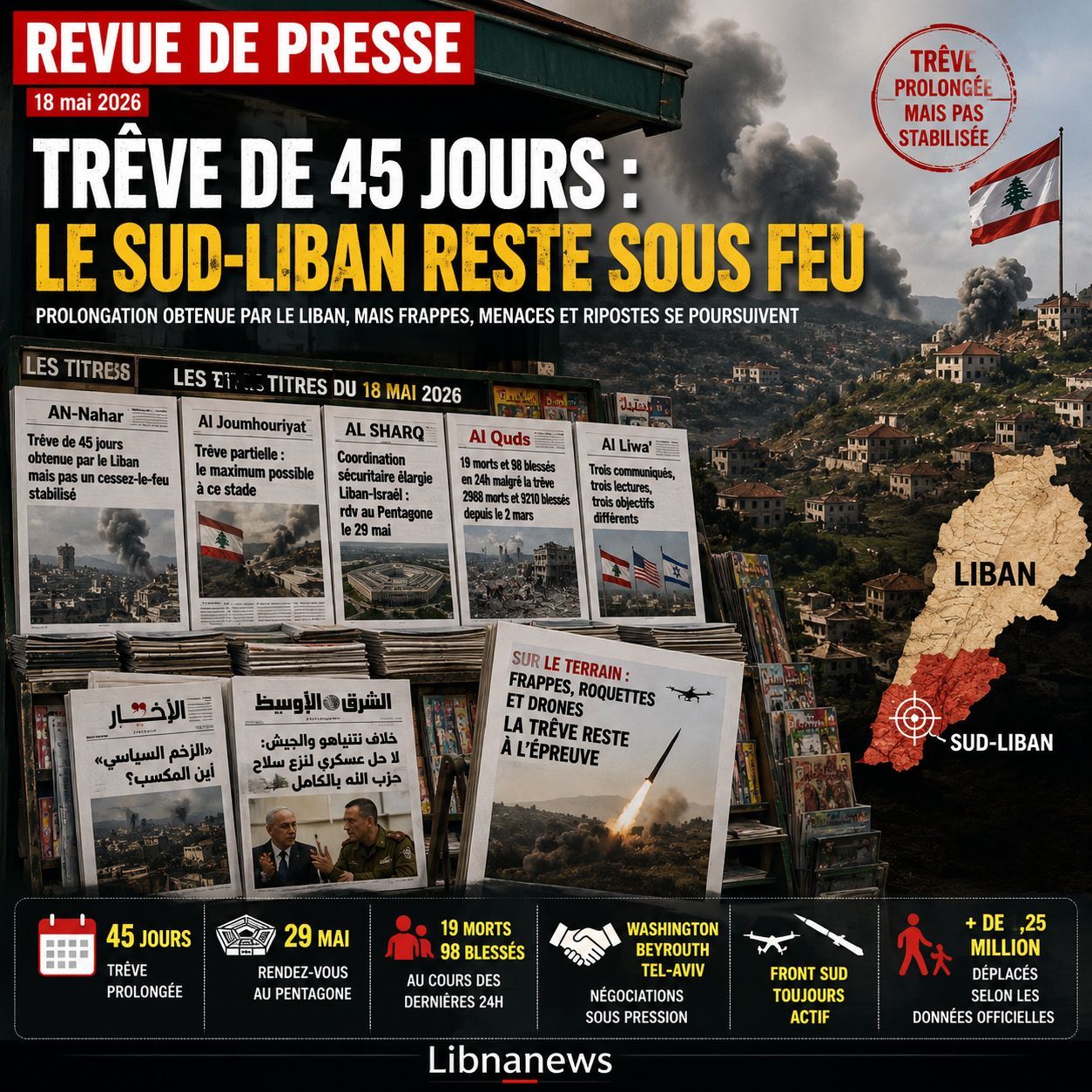
A prolonged truce, but not yet stabilized
The day of May 18, 2026 is dominated by a clear contradiction. Lebanon obtained a 45-day extension of the truce, but the ground remained subject to strikes, threats and responses. Nahar of 18 May 2026 indicates that Beirut insisted on a period of 45 days, while Israel wanted a shorter duration. This duration would have been achieved by American intervention. The same newspaper points out that this extension does not constitute a genuine ceasefire. Israel continues its strikes with a margin of action that sources describe as covered by the right to target Hezbollah’s objectives in the name of its defence. In parallel, Lebanese contacts remain active in building a real stabilization formula before the May 29 session in the Pentagon. Thus, the truce becomes less a cessation of war than a political delay. She gives time to diplomacy. But it does not withdraw its violence from the southern front. Nahar of 18 May 2026 also insists that Western diplomatic sources call for « nothing in expectation ». According to this reading, Tel Aviv will not easily withdraw from the South, and the Washington negotiations cannot be isolated from the Iranian issue and parallel efforts around the Washington-Theran crisis.
Al Joumhouriyat of 18 May 2026 adopts a formula close, but harder. The daily estimates that the 45-day truce, which came into effect from midnight, should not be very different from the two previous versions of the ceasefire. According to political circles quoted by the newspaper, Tel Aviv does not seem ready to accept a full ceasefire as requested by Lebanon. The same text speaks of a partial truce, presented as the maximum that the Lebanese authorities can obtain at this stage. He adds that the success of the diplomatic effort depends on serious US pressure on Israel. Without this pressure, the truce will remain fragile. It will only allow direct negotiations to continue in a less explosive climate, but not in a peaceful environment. This point is central. It shows that diplomacy is advancing without sufficient guarantees. It also shows that the Lebanese State negotiates in a narrow margin, between Israeli pressure, the weight of Hezbollah, and the American will to keep the channel open.
Washington is trying to move the conflict to a political-security framework
The most important innovation is the shift from a simple monitoring mechanism to a wider one. Al Sharq of 18 May 2026 reports that the limited and indirect security follow-up, previously placed at the level of the monitoring mechanism, has moved towards more direct and wider coordination between Lebanon and Israel. According to the newspaper, this new path is to be launched at the US Ministry of Defence on May 29, with military delegations from both countries. The political side is to resume on 2 and 3 June, after three rounds already held. This architecture gives the folder a double way. On the one hand, politics deals with the general form of agreement. On the other hand, security deals with the implementation, Lebanese army, southern areas, guarantees, control and fate of Hezbollah. Al Sharq of 18 May 2026 notes, however, that the third extended round was completed without the Lebanese government obtaining, thanks to American pressure, the cessation of the fire which he had imposed as a condition. On the ground, the daily notes that Israeli attacks intensified in the south and in the Bekaa, while the Lebanese communiqué spoke of tangible diplomatic progress.
A further key to reading is highlighted by Al Liwa on 18 May 2026. The newspaper believes that the third round of direct negotiations between Lebanon and Israel in Washington was not only a new US-sponsored dialogue station. According to this reading, it has become a political and security test for the future of the conflict in South Lebanon. On 18 May 2026, Al Liwas insists on three separate communiqués, Lebanese, Israeli and American. Each reflects a different reading. Lebanon speaks of a ceasefire, guarantees and a return to stability. Israel emphasizes durable security arrangements and the need to prevent the return of armed threats to the South. Finally, Washington seeks to maintain a broad language to avoid the collapse of the process. This difference in vocabulary is not secondary. It reveals a negotiation where the same words hide different objectives. For Beirut, the priority is to end the attacks. For Tel Aviv, the challenge is to change the balance of power in the South. For Washington, the immediate goal is to prevent a return to open war.
The southern front remains the true judge of the truce
Al Quds of 18 May 2026 gives the human and military measure of this impasse. The newspaper reports that Israeli strikes on the southern and Bekaa communities continued, with 19 deaths and 98 injuries in the past 24 hours, despite the Israeli claim to respect the ceasefire. He also cites the Lebanese Ministry of Health, according to which the Israeli offensive since 2 March reached 2,988 dead and 9,210 wounded. Al Quds of 18 May 2026 recalls that Washington announced on the previous Friday a 45-day extension of the agreement. But this announcement comes up against the reality of strikes on the ground. The newspaper also mentions a massive displacement of population, already more than a million and a quarter people according to the official data mentioned. Therefore, the truce is not perceived in the same way by the negotiators and the inhabitants of the South. In the discussion rooms, it can be presented as a chance for the process. In the bombed villages, it may appear as an extension of uncertainty, or even as a further delay under threat.
Nahar of 18 May 2026 describes this same shift from military alerts. The daily reports new Israeli warnings targeting communities in Western Bekaa and Nabatiyah. It also states that the Israeli army has announced the interception of several Hizbullah rockets to its forces in southern Lebanon. At the same time, Hezbollah operations to attack drones and rockets were reported against gatherings of Israeli soldiers. Reports have been received of injuries in Israeli ranks, including officers and soldiers. The terrain thus shows a war scene contained, but not extinguished. Attacks are not broad enough to bring down the whole process. But they are strong enough to empty it of its meaning if they continue. This is why Nahar of 18 May 2026 speaks of a trial period. This term sums up the issue. The truce is not yet a framework. It is a verification test, in which each camp tests the other and seeks not to lose the advantage.
Israel seeks political gain that the land does not guarantee
The Israeli debate weighs heavily on the issue. Al Sharq Al Awsat of 18 May 2026 reports a dispute between Benjamin Netanyahu and the Israeli army over the war against Hezbollah in Lebanon. According to leaks relayed by Israeli media, the army asks the government to provoke a « political breakthrough », because there would be no purely military solution to the disarmament of Hezbollah. The newspaper points out that, even in the event of occupation of all Lebanon, the army could not guarantee the elimination of the party’s last drone capability. Netanyahu responded by accusing the army of deficiencies. He claimed to have identified for several years the danger of Iranian drones, especially after their role in the war in Ukraine. This dispute gives a strong indication. Israel continues military pressure. But part of his security apparatus admits that the military field alone is not enough. The human cost, the drone problem and the duration of the conflict are therefore pushing for a political solution. However, this political solution does not mean relaxation. It can also aim to achieve, through negotiation, what war cannot impose alone.
Nahar of 18 May 2026 reinforces this fact by citing an Israeli source of security that Israel will not stop drone and missile strikes, even in the event of occupation of the entire South Lebanon. This source affirms that a political breakthrough must be achieved while preserving the deterrent capacity in order to change the reality in the South. The newspaper also reports that Yediot Aharonot refers to an Israeli study on the enlargement of the land war in southern Lebanon, for lack of solution to Hezbollah drones. According to Israeli sources cited in the same article, the arrangements discussed with Lebanon would include a military coordination mechanism under American supervision, and this mechanism could be discussed in early June. Nahar of 18 May 2026 finally notes that security sources in Tel Aviv talked about five Israeli conditions for a withdrawal from southern Lebanon. These conditions would have widened the gap in the discussions. This confirms that the issue is not just the duration of the truce. It covers the content of the withdrawal, the role of the Lebanese army, the level of American control and the future place of Hezbollah in the South.
Hezbollah remains absent from the table, but on the ground
The major difficulty lies in the indirect presence of Hezbollah. Al Sharq of 18 May 2026 writes that no Israeli withdrawal, even progressive, is guaranteed in the short term. The newspaper adds that Israel does not yet believe in the ability of the Lebanese state alone to dismantle the armament of Hezbollah. Hezbollah, for its part, does not show a decision to stop the response as long as the Israeli attacks continue. Al Sharq of 18 May 2026 sums up this situation with a series of parallel refusals: no immediate Israeli withdrawal, no Israeli confidence in the Lebanese State’s ability to act alone, no visible complete ceasefire, and no halt to Hezbollah’s responses under the strikes. The problem is therefore structural. Israel is at the table. Official Lebanon too. Washington is in charge. But the actor who holds much of the military map on the field is not sitting directly in the room. This absence complicates any promise. It obliges the Lebanese authorities to negotiate commitments which they must then accept in a delicate internal report.
Al Akhbar of 18 May 2026, in a critical reading of the Lebanese official line, considers that the speech on the « current ceasefire » ignores the perception of the inhabitants of the South, the southern suburbs of Beirut and the Bekaa, who are not living a real suspension of hostilities. The newspaper also criticises the official use of the term « political momentum » and asks what Lebanon has achieved in return. This position reflects the reading of a camp that sees negotiations as a risk of imposed concessions. It cannot be taken as the only analytical grid. But it is useful to understand one of the internal resistances to the process. The debate is not just about Israel. It also focuses on confidence in the state, the scope of American mediation and the fear that the military record will turn into internal political pressure. At the other end of the spectrum, on the contrary, several sources stress the need to give diplomacy a chance to avoid a wider war. It is this tension that defines the current sequence.
A truce suspended from American guarantees
Al Jumhouriyat of 18 May 2026 reports that a security agreement is being drawn up in direct Lebanese-Israeli negotiations under American sponsorship. But the journal states that not all details and phases are complete. He also cites circles where the ceasefire can only be stabilized if Washington exerts serious pressure on Tel Aviv. This dependence on American arbitration is decisive. It shows that the Lebanese State has not yet, alone, sufficient means to impose the cessation of Israeli operations. It also shows that the military calendar is linked to the diplomatic calendar. May 29 at the Pentagon is therefore to be used as a test. He will say whether the 45-day truce can become a starting point, or whether it will remain a simple pause administered between two waves of strikes.
Al-Joumhuriyat of 18 May 2026 further states that Israeli attacks have increased in the south and western Bekaa, resulting in five deaths and dozens of injuries, while Hizbullah responded with drones and rocket weapons against Israeli positions. The same newspaper cites a cumulative assessment by the Lebanese Ministry of Health of 2988 deaths and 9210 injuries between 2 March and 17 May. It also reports a statement attributed to an Israeli security source stating that drone and missile strikes will not stop, even though Israel occupied the entire South Lebanon. The truce is therefore enclosed in a paradoxical logic. It exists in texts, communiqués and calendars. But it remains disputed by military facts. The file is now played between three levels: the front, the Washington table and the Lebanese internal balance. In this equation, the question is no longer just whether the truce has been extended. It is about whether anyone can impose the rules.
Local politics: Lebanese power faced with the dilemma Hezbollah-negotiations
A Presidency at the centre of a fragile balance
Lebanese local policy of 18 May 2026 focuses on a central question: who can guarantee the cessation of fire, and at what internal political cost? Nahar of 18 May 2026 reports that Lebanon continues its efforts between Washington and Beirut to fix the prolonged truce. The newspaper reports that contacts have intensified between official Lebanon, the United States, Israel, and then between the Lebanese government and Hezbollah through the Speaker of the Chamber, Nabih Berri. This data places Joseph Aoun at the centre of a delicate mechanism. The president is seeking US pressure on Israel. But it must also take into account an armed actor who is not confused with the state. Thus, the political scene is not limited to external negotiations. It tests the executive’s ability to speak on behalf of the country, while seeking an agreement with a force that still holds a major part of the military decision on the ground.
Al Sharq Al Awsat of 18 May 2026 describes the same mechanism in more institutional terms. According to Lebanese official sources cited by the newspaper, Joseph Aoun has direct contacts with the American mediator in order to compel Israel to implement the agreement, while Nabih Berri has the link with Hezbollah to guarantee his commitment. The discussions concern the cessation of all military actions on both sides. The aim is to prevent violations that had occurred in previous weeks. This division of roles sheds light on the real functioning of power. Joseph Aoun acts on the international channel. Nabih Berri acts on the internal Shiite channel. The government of Nawaf Salam must maintain the official coherence of a policy that engages the army, institutions and sovereignty. The Lebanese political system therefore appears to be a relay assembly. It advances through successive mediations, rather than a single chain of command.
Al Akhbar of 18 May 2026 gives a more critical reading of the same sequence. The newspaper states that the Presidency is promoting a proposal for a comprehensive ceasefire of military operations, while leaving the Israeli withdrawal file to the outcome of the security and military negotiations. According to Al Akhbar of 18 May 2026, sources close to the case also refer to the role of Lebanon’s ambassador in Washington, Nada Hamadeh, in transmitting information related to American contacts. The newspaper adds that relatives of Joseph Aoun are talking about a coordination with Nabih Berri to join Hezbollah and get his commitment to suspend military operations. This reading reveals the suspicion of part of the political field. For Al Akhbar, the government would sell a stabilization perspective without yet having a solid Israeli commitment. The local debate therefore focuses on both war and confidence in the presidential method.
Hezbollah, absent from the table but present in all the equation
Hezbollah remains the central player in local politics, even when it is not physically present in the negotiating rooms. Al Sharq of 18 May 2026 sums up this contradiction with a series of blockages. The newspaper writes that at this stage there is no guaranteed Israeli withdrawal, even progressive. There is also no Israeli confidence in the Lebanese State’s ability to dismantle Hezbollah’s weapons alone. There is no complete ceasefire in the short term. Finally, there is no clear decision by Hezbollah to stop its responses as long as Israeli attacks continue. This beam of refusal puts the state in the face of a dilemma. He must negotiate with Israel under American sponsorship. But one of the main holders of military decision-making remains outside the direct framework. Thus, Lebanese sovereignty is disputed between an institutional logic and a reality on the ground.
Al Quds of 18 May 2026 reports that reports circulated that Nabih Berri told Joseph Aoun that Hezbollah would respect the ceasefire if Israel respected it. However, the newspaper states that this formula would not be accurate. According to information in Beirut, Nabih Berri would first like a complete ceasefire, then deal with the other files. The shade is important. It shows that Berri does not only present himself as the messenger of Hezbollah. It acts as a guarantor of political priority. First stop the fire. Then the discussions on the heavy issues. This approach seeks to prevent Lebanon from entering into the disarmament or security arrangements debate while the strikes continue. But it does not solve the main question: how can we translate political commitment into effective military discipline on the ground?
Al Quds of 18 May 2026 also highlights the Hezbollah’s official reaction to the anniversary of the 17 May agreement. The party rejects any pressure or external tutelage, American or otherwise, which it believes would seek to impose on Lebanon a path that undermines its sovereignty and independence. He also claims that accepting direct negotiations would strengthen Israeli gains to the detriment of Lebanon and its inhabitants. In another passage, Hezbollah calls on the Lebanese authority to cooperate within the framework of a national consensus to achieve Israel’s complete withdrawal, the definitive cessation of attacks, the release of prisoners, the return of inhabitants and unconditional reconstruction. These positions place the formation of Naim Kassem in a position of pressure on power. It refuses to allow the state to transform the truce into a political concession. It also wants to retain the vocabulary of resistance as the main framework for national decision-making.
Jumblatt reopens the issue of Hezbollah’s decision
Nahar of 18 May 2026 gives the political scene a more personal and direct angle with the words of Walid Jumblatt. The newspaper reports that the leader of Mukhtara said, in an interview given to a French media outlet, that he no longer knew who actually led Hezbollah. He added that the current Secretary-General, Naim Kassem, would be a mere spokesperson, not the true holder of the decision. Joumblatt opposed this situation to the situation that existed under Hassan Nasrallah, with which, according to him, it was possible to dialogue because he knew Lebanon in his own way and had a broad popular base. The formula is politically cumbersome. It is not only aimed at Naim Kassem. She questions the decision structure of Hezbollah after the disappearance of its former leader. It also raises a practical question: with whom can the state or other political forces discuss if the visible interlocutor is not perceived as the real arbitrator?
Nahar of 18 May 2026 also reports the perception attributed to Hezbollah after these statements. According to the newspaper, the party considers that the statements of Jumblatt open doors of irritation and verbal confrontation. He also felt that he had not asked Jumblatt for a dialogue to improve the relationship, the main objective being to maintain a form of management of the disagreement. This point indicates that the relationship between Mukhtara and Hezbollah is not an active alliance, but a controlled coexistence. The tension is old. It comes back here when the country needs internal political channels. The exit of Jumblatt shows that the national dialogue is not only blocked by war. It is also weakened by a crisis of confidence in the representativeness of the interlocutors. In other words, the question is not just what Hezbollah wants, but who can engage it.
At the same time, Al Sharq of 18 May 2026 cites political positions calling for the separation of Lebanese interests from Iranian and Hezbollah choices. The newspaper reports a reading that Nabih Berri’s participation in the follow-up to the negotiation process reflects a form of political realism. This reading considers that Hezbollah’s choices can lead the country to extreme danger, and that the coming period requires a clear commitment on the state monopoly of weapons. Opposite, Al Sharq of 18 May 2026 reports a position of MP Ibrahim Mousawi, a member of the resistance loyalty bloc, who denounces those who, according to him, deny the sacrifice for the homeland and stab the patriots in the back. These two positions draw a local fracture. For some, salvation requires the return of the military decision to the state. For others, resistance remains a part of patriotism, and its challenge is an alignment against it.
The Lebanese Army under political and strategic pressure
Local politics also moved to the army. Al Joumhouriyat of 18 May 2026 stresses that the new security route is a matter of concern to the Lebanese military leadership. The newspaper states that the formation of a future committee or military delegation may become a difficulty, because of the sensitivity of the religious balance. But the main difficulty lies in the contents of the file. The Israeli and American project focuses on the military structure of Hezbollah and its weapons. The daily also quotes from Centcom’s commander, Admiral Brad Cooper, that the main American objective of supporting the Lebanese army is to confront Hezbollah. According to Al Joumhouriyat, this formulation leads to the idea that American annual aid to the army could increasingly be linked to a party disarmament mission.
However, Al Joumhouriyat of 18 May 2026 adds an essential fact. The army leadership has reportedly already indicated on several occasions that it refuses a military shock with Hezbollah for reasons related to the protection of internal stability. This position is decisive for reading local politics. The army can be called upon to step up its deployment. It can also be placed at the heart of the security mechanism with the United States. But it does not want to become the instrument of an internal confrontation. The State is therefore seeking a narrow path. He must convince the outside world that he can regain control of the territory. It must at the same time avoid an internal rupture that would blow up the country. In this equation, the army appears to be both the most demanded and the most exposed institution.
Al Quds of 18 May 2026 states that the meeting scheduled in the Pentagon on 29 May should deal with the limitation of arms, the strengthening of the combat brigades of the Lebanese army, the Israeli withdrawal, the deployment of the Lebanese army, and the activation of the mechanism for monitoring the ceasefire and verification agreement. These points show that local political debate can no longer be separated from military mechanics. Each case refers to a Lebanese institution. The Israeli withdrawal refers to the Presidency and diplomacy. Arms control refers to Hezbollah, Parliament and the government. The strengthening of the army refers to internal balances. Verification refers to the American role. Lebanon is therefore entering a phase where every technical concession can become a political crisis.
Internal files revive sharing logics
The war does not erase other political issues. It sometimes makes them more tense. Al Sharq of 18 May 2026 reports that the dossier of the general amnesty law entered what the newspaper describes as the furnace of the political and religious bazaar. The daily reports that Monday’s advisory meeting remains open despite the planned absence of large parliamentary blocs, including the Lebanese Forces and the independents. He added that several Members felt that the causes that could cause the proposal to fail were still present. Some already refer to different legal issues to release Islamist detainees, such as the special amnesty, the acceleration of trials or their revision. Local policy therefore appears divided between the urgency of the front and the old reflexes of Community negotiations.
Nahar of 18 May 2026, for his part, notes the coldness of the Shiite tandem in the face of the debate on amnesty. The newspaper notes that this tandem does not make this issue a cause of destiny, unlike Sunni MPs who defend the dossier of Islamist detainees. Nor does it push the opposition to the inclusion of persons who are going to Israel, even if it retains its judgment on them. This caution can be read as a tactical choice. The Shiite tandem keeps its forces for war, negotiation and sovereignty issues. It avoids appearing as a central part in a debate that could rekindle unnecessary denominational tensions. But this distance does not remove discomfort. It confirms that Parliament is still crossed by political barter logic.
Al Akhbar of 18 May 2026 adds another local file with appointments in customs. The newspaper reports that some employees refer to the increased influence of the Lebanese Forces in the leadership and attribute the arrival of the official concerned to support from the presidential palace. This statement remains attributed to the daily life and the sources cited by him. However, it illustrates another aspect of the political scene. As the country negotiates its security future, administrations remain places of competition between parties, networks and presidency. The reconstruction of State authority is therefore not limited to the South or weapons. It also involves appointments, administrative neutrality, justice and the ability to prevent each institution from becoming a partisan area of division.
Quote and speech by political figures: sovereignty, war and rejection of 17 May
Joseph Aoun and the institutional language of stability
Al Quds of 18 May 2026 reports that Joseph Aoun called the Kuwaiti Emir, Mechaal Al Ahmad Al Jaber Al Sabah, to discuss developments in Lebanon, Kuwait and the region. The Lebanese President expressed the solidarity of the Lebanese people with the Kuwaiti people in a phase deemed delicate. He also thanked Kuwait for its support for Lebanon and its citizens. The same exchange allowed Joseph Aoun to place his speech in a classic register of Arab relations. He’s not just talking about war. He talks about support, stability and security. According to Al Quds of 18 May 2026, the Kuwaiti emir responded by saying that his country remained alongside Lebanon, especially at this sensitive stage. It also supports the measures taken by Beirut to achieve security, stability and the return of its sovereignty throughout its territory. This vocabulary is important. He gives the presidential speech a diplomatic scope. It seeks to show that the Lebanese crisis is not isolated. It is part of an Arab space where Lebanon still wants to mobilize support.
Al Akhbar of 18 May 2026 presents a more critical reading of the presidential speech. The newspaper states that Joseph Aoun promotes a proposal for a comprehensive ceasefire of military operations, while leaving the Israeli withdrawal file to the outcome of security and military negotiations. According to sources cited by Al Akhbar on 18 May 2026, the Presidency is talking about a contact with Washington to urge Israel to respect the terms of the truce. Joseph Aoun’s relatives also evoke coordination with Nabih Berri. The aim would be to join Hezbollah and secure its commitment to stop military operations. However, the newspaper believes that this speech may give a more reassuring political image than the reality of the field. Thus, the same fact receives two readings. On the presidential side, language is that of a diplomatic chance. On the critical side, it becomes an uncertain betting language. This tension shows that the words of the Presidency are already an internal policy issue.
Nabih Berri and the prudent formula of the ceasefire
Al Quds of 18 May 2026 reports that reports circulated that Nabih Berri told Joseph Aoun that Hezbollah would respect the ceasefire if Israel respected it. However, the newspaper states that this wording is not accurate. According to information received in Beirut, Nabih Berri would first like a complete stop to the fire and then leave the rest of the files at a later stage. This shade changes the meaning of the word. Berri doesn’t give a blank check. Nor does he promise automatic military discipline. He places the order of priorities at the centre of his speech. First the silence of weapons. Then the discussion about the rest. This word is therefore used to protect the Lebanese position. It avoids putting Hezbollah under public engagement before a real Israeli stop. It also avoids giving Israel the opportunity to obtain concessions while the strikes continue.
In the same passage, Al Quds of 18 May 2026 reports that preparations for the security meeting on 29 May in the Pentagon include arms limitation, the strengthening of Lebanese army combat brigades, Israeli withdrawal, the deployment of the Lebanese army and the activation of the ceasefire monitoring mechanism. The speech attributed to Nabih Berri must therefore be read in this context. This is not a simple mediation sentence. This is a political framing. Berri seems to say that the debate on arms cannot precede the cessation of attacks. At the same time, it retains its role as a necessary bridge between the state and Hezbollah. His word therefore has two functions. It calms the institutional scene. It also gives Hezbollah room for manoeuvre. This position reflects a long political method. It consists of not closing the door to negotiations, while refusing to turn Israeli military pressure into a political advantage for Tel Aviv.
Hezbollah between memory of 17 May and refusal of pressure
Al Quds of 18 May 2026 devotes a central place to the Hizbullah communiqué issued on the occasion of the forty-third anniversary of the agreement of 17 May 1983. The party speaks of an agreement of « sham » and « humiliation », according to the translation of the general meaning of the text. He placed the anniversary in a period he considered very dangerous. He referred to the American and Israeli aggression against the region and against Lebanon. It also accuses Israel of continuing the occupation, destruction, assassinations and violation of Lebanese space. Hezbollah’s discourse therefore does not separate historical memory from the present moment. On the contrary, he connects them. May 17 becomes a warning. It serves to say that any direct negotiation with Israel could reproduce, in a new form, a national fault already rejected by Lebanese political history.
Al Quds of 18 May 2026 also reports that Hezbollah rejects any external pressure or tutelage, American or non-American, which seeks to impose on Lebanon a course contrary to its sovereignty, independence and dignity. The party claims that Israeli officials’ statements on settlement or control projects in Lebanon confirm Israel’s ambitions on Lebanon’s land, water and natural resources. He added that accepting direct negotiations would strengthen Israeli gains to the detriment of Lebanon and its inhabitants. This speech is based on three key words: sovereignty, resistance and rejection. Hezbollah is not just talking about its weapons. He seeks to put his weapons in a national vision. This vision is contested by other Lebanese forces. But she remains the heart of her political language.
Al Bina, 18 May 2026, resumes a close line through the positions of national parties and forces hostile to the return of a scenario of 17 May. The newspaper quotes the Syrian National Social Party, according to which the fall of the 1983 agreement had restored to Lebanon its dignity, national identity and membership. The party believes that any attempt to reproduce this experience, in a political or negotiated form, constitutes a direct danger to the national constants and to the unity of the Lebanese. On 18 May 2026, Al Binas added that the leaks around direct negotiations in Washington confirm, according to this current, the gravity of this path. This rhetoric refuses to distinguish clearly between the form of negotiation and its content. For these forces, the very fact of negotiating directly with Israel creates a risk of normalization. Political speech then serves to establish a symbolic limit. She says what must not be crossed, even in the name of the truce.
Fouad Makhzoumi and the speech of the state monopoly
Al Quds of 18 May 2026 reports a position of deputy Fouad Makhzoumi, who claims that the time of weapons outside the state is over. He believes that any future agreement must consolidate the authority of the Lebanese State and reserve to it the decision of war and peace alone. He sees the extension of the ceasefire and the launch of the two US-sponsored political and security tracks as an opportunity to rebuild the state. He also stressed the role of the Lebanese army as the only reference to protect borders, land and people. This speech is in contrast to Hezbollah’s vocabulary. Where the party speaks of resistance, Makhzoumi speaks of a legal monopoly. Where Hezbollah insists on external pressures, Makhzoumi insists on the centrality of national decision-making in institutions.
This position, reported by Al Quds on 18 May 2026, is important because it reflects a Lebanese political current that sees the current sequence as an opportunity. For this current, the ceasefire is not just a military pause. It must become the beginning of an internal reorganization. The sentence on the decision of war and peace is the core of the statement. It directly targets Hezbollah without always naming it as an absolute opponent. She said that lasting stability could not be based on two decision-making centres. Makhzoumi’s speech therefore joins an institutional reading of the crisis. This reading can run counter to the reality of the ground. It can also be accused by its opponents of resuming external pressure. But it clearly exists in the political scene. It recalls that the battle for words also concerns the very definition of the state.
Israeli discourse between military confession and political pressure
Al Sharq Al Awsat of 18 May 2026 reports a very significant internal Israeli debate. According to leaks from the Hebrew media, the Israeli army is calling on Benjamin Netanyahu’s government to bring about a political breakthrough in Lebanon. It claims that there is no military solution to disarm Hezbollah. She adds that even an occupation throughout Lebanon would not guarantee the elimination of the party’s last drone capability. That’s a strong point. He does not come from an enemy of Israel. It comes from within the Israeli security debate. It shows that the war has reached a limit. Fire power can strike. It can destroy. But it is not enough to solve the strategic problem. The Israeli military discourse becomes a confession. It recognizes that the political field is necessary, although this field can be used to impose other forms of pressure on Lebanon.
Al Sharq Al Awsat of 18 May 2026 also reports Benjamin Netanyahu’s reaction. The Israeli Prime Minister accuses the army of shortcomings. He claims to have discovered for six years the danger of Hezbollah acquiring Iranian drones. He said that he had asked the military leadership to act against this risk, especially after the role of drones in the war in Ukraine. This answer shifts the blame to the army. It also targets Israeli opinion. Netanyahu seeks to present himself as the one who had seen the danger before the others. But this word has another effect. It confirms that the drone file became central in the South Lebanon War. It also confirms that the Israeli disagreement is about the method. Do we need more war, or do we need a political breakthrough? The Israeli response remains unclear. But public debate reveals strategic fatigue.
Al Quds of 18 May 2026 quotes an Israeli source of security according to which even a deeper ground advance in southern Lebanon cannot prevent Hezbollah’s strategy of wear and tear, based on rockets and drones. The same source considers that military action alone is not sufficient. It calls for a political breakthrough, while maintaining a long-term military deterrence to change reality. This formula summarizes the most likely Israeli line. She doesn’t want to choose between war and politics. She wants to combine them. The Israeli discourse therefore does not say that war must end. He said that the war must be prolonged by political pressure. For Lebanon, this sentence is heavy. It means that any negotiation could be conducted under threat. It also explains why Lebanese language on guarantees remains cautious.
The speech of the Southern street and the distrust of the truce
Al Quds of 18 May 2026 reports that after the announcement of the 45-day extension of the ceasefire and the preparation of the Pentagon meeting, a wave of anger broke out on social networks. The newspaper evokes a bitter feeling among people in the South, who feel that power has prolonged their suffering for another 45 days. This formula is not an official speech. But it has political value. It shows that the words of the truce are not received in the same way in the chancellery and in the affected villages. For negotiators, the truce gives time. For a part of the inhabitants, it may look like a time frame during which the strikes continue. This social voice weighs heavily on the political scene. It limits the ability of the power to present the sequence as a simple success.
Al Jumhuriyat of 18 May 2026 reports that Israeli attacks have intensified in the south and western Bekaa, with five dead and dozens injured. The newspaper adds that Hezbollah responded with drones and rocket weapons against Israeli positions. He also quotes an Israeli source saying that drone and missile strikes will not stop, even in the event of occupation of the entire South Lebanon. This kind of declaration makes the truce speech very fragile. It gives internal critics a direct argument. How can we talk about calming down if security officials or sources are already talking about continued strikes? Thus, the quotations of May 18 build a divided scene. Some speak of state, sovereignty and stability. The others speak of resistance and refusal. Israel speaks of a political breakthrough under military pressure. Between these registers, Southern speaking remains the most concrete. She first asks that the fire stop.
Diplomacy: Washington installs two negotiation channels
American mediation becomes centre of gravity
Nahar of 18 May 2026 presents the extension of the 45-day truce as a result of Lebanese insistence and American intervention. The newspaper said that Lebanon wanted this duration, while Israel wanted a shorter period. But Nahar of 18 May 2026 also states that this extension does not yet set the ceasefire. Rather, it opens a new trial period. The same newspaper reports that contacts continued between Washington and Beirut to install a mechanism before the meeting scheduled for 29 May in the Pentagon. This data places the United States at the heart of the case. Washington is no longer just sponsoring exchanges. It sets the pace, protects the canal and keeps hands on the transition from the truce to a more sustainable setting.
Nahar of 18 May 2026 also cites Western diplomatic sources who call for « nothing in expectation ». According to these sources, Israel will not easily withdraw from southern Lebanon. They also believe that the Washington negotiations cannot be separated from what is happening on the Iranian side and in Pakistan’s contacts. Thus, Lebanese diplomacy is not taking place in a regional vacuum. It depends on a wider climate. If the canal between Washington and Tehran blocks, the south front can become harder again. If appeasement is emerging, Lebanon can benefit from a more favourable space. The 45-day truce thus becomes a fragile diplomatic tool. It gives time, but it does not yet give a guarantee.
The Pentagon as a place for the security component
Al Sharq of 18 May 2026 describes the most clear change in the process. According to the newspaper, limited and indirect security coordination, previously linked to the monitoring mechanism, has moved towards more direct and wider coordination between Lebanon and Israel. This new course is to be launched in the US Department of Defence on May 29, with the participation of military delegations from both countries. The political side must resume on 2 and 3 June, after three rounds already held. This calendar creates a two-tier architecture. The first deals with security, army, surveillance and the ground. The second deals with the political agreement, guarantees and place of Lebanon in the post-treve.
However, Al Sharq of 18 May 2026 points to a contradiction. The third extended round of direct negotiations began and ended without the Lebanese government obtaining, by American pressure, a complete cessation of the fire it had imposed as a condition. The newspaper also notes that the Lebanese communiqué referred to concrete diplomatic progress, as Israeli attacks continued in the south and the Bekaa. This distance between the diplomatic text and the terrain is central. It shows that Washington is seeking to preserve the process, even without immediate cessation of hostilities. It also shows Beirut’s willingness to remain at the table, as the rupture of the canal could pave the way for a wider war.
Three press releases, three readings
Al Liwa The newspaper describes it as a political and security test for the future of the conflict in southern Lebanon. It notes that three separate communiqués have been issued, Lebanese, Israeli and United States. Each reflects a different vision. The Lebanese communiqué insists on the actual establishment of the ceasefire, the safeguards and the cessation of attacks. The Israeli communiqué focuses on durable security arrangements and preventing the return of armed threats to the South. The American text seeks to maintain a broad language to avoid the collapse of negotiations.
This difference in vocabulary, noted by Al Liwa The three parties are not looking for the same at the same time. Lebanon wants first to stop the strikes and get a withdrawal. Israel wants to transform the truce into a long-term control mechanism. Washington wants to avoid a regional explosion while keeping Israel in a framework that it considers acceptable. The result is ambiguous diplomacy. Words are flexible enough for each camp to accept them. But this flexibility pushes hard questions. It does not yet resolve the fate of the occupied areas, the control of the South, the place of the Lebanese army, or the issue of Hezbollah’s weapons.
A long truce, but under American conditions
Al Joumhouriyat of 18 May 2026 reports that the 45-day extension was considered significant, as it is longer than the previous one. The newspaper adds that several western capitals, especially Washington, had warned of the possibility of an Israeli return to an open war against Lebanon in the coming weeks. According to Al Jumhouriyat of 18 May 2026, the acceptance of a longer truce gives the impression that the United States does not, for the moment, want to expand the fire in Lebanon. This American caution would be linked to the priority given to the Iranian case. But the newspaper states that this does not eliminate the risk of local confrontations or targeted strikes.
Al Jumhouriyat of 18 May 2026 also reports that the American Ambassador to Lebanon, Michel Issa, addressed the head of the Israeli delegation during the Washington talks. He alleged that he had received a Lebanese request for the longest possible extension of the truce, which he supported. After the adoption of the 45 days, he would have expressed his delegation’s hope that the deadline would produce practical measures on the part of Lebanon on the issues on the table. This formulation is important. It shows that Washington is not just stopping Israel. She also awaits Lebanese actions. American mediation therefore works as a two-way pressure. It retains Israeli escalation, but it pushes Beirut towards clearer security choices.
Lebanon seeks guarantees, not just time
Al Joumhouriyat of 18 May 2026 indicates that the Lebanese-Israeli meetings under American sponsorship resulted in an agreement in principle on a global stop to fire during the truce, so that negotiations could continue in a more calm climate. The newspaper states that these discussions must take place on two tracks, security and politics, between the Pentagon and the US State Department. This presentation gives a form to the ongoing diplomacy. The security component must address controls and field actions. The political side must address the end of the state of war and the general framework. But the same newspaper recalls that the fate of the truce depends on Israeli engagement. The keyword therefore remains the guarantee.
Al Quds of 18 May 2026 specifies the expected content of the security meeting on 29 May in the Pentagon. The newspaper refers to the discussion on arms limitation, the strengthening of Lebanese army combat brigades, the Israeli withdrawal, the deployment of the Lebanese army and the activation of the ceasefire monitoring mechanism. This programme shows that diplomacy is no longer just a discussion of stopping strikes. It touches the heart of Lebanese balance. It involves the army, institutions and sovereignty. It also raises a sensitive question. How can we strengthen the state without causing an internal crisis around Hezbollah? It’s the knot of the American route.
The Lebanese Armed Forces at the centre of the planned arrangement
Al Joumhouriyat of 18 May 2026 describes the transition from a management of confrontation to the attempt to build a longer political and security framework. But the newspaper insists that the road remains dangerous and strewn with obstacles. He believes that the phase is more like a truce negotiated under fire than a path to a stable peace. This formula summarizes the diplomacy of the moment. The channels are open. The dates are set. But the military scene continues to weigh on every sentence. The slightest hook can change the balance. The slightest Israeli refusal can deprive the truce of its meaning. Any Lebanese disagreement on weapons can block the security side.
Al Joumhouriyat of 18 May 2026 adds that if negotiations become officially a disarmament calendar, the risks of political and possibly security tension will increase within Lebanon. The newspaper notes that this prospect worries the army leadership. This is crucial to understanding Lebanese prudence. The military is sought by the United States and international partners. It is called upon to control the South further. But she doesn’t want to become the instrument of an internal shock. American diplomacy is pushing for clarification. The Lebanese context is pushing for prudence. Between the two, the presidency and the government are looking for a formula that avoids external war and internal crisis.
Israel seeks coordination under American supervision
Al Sharq Al Awsat of 18 May 2026 reports that Israeli media are talking about a continuation of the war within the limits set by Donald Trump. According to these reports, these limits would prevent Israel from hitting Beirut and the Bekaa, while allowing it to continue to pursue Hezbollah objectives in southern Lebanon. This reading places the White House in a position of military regulation. It does not put an end to Israeli action. It defines its boundaries. For Lebanon, this is a heavy point. It means that American diplomacy can limit the scale of the war, without imposing yet a complete halt to the strikes.
Al Sharq Al Awsat of 18 May 2026 also cites Israeli sources repeated by Haaretz, according to which discussions with Lebanon refer to the establishment of a military coordination mechanism under American supervision. This coordination could be discussed in early June and include intelligence cooperation. But the newspaper points out that this mechanism is far from being acquired. The detail is important. It shows that the discussions are already going beyond the mere ceasefire. They relate to verification, information exchange and control of movements in the field. This is where diplomacy becomes very sensitive for Beirut. Any mechanism too direct could be denounced as standardization. Any too weak mechanism would be rejected by Israel.
Iranian case weighs on Lebanese front
Al 3arabi Al Jadid of 18 May 2026 puts the Lebanese case back in the confrontation between Washington and Tehran. The newspaper reports that Fars agency, close to Iranian conservative circles, published five American conditions and five Iranian conditions for an agreement. According to Al 3arabi Al Jadid of 18 May 2026, Iranian conditions would include the end of the war on all fronts, especially in Lebanon, the lifting of sanctions, the release of frozen Iranian funds, compensation for war damage and the recognition of Iranian sovereignty over the Strait of Ormuz. This reference to Lebanon under the conditions assigned to Tehran confirms that the southern front has become a regional map.
Al Sharq of 18 May 2026 reports that Pakistan’s unannounced visit to Tehran, Mohsen Naqvi, seeks to prevent the complete collapse of negotiations between the United States and Iran. The same newspaper reports that Benjamin Netanyahu spoke with Donald Trump on the background of regional tensions and discussions on a possible resumption of the war against Iran. Thus, diplomacy around Lebanon and diplomacy around Iran are moving forward in mirror. One influence the other. If the Pakistani channel fails, Israel can harden its calculations in Lebanon. If Washington keeps the Iranian channel open, it can try to contain the war in the South.
Al Sharq Al Awsat of 18 May 2026 also reports that talks to end the war, with Pakistani mediation, have been blocked since both sides rejected their respective proposals. The newspaper adds that Iran’s Foreign Minister, Abbas Araghchi, said Iran had received messages from Washington indicating that Donald Trump’s administration remained ready to continue the discussions. This information gives a key reading to American prudence in Lebanon. Washington keeps several files open at once. South Lebanon, Iran, Israel, the Gulf and energy balances are responding. Lebanese diplomacy is therefore taken in a wider space, where each case also serves as a lever on others.
International policy: Iran, Iraq, Gaza and Fatah in a tense region
Washington and Tehran in the face of the blockage of conditions
Al 3arabi Al Jadid of 18 May 2026 places the confrontation between the United States and Iran at the forefront. The newspaper reports that the Fars agency, close to the body of the Revolutionary Guards, published five American conditions and five Iranian conditions for a possible agreement. The title highlights a facade symmetry, but the content shows above all the extent of the blockage. Among the American conditions cited are the refusal to pay compensation to Iran. On the Iranian side, the demand for the release of frozen Iranian funds appears to be a central point. Al 3arabi Al Jadid of 18 May 2026 binds this arm to a call between Donald Trump and Benjamin Netanyahu on the war against Iran, as well as to coordination between the Israeli and American armies. The sequence therefore goes beyond a simple round of negotiations. It shows a balance of power where military threats, financial conditions and regional issues are dealt with together.
Al Sharq Al Awsat of 18 May 2026 describes the same crisis in a register of escalation. The newspaper reports that Donald Trump threatened Iran with serious consequences if its leaders did not hasten. He wrote that time was running out and that Iran had to act very quickly. This warning comes after a telephone interview with Benjamin Netanyahu on the Iranian case. Al Sharq Al Awsat of 18 May 2026 adds that a meeting in the White House Crisis Room was expected with senior national security advisers to discuss military options against Iran. In this reading, diplomacy remains open, but it advances under threat. The American message aims to force an improved Iranian offer. But he can also harden the Tehran line, which sees military pressure as proof of the lack of political guarantees.
Al Sharq Al Awsat of 18 May 2026 also reports that discussions to end the war, with a mediation from Pakistan, ended after the mutual rejection of the proposals. Iranian Foreign Minister Abbas Araghchi reported that Tehran had received messages from Washington saying that the Trump administration remained ready to continue the talks. At the same time, Pakistani Interior Minister Mohsen Naqvi travelled to Tehran to facilitate trade. He met Iranian President Massoud Pezeshkian, then Mohammad Bagher Ghalibaf. This mediation illustrates the paradoxical state of the case. The channels are not closed. Yet the positions remain very distant. For example, Pakistan is trying to avoid a wider resumption of hostilities, while Washington and Tehran are still seeking an advantage before any concession.
Israel, Iran and the regional war contained
Al Sharq Al Awsat of 18 May 2026 reports an Israeli analysis according to which Donald Trump opened a war against Iran, then tried to recover by political means what military action had not obtained. According to that reading, the negotiations initiated after the ceasefire were considered sterile, as the differences between the positions of the two sides would be difficult to bridge. The analysis cited also believes that Tehran believes that Trump has seen Trump step back first when he agreed to stop the fire. It deduces that Iranian officials could choose to hold, refuse concessions, and then wait for internal and external pressure to push Washington to close the war. This reading grid is not neutral. It comes from a worried Israeli space. But it sheds light on the perception of some of the security environments close to Tel Aviv.
Al Sharq Al Awsat of 18 May 2026 also evokes an Israeli line that sees pressure on Iran as a means of reshaping regional balance. According to the analysis quoted by the newspaper, Donald Trump could manage to encircle Iran by soft force, instead of seeking to bring down the regime by military force. This idea is based on a strategy of political, economic and diplomatic exhaustion. It shows that the war is not limited to strikes. It extends into sanctions, alliances, ports, trade routes and corporate effects. For Lebanon, this is essential. The southern front is not isolated. It is one of the theatres of a wider crisis, where Iran, Israel, the United States and the Gulf countries are seeking to re-design their security margins.
Iraq under suspicion of secret Israeli bases
Al Quds of 18 May 2026 reports, based on an investigation by the New York Times, that Israel had prepared a secret site in Iraq during the previous year to use it against Iran. The newspaper also mentions the existence of a second Israeli site, distinct from that discovered after a shepherd spotted a military installation in the desert. According to Al Quds’ account of 18 May 2026, this shepherd, named Awad Al Shammari, saw soldiers, helicopters, tents and a runway before being killed in an attack on the vehicle carrying him. This case puts Iraq in a very sensitive situation. Baghdad is allied with Tehran on several cases. However, according to the sources cited, its territory was used for Israeli operations against Iran.
Al Joumhouriyat of 18 May 2026 also takes up this file. The newspaper reports that the discovery of Al Shammari revealed that Iraq had intermittently hosted two secret bases run by Israel for more than a year. Iraqi and regional officials quoted by the daily report that one of these bases was used to support military operations against Iran. The newspaper adds that the Wall Street Journal had already published information on an Israeli site in Iraq, before Iraqi officials confirmed in the New York Times the existence of a second undeclared base in the Western Iraqi desert. This case directly threatens Iraqi sovereignty. It can also fuel pressure from Iraqi armed groups close to Iran against the American presence.
Al Quds of 18 May 2026 still reports that two Iraqi security officials claimed that Washington had ordered Iraq to close its radars during the previous June war and during the current war launched at the end of February. The closure would have made Baghdad more dependent on United States forces to detect any hostile activity. If this information is confirmed, it adds a serious dimension to the case. It no longer concerns only an illegal Israeli presence. It also affects the American role in Iraq’s ability to monitor its own space. The question then becomes twofold. Has Iraq lost control of part of its desert territory? And did the United States limit its control capacity at the very moment when Israel was using that territory against Iran?
Gaza, protracted war and pressure on civilians
Al Quds of 18 May 2026 reports that the Israeli army continued its offensive in the Gaza Strip despite the ceasefire that entered into force on 10 October. The newspaper reports that at least six Palestinians were killed and that others were injured by Israeli drone strikes in several areas of the territory, including Al Mawasi, west of Khan Yunes, yet presented by Israel as a safe area. The Ministry of Health in Gaza, quoted by Al Quds on 18 May 2026, claims that the war’s record exceeded 72,000 deaths. These figures give the Palestinian issue a central place on the international scene. They also show that the ceasefire, as in Lebanon, does not mean a real end to violence.
Al 3arabi Al Jadid of 18 May 2026 reports that Benjamin Netanyahu claimed that Israel now controlled 60 per cent of the Gaza Strip, compared with 50 per cent at the time of the truce agreement. He added that the Israeli objective remained to ensure that Gaza no longer posed a threat to Israel. This statement sheds light on the logic of the Israeli operation. The truce does not prevent the extension of territorial control. It can even be used to consolidate military gains. For Palestinians, this means that the issue is not just about stopping strikes. It also covers territorial control, the return of displaced persons, so-called safe areas and the risk of prolonged de facto occupation.
Fatah after Congress: visible names, program absent
The Palestinian scene is also marked by the results of the eighth Fatah Congress. Al Quds of 18 May 2026 reports that Marwan Barghouti, who has been detained in Israeli prisons since 2002, came to the top of the competition for the central committee with 1879 votes. He ahead of Majed Faraj, head of Palestinian intelligence, who obtained 1861 votes. Then came Jibril Rajoub with 1609 votes, Hussein Al Sheikh with 1570 votes, Leila Ghannam with 1472 votes, Mahmoud Al Aloul with 1469 votes, Tawfiq Al Tirawi with 1361 votes and Yasser Abbas with 1290 votes. These results place one prisoner at the symbolic top of the elective hierarchy, while figures linked to the security apparatus or political succession also reinforce their presence.
Al Sharq Al Awsat of 18 May 2026 writes that the elections of the Central Committee showed the advance of what the newspaper calls the « generation of the interior », i.e. the cadres active in the West Bank and Gaza, against the old Fatah current. The newspaper recalls that the internal system provides for the election of 18 members of the central committee and 80 members of the revolutionary council, with the possibility for the president of the movement to appoint three additional members. Al Sharq Al Awsat of 18 May 2026 also highlights the entry of personalities such as Majed Faraj, Zakaria Zubeidi and Yasser Abbas. This recomposition indicates a partial transition, but not a complete rupture. The weight of old networks remains. However, the vote shows a demand for renewal, under the combined effect of the war, of the wear and tear of the Palestinian Authority and of the uncertainty over the post-Mahmoud Abbas.
Nahar of 18 May 2026 proposes a more critical reading of this sequence. The newspaper believes that the entry or rise of Yasser Abbas, son of President Mahmoud Abbas, can reinforce Fatah’s wear and tear image and recall Arab precedents of dynastic power transmission. The daily adds that last-minute agreements and external pressures have often played a role in the management of voids within the Palestinian Authority and Fatah. This analysis shows that the Congress does not address the issue of legitimacy. He’s moving it. Marwan Barghouti’s symbolic victory expresses a popular expectation. But the practical organization of power remains in the hands of institutional, security and family networks.
The Gulf is redrawing its roads against the risk of Ormuz
Al 3arabi Al Jadid of 18 May 2026 reports that the American, Israeli and Iranian war, as well as tensions around the Strait of Ormuz, caused a major disturbance in the maritime and energy transport of the Gulf. The paper quotes an analysis of the Institute for International Policy Studies in Milan, according to which the crisis has radically altered the trade and energy map in the region. The Gulf States are therefore accelerating the construction of land and sea corridors capable of protecting commercial traffic. This development is not only economic. It reflects a strategic fear: that of Ormuz becoming a permanent blocking point in any crisis with Iran.
Al 3arabi Al Jadid of 18 May 2026 indicates that the Gulf States’ foreign trade in goods amounts to $1.6 trillion, according to Gulf Statistical Centre data. The same box mentions a gross domestic product of approximately $2.3 trillion and an average per capita gross domestic product of $38,200. These figures give the measure of the issue. A prolonged crisis around Ormuz would not only affect oil exports. It would affect imports, supply chains, ports, insurance prices and diversification plans. Alternative roads therefore become a national security priority. The Gulf seeks to reduce its dependence on a single sea crossing while preserving its role in world trade.
Al Quds of 18 May 2026 also reports that Iraq has announced the completion of 94 percent of the electricity connection project with the Gulf States. The Iraqi Ministry of Electricity is talking about a project between the Wafra station in Kuwait and the Al Faw station in southern Iraq, about 285 kilometres long. This dossier seems technical, but it is part of the same regional logic. States are seeking to weave common infrastructure to cushion shocks. In an area marked by the Iran-United States-Israel war, secret bases in Iraq, Lebanese and Palestinian fronts, and pressure on Ormuz, power grids, ports and roads also become political instruments.




