

Cash economy in Lebanon: a confidence test
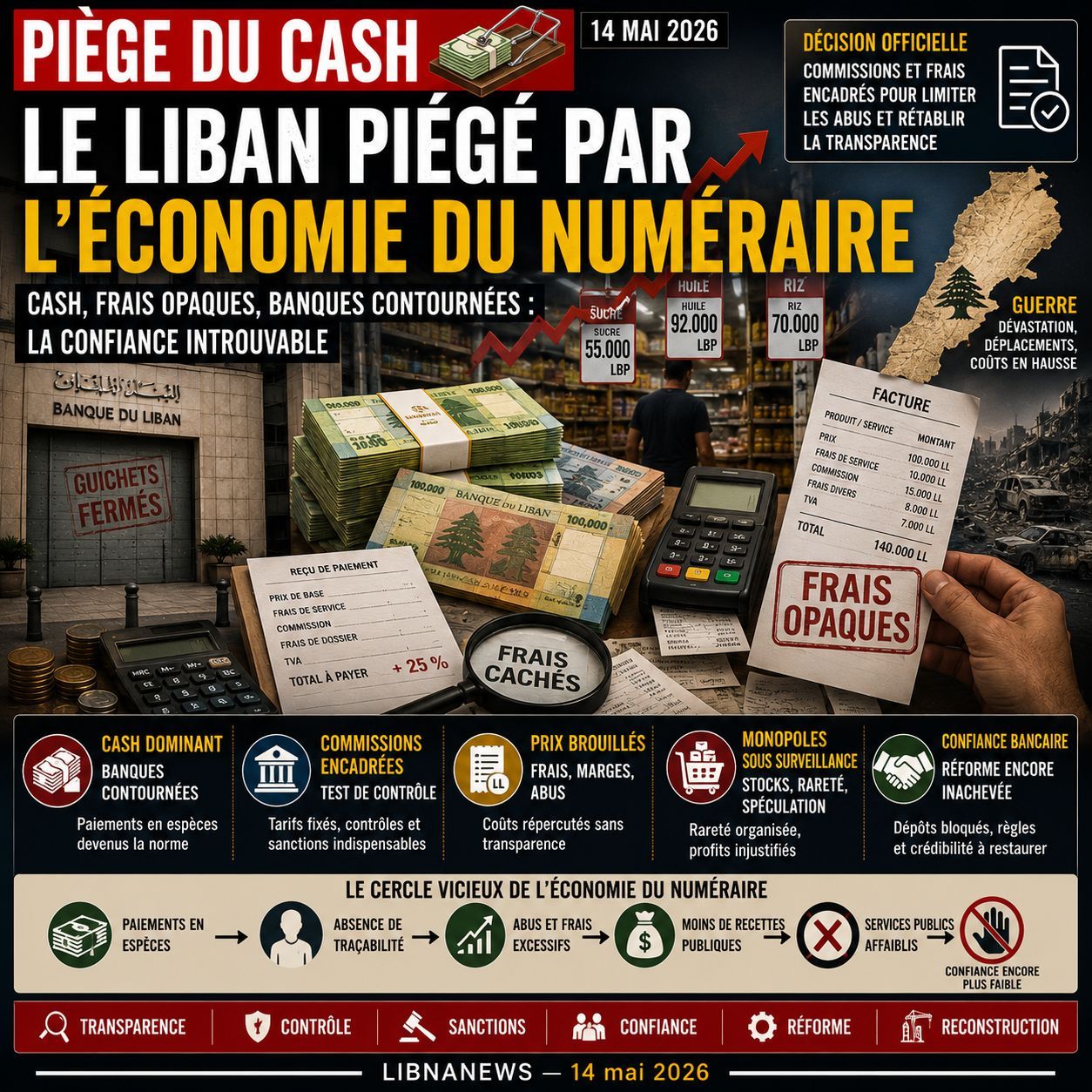
The cash economy in Lebanon is no longer just a habit of crisis. It has become a mode of operation that bypasses banks, blurs prices and makes public control more difficult. The recent decision by a formal financial institution to fix the fees and costs due by the different parties therefore opens an important test. It aims to limit abuses, reduce arbitraryity and provide a more readable framework for payments in a country where financial confidence remains deeply affected.
The subject may seem technical. But it affects everyday life. Every blurred commission, every fee added without justification and every cash payment required reinforces a parallel economy that escapes the common rules. Consumers do not always know what they are paying. The company does not always know what burden to integrate. The administration struggles to track flows. The market is becoming more opaque. In this opacity, monopolies and speculation can flourish.
Lebanon is emerging from several years of banking crisis without a full return to a normal relationship between citizens and financial institutions. Blocked deposits, informal restrictions, multiple rates and loss of confidence pushed households and businesses to cash. This shift allowed us to continue to buy, sell and pay. But it has also created a permanent precautionary system, where everyone seeks protection against banks, price variations and unpredictable decisions.
The decision on commissions and fees does not resolve this crisis. It reveals one of the knots. To get out of the cash economy, it is not enough to ask citizens to use the formal channels again. They must be shown to be less expensive, more transparent and safer than private arrangements. This proof must be practical. It must appear in receipts, prices, payments, controls and sanctions.
Commissions as a symptom of opacity
The commissions occupy a discreet place in the public debate, but they play a central role in price formation. A bank commission, a service charge, a withholding on a payment or a cost imposed by an intermediary may seem modest in isolation. In addition, these fees change the final price. They can also create a grey zone, especially when no one clearly knows which actor has the right to impose them, at what level and on what basis.
In a normal market, fees are published, comparable and questionable. The customer can change supplier. The company can forecast its costs. The supervisory authority may sanction abuses. In the Lebanese case, this architecture was weakened by the crisis. The decline in bank payments, the increase in cash payments and the fragmentation of practices have given more weight to actors able to impose their conditions.
The setting of commissions and fees by an official financial institution therefore seeks to restore a minimum order. But the ad is not worth applying. The real challenge lies in surveillance. Who will check that the rates are respected? Who will receive the complaints? Who will have the power to punish? What documents should be provided to the consumer? Without concrete answers, the decision will remain a signal. With regular checks, it can become a beginning of discipline.
The issue is also social. Opaque costs weigh more heavily on modest households and small businesses. A major economic player can negotiate. An ordinary client is suffering. A small trader often accepts an additional cost not to lose an operation. A family that has to pay an urgent bill does not always have the time to compare. So opacity is a form of inequality.
The final price becomes a conflict ground
War and insecurity reinforce this problem. When imports become more expensive, when insurance increases, when roads appear more risky and when energy costs more, prices are already rising with real factors. But in an emergency climate, it becomes more difficult to distinguish the legitimate cost of abuse. Each increase can be justified by war. Each margin can be presented as a risk protection.
This opens the way for speculation. An actor with a stock can delay the sale pending an increase. An importer can expand its margin on the basis of uncertainty. A distributor can pass on the same cost several times. A retailer can round the prices to cover themselves. The consumer sees only the bill. He does not have access to the full price training chain.
The fight against the cash economy is therefore also a fight for price traceability. Formal payments leave traces. They allow comparison, audit and control. Payment in cash sometimes protects the consumer against certain bank charges, but it also protects the seller who wants to avoid tax, hide his margin or practice variable prices according to the customer. It is this ambivalence that makes the file difficult.
The state cannot simply denounce cash. In the crisis, the liquid was used as a refuge. It has protected households from bank uncertainty. It allowed businesses to continue operating. Nor can the state accept that cash becomes the sustainable norm. An almost fully liquid economy reduces fiscal control capacity, weakens monetary policy, facilitates monopoly practices and makes statistics less reliable.
Link to banking reform
The banking reform under discussion gives a second background to this test. The amendments examined reinforce the role of the Banking Supervisory Commission, reorganise the higher banking authority and specify the treatment mechanisms for banks in difficulty. They include tools such as debt reduction, conversion of liabilities into financial instruments, asset transfer or organised liquidation. These elements belong to the bank resolution site, but they also influence the cash economy.
The reason is simple. Citizens will not abandon the cash until they know what a bank promise is worth. An account must be accessible. A transfer must be useful. A formal payment must be accepted without arbitrary discount. A card must be able to pay at no excessive cost. A bank must be seen as a place of preservation, payment and credit, not as a blocking space. Banking reform must therefore restore the bank’s practical function, not just its balance sheet.
The amendments also refer to the order of distribution of losses between shareholders, creditors and depositors. This remains a decisive point. If applicants consider that the reform imposes most of the cost on them, the distrust will continue. If shareholders and responsible actors do not bear a visible share of the losses, the system will appear unfair. If decisions lack transparency, citizens will keep their money out of banks. In this case, no decision on commissions will suffice to bring payments back into formal channels.
The credibility of the Bank of Lebanon, led by Karim Suaid, and the supervisory authorities will therefore depend on two parallel movements. The first is to treat fragile banks with clear rules. The second is to regulate daily consumer practices. The great reform and the small cash receipt belong to the same problem. They say whether the system inspires confidence or not.
Institutions facing the enforcement test
Lebanon suffers less from a lack of texts than a lack of execution. Many decisions can be announced. Their effect then depends on the controls. In the case of commissions, enforcement must be visible. The actors concerned will have to know the authorised costs. Clients will need to be able to identify abuses. The authorities will have to publish, monitor and sanction. If offenders do not risk anything, the rule will become optional.
Monitoring must also avoid selectivity. In a fragmented market, only small players are sometimes controlled, while the most powerful escape punishment. A policy of combating monopolies and speculation cannot work that way. It must target complete channels: importers, distributors, platforms, financial institutions, traders and intermediaries. The consumer must see that the control does not stop at the last link.
The State must also distinguish between administrative errors and organised practices. A small trader may misapply a new rule. An economic network may use opacity to impose unjustified prices or charges. Sanctions must be proportionate, but real. They must be corrected without destroying, except in cases of repeated fraud or obvious manipulation.
Public information will be a central tool. A scale that no one understands does not protect anyone. Authorized rates must be broadcast in plain language. Complaint procedures must be accessible. Sanctions decisions must be known. The more the rule becomes visible, the easier the abuse is. Transparency does not eliminate fraud, but it reduces its space.
Monopolies and organised scarcity
The reference to monopolies in the currency economy debate is not secondary. A liquid and poorly controlled economy facilitates concentration of power. A person who controls a stock, an import channel, an indispensable service or a payment infrastructure may impose its conditions. If transactions remain untraceable, it becomes more difficult to prove abuse.
War increases this risk. Some goods become rarer. Supply delays are increasing. Transport costs are increasing. Households buy for fear of missing. Companies protect their stocks. In this context, a dominant actor can organize rarity or exploit it. It can sell more expensive, impose a cash payment, refuse certain means of payment or add unjustified charges.
The fight against monopolies cannot be limited to declarations. It requires data. It is important to know who matters, who stores, who distributes, at what price, with what volumes and on what deadlines. However, the cash economy reduces the quality of the data. It makes it more difficult to recover margins. It also weakens the tax administration’s ability to identify differences between actual volumes and reported figures.
The restoration of formal payments must not become a blind constraint. It must be accompanied by lower transaction costs. If paying by official means is too expensive, the actors will continue to choose the cash. The fight against monopolies therefore joins that against excessive commissions. Formal payment must be simple enough and inexpensive enough to become rational again.
Informal economy as a response to fear
The informal economy often thrives on fear. Afraid not to get his money back. Afraid of a bank blocking an account. Fear of a new regulatory change. Fear of an increase in the dollar. Fear of poorly applied control. In Lebanon, these fears are not abstract. They come from concrete experiences. That is why the exit from the cash economy must be gradual and credible.
Force too fast can produce the opposite effect. If the state imposes formal payments without restoring confidence in banks, the actors will look for other ways. They will multiply intermediaries, foreign accounts, split payments or private arrangements. The formal rule will then move to new information. The result will be more complex, not more transparent.
The correct method is to make formal choice. This involves capped fees, quick deadlines, clear rights, effective remedies and minimum deposit protection. It also requires stable rules. A trader or consumer can adapt to a clear constraint. It cannot plan if the rule changes without notice or if its application depends on the interlocutor.
The informal economy is not always a fraud choice. It can be a survival choice. But when she settles down, she creates her own abuses. It protects the most agile and penalizes those who do not have networks, information or bargaining power. That is why the fight against money must not be punitive at the outset. It must be restorative. It must rebuild institutions that citizens have reason to reuse.
Consumers at the centre of the scheme
Consumers are often presented as the final victim of rising prices. He must also become an actor in control. To do so, he must receive clear information. A displayed price must correspond to the price paid. The additional costs must be justified before the operation. Commissions must be visible. Methods of payment accepted must be known. Complaints must be dealt with quickly.
This protection is essential at a time when households are exposed to several pressures at a time. War weighs on travel and incomes. Imports can become more expensive. Electricity and fuel remain heavy stations. Displaced families must incur unforeseen expenses. In this context, a few opaque costs can aggravate an already tense situation.
Small businesses need the same clarity. They cannot build their prices if the commissions change according to the channels, intermediaries or practices of the moment. A legible regulation can help them to avoid undue costs. It can also reduce unfair competition from those who use cash to hide margins or avoid burdens. Formality must not be a handicap to honest business.
Price control should not mean general administrative fixing. Lebanon needs markets that work. But a market does not work properly if the basic rules are opaque. The aim must be to ensure transparency of costs, traceability of transactions and penalties for abuses. Competition can only play its role if players have reliable information.
A project that goes beyond finance
The exit of the cash economy in Lebanon exceeds finance. It affects taxation, competition, consumer protection, banking reform, monetary stability and economic reconstruction. It also calls for an improvement in administrative quality. Departments, financial authorities, municipalities and oversight bodies must share data and act consistently.
It’s a difficult time. The country faces war, displacement, the fall of tourism, agricultural losses and the rise of several indirect costs. In this context, the cash economy may seem simpler. It allows you to go fast. It avoids certain procedures. It gives the seller as well as the buyer the impression of keeping control. But this simplicity has a collective price. It reduces visibility, promotes abuse and weakens the state.
The decision to set fees and fees can therefore serve as a starting point. It will only be useful if it is incorporated into a wider series of actions. Simple rules should be published, intermediaries should be monitored, small consumers should be protected, banking reform should be advanced, excessive costs should be reduced and monopoly practices should be punished. It will also be necessary to avoid imposing on the market a brutal formalisation which banks would not be ready to support.
The next indicator will be concrete. Citizens will look at whether fees are actually falling, whether prices are becoming more legible, whether abuses are being punished and whether formal payments can be made again. Companies will observe whether the rules apply to all. The authorities will have to show that the fight against the cash economy is not limited to a slogan, but begins with clearer receipts, supervised commissions and controls that reach the most powerful actors.




