

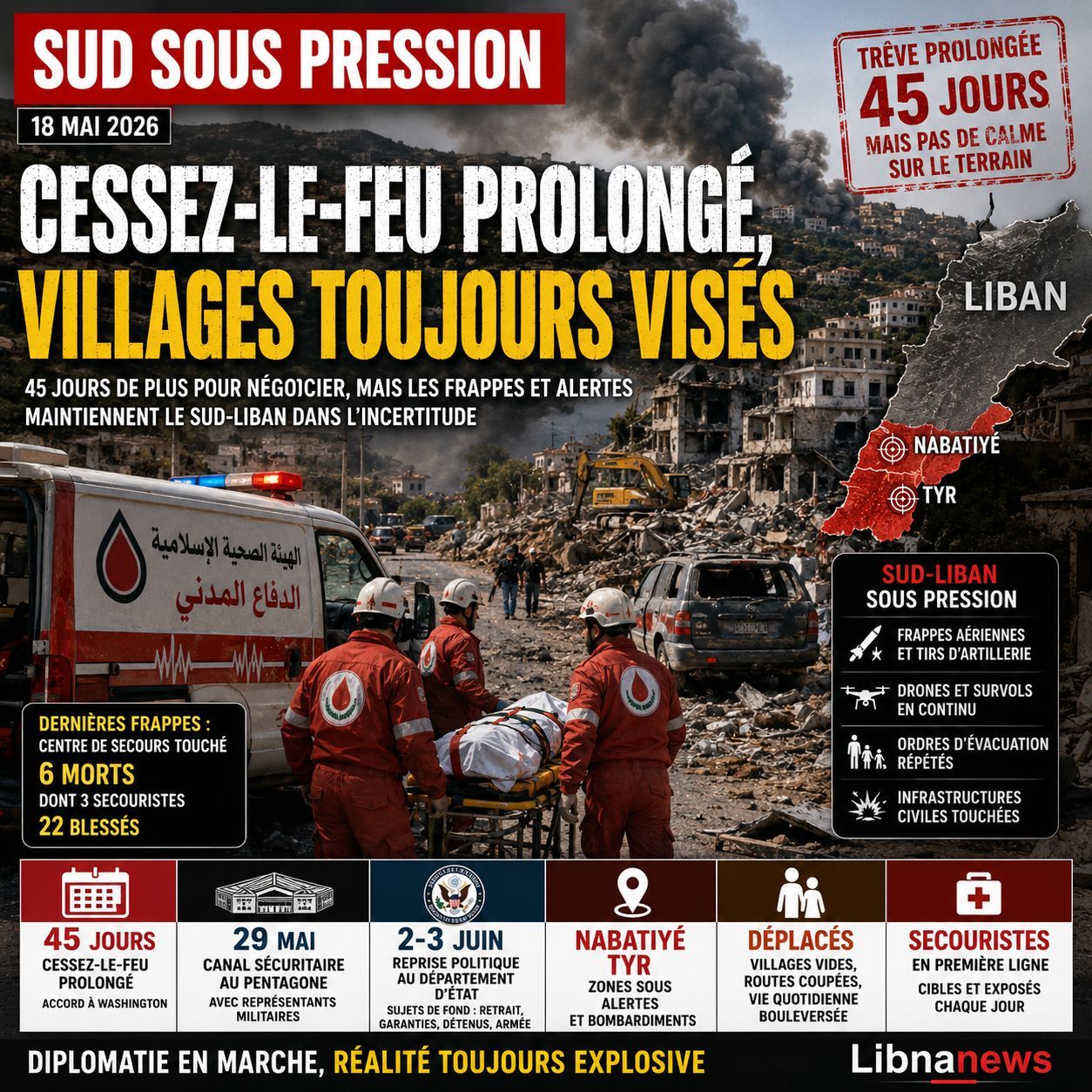
The ceasefire in Lebanon on the ground
Lebanon is entering a paradoxical sequence. While the extension of the cease-fire in Lebanon was announced after two days of discussions in Washington, the southern communities were further hit, artillery fire, evacuation orders and continued air activity. The contrast summarizes the last 48 hours. On paper, diplomacy obtained an additional 45 days to try to transform a fragile truce into a more stable mechanism. On the ground, the inhabitants of Nabatiyah, Tyre and villages close to the front line have seen the continued uncertainty, displacement and response of relief teams. IANI’s dispatches describe a dense chronology, where every political announcement is almost immediately caught up in a military incident. The Lebanese authorities present the open period as a test. Israel, for its part, continues to affirm that it will maintain freedom of action against Hezbollah. Between these two lines, the Lebanese State seeks to impose an agenda centred on withdrawal, return of displaced persons and sovereignty.
The main evolution came from Washington. The Lebanese and Israeli delegations, meeting under United States facilitation, agreed to extend the cessation of hostilities by 45 days. This extension extended the deadline which threatened to bring back the front in a wider confrontation. It opens two distinct channels. The first, secure, is to be launched in the Pentagon on May 29 with military representatives. The second, political, is scheduled to resume in the State Department on 2 and 3 June. The formula allows American mediators to separate operational files from the heavier ones, such as the withdrawal of Israeli positions, security guarantees, detainees and the future role of the Lebanese army. For Beirut, the immediate goal remains to achieve a real drop in strikes. The extension is not valid. It only gives a frame and a calendar. Therefore, Lebanese officials insist on verification, implementation mechanisms and the need for a concrete halt to the violations reported since the truce entered into force.
A prolonged truce, but without internal consensus
This diplomatic advance comes in a tense internal climate. The government wants to show that it acts on behalf of the state and not a party. Hezbollah rejects direct discussions with Israel and considers its armament to be a Lebanese issue. The issue is therefore not limited to the border. It affects the monopoly of the decision of war and peace, the ability of the army to redeploy and the margin of government in a negotiation strongly supervised by Washington. Lebanon presents itself with a clear demand: cessation of hostilities, Israeli withdrawal, return of inhabitants and reconstruction. Israel places at the forefront the neutralization of Hezbollah and the security of its northern localities. These priorities intersect without yet forming a compromise. The forty-five days announced do not resolve any of these disputes. They only require a short window. It will be judged not on the communiqués, but on the actual reduction of strikes and on the possibility for civilians to resume a minimum life in the villages concerned.
However, the field quickly recalled the fragility of the scheme. In the hours following the announcement of the extension, Israeli strikes targeted southern Lebanon. The worst of the last days was an attack on a rescue centre, which had killed at least six, including three rescue workers, and twenty-two wounded. Strikes in the Tyre district also caused dozens of injuries. The official dispatches and reports available refer to civilians, medical personnel and persons present in affected areas. Israel claims to be targeting Hezbollah-related infrastructure or preparations for attack. The Lebanese authorities denounce repeated violations of the ceasefire. This divergence feeds the blockage. Each camp uses its own lexicon. Lebanese talk about sovereignty, civilians and withdrawal. Israel speaks of military threats and prevention. In between, rescue teams operate in degraded conditions, often at the same time as aviation or drones remain active.
Nabatiyah and Tyre under repeated alerts
Sunday, May 17th focused several alerts. Strikes hit Tayr Debba in the Tyre district, injuring two rescue workers from the al-Risala Scout Health Emergency Service, according to local reports taken from the ANI. Rescue and clearing operations continued after the raids. Further east, Nabatiyah district was targeted by airstrikes and artillery fire. Zawtar al-Sharkiyah was hit by aviation. The outskirts of Zawtar al-Sharkiyah, Zawtar al-Gharbiyah, Yohmor al-Shqif, Arnoun and Maifadoun were affected by artillery bombardments reported from the post-minuit until morning hours. These localities form a civil and agricultural arc exposed for weeks. Roads, orchards, isolated houses and village approaches are becoming risk areas. In these areas, the ceasefire in Lebanon is often seen as a diplomatic word, not as immediate protection.
The evacuation orders add direct pressure to the inhabitants. On Saturday, the Israeli army issued a warning against nine Lebanese localities, including Qaaqaaiyet al-Snubar, Kawthariyet al-Siyad, Merwaniyah, Ghassaniyah, Tefahta, Arzai, Babliyeh, Ansar and Baisariiyah. On Sunday, a new order concerned four localities: Arzi, Marwaniyé, Babliyé and Baisariyah. These messages, relayed by the Lebanese media, trigger hasty departures, even when no strike immediately follows. They disrupt families, businesses, care and school trips. They also create a moving mapping of danger, difficult to read for the inhabitants. Not all villages are on the immediate border line. Some belong to deeper areas of the South, which broadens the perception of vulnerability. Local authorities must then manage crowded roads, temporary accommodation needs and requests for assistance. Each warning reminds us that war is not only measured by human results. It also measures the ability to stay at home.
Children and first aid workers at the heart of the assessment
In this context, the humanitarian situation is aggravated by accumulation. UNICEF alerted children. The organization reports at least 59 children killed or injured in one week, despite the cessation of hostilities that came into effect in April. She also reports that children were killed with their mother in a car strike. Since the beginning of the truce, the data reported indicate dozens of children killed and injured. Since the escalation of March, the paediatric record has been even heavier. These figures place the conflict in a long temporality. Families in the South live both the immediate fear of strikes and the lasting effects of displacement. Children lose school, landmarks and sometimes regular access to care. Humanitarian organizations emphasize trauma, but also the basic needs: water, medicine, psychological support, transportation, shelter. The truce was intended to stabilize these needs. Recurrent violence makes them more complex.
The issue of first aid workers has become a central indicator. The last strikes have again affected rescue teams or structures. Paramedics and volunteers operate in areas where roads can be cut, communications remain fragile and secondary strikes are feared. Their exhibition is not just a human drama. It weakens the local response. When an emergency centre, ambulance or medical team becomes a target or is reached in a bombed area, the response times increase. Residents also hesitate to call or move. Health checks are then constructed in an emergency, with sometimes provisional figures. The Lebanese authorities update them throughout the operation. In villages, the presence of first aid workers is often the last visible public service. Their safety conditions the survival of injured civilians, as well as the minimum confidence that allows residents to remain.
Israeli withdrawal remains the political node
The military file has a wider diplomatic arm. BRICS called on Israel to withdraw fully from Lebanese territory, including the five southern positions mentioned in the discussions. For Beirut, this call reinforces the official line: stability cannot be built on residual occupation or repeated strikes. Total withdrawal remains a political prerequisite. It is intended to enable the Lebanese Army and State institutions to resume the initiative in the border area. This demand, however, meets the Israeli position, which makes its movements conditional on guarantees against Hezbollah. American mediators are trying to turn this face-to-face into a gradual sequence. First the maintenance of the truce. Then a security device. Then a political channel on the substantive issues. The risk for Beirut is that the extension will become a crisis management without tangible results. The risk for Israel is to prolong a military pressure that sustains the instability that it claims to reduce.
The Lebanese political scene therefore evolves under duress. The government of Nawaf Salam must convince that it does not negotiate under fire without consideration. Speaker Nabih Berri has already placed the cessation of hostilities at the heart of the sequence. Ministers and officials who speak stress unity of position, sovereignty and the role of the State. However, this unity remains fragile. Opponents of Hezbollah are calling for the crisis to open a debate on weapons and military decision. Hezbollah, for its part, affirms that priority must remain the Israeli withdrawal and refuses to allow its disarmament to be dealt with in negotiations with Israel. The population, especially in the South, looks at these debates with a more immediate expectation. She wanted to know whether roads would be open, whether villages would still be targeted and whether the displaced could return. The next few weeks will therefore also measure the executive’s ability to translate diplomacy into daily security.
A daily life suspended from alerts
Ordinary life does not disappear, but it reorganizes around risk. The dispatches of the last 48 hours also mention weather issues, roads reopened after strikes, continuous aerial activities and local warnings. This information, sometimes brief, speaks a lot of the general climate. A reopened road means that it was cut, inspected, and then considered practicable. An overflight of drones or aircraft at low or medium altitude means that the inhabitants live under constant observation. Shops adapt to reduced hours. Families delay travel. Municipalities improvise responses with limited means. The South is not just a military front. It is a territory of villages, schools, clinics, orchards and small businesses. Every day of war creates invisible costs. They do not always appear in the balance sheets, but they weigh on future reconstruction.
The figures available give the measure of a crisis which exceeds the only sequence of 48 hours. By mid-May, the United Nations reported that nearly 2,900 people had been killed and more than 8,800 injured since the escalation of 2 March. These assessments do not always distinguish civilians from combatants. However, they show the extent of violence and the gradual saturation of local capacities. The Lebanese Ministry of Information had also documented over 1,700 Israeli ceasefire violations since 17 April, including air strikes, artillery fire and demolitions. Israel contests Lebanese reading and claims that its operations respond to threats. This difference in counting complicates mediation. For a mechanism to work, a minimum of common criteria are needed: who finds out, who checks out, who punishes, and how. Without answering these questions, the truce remains exposed to competing interpretations.
The timetable is therefore decisive. On May 29, the security channel announced in Washington must specify the conditions for a more stable device along the border. On 2 and 3 June, the political channel will have to address issues that block any lasting settlement. Lebanon wants to make these steps a lever for Israeli withdrawal and the end of the strikes. Israel wants guarantees on Hezbollah. The United States sought to keep both delegations in a framework of discussion, while the front remained active. The last 48 hours, however, show that diplomacy is not enough to create calm. It must have visible effects in villages, on roads and around relief centres. By the time of the next meetings, the most monitored evolution will not only be the content of the communiqués. It will be measured by the number of unattacked nights, possible returns to evacuated localities and the activity of rescue workers in areas still under threat.




