

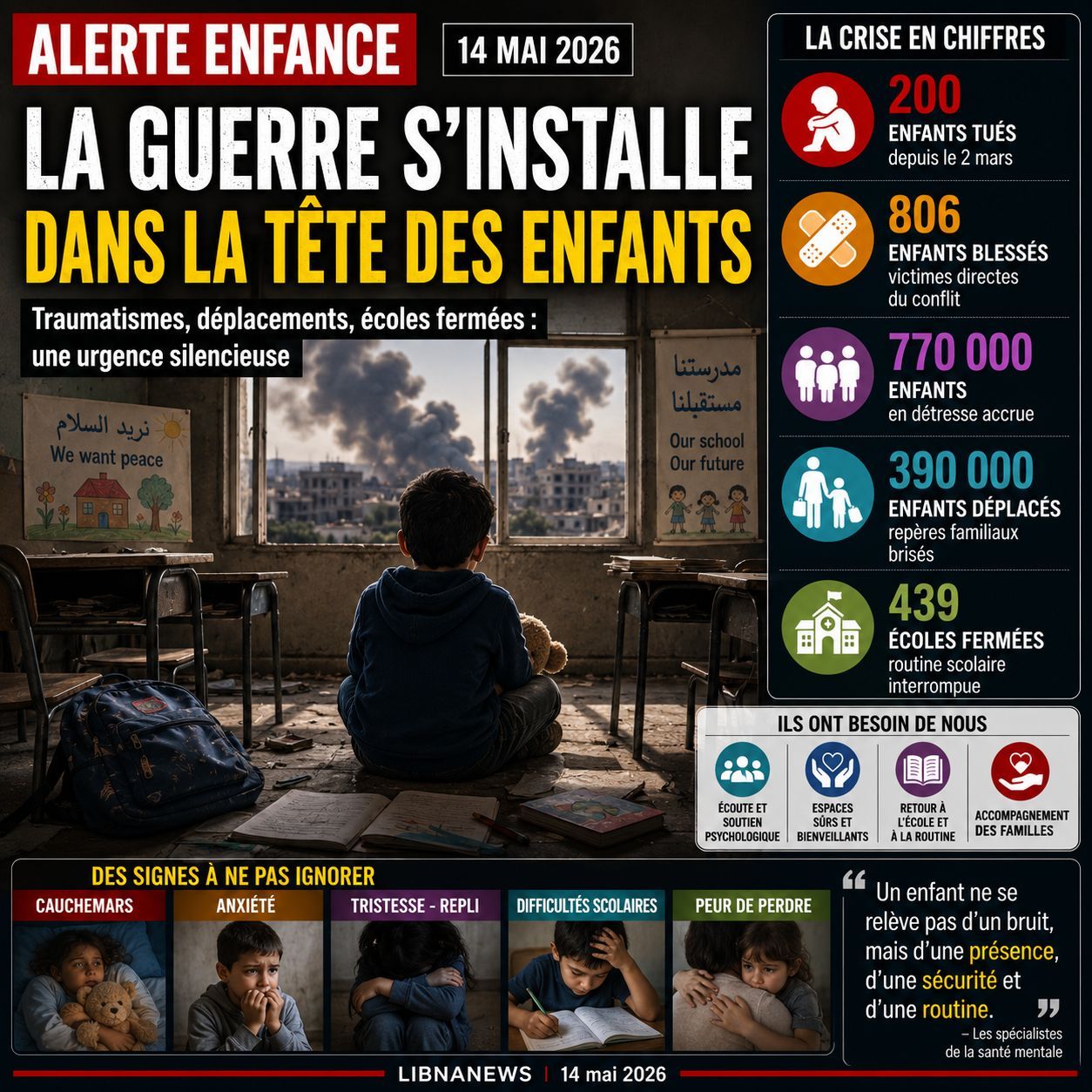
The Israeli-Lebanese conflict leaves visible traces on cities, roads and families. It also leaves a more discreet imprint in children’s memory. The mental health of Lebanese children has become a central issue, as strikes, displacements, bereavements and school breakup create lasting fear. The latest available figures provide a measure of the shock: since 2 March, 200 children have been killed and 806 injured, while approximately 770,000 children are experiencing increased distress due to repeated exposure to violence, loss and displacement.
The crisis not only affects children living near the border. It reaches those who have fled to other regions, those who have changed their homes several times, those who attend school from a distance and those whose parents are no longer able to ensure a routine. The most commonly reported symptoms are traumatic stress: intense fear, nightmares, sleep disorders, sadness, irritability, difficulty concentrating and feeling abandoned. For a child, war is not just about the noise of explosions. It changes the relationship to the body, time, home and adults supposed to protect.
Mental health of Lebanese children: a massive shock
The mental health of Lebanese children can no longer be treated as a secondary subject. The latest humanitarian data indicate at least 59 children killed or injured in one week, despite a ceasefire announced on 17 April. Since then, 23 children have been killed and 93 injured. The pace remains high, with nearly 14 children killed or injured every day since the beginning of the last escalation. Behind these figures are survivors who see a loved one die, separated brothers and sisters, collapsed parents and children exposed to images that they cannot interpret.
Physical damage worsens psychological injuries. A child injured by flash, burned, amputated or hospitalized does not simply come out of a medical service with a scar. He can relive the attack, fear sudden noises, avoid certain roads or refuse to sleep alone. Children who have not been injured may also have the same reactions. Seeing a hit car, hearing an explosion or losing a comrade is enough to install a danger memory. Trauma depends not only on physical proximity to the strike. It also depends on age, family support, repeat events and a sense of safety after the event.
A survey conducted after the previous war had already shown the extent of the malaise. In January 2025, 72% of respondents said their children were anxious or nervous during the war, and 62% described them as sad or depressed. An improvement had been observed after the attack, but it remained fragile. The resumption of violence therefore affected children who had not always recovered. Many have not experienced a real psychological break between two phases of the conflict.
Displacement removes essential markers
Displacement is one of the most powerful factors of child distress. At the beginning of April 2026, more than 1.1 million people were displaced in Lebanon, including over 390,000 children. The war didn’t just take them away from a house. She often deprived them of a bed, a neighbourhood, a school trip, friends, toys and daily landmarks. An displaced child can lose what adults call normality within a few hours.
Repeated movements aggravate the disorder. A first leak can be understood as an emergency. A second or third installs the idea that nowhere is safe. Some children sleep dressed, watch adult discussions or keep a bag ready for them to leave. Others stop asking questions because they feel that answers change every day. This uncertainty becomes a form of chronic stress.
Collective shelters protect from emergency, but they do not replace a home. Noise, lack of privacy, promiscuity and lack of routine disturb sleep. Smaller children can fall back, start wetting their bed again, claim the parent permanently, or lose language skills. Teenagers react differently. Some of them are isolated, others become aggressive or seek to take risks. These behaviours are not always indisciplined. They can translate a clumsy attempt to regain control.
School, first stabiliser lost
School plays a major psychological role. It gives a schedule, known adults, comrades, court, homework and progression. When it stops, the child loses more than an apprenticeship. It loses a structure that organizes the week and limits the grip of fear. But the war has profoundly disrupted the education system. In the spring of 2026, hundreds of public schools were closed, used as shelters or located too close to danger areas.
Humanitarian data indicated that 669 collective shelters were registered, including 364 public schools and 58 technical institutions. In parallel, 439 public schools remained closed in several exposed areas, affecting approximately 256,000 pupils. The Lebanese press also reported that 147,000 students were taking their distance learning courses, while approximately 180,000 were pursuing face-to-face or hybrid education. These figures describe a fragmented school. They also show a fracture between children who keep a frame and those who have more than one screen, sometimes shared, unstable or inaccessible.
Distance learning does not always compensate for this loss. A traumatized child needs a quiet space to attend a class. Many do not have it. In shelters, noise, fatigue and low connection prevent concentration. Among displaced families, the telephone is used for both classes, news, procedures and family contacts. The virtual class then becomes a symbol of continuity, but not necessarily a real place of security.
Sleep, first warning signal
Sleep disorders often appear first. Children exposed to war may find it difficult to fall asleep, wake up in shock or have repeated nightmares. Some fear the night, because it recalls the strikes. Others refuse to sleep away from parents. Adolescents can reverse their schedules, stay awake to monitor alerts or spend long hours on social networks.
The lack of sleep then fuels other difficulties. It reduces attention, increases irritability and weakens memory. A tired child learns less well and suffers less frustration. Parents, themselves exhausted, can interpret these reactions as provocation. The circle becomes dangerous: the child sleeps badly, behaves badly, gets reproaches, and then feels even less secure.
Nightmares are not mere temporary fears. They can replay the event, mix pictures seen on television with personal memories, or turn the absence of a relative into an abandoned scene. Mental health professionals often insist on one point: do not force the child to tell. He must be given a framework where he can speak, draw, play or remain silent without being judged.
Grief, guilt and fear of losing parents
The mourning of children in wartime rarely follows a simple path. It can be brutal, incomplete and surrounded by confused information. A child sometimes learns about the death of a loved one in a shelter, through a message, through a conversation heard or through social networks. Funerals may be impossible, delayed or marked by fear. This lack of ritual complicates acceptance.
Some children develop guilt. They wonder why they survived, why they weren’t with the dead person or why they didn’t stop the departure. Young people may believe that a thought or argument has caused the disaster. Adults must then explain with simple words that the child is not responsible. This sentence may seem obvious. However, it remains essential.
Fear of losing parents often becomes permanent. A child can refuse to let his mother go out and buy bread, panic when his father is slow to return or cry at each separation. This separation anxiety is not a whim. It responds to an experience where adults can disappear without warning. Returning to a routine therefore requires patience, predictability and repeated actions.
Parents too are weakened
The mental health of children is closely dependent on that of adults. A displaced, bereaved, indebted or workless parent does not have the same emotional availability. He can love his child and no longer find words. He may want to reassure him while being terrified himself. Children perceive these tensions. They read the silences, nocturnal calls, arguments and tears contained.
Economic pressure increases risk. Post-conflict surveys had shown that 45 per cent of households had reduced their health expenditures to cover basic needs, and 30 per cent had reduced their expenditure on education. One third of households did not have access to the necessary medicines for children. These deprivations are not solely social. They directly influence mental well-being. When parents have to choose between transport, heating, medicine and school, the child experiences instability.
In large families, adolescents sometimes take on an adult role. They keep the smallest, help to search for water, follow the news or accompany a parent in the process. This responsibility can give them a sense of usefulness. It can also deprive them of their age. A teenager who is too early in the family’s fear may collapse later, when the emergency falls.
Teenagers in the face of an anger without a way out
Adolescents experience war in a particular way. They understand the issues better than younger children, but they do not always have the means to act. They see images, follow political discussions and compare stories. They may feel anger, humiliation, impotence or a need for revenge. These emotions must not be ignored. They can become a factor for withdrawal, verbal radicalization or dangerous behaviour.
Adolescence is also the age when the future is built. However, the conflict blocks studies, examinations, sports, friendships and projects of departure or work. When prospects close, distress becomes less visible. Some young people don’t cry. They’re just saying there’s no point. This feeling of vacuum must alert as much as a panic attack.
Adolescent girls face specific risks. Displacement, promiscuity, lack of privacy and economic tensions can increase the risk of harassment, exploitation or early marriage in the most vulnerable environments. Boys, on the other hand, may be more exposed to the pressure to prove their courage or silence. In both cases, psychological protection must take into account gender, age and family context.
Symptoms not to be trivialized
Not all children exposed to war will develop a lasting disorder. Many recover if safety comes back, the family remains stable and a reliable adult accompanies them. But some signs must alert. A child who no longer sleeps, no longer eats, no longer plays, no longer speaks or constantly relives the dangerous scene needs support. It is also necessary to monitor sudden aggressiveness, withdrawal, pain without clear medical cause, school fall and words of despair.
In the smallest, suffering often passes through the body. Stomach pain, headache, vomiting, enuresia, tremor or refusal to move away from the parent can express deep fear. In school-age children, concentration difficulties dominate. The child seems to forget, pick up, piss off or look in a vacuum. In adolescents, suffering can take the form of insomnia, risk-taking, isolation, anger or excessive exposure to screens.
The mistake would be to wait for the symptoms to get extreme. Psychosocial support works better when it arrives early. It’s not always about specialized psychiatry. Safe spaces, group activities, games, drawing, sport, a gradual return to school and trained adults can reduce the risk of chronication. However, the most severe cases must have access to specialized care.
Inadequate care
Lebanon has qualified professionals, experienced associations and a recognized national mental health plan. But the needs exceed the capacity available. Services are concentrated in some areas, travel complicates access and cost remains an obstacle. Families first look for a roof, food, medicine and a school. Mental health often comes after, when suffering has already grown.
Attacks and pressure on the health system exacerbate the problem. In early April 2026, humanitarian data reported 53 health workers killed and 137 injured since 2 March, as well as 82 reported attacks on emergency medical services. Vehicles and health facilities had been affected and five hospitals had been closed. When the medical system becomes fragile, the most vulnerable children also lose the doors to psychological support.
Funding remains another lock. Psychosocial support programmes require staff, training, safe places, transport and monitoring. They do not always produce spectacular results in the short term. Yet they avoid profound damage: dropping out of school, isolation, domestic violence, addictions, depression and persistent anxiety disorders. Failure to fund these programs is tantamount to delaying the cost to subsequent years.
What families and schools can do
Families can’t stop the war. However, they may reduce some effects. Specialists recommend restoring simple routines: meal hours, sleep schedules, short study time, play time and predictable separation gestures. A child needs to know what will happen in the next hour, even if adults cannot promise the future.
Words matter. It is better to explain with simplicity than lie to reassure. To say that there has been a strike, that adults are looking for a safer place and that the child is not responsible helps to reduce confusion. Exposure to violent images should also be limited. Children hear the news even when adults think they are protecting them. Teenagers should be able to ask questions without only receiving injunctions for silence.
Schools can play a decisive role, even in a degraded situation. A teacher can identify a child who is a student, organize a class ritual, offer a time of expression or direct a service. The courses must remain important, but they cannot ignore the emotional state of the students. Learning after a war first requires restoring a capacity of attention, trust and bond.
The risk of a generation marked by waiting
The psychological injury of Lebanese children will not disappear with a ceasefire communiqué. It will depend on the duration of instability, return to school, access to care, road safety and the ability of families to rebuild a daily life. Current figures already indicate a risk of chronic disorders for hundreds of thousands of children. They also say that mental emergency has become a national emergency.
The country will have to follow this crisis in time. Symptoms will need to be measured, teachers trained, primary health centres strengthened, parents supported and safe spaces opened in reception areas and in return villages. Not all children will ask for help. Many will say that they are fine to protect their parents or to avoid reviving pain. The next few weeks will say whether psychosocial support can be installed early enough, before fear becomes a habit.




