

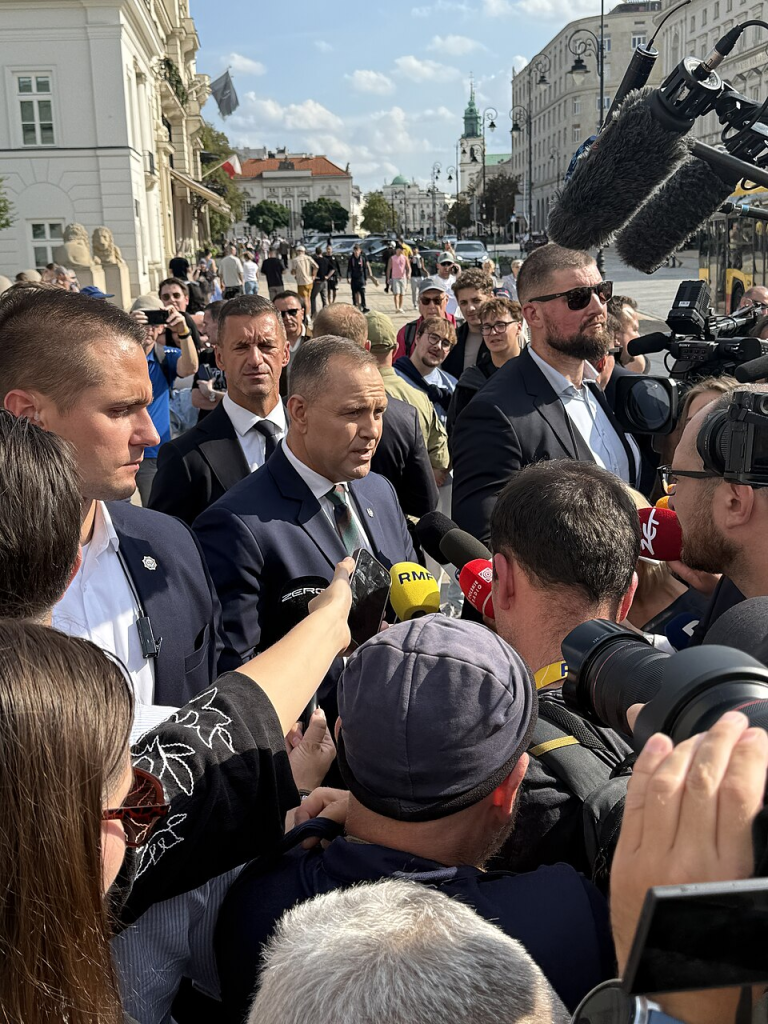
Karol Nawrocki vetoed Polish law on 13 November 2026, organizing a new procedure for blocking illegal online content. The President contested the powers entrusted to the administration and the guarantees offered to the authors of the publications. On the contrary, the government defends a mechanism to speed up the response to threats and violence on the Internet.
This veto does not remove the European regulation on digital services, the DSA. Nor does it call into question the designation of the Polish authority responsible for coordinating its application. It blocks a second national law on injunctions for content after a first law has already entered into force.
Veto de Nawrocki: two texts with different functions
The disagreement relates to the Act of 22 October 2026 amending the rules on electronic services. It comes from Parliamentary Project 2693. The Sejm calendar distinguishes several stages: a third reading vote on October 8, the examination of Senate amendments on October 22, and the transmission to the Speaker on October 23.
This chronology is important: the text had completed its parliamentary journey but had not become applicable. Presidential refusal prevents its promulgation in this form. The reason for the veto, sent to the Sejm on 13 November, calls for a further review of the mechanism.
The Ministry of Digital Affairs recalls that a previous veto in January 2026 led to the separation of the reform into two laws. The first, in effect since 6 November, appoints the President of the Office for Electronic Communications, UKE, as coordinator of digital services. The second was to add a reaction procedure to illegal content.
Government wants to speed up injunctions
In its presentation of the scheme, the Ministry explained that injunctions could have been issued by the President of UKE, the President of the National Broadcasting and Television Council, KRRiT, and the courts. It cites, inter alia, threats, violence and offences against children.
For some serious situations, a request from the police or the prosecutor would have allowed the immediate execution of a blocking decision. Examples of the Ministry include incitement to suicide and certain threats or violence related to origin, religion or political affiliation.
The Deputy Prime Minister for Digital Affairs, Krzysztof Gawkowski, believes that the veto deprives the State of faster means against these offences. It also denounces the power of large platforms to deal with alerts and withdraw publications. This is the government’s assessment of the consequences of the decision, not a finding of general impunity on the Internet.
President contests intervention before judge
Karol Nawrocki says he shares the goal of fighting criminal content. His criticism is about how to restrict access to publications. It considers that the place given to administrative decisions taken before judicial review is excessive.
In his written argument, he acknowledges several changes made after his first veto, including the separation of reform. However, he considered that the guarantees remained insufficient. In particular, it invokes the freedom of expression, the proportionality of restrictions and the effectiveness of recourse to the judge.
The possibility of blocking an entire domain is another point of its challenge. The president fears that a measure aimed at content will also affect licit publications. This objection must be distinguished from an actual blocking: the contested law has not entered into force.
The Government, for its part, maintained that the scheme provided for challenge and judicial review. The two positions are therefore not only opposed to the existence of an appeal. They differ on the timing of the judge’s intervention and on the ability of subsequent control to remedy the consequences of a withdrawal.
The European framework does not disappear
The DSA establishes common obligations for digital services. The European Commission shall ensure its implementation with the national coordinators. These authorities supervise the platforms under their jurisdiction and cooperate at European level. The Regulation distinguishes this monitoring framework from decisions concerning specific content.
Article 9 of the Act regulates injunctions against illegal content issued on the basis of European or national law. The Polish veto concerns a national procedure envisaged in this legal environment. It does not transform illegal content into authorized content and does not erase other instruments already applicable.
Both the Presidency and the Government recognize that the first institutional component remains. Their confrontation now concerns the additional means for the authorities to act on publications. The Ministry announces that it will continue its work with relevant institutions and platforms. No new vote by the Sejm or replacement timetable is established in the official documents consulted.





Comments