

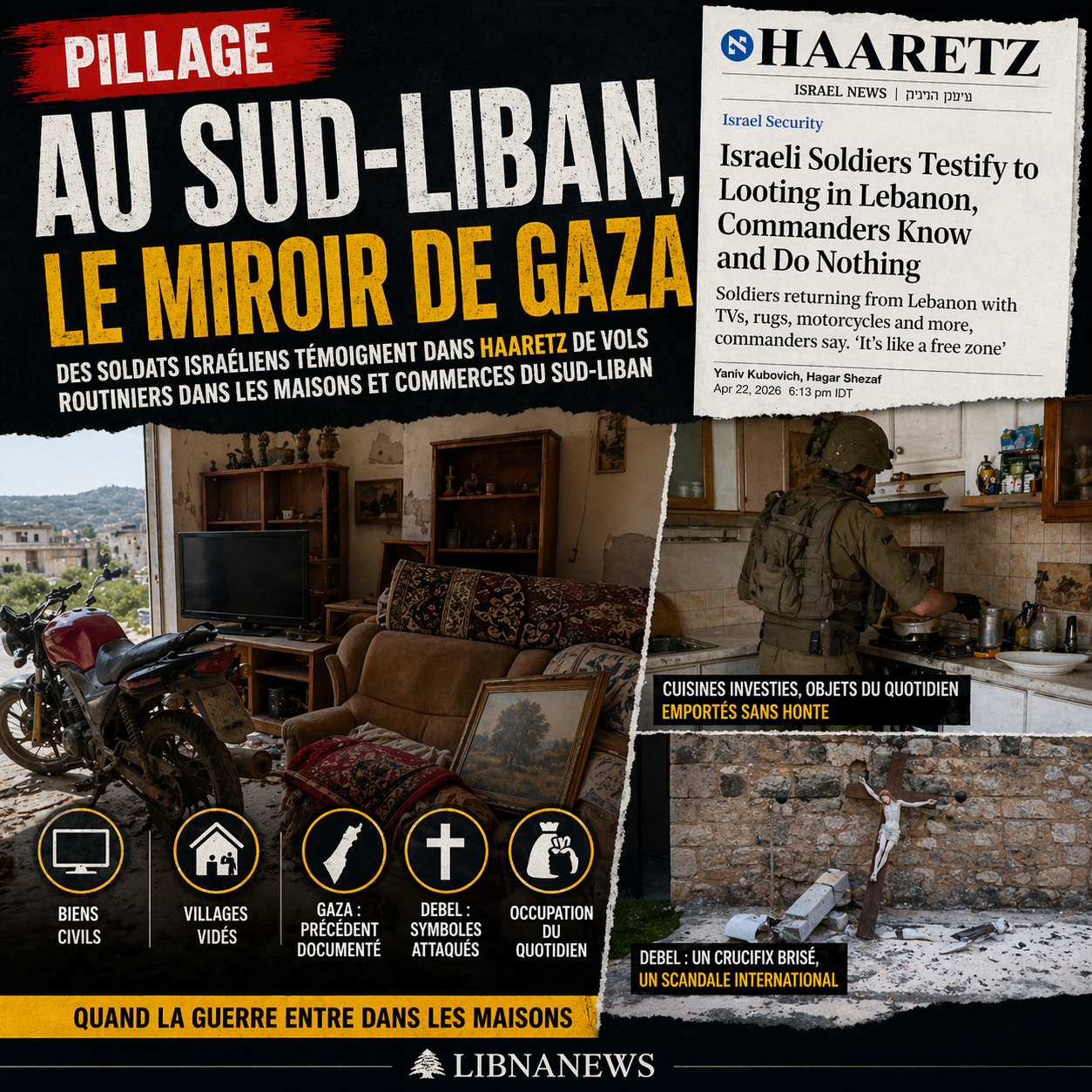
The revelations published by an Israeli newspaper about thefts by soldiers in houses and shops in southern Lebanon describe far more than a series of individual deviations. They show, through testimonies from combatants and commanders on the ground, a practice that has become familiar in locations emptied by the war, partly prohibited from returning their inhabitants and subjected to a prolonged military presence. The looting in southern Lebanon thus appears to be a broader symptom: that of an army that no longer merely controls space, but allows itself to use its property, houses and sometimes even the most intimate signs of civilian life.
The objects mentioned have immediate reach. Motorcycles, television sets, tables, sofas, carpets, tools or goods of shops are neither subject to a questionable military seizure nor to a levy which may be presented as necessary for an operation. They belong to the ordinary world of families, village shops and everyday life. Their appropriation therefore gives the file a particular strength. It removes any ambiguity from the scene described. What is being targeted is not a combat infrastructure, but a civilian heritage.
The most important point is the routine nature of the phenomenon. According to reports, soldiers would leave Lebanon with goods loaded in their vehicles without seeking to conceal them. One of them describes an installed use, to the point that each one would take what he finds and put it immediately in his car or next door, in front of others. When a theft occurs in an atmosphere of triviality, the problem goes beyond personal fault. It affects the climate of tolerance prevailing in unity, the level of command control and the real hierarchy of prohibitions.
Looting as an occupation marker
Looting in southern Lebanon cannot be detached from the territorial context in which it is located. Since mid-April, news agencies have documented the existence of an Israeli line of deployment within Lebanese territory, the continuation of demolitions in several southern localities and the ban on the return of many residents. Villages have been destroyed to varying degrees, sometimes in such a significant way that observers and residents say they fear returning home without finding a home. In this context, theft of private property no longer appears as an incidental incident. It becomes one of the visible forms of a grip exerted on a space emptied of its legitimate owners.
However, the law of war leaves little room on this point. The looting is forbidden. This rule applies precisely to situations in which an army might be tempted to consider a deserted house, a closed trade or a hit village to be available. The fact that an owner fled the bombings, that he was prevented from returning or that his locality was under military control does not in any way nullify his property rights. A TV, carpet, painting or sofa remain civilian property. Their legal value does not disappear with the forced absence of their owners.
It is also for this reason that looting further shockes when it touches domestic objects. A military good can always be discussed, interpreted, requalified. A living room, a kitchen, a stock of goods or a village trade speak differently. They say the brutal suspension of a civilian life. They recall that the return of the inhabitants, already compromised by destruction, may also be marked by the emptiness left in the rooms still standing. The loss is no longer measured only in fallen walls, but in erased traces of ordinary life.
An image of a moral army tested
This case takes on special significance because Israel continues to promote the image of an army governed by demanding moral doctrine. The institution emphasizes the protection of human dignity and property of civilians not involved. This public presentation is a central element of his strategic narrative. It argues that, despite the violence of operations, a strict ethical framework would continue to distinguish the Israeli army from its enemies.
The facts reported from southern Lebanon directly contradict this construction. An army can always argue for operational necessity to justify raids, searches, targeted destruction or a presence in a house. It cannot invoke this necessity for furniture, carpets, electronic devices or decorative objects taken out of a combat zone. From the moment such goods enter the war narrative, the official moral discourse cracks. The contradiction becomes visible, concrete and immediately understandable.
This fissure is not only about the contents of the revelations, but about their origin. When a large Israeli newspaper publishes testimonies from soldiers and commanders on flights in Lebanon, it becomes more difficult to reduce the case to a hostile exaggeration from outside. The debate then moves to the very heart of Israeli society. It no longer concerns only the legality of an operation, but the way in which part of the army lives on the ground and treats the material universe of civilians who have been expelled from it.
From Gaza to Lebanon, a disturbing continuity
Southern Lebanon is not an isolated case. During the Gaza war, several cases had already highlighted scenes of looting, hijacking of civilian objects and staging of domination in Palestinian houses. Reports and investigations had shown that the behaviour of the soldiers was not only a matter of destruction of war, but also of appropriation of the places, personal effects and the domestic world of the missing families.
The same Israeli press had already reported that despite numerous videos and allegations, the judicial response in Gaza had remained very limited. The handling of these cases had fueled the idea of diffuse impunity, in which the most disturbing acts for Israel’s external image can generate a rapid reaction, while the more dispersed, ordinary and less spectacular practices remain largely unobstructed. So the parallel with southern Lebanon is almost self-imposed. The testimony from the Lebanese front shows not a break, but an extension.
This continuity also appears in the nature of the scenes that have circulated. An international news agency checked several publications in Gaza showing Israeli soldiers posing with female lingerie and models found in Palestinian houses. The images showed soldiers joking with underwear, showing them in front of the camera or turning female objects into derision accessories. This type of scene was not a military necessity. He said something else: a symbolic takeover of the other’s intimate space.
The passage from Gaza to southern Lebanon is striking in this regard. In both cases, war goes beyond the strict logic of the forehead to enter the room, living room, kitchen and personal effects. Women’s clothes are no longer just clothes. They become stage trophies. The house is no longer just a place searched. It becomes a temporary setting for the representation of armed power. This symbolic mechanism counts as much as the theft itself, as it reveals the way in which the absent civilian is perceived: not as a subject of law temporarily prevented, but as the owner erased from a world now available.
Kitchens, greenhouses and ordinary appropriation gestures
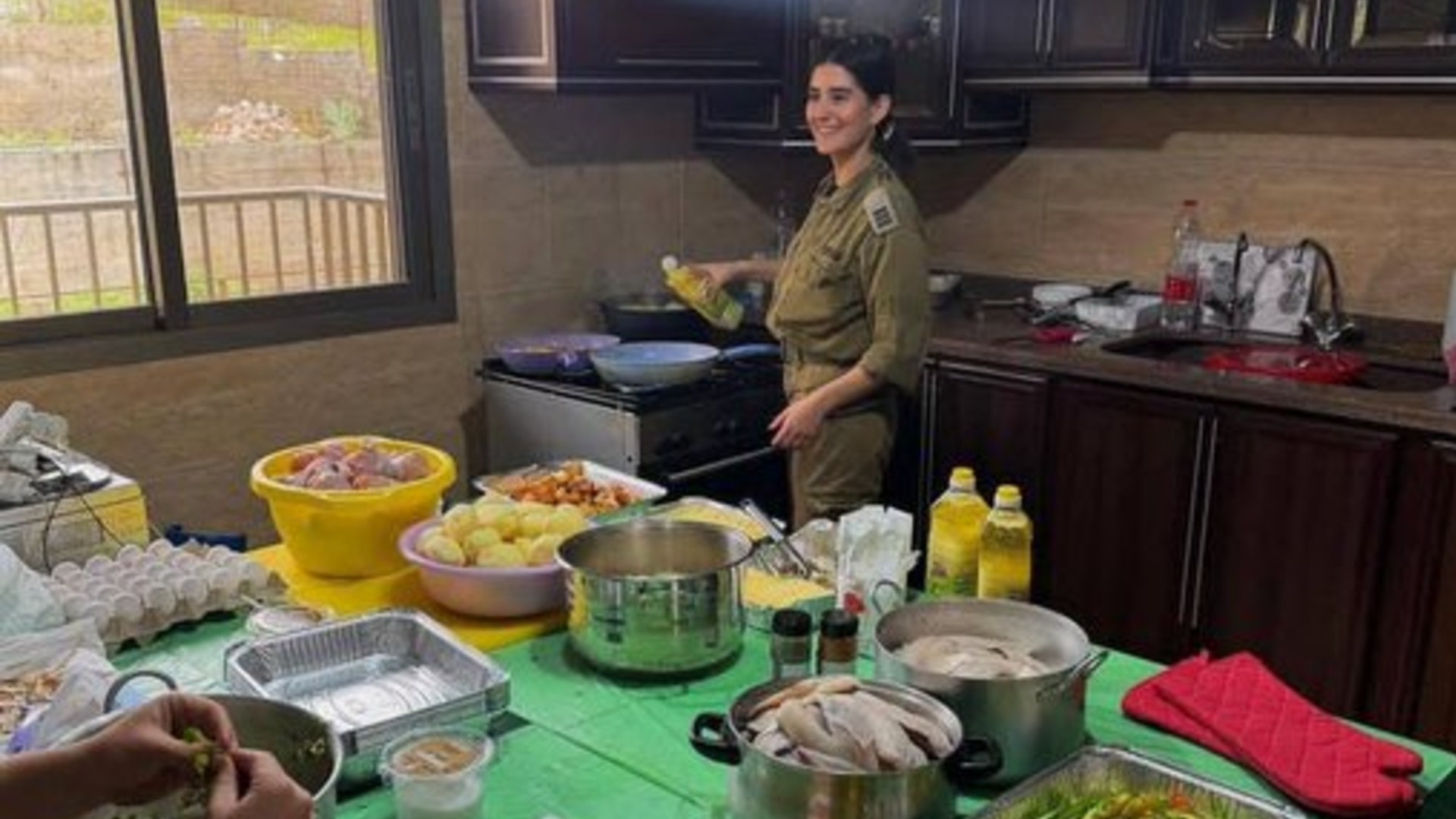
The images broadcast in recent days from southern Lebanon have further reinforced this impression. Viral sequences showed Israeli soldiers in Lebanese kitchens, in the middle of utensils, food reserves or work plans used as if they were already part of their universe. Other images show them picking fruits or vegetables in southern greenhouses and gardens. These scenes have sometimes been presented as anecdotal or folkloric. They’re not.
Their strength lies precisely in their banality. A meal prepared in the kitchen of a displaced family, vegetables picked in an abandoned greenhouse, objects handled in a house where the owners are absent do not come under a simple war period. They show growing familiarity with the private space of others. They show an armed presence that does not just enter, but that settles, uses, transforms and consumes. The occupation of the place becomes also an occupation of gestures.
In this type of scene, the violence is not due to an explosion or the shock of demolition. It is due to the disappearance of the moral border that still separated the army from the civilian home. When a soldier acts in a foreign house as if it were a temporary space available, the idea of a simple military operation is blurred. It is another relationship to the territory that appears, closer to a logic of conquest than a strict passage of war.
The puppy taken, or the logic of sampling
A video re-released in recent days has further fuelled this perception. Turned in 2024 and then re-launched massively on the networks, she shows an Israeli soldier taking a puppy while a bitch chases him. The scene, very commented, was taken up as an additional illustration of how the occupied territory is treated as a sampling space, where one can take not only objects, but also fragments of animal life attached to the house, yard or village.
The detail of the puppy may seem minor in the face of death, ruins and massive destruction. He’s not. It strikes because it condenses in seconds the logic described elsewhere on a larger scale. We take what’s here. We’ll use it. We are acting in a world that the forced absence of the inhabitants would have made available. Whether the scene concerns a sofa, carpet, TV, vegetables, clothing or a puppy, the psychological spring remains the same. The controlled territory ceases to be monitored only. It becomes a place where some soldiers feel allowed to take.
Debel and the battle for reparation
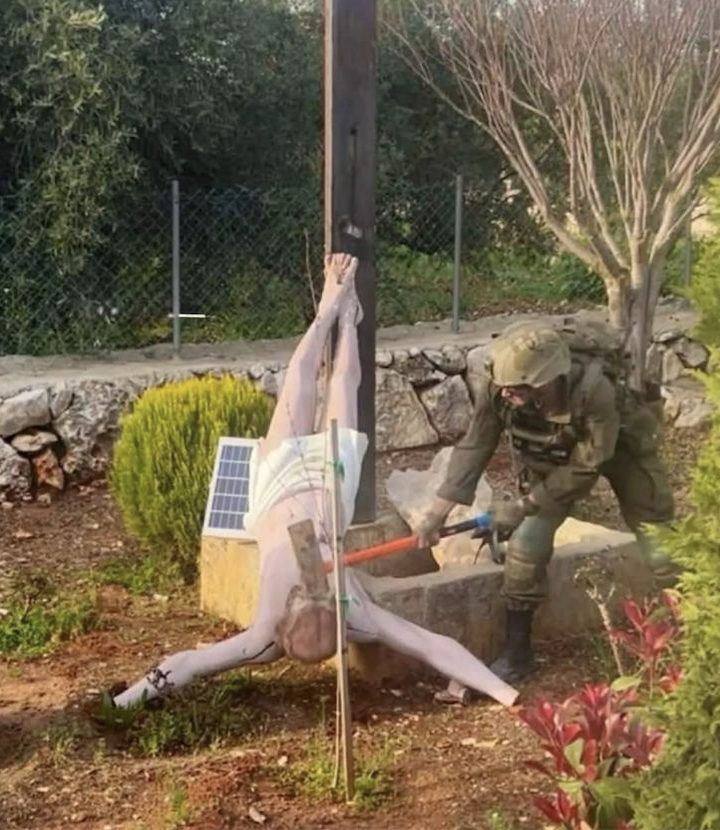
The case of the statue of Christ destroyed in Debel gave this contradiction an international scope. A news agency checked the image of an Israeli soldier striking with an axe a statue of Christ in this Christian village in southern Lebanon. The shock was immediate. Israeli officials, American representatives and religious authorities have denounced the act. The Israeli army announced sanctions against two soldiers and claimed to be working to replace the statue.
This episode allowed Israel to show that it remained able to react quickly when an act on the ground became an image scandal. But the course of reparation also revealed a battle of narrative.
A restoration finally carried by Italy
While the Israeli army has indicated that it will contribute to the replacement, the visible restoration of the new crucifix was eventually carried out by the Italian contingent of UNIFIL, which provided a statue closer to the original with the local community. Another statue brought by the Israeli army, smaller and of a different model, did not occupy the central place in the images of the restoration.
This nuance is important because it shows how crisis communication seeks to recover the gesture of repair. Destroying a Christian symbol in a Christian village exposes Israel to a wave of immediate diplomatic and religious shock. Repair quickly helps contain damage. But the stake is not just to replace a cultural object. It is to restore a story. However, this account remains weakened when at the same time there are reports of looting, images of houses invested, scenes of soldiers in civilian kitchens and stories of destruction of entire villages.
Destroyed villages and impossible returns
The revelations on the flights gain even more weight when they are compared to the material state of southern Lebanon. Reports published in recent days have shown ravaged localities, levelled neighbourhoods and returning residents that their homes were destroyed or uninhabitable. In some villages, the scale of demolitions has raised the fear that the return will be transformed into a simple passage through the ruins. The problem, therefore, is not only that of the goods carried away. It is that of a disbanded civilian tissue.
The appropriation of private objects in such a context produces an additional effect. It prolongs the destruction. When the walls still hold, the rest is missing. Carpets have disappeared, furniture too, sometimes household appliances, tools or goods. War doesn’t just leave rubble. It leaves empty interiors. This weighs directly on the possibility of returning, sleeping on site, reopening a shop or returning to a minimum life in a village already tried out.
The decisive test will therefore not be played in military communiqués alone or in symbolic gestures intended to calm a scandal. It will be played out in what the inhabitants will find when they are able to cross the threshold of their home again, in what will be shown by possible investigations into the flights described by the soldiers themselves, and in the ability to establish whether these acts were the result of a series of individual drifts or of an atmosphere of war now sufficiently installed to transform the looting in southern Lebanon into an almost ordinary scene.




