

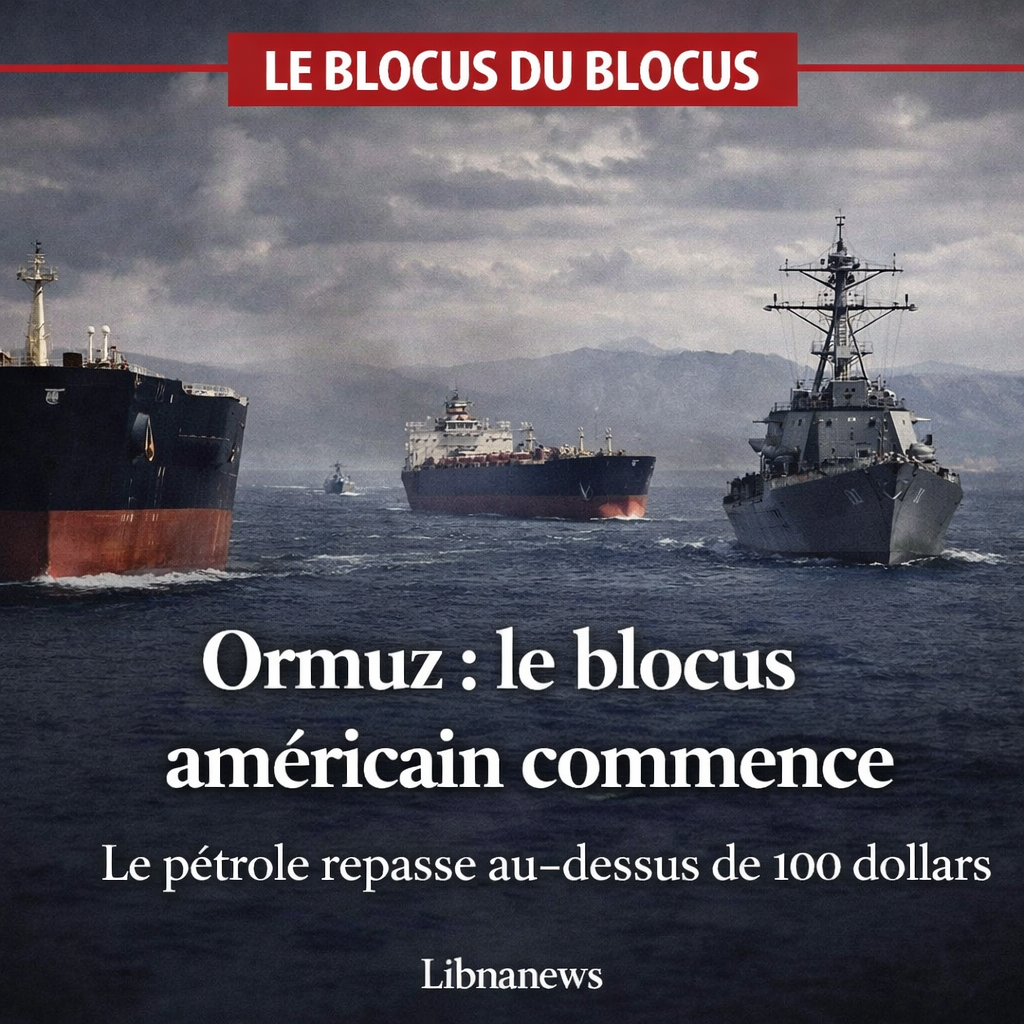
At 2 p.m. GMT, Monday, 13 April, the Ormuz crisis changed its nature. The United States Central Command has begun to enforce a naval blockade against ships entering or leaving Iranian ports. Officially, Washington does not close the Strait to all world traffic. In fact, the announcement is already enough to slow down the movements of tankers, to raise the crude above 100 dollars and to put China, the first buyer of Iranian oil, at the heart of the tremor.
What really starts in Ormuz
The first point to be clarified is the exact nature of the operation. Donald Trump spoke of a blockade of any ship seeking to enter or exit the Strait of Ormuz. The Pentagon then tightened the perimeter. According to Central Command, the measure applies to ships entering or leaving Iranian ports and coastal areas in the Gulf and Gulf of Oman. Ships in transit to non-Iranian destinations are, in theory, not prevented from passing through. This nuance is essential. It means that Washington does not at this stage proclaim a general closure of the Strait to world trade. But she only half reassures the shipowners. In an already mined, militarized and threatened maritime corridor, the distinction between Iranian and non-Iranian trafficking weighs less than the physical risk of interception, confusion or escalation.
Strategically, the White House is trying to return to Tehran the weapon that he himself has brandished since the beginning of the war. Iran had made Ormuz a lever of pressure on navigation and energy flows. Washington now wants to break this geopolitical rent by cutting maritime access to Iranian ports. The idea is simple on paper: to deprive Iran of its exportable oil, its revenues and its ability to damage world trade. Experts interviewed by Reuters, however, sum up the problem with caution: a naval blockade is a heavy, open, long-lasting military operation whose concrete rules of execution remain unclear. At this time, no detailed architecture was made public on the number of buildings mobilized, the possible use of aircraft, or the precise threshold that would trigger seizure, diversion or use of force.
This is where the risk of burning increases. A blockade is not just a message. It is a stress mechanics that becomes credible when it intercepts, diverts, inspects or seizes. Tehran had already warned that the approach of military buildings in the area would be considered a violation of the ceasefire and threatened to retaliate against the Gulf ports. The former US military officials quoted by Reuters feared the shooting of ships, as well as the attacks on the energy infrastructure of the Gulf monarchies hosting American forces. The market hears this threat very clearly. He’s not just looking at what’s announced. He looks at what might follow: an intercept that degenerates, a hit terminal, a targeted Saudi pipeline, or a new blow to the regional refining facilities. This last reading is an inference based on the scenarios explicitly mentioned by the experts and Iran’s threats of reprisals.
High-risk military bet
To understand why the shock wave is immediate, we must return to the weight of Ormuz in the global energy system. According to the Energy Information Administration, nearly 20 per cent of the world’s oil supply went through the Strait before the war. The US agency estimates that the de facto closure of the crossing has already drastically reduced the availability of crude oil on the market, to the point of increasing its price forecasts and anticipating disturbances until late 2026, even if traffic is gradually recovering. In its scenario published on 7 April, the EIA expects an average Brent of 115 dollars in the second quarter before a gradual relaxation. Clearly, the market is not only concerned about stopping flows. He fears the slow start-up, logistical congestion and a risk premium that will last even after a partial reopening.
The price reaction already tells this anguish. On Monday, the Brent climbed by about 7 per cent and crossed the $100 threshold, while the WTI was above $104. Yet this is only part of history. On the physical market, the shock is even more violent. Reuters reported that some barrels immediately available in Europe traded nearly 150 dollars, a sign of a rush from refiners to any crudes accessible outside the Gulf. This divergence between futures and physical markets is a valuable indicator. It means that financial investors are still betting, at least partially, on an exit from the crisis. Industrialists already pay for the actual scarcity of usable cargo now, not in three months. When physics picks up at this point of futures, it is that fear no longer only relates to price. It concerns access even to the product.
The financial markets have reflected this return to risk, but have not plunged into total panic. In Europe, STOXX 600 fell by around 0.7%, while futures contracts for S&P 500 and Nasdaq fell by about 0.6%. The dollar has grown stronger, bond yields have risen slightly and the scenario of declining rates has been further weakened by inflationary fears. In other words, the current sequence is not the equivalent of a crash. It is a brutal return to a market regime dominated by energy, defence, safe currency and the risk of stagflation. The most exposed sectors are already identified by operators: airlines, transport, chemistry, discretionary consumption and heavy industries dependent on gas and fuel oil. Conversely, oil majors and some alternative producers mechanically benefit from price pressure. This sectoral hierarchy is a market reading consistent with the movements observed on stocks, oil, currencies and rates.
Maritime transport reacts as often before the official hazard map is stabilized. Reuters observed that several tankers were already avoiding the strait or turning around before entering the Gulf, even though Washington is ensuring that transit to non-Iran ports is not blocked. Hapag-Lloyd explained that it was still impossible to accurately measure the impact of the measure, stressing that the presence of mines already made the road difficult to exploit and complicated the insurance of ships. This is often underestimated. The first bottleneck is not always military. He can be sure. If the war premiums explode, if the crews refuse, if the shipowners demand unobtainable guarantees, the trade slows down even before any effective interception. The American blockade is therefore also an economic intimidation.
This pressure comes at a time when the safety cushions have already melted. Reuters reports that about 187 loaded tankers carrying 172 million barrels of crude and refined products were still in the Gulf last week. Kpler also has over 180 million floating barrels of Iranian oil. This water stock offers a misleading respite. It allows some buyers to last a few days or weeks. But it does not replace a normal flow. Once the cargo is already loaded, the market will have to live with more expensive, longer and more complex supplies to secure. This is exactly what OPEC fears, which lowered its world demand forecast for the second quarter by 500,000 barrels per day, while maintaining its annual scenario. The cartel thus acknowledges that the shock is sufficiently violent to cause short-term activity, without excluding a subsequent catch-up.
Markets enter red zone
The bottom line is the speed with which a military signal turns into a global financial shock. Within a few hours, oil is rising, inflation expectations are rising, fuel-sensitive values are falling, and the bond market is returning to the idea that central banks will have less room to relax their policy. War thus returns to the heart of asset pricing. Markets are no longer just wondering if the conflict will spread. They try to measure how long the world economy can absorb long-term expensive oil, degraded maritime chains and war insurance once again central to international trade. This reading builds on the reactions observed on Monday on gross, equities, currencies and rates, as well as the official forecasts of EIA and OPEC.
The most sensitive point remains the border between price shock and supply shock. As long as floating cargo can still be delivered and some vessels continue to cross the area, the market can operate at idle. But if the blockade goes from a credible threat to a systematic execution, or if Iran responds by widening the risk zone, then the problem will no longer be that of a more expensive barrel. It will become that of a barrel not found in the short term for some refiners. This explains the nervousness of the physical market, much more pronounced than that of stock market indices. The financial paper can still wait. Refineries must buy, load and transform.
China on the front line
The country most exposed to this screw tightening is China. Beijing responded on Monday by denouncing a blockade against the interests of the world and calling for calm. This posture is not only diplomatic. It is deeply material. According to Reuters, China purchased over 80% of the oil shipped by Iran in 2025. On average, this represented 1.38 million barrels per day, or about 13.4% of its marine crude imports. In other words, China is not a distant observer of the crisis. It is the first outlet of Iranian oil and, as such, the first industrial economy directly affected by the US blockade. This is also why Beijing opposes a measure which it considers dangerous for international interests: behind the formula there is its own energy security.
This dependence first affects a specific segment of the Chinese industry: independent refiners, the famousteapot, largely concentrated in Shandong Province. They are the ones who buy the bulk of Iranian crude, attracted by discounts that, before the war, often reached 8 to 10 dollars per barrel compared to unsanctioned qualities like the Oman crude. For these actors, Iranian oil is not only a source of supply. It’s an economic model. It supports already narrow margins in a weak domestic market. But these discounts eroded with the war, while the Brent returned over $100. Reuters reported as early as 31 March that several of these refiners were planning to reduce their utilization rates to around 50% in April. If the blockade gets tougher, the pressure will increase on these plants, with a possible effect on local employment, fuel stocks and regional petrochemical chains.
The impact on China is not limited to refining. It extends to macroeconomics. A Reuters survey published on Monday already shows that rising energy and transport costs associated with the war are weighing on Chinese export prospects. Economists surveyed anticipate a sharp slowdown in export growth in March, at 8.6% year-on-year, after 21.8% in the first two months of the year. It is not only the price of oil that is involved. This is the second-round effect: more expensive freight, purchasing power from foreign customers, increased uncertainty in the global industry. Even in a China driven by exports of semiconductors, servers and equipment related to artificial intelligence, the energy shock ends up biting. Beijing certainly has advantages: stocks, a very competitive industry and the possibility of arbitrating between Russian, Saudi, Iraqi or Canadian suppliers. But these substitutes have a price, and they don’t offer the same discounts as Iranian crude.
The Chinese paradox is there. The country is probably better prepared than many others to absorb a shock of raw materials. The EIA recalls that China imported an average of 11.1 million barrels per day of crude oil in 2024 and diversified its supplies, including through Russia, Saudi Arabia, Iraq, Oman and Canada. But this diversification does not mean immunity. It means partial replacement capacity. Replace is not reproduced. When a cheap Iranian barrel disappears, it can be compensated by a barrel coming elsewhere, often more expensive, sometimes longer to deliver, and not necessarily available at the same time. For a large state group, it is absorbable. For a constellation of independent refiners with fragile margins, this is another story. The US blockade therefore affects China less by the total amount of energy available than by the economic quality of the barrel it loses. This latter conclusion is an inference supported by the structure of Chinese imports and the role of independent refiners in purchasing Iranian crude.
What markets will look at now
In the short term, the markets will monitor three things. First, will the actual execution of the blockade: will there be simple remote controls or real interceptions? Then, the Iranian reaction: verbal threats, limited firing, naval harassment, or attacks on regional infrastructure? Finally, the ability of other producers to compensate. On this last point, the news is not frankly reassuring. Reuters reports that OPEC+ production fell by 7.7 million barrels per day in March, and that the quota increases decided for May are likely to remain largely theoretical as long as the blockade of Ormuz continues. The market therefore has no simple solution at present. He has stocks, detours, some alternative roads, and a huge premium of fear.
That’s why the episode that opens in Ormuz exceeds the duel between Washington and Tehran. For the United States, the blockade is supposed to take over a strait that Iran had turned into a political weapon. For Iran, the challenge is to show that economic bottlenecks will not remain without regional costs. For China, the aim is to prevent an energy crisis from turning into an industrial and commercial shock. For markets, the message is clear: geopolitics has taken over the price of oil, inflation expectations and the very mechanics of world trade. In Ormuz this Monday, the problem is already no longer just who controls the strait. It is to know how much the world will cost the attempt to take it back. This synthesis is a journalistic reading based on American announcements, Iranian and Chinese reactions, market data and official energy projections.




