

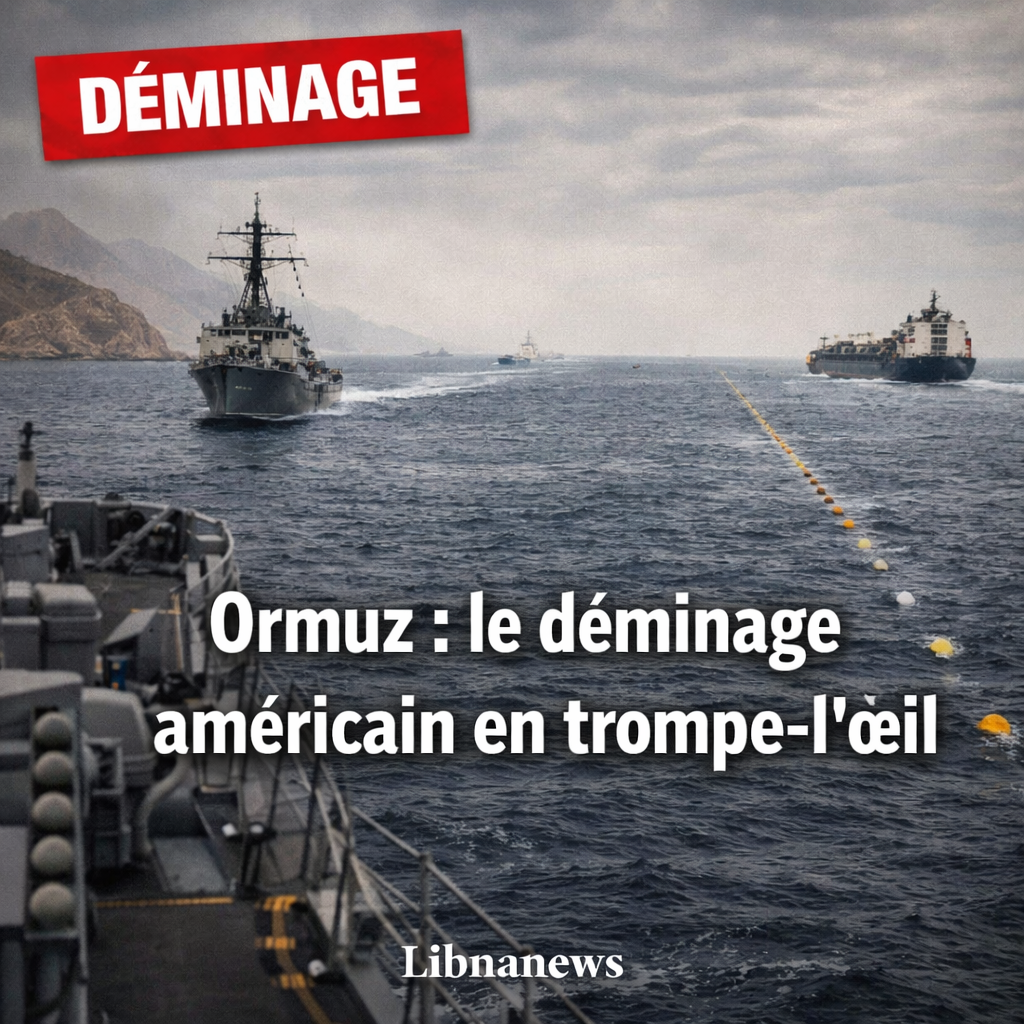
The word « mining » gives the illusion of a clean, almost mechanical operation. In the Strait of Ormuz, the reality is quite different. Washington claims to have launched a mission to secure the sea lane and restore commercial traffic. But the vocabulary chosen by the American command is already revealing: it does not speak of a completely cleaned strait, nor of a guaranteed rapid reopening, but of a phase of « conditioning » and the establishment of a new safe passage. This nuance has nothing to do with communication. It says, in a hollow, that the United States can attempt to open a corridor, protect unmanned means and organize a gradual resumption of traffic. It does not prove that they now have the mass, redundancy and depth necessary to clear the entire Strait of Ormuz, on their own and within short deadlines.
The subject is decisive because Ormuz is not a peripheral theatre. US energy data describe it as the world’s main oil bottleneck, with 23.2 million barrels per day in transit in the first half of 2025, or 29 per cent of global sea oil flows. When a space of this importance is threatened by mines, the question is not just whether a navy of war can pass. Shipowners, insurers and riparian states must be able to demonstrate that the road is safe enough to return to large-scale use. However, in the area of mine warfare, the difficulty is not only to destroy some of the equipment identified. It consists of proving that there is not elsewhere, in dense traffic, on a large area, under threat of missiles, drones and surface attacks. This is where the American discourse on the recapture of the Strait comes up against the much less flattering reality of its available resources.
Washington talks about security, no total demining
The first element to look at is the official formulation itself. On 11 April, the U.S. Central Command announced that its forces had begun « preparing conditions » for the clearance of the Strait, following the passage of two destroyers, USS Frank E. Peterson and USS Michael Murphy. The same press release states that it is a matter of establishing a « new passage » to be communicated to the shipping industry, while submarine drones will support the effort in the following days. This sequence is important because it shows what Washington really does: test, mark, protect, open a usable road. It does not correspond to the image of an entirely sanitized strait. A safe channel is not a fully mine-free space. It is a road that is considered to be sufficiently practical for framed traffic, which is already very different, militarily and commercially, from a return to normal.
This lexical prudence is all the more significant since the buildings visible at the beginning of the operation are not by nature mine hunters. They’re missile destroyers. They can protect an air defence bubble, escort more specialized means, cover drones and impose a presence in a hostile environment. They alone do not constitute a conventional mine war force. The signal sent is therefore double. On the one hand, the United States wants to show that it remains the strategic initiative in the Gulf. On the other hand, they reveal, in spite of them, that they no longer have in hand, in the region, the old dedicated architecture that once allowed to absorb a large-scale mining crisis with specialized means already in place. When destroyers open the walk, this is not proof that the problem is solved. It is often the clue that the real tools still lack, arrive slower or are not present in sufficient numbers.
The real gunmen left Bahrain
The second, much heavier, fact is structural. In September 2025, the U.S. Navy disarmed in Bahrain its last Avenger-class ships dedicated to mine warfare. For decades, these buildings were the hard core of America’s advanced capacity in the area. Their withdrawal did not simply mark the end of a technical cycle. It ended a specialized, permanent and immediately available presence close to the Strait. Officially, the rotation was to be carried out by combat ships, or LCS, equipped with a mine war module that boarded several unmanned systems. On paper, this transition promised more security distance, less direct human risk and a more modern architecture. In fact, it has replaced a proven capacity with a still growing, more modular, more dispersed and more dependent on technological bricks that have not all reached full maturity.
The most important point is not that the United States would no longer have any capacity. They still have, and it would be wrong to write the opposite. The problem is that they lost the depth of the fleet that gave resilience to their device. The Avengers were old, vulnerable and imperfect, but they were there. They formed an organic capacity, identified, parked forward, thought for this type of mission. By removing them before the succession fully proved its operational robustness, Washington took the bet that a lighter architecture, centred on multi-platform and autonomous systems, would be enough to hold the line. The Ormuz Strait today shows the strategic cost of this bet. When the crisis erupts, the debate no longer focuses on the elegance of the capacitive transition. It deals with a much more brutal question: how many means actually available, immediately, can treat a minefield in one of the most sensitive passages on the planet.
LCS succession remains incomplete
The U.S. Navy is highlighting its new mine war module for the LCS. This module reached its initial operational capability in March 2023. It combines surface drones, sensors, an MH-60S helicopter and equipment capable of detecting, classifying, neutralizing and sweeping threats. USS Canberra was the first vessel of this category to arrive in Bahrain with this module in May 2025, and then other ships joined it. This rise in power is real. She’s not fictitious. But it does not mean that the problem is solved. An initial capacity is not a mass capacity, let alone a guaranteed capacity in a prolonged war scenario, under logistical constraint, with routes to reopen quickly and shipowners waiting for something other than a technical promise.
The public documents of the American Congressional Controller introduce a decisive reservation here. By June 2025, they reported that the Navy had not provided a comprehensive plan explaining how it intended to address all of the systemic deficiencies in the LCS program. The same audit also noted the lack of documentation on lessons learned from existing deployments. More broadly, another report published in March 2025 pointed out that mission systems for the LCS, crucial for their anti-submarine, surface and mine war roles, had never fully delivered the promised capabilities. This formula, in such a sensitive case, weighs heavily. She doesn’t say the LCS are useless. She said that the U.S. Navy had begun replacing its former dredgers with a solution that its own public controllers still considered incompletely stabilized.
This fragility becomes even more visible when we look at the concrete availability of buildings. According to the American specialized press, which closely follows fleet movements, the three LCS based in Bahrain with the first operational modules are Canberra, Tulsa and Santa Barbara. But when the Ormuz crisis turned into an active phase, the immediate availability of this triptych did not seem complete. Part of the system was located at a distance in South-East Asia for logistical or maintenance stops, while the question of exactly how the United States intended to reopen the Strait remained officially open. This point is central. In a mining crisis, capacity is not only measured by the number of theoretically held systems. It measures what is present, armed, supported, connected and available in the critical window of the first days. This is often where the nominal power is separated from the actual capacity.
Heliported component exits the game
The third element, less visible for the general public but essential for specialists, concerns the MH-53E Sea Dragon helicopters. For years, they have been the backbone of American airborne demining. Officially, the U.S. Navy still describes them as its platform dedicated to the airmine war, capable of hunting, scanning and neutralizing. But everything in recent public documents shows an accelerated end to the cycle. The Navy itself explains that the deployment of the first mine war modules on LCS opens the process of withdrawing MH-53 and Avenger ships. At the same time, the official press of the naval aircraft points out that the last two training and employment units of the Sea Dragon are heading towards the closure of this type of aircraft. Again, the problem is not the absolute absence of any resources. The problem is the simultaneous transition of two historic pillars, specialized ships and dedicated helicopters, at a time when mining risk is becoming central again in the Gulf.
In such a context, Washington finds itself betting on a replacement logic rather than on a superposition logic. However, in the area of mine war, this choice is risky. Mines do not forgive capacity holes or administrative transitions. The old lesson of the Persian Gulf is even exactly the opposite: when a mining crisis breaks out, it is better to have successive layers of means, not a new system still in validation, replacing, almost with a tense flow, old but available tools. The current situation specifically highlights this vulnerability. The United States maintains immense naval superiority in the region. But their overall superiority is not mechanically transformed into excellence in the mine war, which remains a slow, ungrateful, expensive and highly dependent specialty of sharp equipment, trained crews and fine logistics.
Demining the Strait of Ormuz is not reopening a road
This is also the most misunderstood point of the debate. Demining the Strait of Ormuz does not only mean destroying identified devices. We need to inspect, classify, check, rebalay, neutralize and document. The maritime sector must then be convinced that the road is safe and operationally acceptable. In the best case, a navy can gradually restore safe corridors before it can claim that an area has been sanitized in conditions close to normal. That is exactly why historical precedents remain instructive. In 1987, during Operation Earnest Will, the oil tanker Bridgeton struck an Iranian mine from the first convoy escorted. In 1988, the frigate Samuel B. Roberts struck a mine. In 1991, USS Tripoli and USS Princeton were damaged by Iraqi mines a few hours apart. The history of the Gulf thus recalls a constant: a single well-positioned machine is enough to break the narrative of control, to slow down traffic and to raise the political cost of a naval operation.
The Strait adds its own geography. Trade routes are tightened, traffic is dense, and the energy challenge is enormous. US figures confirm that a major part of world oil flows and a significant part of liquefied natural gas still go through this corridor. Even if the United States were able to quickly clear one or two narrow axes, this would not be enough to eliminate the economic impact of mines. The road would remain fragile, selective, high-priced and exposed to the slightest incident. This is also the point already made by the shipping sector, which points out that the presence of mines makes the road unusable or very difficult to achieve. The heart of the case is here: Washington can probably restore a framed start of traffic. At this stage, it lacks the elements to promise full, sustainable and rapid clearance of the Strait as a whole.
Even Washington is now looking for a coalition
The last clue to this American limit is diplomatic. If the United States Navy had, alone, an obvious, massive and immediately sufficient capacity to solve the problem, the discussion of a multinational defensive mission would be secondary. But it returns to the forefront. This week London and Paris are co-organising discussions on a possible strictly defensive naval mission to restore freedom of navigation in the Strait. One news agency said that such exchanges should bring together countries ready to join a peaceful mission separate from the parties to the conflict, and recalled that some 40 States had already been approached in a separate framework, without American participation. This movement does not mean that Europe will replace the American navy. It means something else: even for Western allies, the reopening of Ormuz is not a mere technical formality that Washington would settle alone, at short notice, with its organic means alone.
This sequence must therefore be read for what it is. The United States retains the ability to penetrate the area, defend its buildings, deploy drones, build temporary roads and impose a military framework on maritime space. On the other hand, the available public evidence suggests that they no longer have, alone and immediately, a deep demining capability commensurate with the challenge posed by the Strait of Ormuz. The withdrawal of the Avengers, the unfinished transition of the LCS, the extinction of the Sea Dragons, the reservations of the American public controller and the very prudence of the vocabulary employed by the military command all converge in the same direction. Washington can open a passage. It can secure a corridor. He can start an operation. But between this ability to intervene and the promise of a truly cleared strait, the distance remains considerable, and it is precisely in this gap that American strategic credibility in the Gulf is now being played out.




