

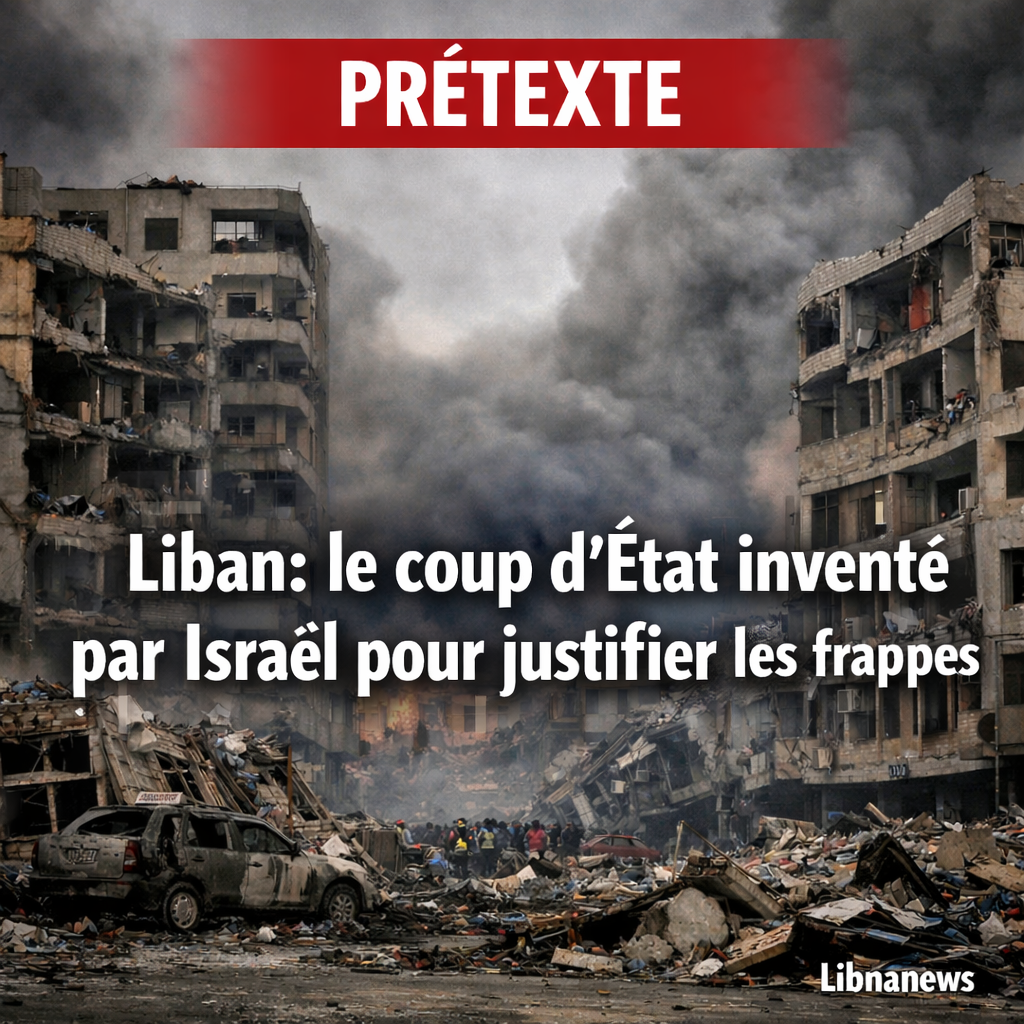
On 8 April, Lebanon suffered a wave of Israeli bombings of exceptional violence. More than 100 strikes in ten minutes, more than 250 on the whole day, more than 300 dead, more than a thousand injured, including many civilians and many children. Residential neighbourhoods were hit while a ceasefire was announced. What happened that day was nothing more than a military episode. It’s a massacre. And it is all the more serious that a large part of the international community has seen or denounced a war crime.
We have to say things clearly. When civilian areas are hit on this scale, when whole families are caught under bombs, when the dead and wounded are counted in hundreds in a few hours, there is no ordinary defensive operation. We are talking about a massive attack whose human cost was paid primarily by the Lebanese population. On 8 April, civilians took the brunt of the shock. Children have paid the price of military and political choices that exceed them.
In the face of the scale of the scandal, Israel put forward a motive: Hezbollah would have prepared a coup d’état. This thesis doesn’t hold. First for a simple reason: there has never been a coup d’état. Secondly, because no credible material was presented to support such a serious charge. Finally, because if there had really been an attempt by Hezbollah to take power, such a scenario would have objectively served Israeli interests. It would have provided Tel Aviv with the best possible argument to prolong, intensify and legitimize its operations in Lebanon in the name of the collapse of the internal order. Nothing like that has happened. The story of the coup d’état therefore looks less like an explanation than a pretext.
This is where the real issue of 8 April lies. What bothered Israel was not an imaginary putsch. What bothered Israel was the dynamics of negotiations between Iran and the United States. For this diplomatic sequence opened the possibility of a ceasefire or, at the very least, regional de-escalation that would have reduced Israeli room for manoeuvre. It also threatened to redraw the political power ratio in Lebanon without Tel Aviv controlling its pace and terms.
For the Lebanese government, this sequence also created an impasse. On the one hand, supporting or accompanying a cease-fire backed by an Iranian-American dynamic could strengthen Hezbollah on the domestic political ground and weaken its opponents. On the other hand, continuing to rely on negotiations with Israel was tantamount to entrusting itself to an actor who, at that very moment, showed no serious will to move forward by any other than force. In other words, Beirut was faced with a false choice: to accept a diplomatic outcome whose internal political benefit could benefit Hezbollah, or to continue to wait for negotiations with Israel even though Tel Aviv refused to comply with the minimum conditions.
In this reading, 8 April is not only a day of bombing. It’s a political operation. Israel not only hit Lebanon; He hit a diplomatic moment. He sought to torpedo a sequence that bothered him, to resume the regional initiative and to recall that no de-escalation could take place without him or against his interests. The brutality of the attack had a precise function: to break an emerging framework, to reimpose the balance of power and to put Lebanon under direct pressure of war.
International convictions were quick, public and documented. At the United Nations, the High Commissioner for Human Rights Volker Türk described the extent of death and destruction in Lebanon as horrific and called for prompt and independent investigations into possible violations of international humanitarian law. Antonio Guterres also condemned the massive strikes. On 9 April, 63 States and the European Union further denounced in New York the heavy civilian casualties, the destruction of infrastructure and the need to protect UNIFIL, recalling that attacks against peacekeepers could be considered war crimes.
The French response was clear. The Quai d’Orsay condemned the massive strikes of 8 April in the strongest terms, stressing that they were all the more unacceptable as they undermined the truce concluded the previous day between Washington and Tehran. Jean-Noël Barrot then demanded that Lebanon be included in the ceasefire, and Emmanuel Macron said that Lebanon should be fully covered by the agreement, while denouncing indiscriminate Israeli attacks.
Spain has been even more frontal. José Manuel Albares accused Israel of violating international law and the ceasefire; It considered the invasion of a sovereign country such as Lebanon unacceptable and recalled that Madrid proposed sanctions against Israel for violations of international law. Pedro Sánchez denounced Benyamin Netanyahu’s contempt for international law and life, called for the suspension of the EU-Israel Association Agreement, called for an end to impunity for Israel’s criminal actions and closed Spanish airspace to aircraft involved in the conflict.
Hardening was not limited to Paris and Madrid. Kaja Kallas believed that the Israeli strikes, which had killed hundreds, put the Iranian-American truce under heavy pressure and made it difficult to present such intensity as self-defence. London spoke of a profoundly damaging escalation. Rome, after Israeli fire on an Italian UNIFIL convoy, summoned the Israeli ambassador; Giorgia Meloni said that the Israeli attacks in Lebanon must stop immediately.
Threats of reprisals were explicit. Hezbollah, which had suspended its attacks after the announcement of the truce, resumed rocket fire to the north of Israel, claiming to be responding to ceasefire violations. Hassan Fadllallah warned that the continuation of the strikes would affect the whole agreement. The Iranian Revolutionary Guards warned Washington and Tel Aviv that they would respond if the attacks on Lebanon continued, while the President of the Iranian Parliament already considered it unreasonable to pursue bilateral negotiations under these conditions.
This is also why the thesis of the coup d’état must be looked at for what it is: a useful narrative, built to divert attention. Instead of talking about the hundreds of strikes, hundreds of deaths, thousands of wounded, ravaged civilian neighbourhoods and the empty cease-fire, we move the debate towards an assumed, impossible to verify and politically convenient internal threat. It is a classic mechanism: to make an absolute danger to justify the unjustifiable.
On April 8, the reality is simpler and more brutal. Lebanon was bombed on an extreme scale. Civilians were killed in mass. Children were torn from life. Civilian neighbourhoods were affected. And all this happened at the very moment when it was claimed to open a ceasefire perspective. The Israeli story of the coup does not illuminate this day: it serves to cover it. We must therefore refuse the reversal of the real. On that day, Israel did not prevent a coup that never happened. He used a political pretext to justify an offensive of overwhelming violence, at a time when diplomatic dynamics might escape him. And it was Lebanon, once again, that paid the heaviest human price.




