

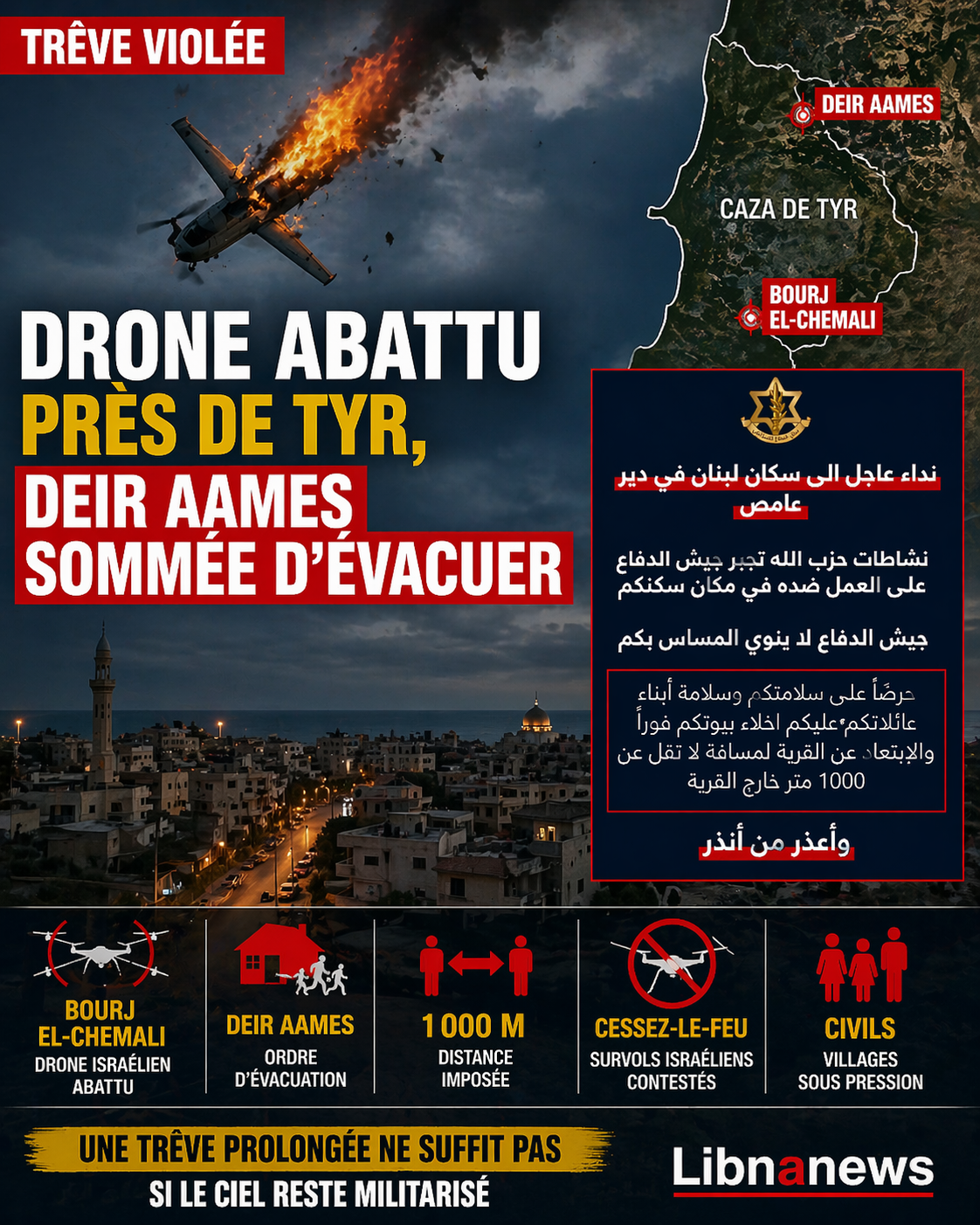
An Israeli drone was shot dead on Friday, 24 April, over Burj al-Shemali in the Tyre area in southern Lebanon. The first available information indicates that an aircraft was hit while flying over a inhabited area. The exact type of drone, its equipment and the precise location of debris fall have not yet been confirmed by an official authority.
This incident occurs when the truce between Lebanon and Israel has just been extended by three weeks under American sponsorship. The flights of Israeli drones over Lebanese territory constitute a violation of the ceasefire, as they maintain military activity in Lebanese airspace despite the announced cessation of hostilities. They also constitute a violation of Lebanon ‘ s sovereignty.
In the same sequence, the Israeli army issued a warning in Arabic to the inhabitants of Deir Aames, in Tyre District. The message asks them to immediately evacuate their homes and move at least 1,000 metres away from the village, claiming that Hizbullah’s activities force the Israeli army to act in their area of residence.
A drone shot down in the Tyre area
The incident was reported early in the afternoon by Lebanese media. The first warnings place the slaughter over Burj al-Shemali, a town in the Tyrus agglomeration. Online images show an aircraft in flight, then an interception or explosion before it falls. No complete technical identification has yet been made public.
Bourj el-Chemali is located in a dense civilian environment. The town is close to Tyre, Palestinian refugee camps, residential areas, busy roads and villages already exposed to military tensions. The fall of a drone or its debris in this type of area poses a direct risk to the inhabitants, even when no casualties are reported immediately.
No definitive human results were reported in the first few hours. Security services are usually required to secure the perimeter, prevent residents from touching debris and determine whether the aircraft was carrying explosive components, damaged batteries or sensitive equipment. These audits condition any specific risk assessment.
The Israeli army had not yet published a full version of the event at the time of the initial information. Nor did Hezbollah immediately provide a detailed statement claiming interception, the system used or the unit involved. The wording must therefore remain cautious: an Israeli drone was reported to have been shot down over Burj al-Shemali, but several technical elements remain to be established.
Drone flights that violate the ceasefire
The presence of Israeli drones in the Lebanese sky is one of the most sensitive points of the truce. A ceasefire is not limited to stopping artillery fire or airstrikes. It also implies the cessation of offensive military, intelligence and pressure activities in the territory of the other party. As such, Israeli overflights are violations of the ceasefire.
These flights continue to pose a threat to civilians. In the South, the noise of a drone is not seen as a mere overflight. It is associated with targeted strikes, assassinations, house tracking, vehicle destruction and evacuation alerts. For residents, the drone often announces the possibility of a strike or a new warning.
Lebanon has for years denounced Israel’s repeated violations of its airspace. In the current context, these violations take on additional scope, as they occur during a period presented as a truce. They therefore weaken the credibility of the extension announced in Washington and fuel the perception of an unevenly applied ceasefire.
Israel also claims to be conducting surveillance operations against Hezbollah and its infrastructure. This justification does not remove the legal and political problem posed by overflights. The purpose of the ceasefire is precisely to suspend military operations and create a de-escalation space. A military drone over a inhabited area contradicts this objective.
A prolonged but still incomplete truce
The three-week extension announced in Washington did not turn the situation in the South into complete calm. High-intensity hostilities have declined, but point strikes, fire, demolitions, overflights and evacuation warnings continue. The drone shot down in Bourj el-Chemali is part of this grey area.
The ceasefire therefore functions as a diplomatic framework more than as a total protection. The United States is seeking to maintain a channel between Beirut and Tel Aviv. The Lebanese government is calling for an end to the attacks, the Israeli withdrawal, the return of the displaced and the reconstruction of the villages. Israel links every step forward to safeguards against Hezbollah.
In fact, the people of the South do not judge the truce from diplomatic communiqués. They measure it by the presence of drones in the sky, explosions heard, roads cut off, houses destroyed and evacuation messages received on social networks. When these elements continue, the truce remains partial.
The killing of an Israeli drone also shows that aerial military activity continues over Lebanon. Although the overall intensity has decreased, the Lebanese sky remains militarized. This situation carries the risk of a rapid resumption of confrontations, as each interception can be followed by a response or a new strike.
Israeli warning to Deir Aames
The other important part of the day concerns Deir Aames. A message in Arabic, attributed to the Arab-speaking spokesman of the Israeli army, is addressed to the Lebanese inhabitants present in this locality of Tyre District. He claims that Hezbollah’s activities force the Israeli army to act in their place of residence.
The text states that the Israeli army does not seek to reach civilians. However, it orders the inhabitants to immediately evacuate their homes and to move away from the village of at least 1,000 metres. The final formula, « the one who warns is excused », echoes a rhetoric frequently used in Israeli evacuation messages.
This alert is also a sign of the fragility of the ceasefire. A complete truce should allow the inhabitants to stay home, move around and resume a minimum life. On the contrary, an evacuation warning sent to an entire village indicates that a military operation is being planned or prepared in a civilian area.
Deir Aames is not an abstract military position. It is inhabited, with families, elderly people, children and residents who have sometimes experienced displacement. Asking them to leave immediately and to move away from one kilometre creates direct pressure, especially when roads are damaged or families do not have a place of reception.
Evacuation Summations as Military Pressure
Evacuation warnings are presented by Israel as measures to limit civilian casualties prior to a strike or operation. However, they do not erase the obligations imposed by international humanitarian law. An alert does not automatically make an attack legitimate. The target, military necessity, proportionality and precautions taken remain decisive.
In the context of southern Lebanon, these conclusions also have a displacement effect. They empty villages, interrupt returns, close shops and cause panic. The inhabitants must decide in a few minutes whether to stay or leave, without knowing whether the strike will take place, what area will be targeted or when they can return.
The proliferation of these messages during the truce weakens the very notion of a ceasefire. It means that the population is still living under the threat of imminent operation. It prevents the stabilization of villages and delays the assessment of damage by municipalities, relief workers and public services.
The message sent to Deir Aames must therefore be read with the drone shot down in Bourj el-Shemali. Both facts belong to the same security sequence in the Tyre area. One concerns airspace and the violation of the ceasefire by Israeli overflights. The other concerns the pressure exerted on the ground by an evacuation warning.
A civilian population exposed
The Tyre region now concentrates several forms of risk. The drones fly over the localities. The debris can fall into the inhabited area. Evacuation alerts can cause precipitated departures. Strikes can follow warnings. The inhabitants thus live between waiting, monitoring and forced departures.
Bourj al-Shemali is a particularly sensitive case. The density of the population increases the risk in the event of a fall in the apparatus. Residents may be injured by fragments, fires or secondary explosions. Children and the curious can also get close to the debris before the security forces arrive, creating an additional danger.
In Deir Aames, the risk is different but equally concrete. Families must leave their homes in an emergency. Older people, sick people and large families have more difficulty moving. Those who do not leave remain exposed to a strike. Those who leave do not know if their house will still be standing when they return.
This reality shows why the truce cannot be assessed solely by the number of shots. It must be judged on the real security of civilians. As long as Israeli drones fly over the villages, as long as evacuation orders are issued and as long as possible, the ceasefire remains incomplete.
Hezbollah and the response to overflights
Drones occupy a central place in the confrontation between Israel and Hezbollah. Israel uses them for surveillance, intelligence, target identification and sometimes support strikes. Hezbollah, for its part, seeks to challenge this aerial superiority by regularly announcing interceptions or launching drones to Israeli positions.
When an Israeli drone is shot down, Hezbollah can present the incident as a response to a violation of the Lebanese sky. On the contrary, Israel can call it hostile action against an aircraft engaged in a surveillance mission. These two accounts then feed into the mutual accusations of ceasefire violations.
The underlying problem remains the same. The presence of an Israeli military drone over Lebanese territory during a truce is already a violation. Interception of this aircraft occurs in a context where Israeli air activity has not ceased. It cannot therefore be separated from the issue of overflights.
This dynamic is dangerous. A drone entered Lebanese airspace. He’s targeted. The Israeli army can respond. Hezbollah can respond. The truce becomes fragile by chain. It is precisely this scenario that mediators seek to avoid, but no sufficiently clear public mechanism seems yet to prevent these incidents.
The expected role of the Lebanese State
The Lebanese State must document these violations. The army, security services, municipalities and administrative authorities can establish the location of the drone fall, identify debris, detect damage and transmit the elements to the authorities concerned. This documentation is essential for ongoing discussions under American sponsorship.
The Lebanese Government affirms its desire to halt Israeli attacks, respect the sovereignty of the country, the withdrawal of Israeli forces and the return of displaced persons. Overflights of drones enter this file directly. They are not secondary incidents. They affect the heart of the ceasefire and the control of national airspace.
The Lebanese response must also take into account the immediate security of civilians. In Bourj al-Shemali, debris must be secured and the inhabitants must be prevented. In Deir Aames, it is necessary to monitor possible movements, assist vulnerable families and monitor the possibility of a strike. Municipalities are often in the front line, with limited resources.
This sequence recalls the difficulty of the Lebanese State. It must protest Israeli violations, while showing that it can protect civilians and regain control of the ground. He must also manage the presence of Hezbollah, which retains its own military capacity and its own reading of the truce.
A Test for American Mediation
American mediation is faced with a concrete test. Washington got the truce extended for three weeks. However, this extension loses its scope if Israeli drone flights continue, if villages receive evacuation orders and the inhabitants of the South remain exposed to strikes.
The United States presented the truce as a space for de-escalation. For it to become credible, violations must be identified, named and dealt with. Israeli overflights cannot be ignored as mere intelligence gestures. In a ceasefire, military air activity over Lebanese territory constitutes a hostile act.
The question is therefore not only technical. She’s political. If Israel retains freedom of overflight, threat and strike, Lebanon will not be able to present the truce as a return to sovereignty. If Hezbollah continues to respond by firing or intercepting, Israel will continue to justify its operations. The diplomatic mechanism may then remain trapped on the ground.
The next stage of the discussions should address this point. An effective truce requires the cessation of strikes, fire, demolitions and ground incursions. It also requires the cessation of overflights of Israeli drones, as these overflights maintain war over villages and provoke armed responses.
Points to be confirmed in the next hours
Several elements will need to be confirmed. The first concerns the model of the drone shot down in Bourj al-Shemali. Its identification will determine whether it was a surveillance, guidance or armed drone. Debris and possible serial numbers could help specialists establish its nature.
The second point concerns the interceptor. An official Hezbollah claim or an Israeli communiqué may specify the circumstances. In the absence of such confirmation, the incident must be reported as an Israeli drone shot down over the Tyre area, without definitively assigning the method used.
The third point concerns developments in Deir Aames. The Israeli warning announces a possible military action. It will be necessary to check whether strikes follow, whether the inhabitants actually evacuate the village and whether the local authorities see any damage or displacement. The continuation of this alert will tell if the truce is further broken on the ground.
The fourth point concerns the civilian balance sheet. No final results were published immediately for Bourj el-Shemali. Any injuries, property damage or fires related to the fall of the drone will have to be checked. In this type of incident, the balance sheet can evolve after the intervention of the security services.
The day therefore remains open in the Tyre area. An Israeli drone was shot down over Burj al-Shemali. Israeli overflights constitute a violation of the ceasefire. An Israeli warning called on the inhabitants of Deir Aames to leave their homes immediately. The diplomatic extension of the truce once again comes up against the facts observed in the sky and in the villages of the South.




