

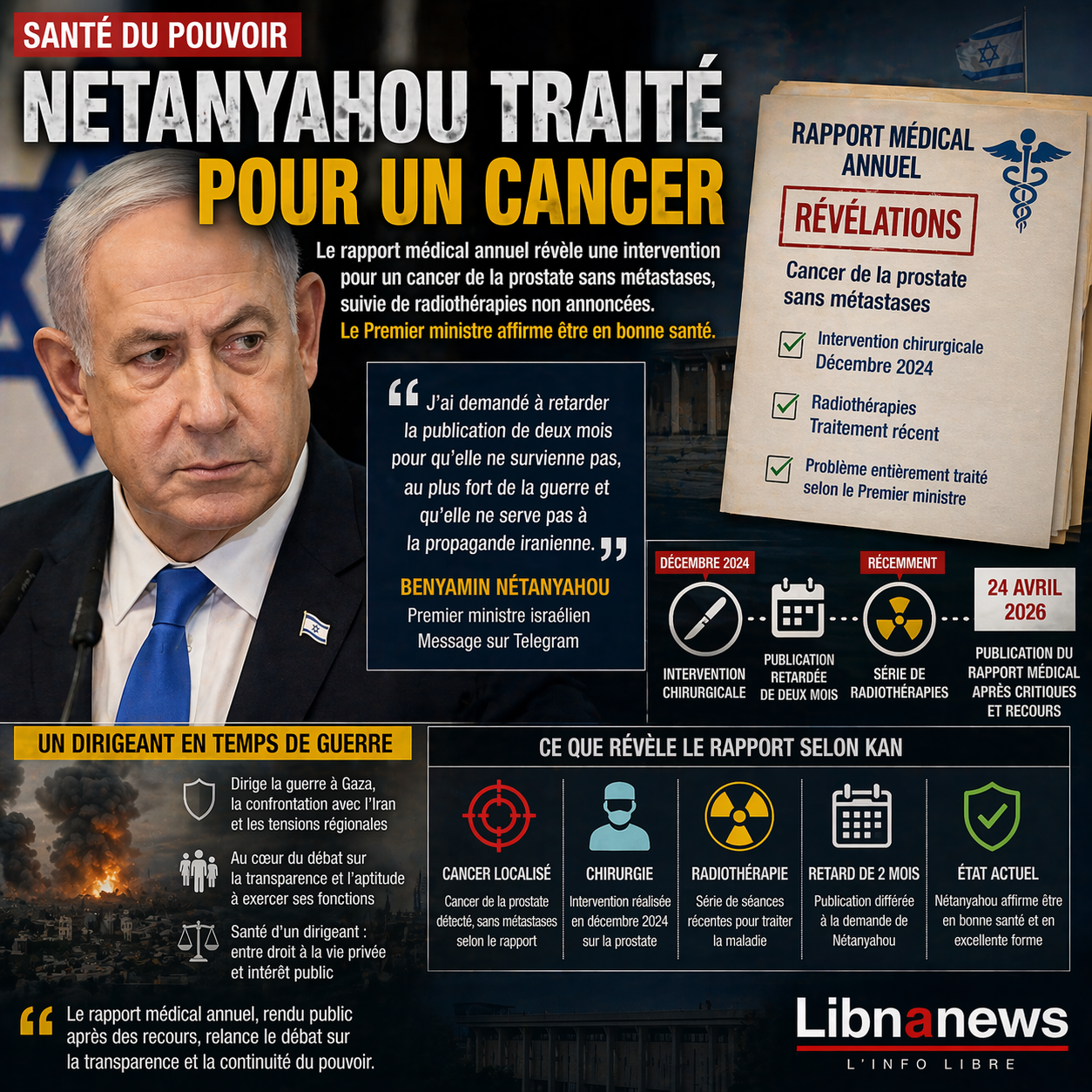
Israeli Prime Minister Benyamin Netanyahu underwent a surgical procedure related to metastasis-free prostate cancer, according to information published on Friday, 24 April by the Israeli public channel Kan, based on the annual medical report released by the office of the head of government. The same source reports that the Israeli leader subsequently followed a series of radiotherapy sessions, without the information being communicated to the public at the time of medical procedures.
The release of this report follows criticism of the level of transparency surrounding the Prime Minister’s state of health. According to Kan, the annual medical record was made public after repeated appeals and requests for information. It reveals that the procedure dates back to December 2024 and that it concerned prostate cancer presented as without extension or metastases.
Benyamin Netanyahu claims to be healthy. In a message sent to his subscribers on Telegram, he explained that the publication of the report had been delayed by two months at his request, so that, according to him, it would not occur at the height of the war and would not be used for Iranian propaganda. The announcement now places his health at the centre of an Israeli public debate combining medical information, continuity of power and citizens’ right to be informed.
A revelation from the annual medical report
The Kan channel reports that the annual medical report published by the Prime Minister’s office reveals an element previously not communicated to the public: Benyamin Netanyahu underwent surgery in December 2024 to treat prostate cancer, described as without metastases. The report also states that he has followed radiation therapy recently to treat the disease.
The information changes the reading of the known medical episode of December 2024. At the time, the official communication focused on a procedure related to benign prostate hypertrophy and urinary infection. The new publication introduces a different element: the presence of cancer, detected and treated, according to the evidence reported by Kan.
Medical nuance is important. This is not a simple malaise or isolated minor intervention. The term used in Israeli information refers to a localized cancer disorder, without metastases reported. This precision means that the disease was not presented as scattered in the organism, according to the report quoted by the chain.
However, the Prime Minister’s office accompanied the publication of a reassuring message. Benyamin Netanyahu stated that the medical problem had been fully addressed. He said he was healthy and in excellent physical fitness. These elements are part of the communication of the Israeli leader, as reported after the publication of the medical document.
Netanyahu’s medical calendar
Kan’s calendar begins with the December 2024 intervention. The Israeli Prime Minister was then operated on the prostate. The intervention had resulted in hospitalization and official communication focusing on a benign pathology. The annual report published on Friday now provides a more complete version of the medical follow-up.
Following this operation, Benyamin Netanyahu continued to receive regular medical attention. According to the published evidence, a check identified an anomaly. The information provided indicates that this was a localized outbreak, followed by metastasis-free prostate cancer. The wording remains medical and should be read within the limits of the published report.
Treatment did not rely solely on surgery. Kan says the Prime Minister has also recently undergone a series of radiotherapy. Professor Aharon Popovtzer, Director of the Sharett Institute of Oncology at Hadassah Hospital, is quoted by Kan as indicating that Benyamin Netanyahu had chosen radiation treatment about two and a half months earlier and that, for the time being, the disease appeared to have been treated.
This information makes it possible to distinguish three moments: the December 2024 operation, the discovery or confirmation of a cancer outbreak as part of the follow-up, and the recent radiotherapy. The report published on Friday gives consistency to this sequence, but it does not specify all the medical details that would allow an independent evaluation of the chosen protocol.
Two months delayed publication
Benyamin Netanyahu explained that the publication of the annual medical report had been delayed by two months at his request. According to Kan’s message, he did not want the document made public at the height of the war. He said he wanted to avoid the Iranian regime using this information to spread propaganda against Israel.
This rationale puts the Prime Minister’s health in the regional security context. Israel is engaged in several military and diplomatic fronts, including the war with Iran and tensions related to Lebanon, Gaza and Hezbollah. In this context, the state of health of the head of government is a sensitive subject, because of its central role in the conduct of the executive.
However, the decision to delay publication opens a different debate. The health of an active leader is not ordinary private information when it may affect his or her ability to govern, participate in war decisions or assume his or her institutional responsibilities. The subject therefore also concerns democratic transparency.
Kan points out that the report was published after numerous public criticisms and appeals. This precision places information in a context of institutional and media pressure. The medical document was not only circulated as a voluntary gesture of communication. It comes after an increased request for clarification.
Public transparency
The revelation revives the question of the medical transparency of Israeli politicians. A Head of Government retains a right to privacy. But when he leads a country at war, participates in military decisions and is required to appear in court proceedings, his state of health also becomes a matter of public interest.
The case of Benyamin Netanyahu focuses on these issues. The Prime Minister remains the central player in the ruling coalition. He runs the cabinet meetings. He participates in security arbitrations. He is involved in relations with the United States, European countries, Arab countries and mediators involved in regional fronts.
In this context, the lack of complete information at the time of treatment may raise questions. Citizens may want to know whether medical intervention, hospitalization or radiation therapy have had an impact on the exercise of power. The authorities may reply that the procedures have not prevented the continuity of the State. The debate then focuses on the level of information to be made public.
The publication of the report does not necessarily end the discussion. It provides new elements, but it happens after the fact. The question asked is therefore also the question of the time limit: when should important medical information about a Prime Minister be disclosed, and with what degree of precision?
A treatment submitted as completed
The evidence reported by Kan indicates that treatment of Benyamin Netanyahu prostate cancer is presented as complete or effective at this stage. Professor Popovtzer indicated that the disease appeared to have been treated. The Prime Minister says the problem is behind him and that he is in good physical condition.
These formulations should be used with caution. They do not make it possible to transform medical communication into absolute certainty about the future. In cancer follow-up, physicians generally continue to monitor the patient’s course after treatment. The available report, as summarized by Kan, indicates a reassuring current state, without detailing the future follow-up.
However, the lack of metastases is a central medical element. It means that in the published report the disease was not described as spread. It also gives an indication of the type of treatment mentioned: a localized pathology, treated with a combination of intervention and radiotherapy, according to the elements made public.
The communication of Benyamin Netanyahu insists on three ideas: he is healthy, he remains fit and the medical problem has been solved. This line aims to reassure Israeli opinion, its political partners and international actors following the continuity of power in Jerusalem.
Policy implications to be measured
Medical information alone does not lead to an automatic institutional consequence. Nothing in Kan’s published evidence indicates that Benyamin Netanyahu is prevented from performing his duties. The announcement is about a past treatment and a state presented as stabilized. The Prime Minister therefore remains in office.
The subject, however, can fuel the Israeli political debate. The opposition may question the time limit for publication, the nature of the information submitted in December 2024 and the absence of any public detail on the treatment followed thereafter. Benyamin Netanyahu’s supporters can answer that the medical record confirms, on the contrary, that he has been treated and that he is able to lead.
The debate may also affect judicial proceedings concerning the Prime Minister. His medical problems had already affected certain hearings or schedules. The publication of a more comprehensive report can lead its opponents and advocates to reread reports, absences and requests related to its state of health.
The security dimension is also present. The Prime Minister’s message on the delay in publication explicitly refers to the war and Iran. This justification may become a point of discussion: some will see it as strategic prudence, others as a way of limiting transparency during a period when public decisions were the most sensitive.
The health of a wartime leader
The health of a wartime leader always raises a particular question. Military and diplomatic decisions require constant availability, concentration capacity and presence in command bodies. Any heavy treatment or hospitalization can therefore become a political subject, even when the patient recovers.
In the Israeli case, this issue is becoming more intense. The country is going through a period of prolonged conflict, with open or latent fronts. The Head of Government plays a direct role in strategic choices, in relations with Washington and in ceasefire or truce discussions involving several areas.
The revelation of prostate cancer and recent radiation therapies does not mean that the Prime Minister was unable to govern. It means that opinion learns after the fact that serious medical treatment has taken place. It is this time lag that gives the case its public scope.
The question therefore goes beyond the health of Benyamin Netanyahu. It concerns the communication rules applicable to current managers. It also concerns the ability of institutions to ensure the continuity of power when the head of government undergoes intervention or treatment. The report released on Friday revives this debate without fully resolving it.
Choice of words in official communication
The words used in this folder count. By December 2024, public communication had highlighted benign prostatic hypertrophy. The report released on Friday, according to Kan, reveals a prostate cancer treated without metastases and subsequent radiotherapy. The difference between the two formulations explains the current questions.
Benign hypertrophy and cancer do not refer to the same level of severity perceived by the public. Even when cancer is located and successfully treated, its evocation alters the understanding of the medical episode. The citizen does not hear the same when he is told about a urinary infection related to a benign pathology or a cancer treated.
The Prime Minister states that the problem was limited and that it was resolved. This precision is intended to avoid an alarmist reading. But the public question is less about medical prognosis than about the information available at the time of the incident. Why wasn’t the cancer character known earlier? Why was recent radiation therapy not announced before the annual report?
Kan reports that the document was published after criticism and recourse. This context indicates that the issue of transparency is not just medical. It is institutional. It concerns confidence in the information provided by the Prime Minister’s office.
Information to be processed without speculation
The article must avoid two pitfalls. The first would be to minimize important medical information about an active leader. The second would be to speculate on the real state of Benyamin Netanyahu beyond what the published report makes possible. The facts available are limited to the information provided by Kan based on the medical report and the Prime Minister’s message.
What is established in this source is precise: an intervention related to prostate cancer without metastases, recent radiotherapy, a late publication of the medical report, a justification for delay in the context of war and a personal communication from Benyamin Netanyahu stating that the problem has been treated.
What is not publicly established in these elements must remain outside the article. We must not conclude that there is a disability, a relapse, a criminal concealment or an unannounced institutional consequence. Nor should a detailed medical prognosis be extrapolated. Information is political because it concerns a head of government, but it remains medical in its content.
At this stage, the file therefore focuses on transparency, timing and continuity of power. The medical report makes public a treatment that Israeli citizens had not experienced in its entirety at the time of the incident. The follow-up will depend on any requests for explanation, the publication of additional details and how the Prime Minister’s office will respond to criticism.
A file to remain public
Kan’s revelation comes in an already tense political environment. Benyamin Netanyahu faces prolonged war, internal criticism, international pressure and a judicial calendar. Any information about her health can therefore be quickly integrated into partisan debate, even when she reports first on a medical report.
The Head of Government has chosen to respond directly to its subscribers, with a focus on his health and ability to continue. This personal speech is intended to regain control of the narrative. It also seeks to prevent published information from being interpreted as a sign of political or physical fragility.
However, the publication of the report can revive calls for clearer rules. Democracies are regularly confronted with this problem: how to inform a leader about his state of health without unnecessarily violating his privacy? How can we ensure that citizens have access to essential information when decisions are taken in the midst of war, security and diplomacy?
The Netanyahu case provides a partial but late response. The report is now public. Treatment is presented as effective. The Prime Minister claims to be healthy. The question remains of the deadline for publication, which remains the most political point in this case after the revelation of intervention and radiotherapy.




