

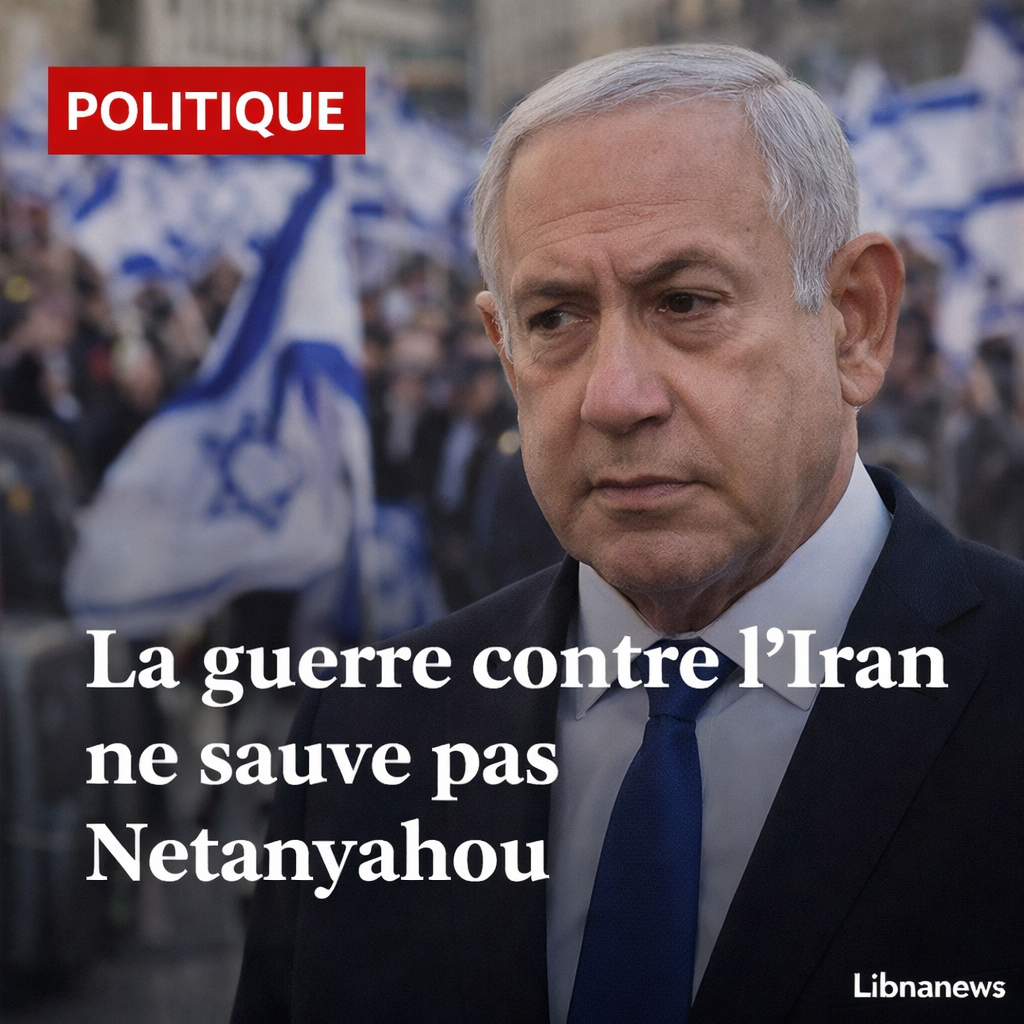
The war against Iran was to offer Benyamin Netanyahu an almost mechanical political advantage. In Israeli history as elsewhere, the opening of an external front often produces a rallying reflex. The head of government clearly hoped. His camp bet on a short, spectacular and legible sequence: effective strikes, a net weakening of Tehran, a demonstration of regional authority, and a rapid electoral translation. However, as the general election is approaching, which is expected by the end of October, this scenario is not required in the opinion. The recent investigations show instead a prime minister who remains central in the political game, but who does not convert war into a majority dynamic.
The paradox is all the more striking as Israeli opinion has not been abruptly converted to compromise. A large part of the public continues to judge the Iranian threat as a priority. Many Israelis refuse the idea of a lasting ceasefire if it leaves Iran’s military capabilities intact or does not stabilize the Lebanese front. Yet this hardness does not automatically benefit Benyamin Netanyahu. What surveys measure is not a new aspiration for moderation; This is a disappointment at the gap between the stated objectives and the results achieved. In other words, the Prime Minister does not pay for the choice of war in itself. He pays especially for the lack of clear victory.
A rallying effect that does not come
The figures summarize this contradiction. Benyamin Netanyahu’s approval has receded since the beginning of the war, while the official speech insists on historical success. Only a small minority consider the campaign against Iran a success. In electoral projections, the Likud remains a major party, sometimes even the first in seats, but its bloc remains too short to govern alone. So the coalition is not getting the security bonus that it was hoping for. In the Israeli system, winning in the lead is not enough if the addition of allies does not reach the majority in the Knesset.
The ceasefire survey further illustrates the situation. Nearly two thirds of Israelis reject the halting of strikes against Iran. But when the issue becomes concrete, the country divides itself almost in two between those who want to respect the truce and those who want to resume the attacks. The head of government therefore does not appear to be the man of consensus, nor the man of decision-making. He finds himself at the centre of an adversarial anger: for some, he accepted too early an imposed break from the outside; For others, he locked Israel in a war without a political horizon. This double reproach is electorally corrosive because it prevents the consolidation of a simple narrative.
The figures on the campaign
The main indicators available provide a measure of this political impasse. They collect the latest survey data, economic cost estimates and seating projections published in recent days.
| Indicator | Observed level |
|---|---|
| Approval of Benyamin Netanyahu | 34 % |
| Approval at the beginning of the war | 40 % |
| Israelis considering war to be successful | 10 % |
| Support for respect for the ceasefire | 41 % |
| Support for a resumption of strikes | 39% |
| Opposition to the extension of the truce in Lebanon | 61% |
| Estimated cost of war for Israel | $11.5 billion |
| Kan projection: seats in Netanyahu Block | 51 |
| Kan projection: Zionist opposition seats | 59 |
| Projection Channel 12 : Likud | 25 |
| Projection Channel 12 : Bennett party | 22 |
This picture does not indicate an ideological shift in the country. He pointed out that the electorate remained concerned, hardened, often in favour of continuing military pressure, but he doubted that the Prime Minister was still able to transform that firmness into a strategic outcome. For a leader who has built his political identity on security, this nuance is formidable. It removes from power one of its main levers of survival: the idea that in wartime there is no credible alternative. Today, the alternative is not yet stabilized, but the argument of the irreplaceable s
A war without clear political victory
On the regional level, the difficulty lies first of all in the concrete results of the campaign. Despite Israeli firepower and American support, the war did not produce the image of a decisive strategic shift. The Iranian regime remained in place. Iran’s nuclear and ballistic capabilities remain at the heart of the negotiations. The Strait of Ormuz continues to weigh on energy and diplomatic calculations. Israel has demonstrated its ability to strike, but not its ability to impose a new order alone. For a Prime Minister who presented Iran as the supreme test of his career, the gap between promise and outcome is very heavy.
This impression of incompleteness is also read on the peripheral fronts. In Lebanon, hostilities continue despite the American-Iranian truce. Direct discussions in Washington between Israel and Lebanon, a first in decades, show that a diplomatic door opens. But they did not produce any concrete framework for de-escalation or agree on the hierarchy of priorities. Israel demands the disarmament of Hezbollah and refuses to speak of a ceasefire without guarantees. Beirut highlights the humanitarian emergency and the cessation of strikes. The mere fact that these talks exist is a diplomatic turning point. At the Israeli domestic level, they confirm above all that the war did not resolve the issue of the northern front.
Discussions with Lebanon, however, may offer Benjamin Netanyahu a partial political outcome.
In the absence of a decisive military success against Iran, the Israeli Prime Minister can seek a more presentable victory in the Lebanese case: that of a balance of power transformed into a diplomatic advance, with a long-term weakening of Hezbollah and a secure northern front. But this bet is narrow. In order to sell this sequence to his electorate, Benyamin Netanyahu must also prove that he does not yield to Hezbollah’s disarmament or the demands imposed on Beirut. However, the Israeli line in the talks remains very harsh, as Israel refuses at this stage to approach a ceasefire in Lebanon without major security guarantees, while a majority of Israelis rejects the idea of extending the truce to the Lebanese front. It can therefore be deduced that the more the Prime Minister publicly hardens his position to reassure his base, the more he reduces the margin of compromise that could lead to the negotiations. What could become his main short-term political success contains in itself the possible reasons for his failure.
In Gaza, the same difficulty undermines the narrative of power. Hamas remains a threatening actor, while Hezbollah remains active on the Lebanese front. The Iranian conflict therefore did not erase previous failures; He superimposed them. In the opinion, this accumulation feeds a specific fatigue. It is not just a moral rejection of war. It is a weariness before a war that goes on, changes shape, moves from one front to another, but does not deliver a point of completion. The reputation of Mr. Safety was based on the promise to control climbing. Today, climbing seems permanent, so less controlled.
The post-war internal trap
Benyamin Netanyahu’s political weakness is also due to personal and judicial data. De-escalation with Iran does not bring him a respite. On the contrary, she reactivates her corruption trial. As long as the state of emergency partially suspended the institutional pace, the war offered the Prime Minister a form of indirect political protection. Resumption of the hearings has put judicial chronology at the forefront. The risk is not only symbolic. It affects the agenda, the image of authority and the ability of the head of government to control public conversation. Every day of the audience recalls that beyond the war, he also plays his own political and personal survival.
This reality illuminates a movement observed for several weeks: power has oscillated between the temptation of early elections and the need to avoid them. When Benyamin Netanyahu’s entourage still believed that he could capitalize on the confrontation with Iran, the idea of an advanced election was circulating. Then the calculation changed. Above all, the government sought to have the budget adopted before the deadline to prevent an automatic dissolution of the Knesset. The budget was finally adopted at the end of March, which provided an institutional stay for the Prime Minister. But a stay is not a winback. He only says that power managed to prevent the accident, not restore momentum.
The coalition remains, in fact, under pressure on several lines. The ultra-Orthodox parties continue to influence conscription-related arbitrations. The toughest partners demand the continuation of the war without always bearing the international and economic cost of such a line. Other right-wing elected officials fear that silencing will weaken the entire national camp before the election. In this context, each decision becomes politically costly. Accelerating the offensive exposes to further failure. Slowing opens space to accusations of weakness. The Prime Minister no longer enjoys the tactical freedom that has long been his strength. He now rules in a narrow corridor, between his allies, judges, Washington and a nervous opinion.
Three major electoral obstacles
Three elements today prevent the war from becoming a net electoral asset for Benyamin Netanyahu:
- Lack of decisive victory against Iran and its regional allies;
- the simultaneous return of the corruption trial and the issue of political responsibilities;
- The existence of competition on the right, especially around Naftali Bennett, which deprives the Likud of the monopoly of the security vote.
A still dispersed opposition, but more audible
One reason why Benyamin Netanyahu remains competitive despite everything is the persistent weakness of his opponents. The Israeli opposition does not yet present a perfectly unified bloc or a single leadership. Yair Lapid, Naftali Bennett, Yair Golan and other figures are fighting space, priorities and tone. This fragmentation prevents, for the moment, the appearance of a simple alternation. Yet, it no longer nullifies the wear and tear of power. Criticisms from the opposition are now on a very sensitive ground for the Israeli right: not only public morality or institutional reform, but security effectiveness itself.
Naftali Bennett takes particular advantage of this configuration. Former Prime Minister, anchored to the right, he can challenge Benyamin Netanyahu without being suspected of strategic naivety. When the polls place him very close to the Likud, they send an important signal: part of the conservative electorate seeks less an ideological revolution than a change of pilot. This move is essential. It means that the anti-Netanyahu vote can feed on a language of security, competence and management, not just an institutional or liberal discourse. Yair Lapid maintains a base, Yair Golan mobilizes another segment, but Bennett most clearly embodies the threat of a right turn.
This movement does not guarantee an alternation. The projections even show that neither the government bloc nor the Zionist opposition have an automatic majority alone. Arab parties could once again have a share of the coalition equation, which complicates any scenario. In addition, relations between opposition leaders remain tense, as demonstrated by recent exchanges between Yair Lapid and other rivals. But the new data is not the perfect unity of opposition. This is its growing ability to prevent Benyamin Netanyahu from turning war into a lever of domination. In Israel, a leader can survive a long time in a fragmented landscape. However, it must retain the initiative. It is precisely this initiative that is beyond his control.
The American bet turned around
Camp Netanyahu has relied heavily on the proximity to Donald Trump. This relationship was to give Israel diplomatic depth, military coverage and an internal political dividend. In the early days of the war, the argument seemed to work: the Israeli-American coordination seemed to confirm that the Prime Minister remained, better than anyone, able to align the Israeli strategy with Washington’s interests. But the rest changed that reading. The ceasefire was negotiated within a framework that did not marry Israeli preferences, with Pakistani mediation between Washington and Tehran. In the eyes of some opinion, this reduced Benyamin Netanyahu to an important ally, not a game master.
The reverse is also economic. The cost of war is estimated at $11.5 billion for Israel. In a country already plagued by the post-7 October budgetary, social and military tensions, this bill fed criticism. The war against Iran has not only mobilized the army; It recalled the fragility of the economy during periods of prolonged mobilisation. At the same time, the rise in global energy risks, particularly linked to the Ormuz issue, has reinforced the feeling that a tactical victory can produce a more unstable strategic environment. The Prime Minister needed a short and politically profitable war. He found himself with an expensive and politically ambiguous war.
The international scene adds another pressure. France asked that the truce should extend to the various theatres, particularly Lebanon. Italy suspended a defence cooperation agreement with Israel. Ten countries urgently called for an end to hostilities in Lebanon following the death of peacekeepers and the worsening of the conflict. For the most nationalist Israeli electorate, these reactions can reinforce the idea of a hostile world. But other voters also have a very concrete concern: that of growing isolation without any net strategic benefit. Again, Benyamin Netanyahu does not lose because he is waging war; it loses because it seems to accumulate costs without clarifying the gains.
An election of competence more than ideology
As the October deadline approaches, the Israeli debate could therefore move. The central question will not necessarily be who speaks harshly to Iran, Hezbollah or Hamas. It could become simpler and more formidable for the Prime Minister: who still seems capable of managing a country engaged on several fronts, under judicial, budgetary and diplomatic pressure? Benyamin Netanyahu retains obvious assets. His experience remains unparalleled. Its electoral base remains strong. He mastered the language of fear, alert and urgency better than his rivals. He also knows how to fragment his oppositions and dramatize every election.
But the tool that so often allowed him to bounce seems less reliable. For years he was able to convince a decisive part of the Israelis that in times of crisis he alone had the necessary strategic thickness. The war against Iran should have revived that jurisdiction. She only used it more. Polls don’t yet say Netanyahu is closed. Rather, they indicate that the war, far from making it undisputed centrality, has transformed the upcoming campaign into a referendum on its real effectiveness. It’s not the same thing. In a country shaped by the security emergency, losing the perceived monopoly of competence is often heavier than losing a few points of popularity.
Then remains an open question, and it goes beyond the immediate fate of the Prime Minister. If the most symbolic war of his career was not enough to restore his political credit, what could still do so? A further escalation could temporarily resolute part of the country, but there is no guarantee that it would erase the accumulated doubts. A more lasting lull would put the trial, economic cost and the usury of power at the forefront on 7 October. Between these two scenarios, Benyamin Netanyahu moves towards the election without benefiting from the dividend he hoped to draw from the war against Iran, while a growing part of the Israeli electorate seems to be asking a question more brutal than partisan: after so many open fronts, who still really controls the rest?




