

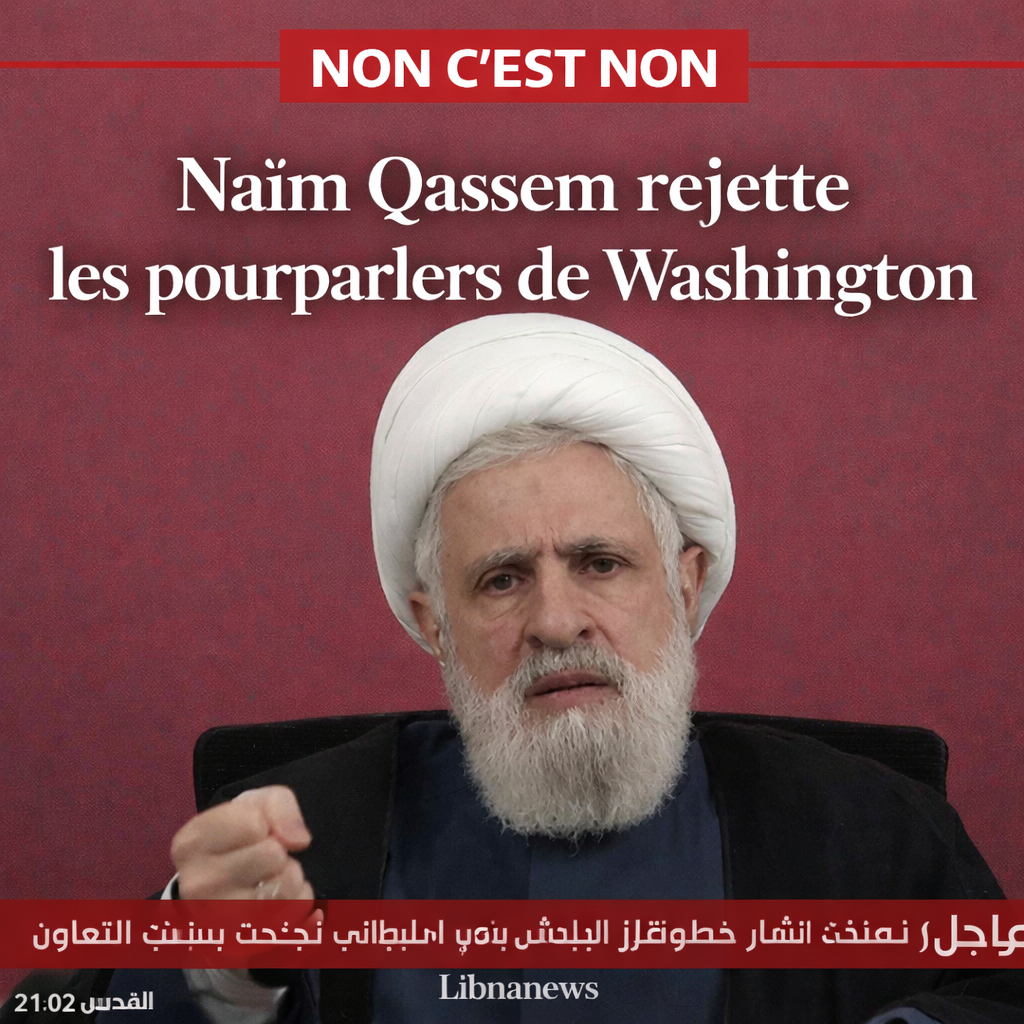
In a speech broadcast Monday evening on Al Manar, Hizbullah’s Secretary General, Naïm Qassem, called for the cancellation of the meeting scheduled for Tuesday in Washington between the ambassadors of Lebanon and Israel. He considered these discussions unnecessary as long as the Israeli bombing continued and reaffirmed the continuation of the military confrontation.
Rejection of discussions scheduled Tuesday
Naim Qassem opened his speech with an Easter message addressed to Christians. He then described the Israeli offensive as an aggression that did not respect human and moral considerations, before asserting that Lebanese diplomacy had not achieved tangible progress in 15 months and that the indirect agreement reached in November 2024 had not been implemented.
The leader of Hezbollah rejected any negotiations with Israel under the current circumstances. He felt that no Lebanese official could engage the country in this direction without internal consensus, and presented the Washington meeting as a concession made under fire. He also argued that the only way to sovereignty was through the application of the existing agreement and, first, through the total cessation of aggression.
The five points advanced by Hezbollah
In detail, Naïm Qassem listed five priorities. He called for the complete cessation of Israeli bombings, the immediate withdrawal of all occupied Lebanese lands, the release of the prisoners, the return of the inhabitants to the last border village and the launching of the reconstruction, which he presented as the fifth point to be taken over by official decision and international support.
His speech was on the eve of a meeting planned in Washington between the ambassadors of Lebanon and Israel in the United States. According to Reuters, Beirut intends to use this meeting to try to get a ceasefire, while Israel has excluded from discussing a truce with Hezbollah in this context. AP points out that it is a rare face-to-face between representatives of two countries that are officially still at war.
Direct message to the Lebanese authorities
In his speech, Naïm Qassem directly challenged the direction followed by the Lebanese authorities. Addressing President Joseph Aoun, he said that external pressure was aimed at pushing the state to face its own population. He also attacked Prime Minister Nawaf Salam, asking what the pressure on Lebanon had brought to the country since the formation of the government.
Hezbollah’s Secretary-General called on Lebanese officials to « face together the aggression » and then discuss the future of the country. In the same sequence, he accused the authorities of multiplying the free concessions and repeated that the State should, in his view, respond to the aggression by entrusting the army and security forces with confrontation with the enemy.
Refusal of surrender and continuation of fighting
At the military level, Naïm Qassem assured that Hezbollah fighters remained on the ground. He claimed that the movement would not calm down, would not stop and would not go, repeating that the resistance would continue « to the last breath ». He also rejected the idea that the ongoing fighting would be « wars of others », presenting the conflict as a war waged against Lebanon itself.
In the final part of his speech, the Hizbullah leader hailed the deaths of the State Security, the army, medical, nursing and relief services. He included these losses in a broader reading of the conflict, saying that Israel was not only targeting front-line fighters.
A statement before a diplomatic appointment under tension
Monday’s intervention is part of a continuous military escalation. Reuters reported on Monday that fighting was concentrated around Bint Jbeil, on the eve of the Washington talks, while the Lebanese authorities are now estimating more than 2,000 deaths since the start of the offensive launched after Hizbollah’s entry into the war on 2 March. AP, for its part, mentions more than one million displaced persons and a growing tension between the Shiite movement and the Lebanese government.
On the eve of the Washington rendezvous, Naïm Qassem’s speech therefore set a clear public line: refusing direct negotiations with Israel as long as the bombings continued, rejecting any logic of surrender and maintaining armed confrontation.




