

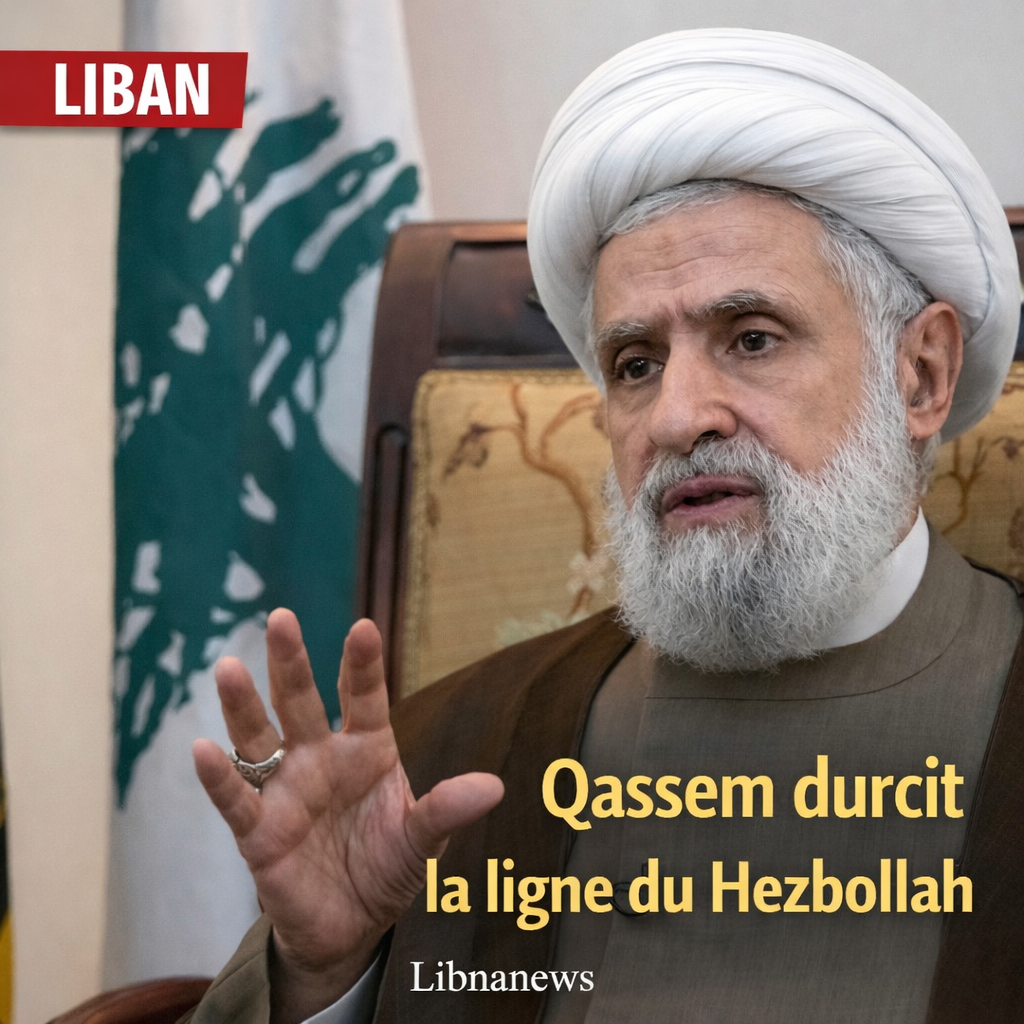
In an address to the « resilient and sacrificial Lebanese », Hizbullah’s secretary-general, Naïm Qassem, adopted a tone of combat, mourning and political firmness. The text, which focuses on the tribute to the dead, solidarity with the wounded and the affirmation of an Israeli failure on the ground, comes in a moment of very strong tension in Lebanon. As of 9 April 2026, Israeli strikes resulted in hundreds more deaths, more than one million displaced persons and extreme pressure on the Lebanese hospital system.
The interest of this speech goes beyond partisan rhetoric. It illuminates the current Hezbollah line on three levels. First, the movement seeks to transform human losses into proof of legitimacy and continuity. Then he intends to impose the idea that Israeli firepower does not amount to a political victory. Finally, it sends an explicit warning to the Lebanese authorities at a time when discussions are emerging on possible direct negotiations between Israel and Lebanon. Benjamin Netanyahu announced that he wanted to open talks « as soon as possible », while Lebanese officials called for a ceasefire as a prerequisite.
A speech first built around mourning
The first part of Naïm Qassem’s message is part of Hezbollah’s discursive tradition. He expressed his condolences to the families of the dead, evoked the » martyrs » among men, women, children and combatants, and then invoked patience for the loved ones and healing for the wounded. This choice is not purely religious. It meets a political need. In a war where civilians pay a very heavy price, the movement must give meaning to suffering, place it in a collective narrative and prevent it from becoming an open challenge to confrontation. This grieving mechanism is all the more central as recent Israeli strikes have affected densely populated urban areas, including Beirut, aggravating the feeling of insecurity beyond Hezbollah’s traditional strongholds.
The text attributed to Naim Qassem thus presents shed blood as a source of honour and future victory. This grammar of sacrifice is ancient in the history of the movement. It makes it possible to convert loss into symbolic capital, to maintain the cohesion of the base and to include the dead in an ideological continuity. At the journalistic level, this means that the speech should not only be read as a tribute. It is also an act of moral organization, intended to lock the inner narrative of Hezbollah at a time when war imposes considerable human, social and territorial costs on Lebanon. The PA and Reuters data on the extent of deaths, injuries and displacements give this dimension a much greater scope than a simple communication exercise.
The central thesis: Israel would have failed on the ground
The political heart of the speech lies in a clear statement that the Israeli army would have failed to achieve its earthly objectives. Naïm Qassem claims that Israeli forces did not succeed in the announced invasion, that their soldiers fell into ambush and that their vehicles were destroyed at the entrance to villages and towns in the South. He adds that the enemy would have changed his war goal several times, moving from a perspective of progress to the Litani to more limited objectives, then to a strategy dominated by destruction and bombing. In other words, it opposes the inability to impose a lasting control of the ground on Israeli air and technology superiority.
These statements belong to the War Communication Register and cannot be validated in their entirety from the text alone. On the other hand, the documented context shows that the conflict has been well accompanied by limited Israeli land operations in southern Lebanon, along with a campaign of massive strikes. The same sources point out that, despite this military pressure, hostilities continue, that Hezbollah continues to fire missiles and drones, and that there is no rapid exit. This makes it possible to understand the logic of the discourse: Hezbollah does not seek to deny the violence of the Israeli offensive, but to argue that it does not produce the announced political result.
This distinction between firepower and political victory is fundamental. In asymmetrical conflicts, the best-armed side can destroy more without achieving stabilization of the terrain or completely disjointing the adversary. This is exactly the story that Naïm Qassem is trying to impose. According to him, Israel would compensate its ground limits by intensifying strikes against civilians and dense areas. The PA reported on 9 April that the most deadly bombings had affected areas of Beirut and other Lebanese regions, with more than 300 dead and more than 1,100 injured in a single day according to local authorities. Reuters, for its part, relayed the WHO alert on the imminent depletion of essential medical stocks.
A battle of narrative in the face of diplomatic discussions
Naïm Qassem’s speech comes at the very moment when the question of a political outcome, even if uncertain, returns to the debate. Reuters reported on 9 April that Israel wished to enter into direct negotiations with Lebanon « as soon as possible », with the background for the disarmament of Hezbollah and the opening of a wider diplomatic sequence. A senior Lebanese official, quoted by the Agency on the same day, however, said Beirut was first seeking a temporary ceasefire to allow wider discussions. At the same time, a Hezbollah MP, Ali Fayyad, rejected any direct negotiations with Israel as long as military operations continued.
In this context, the speech plays a preventive role. When he states that Hezbollah will not accept a return to the previous situation and calls on those responsible to stop « free concessions », Naïm Qassem seeks to weigh on the very framework of possible discussions. It means that the movement refuses to be placed in the position of an actor who allegedly suffered the blows, carried the bulk of the military cost, and then left to others to negotiate the terms of the next day. It’s also a way to remember that any exit from crisis will have to count with him, not build up against him.
This sequence reveals a constant line of Hezbollah: to associate armed struggle with national political legitimacy. Hence the phrase repeated in the speech: « State, army, people and resistance ». This narrative architecture is not new, but it takes on a special relief today. While some Lebanese officials refer to a strengthening of State authority and international discussions put the issue of disarmament on the table, Hezbollah reiterates that it does not perceive itself as a force outside Lebanese order, but as one of its defence pillars. Reuters also reports that the discussions envisaged by Israel are explicitly aimed at the disarmament of the movement.
Mobilizing internally displaced persons as a political resource
Another important part of the speech concerns internally displaced persons and those who receive them. Naim Qassem sees it as a demonstration of pride, high morale and « humanity ». This point deserves attention because it touches the heart of the Lebanese inner battle. The displacement of more than one million people, reported by Reuters, the PA and the joint declaration of dozens of states to the United Nations, is not merely a humanitarian element. It is also a major political fact, likely to reveal community fractures, social tensions and criticism of the cost of war.
By welcoming both the displaced and their hosts, Hezbollah is trying to produce a unified narrative. He suggests that Lebanese society, far from dislocating under the bombs, would demonstrate greater cohesion. This narrative has an obvious function: to prevent social fatigue from turning into political disavowal. In a Lebanon already marked by a lasting economic crisis, the reception of displaced populations, pressure on public services and the exhaustion of hospitals can fuel a deep exasperation. WHO warned on 9 April that Lebanese hospitals could lack basic medical supplies in a few days, especially for trauma, after consuming in a single day the equivalent of several weeks of reserves.
The passage on the determination of young people to join the field is of the same logic. It serves to show that the movement would retain a capacity for human and moral renewal, despite strikes, loss of management and military pressure. Reuters already recalled in January that Hezbollah had been severely weakened by previous clashes with Israel. The stakes, for Naïm Qassem, are therefore twofold: to reassure his base on the continuity of the organization, and to point out to the adversary that the war of wear and tear will not dry quickly.
A word of deterrence and intimidation
The speech also contains extremely harsh language for Israeli forces. Naïm Qassem claims that even a hundred thousand soldiers would not allow an occupation of the South, adding that they would turn into « body and pieces ». In conflict language, this type of sentence does not provide new information; It is a matter of psychological deterrence. Hezbollah wishes to recall that a prolonged land presence in South Lebanon would, in its view, have a very high human and operational cost to Israel. This rhetoric prolongs an old strategy of the movement: to present the Lebanese terrain as a space where technological superiority does not guarantee control.
A distinction must be made here between the record and the record. The verbal violence of the speech serves less to describe the situation than to maintain an imaginative enticement for the adversary. But this imagination remains central in the doctrine of Hezbollah. The organisation has long insisted on its ability to make any occupation lastingly expensive. The PA reports that Israel has engaged in ground operations in southern Lebanon and that the clashes continue, with no prospect of a decisive victory in the short term. This context gives a particular resonance to Qassem’s rhetoric, even if it must be read as a word of combat.
This intimidating dimension also targets the internal public. In periods of intense bombing, armed organizations must convince their supporters that fear is changing, or at least that it is not univocal. By describing Israeli soldiers living « in fear and terror, » Naïm Qassem tries to psychologically return the balance of power. The issue is not just military. It is due to the ability of an actor to maintain belief in its effectiveness, despite the destruction visible on its own territory. In a long war, this belief becomes a central element of political resistance.
The regional dimension
The speech speaks of an « Israeli-American enemy », which shows that Hezbollah fully enshrines the war in Lebanon in a wider regional confrontation. This reading is consistent with the events of recent weeks. The PA recalls that the escalation between Israel, the United States, Iran and Tehran’s allied groups has redefined the framework of the conflict since early March. The war in Lebanon can no longer be analysed as a mere autonomous front. It is mired in a regional dynamic that includes the Iranian-American crisis, the situation in the Strait of Ormuz and tensions in several simultaneous theatres.
For Hezbollah, this regionalization has a political advantage. It allows him to present himself as a front-line actor of a wider confrontation, and not as a single Lebanese force caught in a face-to-face with Israel. But it also carries an internal risk. The more the war seems dictated by regional balances, the more part of Lebanese society can question the price paid by the country for a confrontation that partially exceeds it. Naïm Qassem’s speech attempts to neutralize this criticism by constantly returning to Lebanon’s sovereignty, the land of the South and national dignity. Yet the vocabulary used and the constant reference to the Israeli-American enemy remind us that the strategic horizon of the movement is not limited to Lebanese borders.
This tension crosses the entire Lebanese political field. On the one hand, the war pushes many leaders to demand greater protection of national sovereignty and a halt to bombing. On the other hand, it revives the debate on the place of an armed organisation linked to the Iranian axis in an already weakened state. Naïm Qassem’s speech does not resolve this contradiction. He assumed it by covering it with a narrative of national resistance. This is his political strength, but also his limit.




