

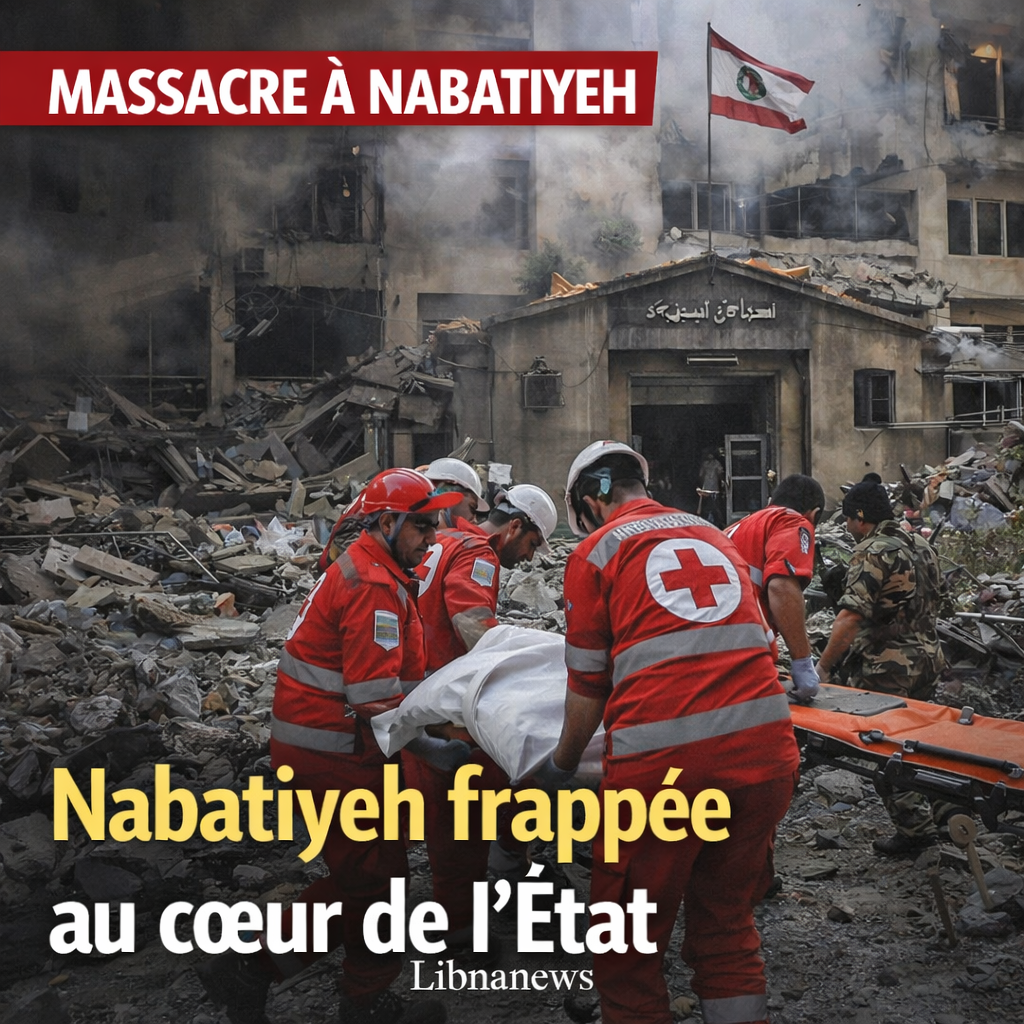
An Israeli strike targeted Nabatiyah and caused another major shock in South Lebanon. According to information provided by the Lebanese National Information Agency, the bombing struck the LebaneseNabatiyeh Government Seraland caused heavy losses among Lebanese State agents. Thelast report reported 17 deaths, but it remainsprovisional, the clearance and identification operations are continuing. In the first instance, the8 members of Amn al-Dawla killed as initial assessment, which shows the extent of the worsening count over time.
This tragedy comes at a time when Israel announced that it had agreed to negotiate directly with Lebanon under American pressure. At the same time, the US authorities pressured the Hebrew state to reduce the number of strikes. The Israeli response now seems to be known.
The gravity of this strike is as much due to its record as to the quality of the victims. Among the deaths were members of theState securityand, according to the elements transmitted in this wire, staff also belonging to thegendarmerieand otherLebanese security services. This gives the attack a particular political significance. Israel regularly claims to target Hezbollah and its infrastructure. But when a strike hits the administrative and security heart of a southern city and kills Lebanese officials, the border between claimed military operation and direct interference with state institutions becomes increasingly blurred.
A still provisional balance sheet
It is important to stress this point:17 deathsshall not be presented as final. In this type of bombardment, the figures often change for several hours, or even more, because of the serious injuries, the bodies still extracted from the rubble and the identifications under way. The Commission’s own opinion on theInitial assessment of 8 State Security officers killedafter violent strikes around the Nabatiyah Serail. Other Lebanese media then reported a higher number of casualties as the field reported.
Journalistically, this caution is essential. In an emergency, the balance sheets vary rapidly. We must therefore write thatthe last available record is 17 deaths, but that it remains provisional. Today it is the most rigorous formulation.
Names already known among the martyrs of Amn al-Dawla
Names already known among the martyrs of Amn al-Dawla
Among the names transmitted in this thread about the martyrs of theState securityThese include:
- Hussein Harb
- Ahmad Hassan Qansou
- Mohammad Daoui
- Ali Hijazi
- Ali Badir
- Khalil Mekdad
- Mohammad Rasslan(genre of Doueir)
- Ali Fakih
- Moussa Haidar
- Hussein Mallah
- Hassan Trehini
- Youssef Qansou
This list concerns names already raised for theState security. It does not necessarily cover all the victims announced in the last overall assessment of 17 deaths. Here, too, the full identification of those killed and their exact distribution among the various security services remain to be consolidated.
A strike against the Lebanese state apparatus
The most striking point of this attack is that it not only strikes an area already exposed to the South. She seems to have targeted aState administrative siteby killing security officers under official institutions. This detail changes the reading of the event. When State Security, Gendarmerie or other official services are affected in numbers, the strike can no longer be read only through the usual prism of a war against Hezbollah.
The Government Seral symbolizes the local public authority. It is an administrative centre, a coordinating point and a place that still embodies the continuity of the state in a highly exposed region. The fact that it is reached in this way gives rise to a serious question: was it a clearly established military target, or was it a strike carried out in a context of escalation where distinctions between state institutions, urban areas and theatres of operation become increasingly weak.
A new attack on the Israeli version of a « targeted » war
Israel presents its campaign in Lebanon as a series of targeted strikes against Hezbollah-related targets. But the facts observed on the ground are increasingly complicating this presentation. In recent days, Israeli bombings have already affected densely populated neighbourhoods, relief workers, civilians and even protected personnel, according to several field reports. In Nabatiyah, members of the Lebanese security services are now among the victims.
This reinforces the existing criticism of Israeli military communication. When the deaths are multiplied among Lebanese State agents, the question is no longer only that of the intention displayed, but of the reality of the targets, the proportionality of the strike and the precautions actually taken. The more the war spreads to administrative buildings and official personnel, the more the thesis of a strictly Hezbollah infrastructure campaign loses political credibility.
A country already exhausted by the bombings
This strike occurs in a Lebanon already immersed in a sequence of massive destructions. Reuters reported that approximately1,700 people had been killed in Lebanon since 2 March 2026according to the Lebanese authorities, whilemore than 1 million people have been displaced. The World Health Organization has also warned that Lebanese hospitals are likely to rapidly lack vital supplies after the massive influx of injured people caused by recent strikes.
In this context, the Nabatiyah massacre adds an additional dimension to the crisis. It does not only affect civilians or residential areas. It directly reaches public order, security and institutional continuity officers. In this regard, it marks another threshold in the deterioration of the Lebanese situation.
A Political Attack
The political effect of this strike will be important. It will give weight to those who accuse Israel of no longer limiting its strikes to clearly identified military objectives. It will also strengthen the feeling, very present in Lebanon, that public institutions themselves become targets in a war that goes beyond all theoretical lines of separation.
As the last balance sheet remainsprovisional, the central point is already established : Nabatiyah suffered an extremely serious strike, which killed members of theState securityand, according to initial information, other Lebanese security services. The17 deathsIt must therefore be handled with caution, but also with clarity: at this stage it is thelatest available balance sheet, likely to be increased.




