

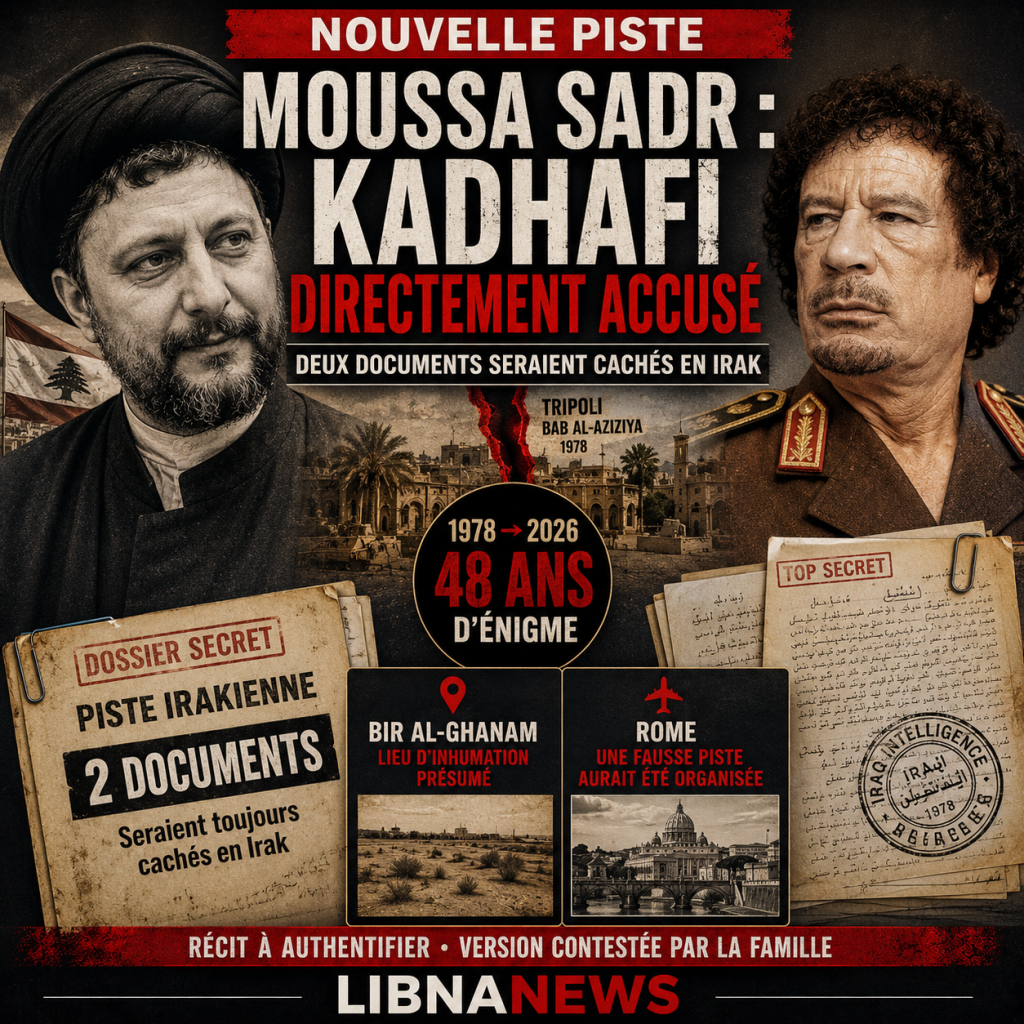
Forty-eight years after the disappearance of Imam Moussa Sadr in Libya, a new version claims that Muammar Gaddafi personally shot two people on 31 August 1978, before having his two companions killed. Presented by Iraqi researcher and historian Hamid Abdullah, this story is based on information allegedly collected by Iraqi services from a Libyan source. Abdullah states above all that two documents that could support this trail would still exist in Iraq. However, these claims have not been established judicially and Moussa Sadr’s family challenges several elements.
A new path is reviving one of the most sensitive cases in Lebanon’s contemporary history. Iraqi researcher, historian and mediaman Hamid Abdullah claims that Muammar Gaddafi himself killed the imam Moussa Sadr in Tripoli, Libya, on 31 August 1978.
According to the account presented in his programme « Tilka al-Ayyam », the former Libyan leader reportedly shot two bullets in the chest of the Shiite dignitary after a violent altercation in Bab al-Aziziya. The two men accompanying Moussa Sadr, Sheikh Mohammad Yaacoub and journalist Abbas Badreddine, were later reportedly killed on Gaddafi’s orders.
But the potentially most important element put forward by Hamid Abdullah concerns documentary evidence. The researcher claims that two documents related to the case would have escaped destruction and would still be hidden in Iraq by former Iraqi intelligence personnel.
None of these documents, however, was made public in the available material. Their authenticity could therefore not be independently established. Abdullah’s account must, at this stage, be considered as a trail to be checked and not as a definitive reconstitution of Moussa Sadr’s disappearance.
Moussa Sadr: two documents would be hidden in Iraq
Hamid Abdullah claims that the former Iraqi intelligence services had established a file on the disappearance of Moussa Sadr and his companions. Some of this information is said to have survived the political upheavals in Iraq.
According to him, two pieces are particularly important.
The first is a letter addressed to Muammar Gaddafi by a man named Hosni al-Ahrari. The latter reportedly confirmed the execution of the order to bury the bodies of Moussa Sadr, Mohammad Yaacoub and Abbas Badreddine.
The second concerns the sending of three Libyan service officers to Rome a few days after the disappearance of the three men. This mission was allegedly part of an operation to make an Italian false track.
The scope of these documents would be considerable if they were found, authenticated and confronted with the evidence already gathered in the case. They could provide guidance on two central questions that had not been answered since 1978: what happened to the three men in Libya and how the Gaddafi regime then attempted to conceal their fate.
However, Hamid Abdullah does not present his account as the final closure of the case. It recognizes that information must be verified and compared with other testimonies, documents and investigations accumulated for almost half a century.
This precaution is essential. The alleged existence of documents in Iraq does not in itself constitute proof of their content or authenticity.
Libyan source recruited by Iraqi intelligence
Abdullah’s story describes a long chain of information transmission.
His starting point would be Salim al-Hajani, a former Libyan and Baast colonel who had applied for political asylum in Baghdad. He reportedly informed the Iraqi intelligence services that a senior Libyan external security official, Mohammad Ahmad al-Adl, held sensitive information about the Gaddafi regime.
The Iraqi services then reportedly organized a meeting with al-Adl at the Iraqi embassy in Tunis.
According to this version, the Libyan official later became a source of Iraqi intelligence. He reportedly provided various information on the functioning of the Gaddafi regime, including information on the fate of Moussa Sadr.
The initial source of his account, however, adds an additional degree to the chain of testimonies. Al-Adl himself reportedly obtained the details of a woman belonging to Gaddafi’s personal custody.
The information presented today therefore does not come from the public testimony of a person claiming to have directly attended the entire stage. They reportedly followed several intermediaries before being recorded by Iraqi intelligence.
This requires special caution in the evaluation of the narrative.
A dispute over the Green Paper
Hamid Abdullah also explains the alleged conflict between Moussa Sadr and Muammar Gaddafi.
At the time, the Libyan regime financially supported several organizations in Lebanon, then plunged into civil war. According to this account, the Amal movement was among the beneficiaries of this policy.
At the same time, Gaddafi sought to disseminate abroad his « Green Paper », in which he explained his political and social conception. Copies had been sent to Lebanon.
Moussa Sadr would have read one.
According to the information reported by Abdullah, the Shiite dignitary privately expressed an extremely negative judgement on the work and its author. Libyan intelligence, allegedly infiltrating the Amal movement, reportedly recorded this conversation before transmitting its contents to Gaddafi.
It would be this episode that would have fueled the anger of the Libyan leader.
Again, this sequence is based on the story presented by the Iraqi researcher. There is no record to publicly establish the existence of this conversation at this stage of the available information.
The story of a fatal encounter on August 31, 1978
Moussa Sadr arrived in Libya on 25 August 1978 with Sheikh Mohammad Yaacoub and journalist Abbas Badreddine.
According to Hamid Abdullah’s reconstitution, Gaddafi reportedly requested to meet with Imam alone on 31 August in Bab al-Aziziya, a complex that was one of the Libyan power centres.
The Libyan leader was said to have asked directly about what he had heard about the Green Paper.
Moussa Sadr reportedly confirmed his judgment and explained to his interlocutor that the book contained no theory or idea of real value.
The confrontation would then degenerate.
Gaddafi reportedly violently insulted his guest and was taken from his religious turban, which he allegedly threw to the ground. He also allegedly accused Moussa Sadr of being an « Israeli » agent.
According to Abdullah, the dignitary would have remained calm and replied to Gaddafi that his destiny would be hell.
The Libyan leader reportedly ordered his guards to stop Moussa Sadr and take him away.
It is at this point that the most serious accusation made by the Iraqi researcher lies.
Gaddafi reportedly fired twice at Moussa Sadr
According to this version, Gaddafi reportedly followed the men who took Moussa Sadr and called Hosni al-Ahrari.
The Libyan leader then reportedly pulled out his own gun and fired twice into the chest of l.
He reportedly handed over the weapon to al-Ahrari and ordered him to kill Sheikh Mohammad Yaacoub and Abbas Badreddine as well. The two men would have already been tied up and taken to another place.
Hamid Abdullah therefore claims that the three disappearances were the result of a decision to execute them at the highest level of the Libyan regime, since Gaddafi personally killed Moussa Sadr.
This version provides a clear answer to a question that has remained officially unresolved since 1978. But it remains an allegation until the material elements mentioned are produced and authenticated.
It also differs from several assumptions made over the decades about the prolonged detention of Moussa Sadr after his public disappearance.
The three bodies were reportedly buried in Bir al-Ghanam
After the three alleged murders, the regime should have destroyed the bodies.
According to Abdullah, Hosni al-Ahrari was ordered to transport the remains of Moussa Sadr and his two companions to the Bir al-Ghanam region of Libya for burial.
This location is one of the most concrete elements of the new track.
If authentic documents or independent testimony were to confirm this indication, Bir al-Ghanam could become a major point of any new investigation.
The Iraqi researcher states precisely that one of the two documents he says still present in Iraq would be linked to this operation. This would be the confirmation to Gaddafi by Hosni al-Ahrari after the burial of the three bodies.
At this stage, however, no material discovery has been reported to confirm the presence of the remains in this area.
An operation would then have created the Rome trail
The new version does not stop at the alleged murders. She also seeks to explain why Italy was at the heart of the first versions on the fate of Moussa Sadr.
After removing the bodies, the Libyan services reportedly organized an operation to make it appear that the three men had left Libya alive.
Agents reportedly used the passports of Moussa Sadr, Mohammad Yaacoub and Abbas Badreddine. Three members of the services were reportedly sent to Italy to make themselves known to them and to create administrative traces corresponding to a trip to Rome.
Tickets were reportedly purchased on a Tripoli-Rome-Beirut route.
The aim would have been to transfer responsibility for their disappearance from Libya.
The second piece that Hamid Abdullah talks about is that mission. It would involve sending three Libyan officers to Rome after the disappearance.
This part of the story joins an ancient part of the file: Gaddafi’s regime claimed that Moussa Sadr and his companions had left Libya for Italy. However, Italian investigations had not established that the three men had actually entered Italian territory.
Moussa Sadr’s family contests the story
The publication of this new version did not remove the differences on the fate of imam.
Hamid Abdullah himself reported a message received from Sadreddine al-Sadr, son of Moussa Sadr and director of the Imam Sadr Center.
According to the Iraqi researcher, Sadreddine al-Sadr challenged the information presented in the broadcast and considered that many of them did not correspond to reality.
This reaction is important because it prohibits presenting the Iraqi version as an acquired fact.
The family and the officials responsible for the case have long defended the claim that Moussa Sadr and his companions were abducted in Libya and continued to seek information to determine their fate.
Hamid Abdullah responded to these reservations by highlighting the age that would today be Moussa Sadr, born in 1928. However, this argument does not constitute evidence of the circumstances of his disappearance or death.
The point that could change the file is elsewhere: in the archives.
Searching documents becomes the central issue
Nearly half a century after the facts, the new Iraqi track will only be able to take on a probative dimension if the pieces mentioned by Hamid Abdullah are found.
The first should, according to his account, establish that an order to bury the three bodies was executed. The second would document the operation in Italy to create the appearance of a departure of Moussa Sadr and his companions from Libya.
Their discovery would not automatically suffice to establish the facts. Their provenance, date, authors, chain of conservation and authenticity should be further determined. Their content should then be confronted with the Libyan, Italian, Lebanese and Iraqi archives and the judicial investigations already carried out.
The date chosen for the release of this case gives it a special resonance. On 31 August each year in Lebanon, Moussa Sadr, Mohammad Yaacoub and Abbas Badreddine disappeared. In 2026, 48 years have passed since their disappearance in Libya.
Hamid Abdullah’s account now provides names, a presumed burial site and especially the trail of two documents that are still available. Until these pieces are produced and evaluated, they will remain the main promise, but also the main unknown, of this new version of the Moussa Sadr case.




