

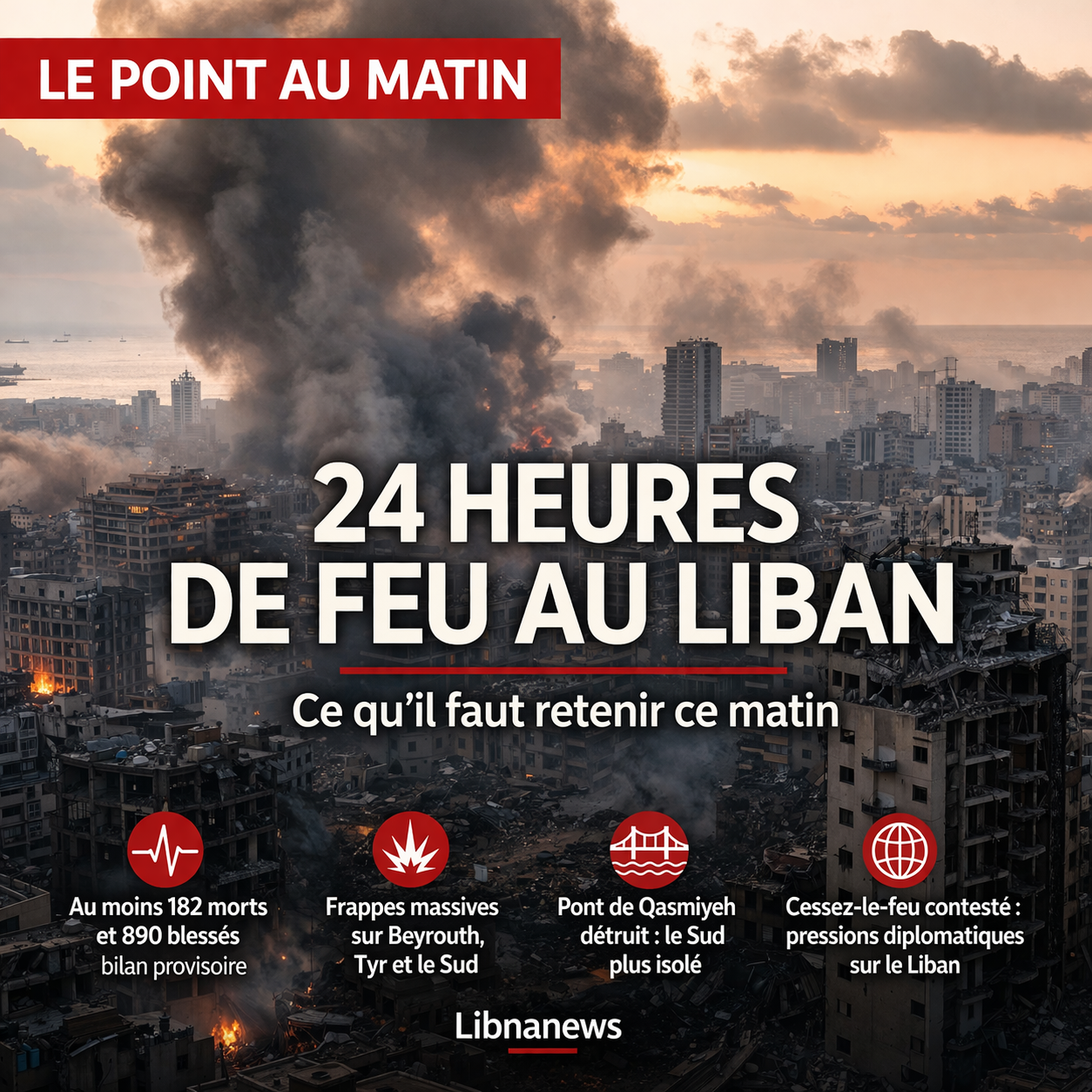
The announcement of a ceasefire between Washington and Tehran only offered Lebanon a respite from the front. On the morning of Thursday 9 April, the country wakes up after one of the twenty-four most violent hours since the opening of this new phase of war. The Israeli strikes on Wednesday resulted in at least 254 deaths and more than 1,100 injuries according to the Civil Defence, while the Lebanese Ministry of Health published a provisional assessment of 182 deaths and 890 injuries, which was also presented as not final. In Beirut, residential areas were hit, sometimes without notice. In the south, entire localities continue to be shelled, and the destruction of the Qasmiyeh bridge has further aggravated the isolation of areas already weakened by bombings and evacuation orders. For the Lebanese authorities, as for several foreign capitals, the question is no longer only military: it is now the very credibility of the regional ceasefire that is being played on Lebanese territory.
The contrast between the diplomatic sequence and the reality of the terrain is brutal. While Iran, Pakistan, France, the United Kingdom, Australia and the United Nations have all, to varying degrees, defended the idea that no serious truce could ignore Lebanon, Israel and the United States reaffirmed that the Lebanese front was not included in the agreement. On Wednesday night, Benyamin Netanyahu publicly assumed this line by stating that Lebanon was not part of the ceasefire and that the Israeli army would continue to hit Hezbollah « with force ». A few hours later, warnings, raids, artillery fire and rockets resumed. At 1140 hours, Lebanon thus appeared to be the breaking point of an already contested truce, and as the space where the diplomatic battle was being redefined by force.
The last 24 hours: an exceptionally large-scale strike campaign
On Wednesday, the Israeli army conducted what it itself described as the largest wave of strikes against Hezbollah since the beginning of this phase of the conflict. Reuters reports that Israel reported targeting more than 100 command centres and military sites of the movement in Beirut, Bekaa and South Lebanon in a ten-minute sequence that marked a scale break. The raids affected densely populated areas. In Beirut, several strikes shook the capital in the afternoon and then in the evening. Rescue teams had to evacuate trapped residents into partially collapsed buildings. One of the largest hospitals in the capital called urgently for blood donations. Reuters reporters also saw injured people being transported on motorcycles for lack of sufficient ambulances.
The human balance is still moving this morning. Lebanese Civil Defence reported 254 deaths and over 1,100 injuries throughout the country, while the Ministry of Health issued a second provisional estimate of 182 deaths and 890 injuries. The difference between the two sets of figures is due to the still incomplete nature of the upsurges, while victims remain under the rubble and some southern localities are difficult to access. At 10:40 a.m., MTV Lebanon relayed a national news agency news report that the attack on Zrariyeh had caused more than ten victims, including women and children, indicating that the record continues to evolve hour by hour. In this context, any encrypted photograph remains provisional.
What is no longer in doubt, however, is the exceptional nature of Wednesday’s day. Reuters described it as the most deadly since the beginning of the war on 2 March, after Hezbollah fired in support of Tehran following the American-Israeli strikes on Iran. The United Nations High Commissioner for Human Rights, Volker Türk, spoke of a « horrific » level of destruction and « horrific » civilian records. In a country that has already been hit by weeks of bombing, this new rise in power has replaced a climate of sideration. Above all, it showed that, despite the announced truce between Washington and Tehran, the Lebanese front remained fully open, with immediate human consequences.
Beirut, Tyre, Zrariyeh: the affected areas this morning again
Beyond the shock of Wednesday, the bombings did not stop with the night. During the morning, reports relayed by MTV Lebanon based on dispatches from the National Information Agency reported new strikes on Qlaileh, Kherbet Selem and Charqiyeh. At 1046, MTV was still relaying an NNA dispatch on these raids in the south. Shortly before, at 1040 hours, the same channel reported that the attack on Zrariyeh had claimed more than ten lives. These announcements show that Thursday’s day does not open up to stabilization, but to the continuation of the military sequence.
The Tyre region is particularly exposed. On Wednesday, Israel issued repeated warnings to the people of Tyre, ordering them to leave the area immediately and return north of the Zahrani River. Reuters notes that these evacuation orders occurred after Netanyahu’s statement excluding Lebanon from the ceasefire. The inhabitants thus find themselves caught between orders of departure, roads that have become uncertain and strikes that continue to target both open and inhabited areas. For many families, the very notion of a « safe area » becomes almost meaningless.
The situation in Beirut remains equally tense. Wednesday’s strikes hit the centre of the capital like its southern periphery. Reuters points out that some central quarters had not received any prior warning. On Thursday, the Israeli army claimed to have killed Ali Youssouf Harchi, the previous day in Beirut, as Naim Qassem’s personal secretary and nephew. MTV Lebanon was relaying this Israeli announcement at 1048 hours. At this stage, the precise military scope of this strike remains difficult to measure, but its political impact is clear: Israel wants to show that it can strike the immediate vicinity of the Hezbollah leadership to the capital.
Qasmiyeh Bridge: a symbol of more southern isolation
One of the most serious developments on the ground is the Qasmiyeh bridge north of Tyre on the Litani River. Reuters reports that Israel hit Wednesday the last still usable bridge linking southern Lebanon to the rest of the country in this sector. An Israeli military spokesman even said that the area south of Litani was now « disconnected from Lebanon ». This sentence, beyond its descriptive scope, has a very strong political dimension. It gives the impression that Israel no longer targets only ad hoc military objectives, but also seeks to physically reshape the space of war by isolating entire territories.
The National Information Agency, for its part, reported in the morning that the Lebanese Army had cut off the road at the Qasmiyeh bridge after receiving an Israeli threat to the bridge. Other NNA dispatches then reported that the Civil Defence and Relief teams were working to reopen the bridge, while families south of the Litani were calling for evacuation by claiming to be under a « total seat » after the bridge was destroyed. LBCI already recalled two weeks ago that the Israeli strikes on the Litani bridges severely disrupted movement and sent increasingly explicit « escalation messages ».
For the South, the stake is vital. Destroying or neutralizing bridges does not only mean slowing down the circulation of Hezbollah. It also complicates the delivery of aid, the evacuation of the wounded, access to hospitals and the daily lives of thousands of civilians. Reuters recalls that Israel has already hit hospitals and power plants in the area it says it wants to turn into a « buffer zone ». The destruction of the last operational bridge in the Tyre area is therefore a matter of deep concern: that of seeing the southern Litani transformed into an enclave under continuous fire, which is increasingly difficult to refuel and rescue.
The resumption of exchanges of fire: Hezbollah, rockets and sirens
Hezbollah, which had suspended its fire at the time of the idea of a ceasefire including Lebanon, resumed its attacks. Reuters wrote early Thursday that the movement had fired rockets at the Kibbutz in Manara, denouncing Israel’s « ceasefire violations ». In the morning, at 11.05 a.m., MTV Lebanon relayed a Hizbullah claim that it targeted Kiryat Shmona with rockets, and then at 11.14 a.m., the Israeli sirens activated in Kiryat Shmona, Metula and Tel Hai. Israel’s northern front, therefore, has again been set on fire, even though the intensity of these responses remains, for the time being, unmistakable with the magnitude of the Israeli strikes of the previous day.
This resurgence of fire locks Lebanon in a formidable gear. The more Israel strikes massively, the more Hezbollah believes it has to respond in order not to endorse the idea that Lebanon can be bombed without immediate cost. The more Hezbollah responds, the more Israel asserts that the Lebanese front is distinct from the Iranian-American truce and justifies its continued operations. The dynamics are all the more dangerous because, on the ground, civilians are already in an extreme situation: more than 1.2 million displaced persons, according to Reuters, entire areas subject to evacuation orders, and an already very damaged traffic network.
Hezbollah’s speech remains focused on the idea of an Israeli violation of the ceasefire. On Wednesday, MP Ibrahim Moussaoui explained to Reuters that the movement had been informed that he was part of the truce, and that he therefore complied with it before Israel « raped her » by committing « murrages » throughout Lebanon. This version is obviously not recognized by Israel or Washington. But it is important to understand the logic of the response of the Shiite movement: in the eyes of Hezbollah, it is not a question of breaking a truce, but of responding to its denial by Israel.
Israeli remarks: To exclude Lebanon from the truce and assume the continuation of the war
The Israeli line has become tougher in recent hours. On Wednesday evening, Benyamin Netanyahu said in a television address that the ceasefire with Iran did not apply to Lebanon and that the Israeli army was continuing its strikes against Hezbollah « with force ». Reuters reports that the White House, by the voice of Karoline Leavitt and then Vice-President JD Vance, took up this position by saying that the exclusion of Lebanon was a « legitimate misunderstanding » on the Iranian side. In other words, Washington and Tel-Aviv worked very quickly to close any regional reading of the truce.
But it is mainly the Israeli formulations on the ground that receive attention this morning. Reuters quotes an Israeli military spokesman explaining that the area south of Litani was « disconnected from Lebanon ». On X, the Arab-speaking spokesman of the Avichay Adraee army also said on Wednesday that Hezbollah had moved beyond its traditional stronghold of the Dahiyé to religiously mixed neighbourhoods in Beirut, before adding that Israel would pursue it « in all places ». This rhetoric prepares and justifies strikes in ever wider areas. It also feeds fear in the capital that war will cease to be confined to certain areas identified to reach increasingly diverse urban spaces.
To this are added the signals from the Israeli media. MTV Lebanon reported this morning at 7.58 a.m. that a small ministerial team had received a briefing from Netanyahu on the agreement with Iran and the exclusion of Lebanon. This may seem technical, but it confirms that the separation between the two files is not a mere communication detail: it is assumed as a central political line of the Israeli government. For Beirut, this means that no appeasement can be presumed until an explicit decision to include Lebanon is taken.
Diplomatic initiatives: support for Lebanon, but without any real lock
At the diplomatic level, Lebanon has received more verbal support in recent hours. Emmanuel Macron called Donald Trump and Massoud Pezeshkian to tell them that no ceasefire would be « credible and lasting » without including Lebanon. Jean-Noël Barrot repeated on Thursday that Beirut should be covered by the agreement. The United Kingdom, by the voice of Yvette Cooper, also expressed a strong desire for the extension of the truce in Lebanon and described the Israeli bombings as « deeply damaging ». Spain condemned strikes which it considered contrary to international law and the ceasefire, while Australia also considered that the truce should apply to Lebanon.
The United Nations, for its part, warned that the continuation of Israeli military activity in Lebanon posed a « serious danger » to the two-week ceasefire between the United States and Iran and to peace efforts in the region. This formulation is important because it implicitly contradicts the American reading of a separate Lebanese front. It also joins the French, British and, more carefully, Australian line. The problem for Beirut is that diplomatic convergence remains incomplete. It does not include the United States, which remains the indispensable actor of any effective de-escalation. As long as Washington repeats that Lebanon is not included in the agreement, the positions of Paris, London, Madrid, Canberra or the UN will weigh politically, but without creating a binding mechanism.
Lebanon thus finds itself in a paradoxical situation: never its centrality in the crisis has been so verbally recognized, but never has its practical exclusion from the framework of the truce been so clearly assumed by the two actors who have the greatest capacity for military action on the ground. Diplomatic support exists. Protection still does not exist. This reading is an inference from the contradictory public positions of Washington, Israel and several other capitals.
What the morning of April 9 reveals
At 11.40 a.m., the situation in Lebanon can be summarized in three observations. The first is humanitarian: the country is emerging from a day of unprecedented bombardment in this phase of war, with a still provisional but already catastrophic record, of hospitals under tension and relief teams facing multiple destruction. The second is military: far from entering into a dismal sequence, the war continues this morning with new strikes in the South, exchanges of fire and even more degraded road infrastructure, especially around the Qasmiyeh bridge. The third is diplomatic: a significant part of the international community affirms that Lebanon must be included in the ceasefire, but that position faces an end to non-receiving Israeli-Americans.
Qasmiyeh Bridge alone summarizes this day. It is both a strategic work, a roadway for civilians, a symbol of isolation from the South and a concrete proof that war is changing Lebanon’s geography. Netanyahu’s statements and Israeli military officials show that this transformation is not perceived by Israel as collateral damage, but as a leverage of its strategy. As for diplomatic initiatives, they attest that the Lebanese issue is no longer secondary in regional discussions, but at this time does not offer effective protection to civilians.
This is why this morning’s situation is more than just a record of strikes and balances. It shows that Lebanon has become a concrete measure of the strength or failure of the ceasefire between Washington and Tehran. As long as Beirut, Tyre, Zrariyeh, Qlaileh or Kherbet Selem continue to be hit while capitals debate the perimeter of the truce, the reality will remain the same for Lebanese: a total war can continue even when the region claims to be in a pause.




