

On 13 April 1975, 15 years of civil war had begun in Lebanon. On 13 April 2026, it did not mark the automatic return to this scenario, but it revealed a specific danger: that of a country once again caught in a regional war, subjected to Israeli military pressure that weakened the State, displaced the population massively and revived internal fracture lines that Lebanon had never completely closed.
The parallel is not worth identity. Today’s Lebanon is not that of 1975. However, since 2 March, the war between Israel and Hezbollah has taken on a scale that goes beyond the border face-to-face: strikes to Beirut, expansion of destruction to the south and the Bekaa, more than one million displaced persons, more than two thousand dead according to the latest records, and already weak institutions even more exposed.
The real thing in common with 1975 is not the form of fighting. It’s political mechanics. A civil war begins when the state no longer protects, when membership takes over citizenship, and when the country becomes the place where others impose their confrontation. It is this threshold that Lebanon sees coming closer today.
On April 13, 1975, a date that never stopped talking
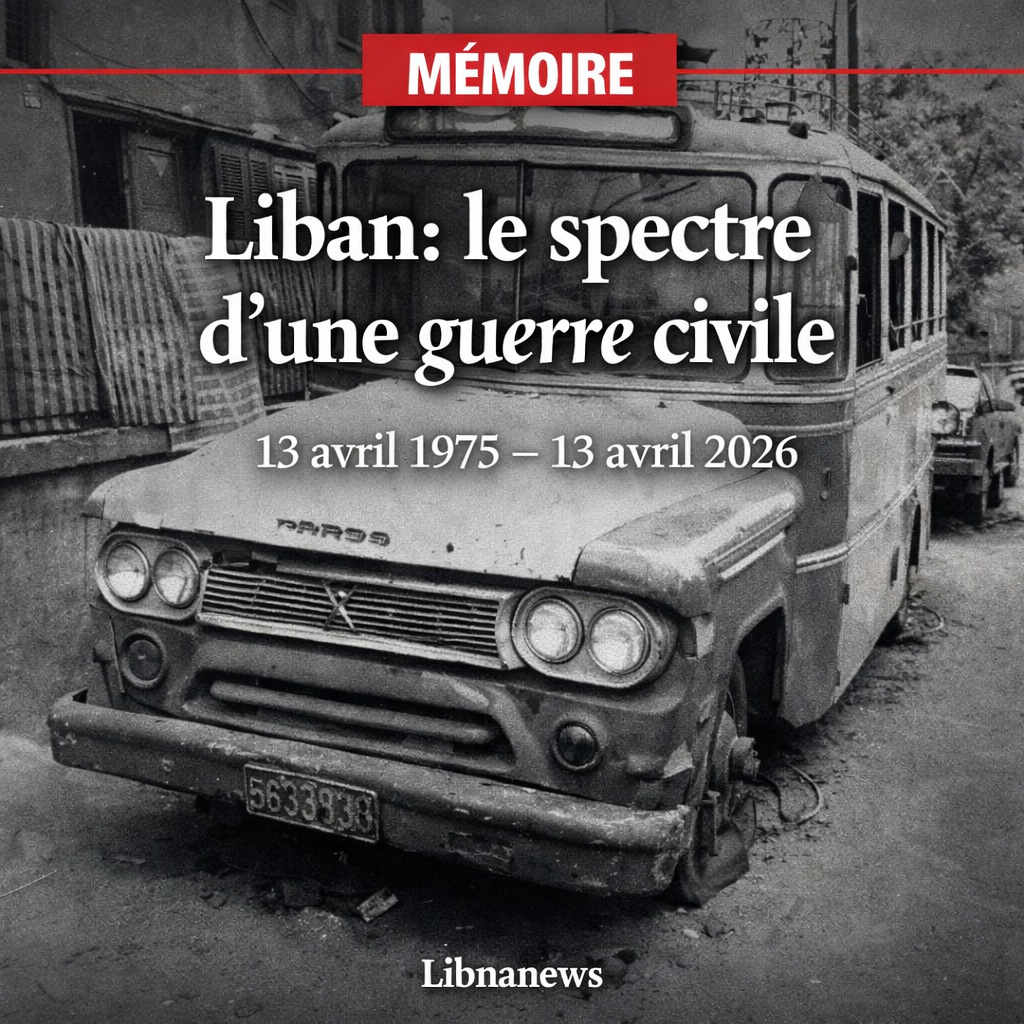
On April 13, 1975, it remains a milestone because it tells more than just a beginning. The attack on the bus carrying Palestinians to Ain al-Remmaneh served as a spark to an already mature crisis. Confessional tensions, imbalances in the political system, the rise of militias and the Palestinian armed presence had already weakened a declining State. Second, the civil war killed at least 150,000 people, displaced hundreds of thousands and left some 17,000 missing, a figure still being taken up by families and humanitarian agencies.
This reminder counts because it breaks a tenacious illusion: that of a civil war permanently closed by time. In reality, memory has remained fragmented, often absent from textbooks and worn mainly by families, some places of memory and civil initiatives. A trauma that is commemorated without politically treating it can become a reactivation ground once an external crisis encounters internal fractures.
Last year, for the fiftieth anniversary, the Lebanese State had attempted a gesture of memory with a minute of silence and a ceremony in Beirut. The official message was clear: do not repeat the past. A year later, this promise sounds darker. The country is not just facing armed conflict. At the same time, it faces a challenge to its sovereignty, social cohesion and the capacity of its institutions to protect all citizens in the same way.
Warning indicators that accumulate
The indicators accumulated since the beginning of March draw an alert landscape. More than one million internally displaced persons, human balances exceeding two thousand dead, entire areas emptied by evacuation orders, Israeli land incursions and the prospect of a buffer zone to the Litani: none of these elements alone mean civil war. But their combination destroys coexistence routines, redistributes fear between territories and weakens the idea of a protective state.
Since 2 March, Israeli logic has been imposed with increasing brutality. After Hezbollah fired in solidarity with Iran, Israel launched a military campaign that no longer targets a limited front. The strikes hit dense parts of Beirut, the South and the Bekaa. On 8 April, the Office of the United Nations High Commissioner for Human Rights denounced a wave of attacks of a horrific magnitude, carried out in about 100 strikes in ten minutes, with civilian deaths, hospitals under pressure and devastation scenes observed on the spot.
When a war thus overflows the fronts and strikes the urban space, it ceases to be perceived as a distant confrontation between an army and an armed organisation. It becomes a force that reorganizes society as a whole. The inhabitants flee, the cities of refuge saturate, the municipalities calculate, and spontaneous solidarity begins to strike against social fatigue, lack of resources and fear of a sustainable settlement.
| Indicator as at 13 April 2026 | Order of magnitude |
|---|---|
| Deaths in Lebanon since early March | more than 2,000 |
| Internally moved | more than 1 million |
| Territory concerned by evacuation orders | about 14 per cent |
| Israeli goal posted in the South | buffer zone to Litani |
When the external war begins to divide the Lebanese
It is precisely on this ground that the risk of sedition between Lebanese becomes serious. At the beginning of April, some communities were reluctant to accept internally displaced persons and the Government insisted on the need to preserve internal stability as the war brought political and religious lines back under stress. In a country where displacement is never a mere humanitarian fact, but a fact immediately read in demographic, electoral and security terms, the exodus produces an anguish of internal recomposition.
The Pierre Moawad case further aggravated this climate. This local Lebanese Forces official, a Christian formation very opposed to Hezbollah, was killed with his wife in an Israeli strike in Ain Saadé, a Christian city near Beirut. Israel claimed to be targeting a terrorist site and assured that it was not the target. The political effect was immediate: instead of bringing the Lebanese closer to external aggression, the strike expanded the anger against Hezbollah in some Christian circles and reinforced the idea that the war that came elsewhere could be returned to internal adversaries.
This mechanism is formidable. The more Israel strikes beyond the traditional strongholds of Hezbollah, the more the temptation increases in other communities to present the Shiite party as the only person responsible for the country’s exhibition. This reproach is not new. But it takes an explosive dimension when it combines with the images of destruction, the massive arrival of the displaced and the sensation that Lebanon pays for a regional war that exceeds it. In this context, the Israeli campaign is not just hitting an opponent. It also accentuates the breaking points of Lebanese society.
The massive displacement acts as an accelerator. More than one million people have fled, or more than one fifth of the population according to several reports taken by Reuters. Many are housed by relatives. Others live in schools, collective shelters, parking lots, improvised tents or cars. Israeli evacuation orders affected approximately 14 per cent of Lebanese territory as early as mid-March. In such a small, dense and politically segmented country, this figure is far greater than its mere statistical value.
For displacement to Lebanon is never neutral. When a majority of internally displaced persons come from Shia areas in the South or from the southern suburbs of Beirut, their arrival in Christian, Sunni or Druze localities is not just a humanitarian emergency. It is immediately interpreted by some as a risk of infiltration, social pressure or local balance change. It’s unfair to the families at large. But it is politically real, and therefore dangerous.
Refusal of reception, municipal reluctance and family scenes rejected or redirected to other areas are the first symptoms of this corrosion. They do not mean that Lebanon has already returned to the logic of the militias. They show, however, that the national fabric is contracting. When the shelter depends on membership, accent, political reputation or area of origin, the citizen gradually ceases to be protected by the State. It becomes dependent on a group, local leader or community.
Israel knows what this dynamic produces in a country like Lebanon. The combination of massive evacuation orders, the destruction of villages, continued military pressure and a speech on the creation of a buffer zone up to Litani amounts to governing the war through the displacement and fragmentation of the territory. At the end of March, Human Rights Watch estimated that this policy could be the result of a forced displacement potentially constituting a war crime. In Beirut, this reading is based on the idea that the Israeli campaign also aims to deplete Lebanon socially, not just to reduce a military threat.
Israel puts pressure on the state, not just Hezbollah
Israeli pressure is also spreading on the political ground. Benjamin Netanyahu announced his intention to open direct negotiations with Lebanon as soon as possible. Officially, the objective would be a peace agreement and the disarmament of Hezbollah. Seen from afar, the idea may seem diplomatic. Seen from Beirut, it is more like a peace under continuous fire. Israel did not make this opening conditional on a prior halt to its strikes, while the Lebanese side made the ceasefire the condition for any progress.
This sequence feeds a very strong perception in Lebanon: Israel seeks less a compromise between States than an internal reconfiguration of the Lebanese balance of power. Asking the Lebanese government to disarm Hezbollah while the country is bombed, while a part of the South remains under threat of occupation and the Shiite population bears the bulk of the human and material cost, is putting the state before an impossible alternative. Either he does nothing and appears powerless. Either he tries to impose this disarmament by force and risks the internal explosion.
Lebanon fears civil unrest if the army is forced to confront Hezbollah. This fear is not mere speculation. Hezbollah remains a structured armed organization, socially and politically rooted, which considers its arsenal as an instrument of defence against Israel. No Lebanese government today has the material and political capacity to face it in front of it without squandering the entire country.
In other words, Israeli pressure is based on a calculated contradiction. Israel claims to want to deal with the Lebanese state, but it continues to weaken militarily, territorially and socially. State security agents have been killed again in Nabatiyah in an Israeli strike in recent days. Israel calls for a monopoly of the security forces in Beirut while bombing a country whose institutions are already fragile. Such an equation does not favour the consolidation of a state. On the contrary, it increases the likelihood that Lebanese will accuse each other of being the weak link, accomplice or shield of the other.
The most worrying is not only the violence of strikes. That is how they re-design the Lebanese debate. The central question is no longer just how to stop aggression and protect the territory. Who in Lebanon caused the disaster? Who has to give in? Who should be isolated? Who must be disarmed? Who needs to absorb the displaced? It is this shift from the centre of gravity that brings the country closer to an externally imposed civil war scenario. A foreign power does not need to create new militias when it succeeds in transforming an already fragmented society into a permanent court against itself.
Lebanon is not yet in civil war, but the threshold is approaching
We must keep an essential measure. Lebanon is not yet in a civil war. The widespread clashes between communities did not take place. Despite its weaknesses, the Lebanese army remains one of the few institutions still recognized at the national level. Both President Joseph Aoun and Prime Minister Nawaf Salam have repeatedly stressed the priority given to civil peace. And the concrete memory of the years 1975-1990 still acts as a powerful brake in society.
However, the tipping threshold is close when three conditions combine:
- the disappearance of the idea of a State-guaranteed common shelter;
- turning the displaced person into a suspect;
- the temptation of an internal settlement of the Hezbollah case under foreign pressure.
For the time being, this danger is mainly found in speeches, fears and micro-fractures. It’s already a lot. Civil wars do not always start with great battles. They often start with a deterioration of the tolerance thresholds, a multiplication of the cross accusations and the idea that the suffering of some would be the normal consequence of the choice of others. This is exactly what is now striking, at low noise, in several Lebanese regions.
What is really recalled on April 13, 2026
13 April 2026 should therefore be understood not as a mere date of memory, but as a political test. Lebanon can still avoid regional war becoming a national implosion. First of all, it means naming the problem clearly. Yes, Hezbollah exposed the country in a regional confrontation. But yes, too, Israel is conducting a campaign whose methods, expanded targets, forced displacement and political demands create conditions for a discord between Lebanese. To reject this second evidence would be to see only half the trap.
Avoiding the worst then imposes an imperative of language and responsibility. Lebanese parties opposing Hezbollah have the right to challenge its strategy and armament. But crossing the line of making Shiite displaced persons or bombed areas the collective leaders of the disaster would open an irreparable breach. In the same way, Hezbollah cannot invoke resistance to demand a national white-seing even though entire parts of the country refuse to remain captive to a regional agenda that goes beyond them. Civil peace will not arise from forced silence, but from a clear hierarchy: no internal disagreement can become a permission given to a foreign war on Lebanese soil.
Finally, the decisive question remains: that of the State. If the institutions want to prevent a new logic of civil war, they must immediately prove that they can treat all Lebanese as equal citizens in protection, aid, accommodation and public speaking. Resistance to sedition is on this concrete ground. Not in commemorations alone, but in the ability to prevent an displaced person from becoming an intruder, from becoming an internal border, from becoming an existential divide. April 13 is less reminiscent of what happened than what can happen again when a country ceases, even a few weeks, to think of itself as a common house.




