

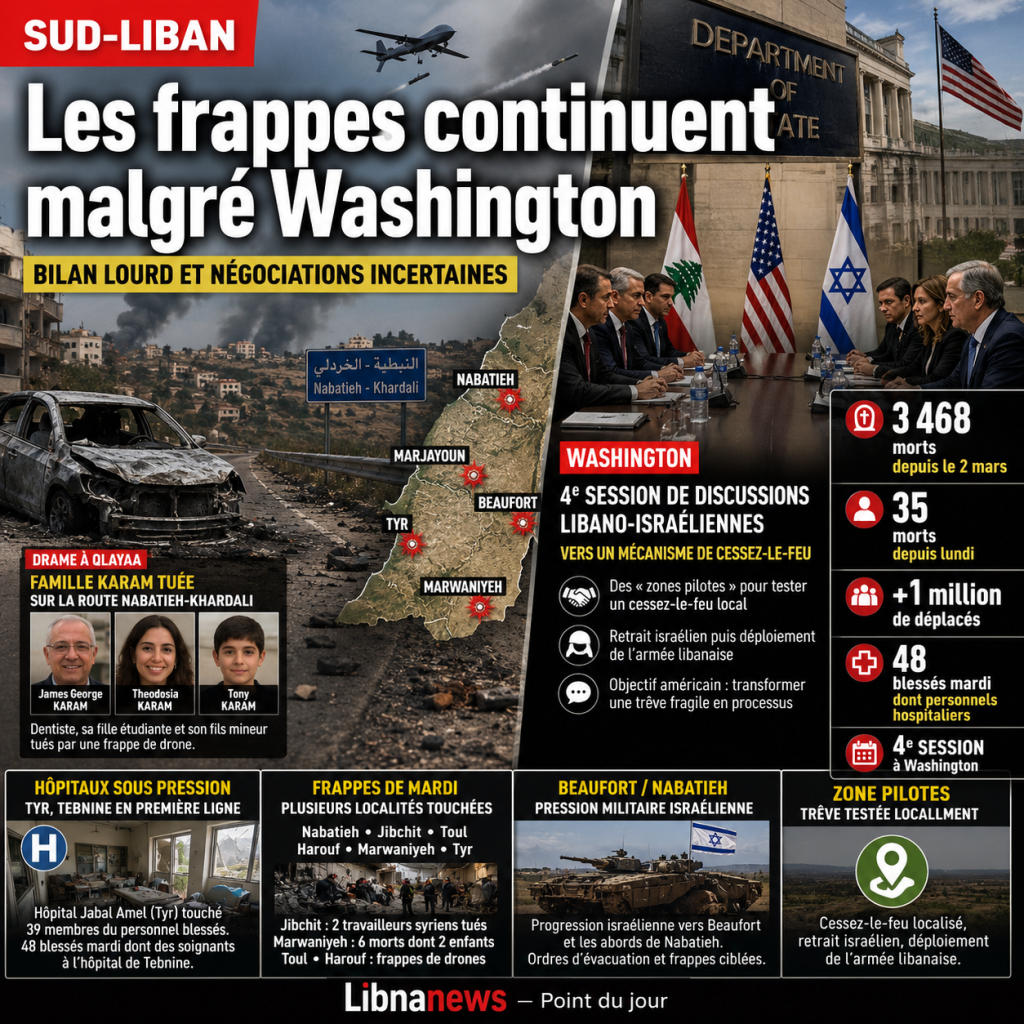
Lebanon: A heavy toll on awakening
Lebanon is waking up this Wednesday on a brutal note: diplomatic assurances from Washington have not stopped Israeli bombings in the South. The latest consolidated report available shows that 3,468 people have died since 2 March in the Israeli campaign in Lebanon, 35 of whom have been killed since Monday, according to the Lebanese Ministry of Health, which was taken over by an international agency. More than one million people have been displaced. This national assessment gives the measure of a war that now extends beyond the front lines and weighs on roads, hospitals, villages and inhabited neighbourhoods.
The last 24 hours have been marked by a double sequence. In Washington, the Lebanese and Israeli representatives met for a further discussion session, the fourth since the beginning of the war. On the ground, the Israeli army hit about 20 localities, according to press reports, while Hizbullah claimed attacks against Israeli soldiers in southern Lebanon. The American formula of de-escalation therefore seems to be suspended from a military reality which almost immediately contradicts it.
Karam family killed on the Nabatieh-Khardali road
The most identified drama remains that of the Karam family, from Qlayaa, in Marjayoun District. Dr. James George Karam, a 61-year-old dentist according to local relatives, was killed with his daughter Theodosia and son Tony in a drone strike against their car on the Nabatieh-Khardali road. The family returned from examinations and school procedures. Theodosia was a student. Tony was still a minor. At the time of writing, there is no verified public element establishing a combative function for the three victims.
The Nabatieh-Khardali road is not a secondary axis in the life of the South. It connects the towns of Marjayoun with the Nabatieh roads and is used for family travel, care, education and refuelling. In wartime, it also became a drone-controlled corridor. The attack on the car of the Karams has therefore caused a particular emotion. She hit a family moving for civilian reasons, in a space where the border between ordinary traffic and the military zone disappears a little more every day.
Jibchit, Toul, Harouf, Marwaniyeh: the other victims
Other victims were reported in several localities. In Jibchit, Nabatiyah governorate, two Syrian nationals were killed in a strike against a nursery where they worked. In Toul, a drone attack hit the area of a motorcycle or vehicle, killing two people according to international press reports. Between Harouf and Toul, another hit on a car killed one person. The names of these victims were not publicly confirmed in the sources consulted at the time of writing.
In Marwaniyeh, near Saida, the rescuers removed six bodies from the rubble of a damaged building on Monday night. The victims belonged to the Hassan Abdullah family, according to Lebanese Civil Defence, which was taken over by several media outlets. Two children and one woman were among the dead. Three wounded were also removed from the ruins. Again, not all of the victims’ full names were confirmed in a manner that was reliable enough to be fully published.
This is important. Nameing victims makes it possible to get out of an abstract balance sheet. But publishing an unverified name exposes to a serious error, especially when the bodies are found after several hours of searching. At this stage, the names confirmed with the highest degree of reliability are James George Karam, Theodosia Karam and Tony Karam. For Marwaniyeh, identification by the Hassan Abdullah family is reported, but individual nominative details remain to be consolidated. For Jibchit, Toul and Harouf, the sources give the place, the number of deaths and sometimes the nationality or working context, but not the complete identities.
Five dead Tuesday, 48 injured
Tuesday’s review by the Lebanese health authorities reported five deaths and 48 injuries during the day’s strikes, including one child among the dead. The injured included a doctor and five employees of the Tebnine Public Hospital. This figure does not always coincide with the figures published by the agencies, as some victims were killed Monday night and then found or announced Tuesday. The day must therefore be read in two levels: the official daily health record, and the expanded assessment of the attacks recorded over 24 hours.
The map shows a scattered pressure. Nabatieh, Nabatieh al-Fawqa, Kfar Rummane, Choukin, Kfar Tebnit, Jibchit, Toul, Harouf, Marwaniyeh, Qlaileh, Burj al-Chamali and the surroundings of Tyre appear in the reports. Artillery fire also hit communities in the southern band. This dispersion maintains a climate of uncertainty. Residents do not always know whether the danger comes from a public alert, an invisible drone, an aircraft flying over the area or a hit on a vehicle driving in front of them.
Southern hospitals under pressure
In Tyre, the Jabal Amel hospital resumed operation after an Israeli strike at a nearby site that injured 39 staff the day before. The images and testimonies describe broken windows, damaged rooms and medical teams forced to return to service in the emergency. A hospital does not only become a place of care in this war. It becomes a barometer of civil resistance. When its teams work in the midst of debris, it is all the health architecture of the South that works at the limit.
The Tebnine sector adds further concern. The 48 injured on Tuesday included staff from the local public hospital, according to the Lebanese Ministry of Health. The number does not say everything. It means that places of care, already sought by the displaced and wounded, are themselves suffering the effects of war. Every injured doctor, every nurse absent, every damaged ambulance reduces the ability to respond within hours. In South Lebanon, this operational loss can cost lives.
Nabatieh and Beaufort at the centre of Israeli pressure
Nabatieh remains one of the centres of gravity of the day. The Israeli army ordered the inhabitants to leave areas of the city before strikes. It says it wants to strengthen its operations in the South. This military language accompanies a deeper Israeli progression towards the outskirts of Nabatieh and the heights of Beaufort. Israel presents this action as a means of reducing the threat posed by Hezbollah to the north of its territory. In Lebanon, it is seen as a dangerous extension of the Israeli military presence.
Beaufort, or Qalaat al-Shaqif, concentrates a strategic and symbolic dimension. The site dominates valleys and roads. He had already held a strong place in the memory of the Israeli occupation until 2000. The fact that Israeli forces have resumed their positions or progressed in their environment alters the perception of the conflict. It is no longer just border trade. The war is moving towards inner southern lines, with direct consequences for Nabatieh, Marjayoun and villages between them.
Hezbollah claimed fire on Israeli troops near Beaufort and attacks on military vehicles south of Nabatiyah. He also claimed to have targeted an Israeli tank near Hadatha. The movement distinguishes these acts of fire against Israeli civilians. Israel, for its part, affirms that Hezbollah violates the ceasefire and justifies its strikes by the need to neutralize infrastructure and combatants. This divergence of reading blocks any immediate stabilization.
Beirut spared, but still under threat
The southern suburbs of Beirut remain alert, even if the massive strike feared on Monday did not take place. The Israeli Prime Minister had threatened to target Dahiyah, Hizbullah’s stronghold, in case of continued attacks against Israel. This threat has led to departures and closures of shops. On Tuesday, drones were still flying over the area at low altitude, according to press reports. The capital thus escaped a major attack, but it did not recover normality.
It is precisely this point that explains the fragility of the American announcement. Donald Trump claimed to have obtained from Benjamin Netanyahu the commitment not to send troops to Beirut and, on the Hezbollah side, a promise to cease the fire. But the original wording was quickly challenged by the facts. Israel continued to hit the South. Hezbollah continued its attacks on Israeli forces on Lebanese territory. Benjamin Netanyahu reiterated that the Israeli army would continue to operate in southern Lebanon.
Washington: a decisive fourth session
The Washington negotiations are therefore at the heart of the moment. Lebanese and Israeli diplomatic delegations met on Tuesday in the US State Department. This is a rare format, as both countries do not have diplomatic relations and remain technically in a state of war. The session is part of a series of meetings started in April. Washington wants to turn the fragile ceasefire into a political and security process. The State Department spoke of progress on both aspects and announced a resumption of discussions on Wednesday.
The Lebanese delegation is led by the Ambassador of Lebanon to the United States, Nada Hamadeh Muawad. The Israeli side is represented by Israel’s ambassador to Washington, Yechiel Leiter. On the American side, the meeting was held under the auspices of the State Department, with the participation of officials from the White House and the American administration. Marco Rubio did not chair the session directly, but he set the political framework: Washington wants to dissociate the Lebanese-Israeli issue from the negotiations with Iran.
This decoupling is contested by Tehran and indirectly by Hezbollah. Iran considers that the Israeli strikes in Lebanon are part of the regional equation opened since the American-Israeli offensive against Iran at the end of February. On the contrary, the United States asserts that Lebanon must be treated on a separate rail. This difference weighs on the talks. If Lebanon becomes a variable in the Iran-US negotiations, the Beirut margin is reduced. If the Lebanese case is isolated, Hezbollah risks rejecting an agreement that does not meet the guarantees required by its regional ally.
« Pilot zones » to test a ceasefire
The track discussed in Washington is based on a gradual approach. A senior Lebanese official mentioned pilot areas. In these areas, hostilities would cease, Israeli troops would withdraw, and the Lebanese army would deploy. The aim would be to progressively extend this model to all Lebanese territory. The idea responds to a practical difficulty: no one today seems able to impose a complete ceasefire immediately. So Washington is looking for a verifiable mechanism, zone by zone.
However, there is a political risk associated with this option. A pilot zone can open a path to withdrawal. It may also temporarily freeze an Israeli presence elsewhere. Official Lebanon wants to avoid a security mechanism becoming an indirect recognition of an Israeli-controlled buffer zone. Hezbollah refuses to disarm under pressure, even though the Lebanese government also claims to want, in the long run, the state monopoly on weapons. Israel makes the disarmament of Hezbollah a central requirement.
In this context, Nawaf Salam defends negotiation as the least costly option for Lebanon. This formula summarizes the government’s dilemma. Refusing to talk would leave the land to decide alone. Accepting to discuss exposes Beirut to the critics of Hezbollah and some of the opinion, who fear a negotiation conducted as the strikes continue. The head of government is therefore looking for a narrow line: to negotiate to reduce the losses, without giving the impression of covering Israeli military pressure.
Nabih Berri retains a role of passage. The President of Parliament remains one of the few Lebanese officials able to convey messages to Hezbollah while speaking to Western interlocutors. The scheme announced by the Lebanese Embassy in Washington illustrates this indirect mechanism: American messages to Beirut, Lebanese institutional relays, and then return to Hezbollah. This architecture does not solve the problem of sovereignty. On the contrary, it shows how the Lebanese State still depends on internal mediation to translate a diplomatic promise into a military decision.
In the morning, the gap between diplomacy and the field remains whole. Washington talks about progress. The Lebanese Ministry of Health counts the dead. Southern hospitals repair windows and heal the wounded. The families of Qlayaa mourn James George Karam, Theodosia and Tony. In Marwaniyeh, the Hassan Abdullah family became another collective name of the day. In Jibchit, two Syrian workers were killed far from the military communiqués. In Toul and Harouf, other victims add to the still incomplete lists.
The point of the Lebanese day is therefore not in the announcement of a ceasefire, but in its immediate test. If the Washington talks lead to a clear territorial mechanism, the next few hours could lead to local de-escalation. If Israel continues its strikes around Nabatieh, Tyre, Marjayoun and Beaufort, and if Hezbollah maintains its attacks on Israeli troops in the South, Lebanon will remain in that grey area where every diplomatic promise comes after the drones sound.




