

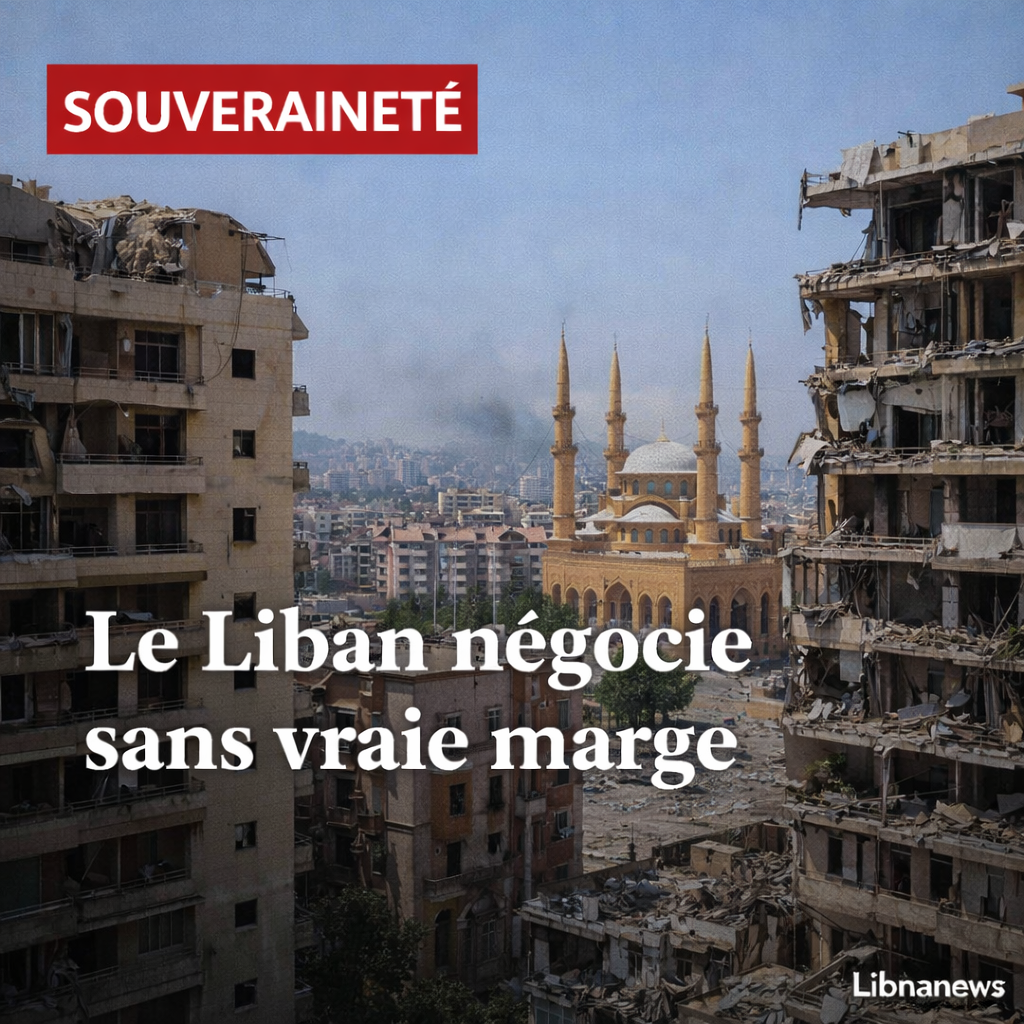
Lebanon enters into its discussions with Israel without any real diplomatic freedom. This is the whole paradox of the open sequence in Washington. Beirut needs to talk, because the war destroys the South, exhausts the State, delays the return of the displaced and threatens to establish a new military state of affairs. But it cannot engage in any direction, because Israeli demands concern the most explosive issue in the Lebanese system: Hezbollah’s weapons and the real ability of the State to impose its sovereignty alone. Hence, negotiation is not a classic exercise. The Lebanese authorities are not seeking a major historic agreement or assumed normalization. He’s looking for a minimum breathing space. According to a news agency, the Lebanese delegation highlighted three immediate priorities: the ceasefire, the return of internally displaced persons and the humanitarian emergency. In front of it, Israel refused to make the truce the heart of the talks and placed the neutralization of Hezbollah first. This lag sums up the whole difficulty. Lebanon wants to stop the war before reopening the most explosive files. Israel wants to use the war to achieve results on these issues. Between the two, the Lebanese margin of manoeuvre is not measured by the freedom to negotiate, but by the ability to avoid the worst without losing what remains of internal cohesion.
The first impossible is military. Beirut knows that it cannot endure an increasingly costly war for a long time. The destruction is accumulating, the economy is falling further, the villages in the South are emptying, and the central government has neither the financial resources nor the institutional strength to absorb prolonged conflict. Even when it calls for political firmness, the Lebanese government is reasoning with this basic fact: each additional week weakens a little more the state and reduces its ability to regain foot in the affected areas. According to media sources, more than 2,000 people have been killed since the widening of the confrontation in March and about 1.2 million people have been displaced, at least temporarily. These figures alone do not produce a diplomatic outcome, but they explain why Beirut insists on the urgency of a cessation of hostilities. Lebanon is not in the position of a State that chooses between several strategic options. It acts under duress, with a priority objective that has nothing to do with ideology: to prevent the war from destroying permanently what remains of public authority and social fabric in the South. This is also what makes the discussion so delicate. The more the power needs a ceasefire, the more it finds itself exposed to pressure from the other side, which knows perfectly well that the war is now costing Lebanon much more than Israel in terms of civilian, institutional and territorial costs.
The second impossible is political. The Lebanese State can recall that the decision on war and peace must come back to it, it can repeat that sovereignty is not shared, it can affirm that the return of the army and administration to the South is a national necessity. But between this principle and its immediate implementation, the gap is immense. The disarmament of Hezbollah is not an administrative file that the government could execute under external injunction. This is the country’s most sensitive issue, the one that commits the balance of power between communities, the memory of internal conflicts, the status of « resistance », Iran’s place in Lebanon and the real ability of the army to impose itself without causing an even more serious crisis. Lebanese leaders know that. Some of their Western partners know that too. That is why Beirut is defending a gradual approach. With this in mind, violence should first be reduced, the State should be returned to the centre in the most affected areas, the return of civilians should be secured and the structural issues should be progressively reopened. Israel demands the opposite: a strong signal about Hezbollah before any serious discussion of the truce. This reversal of the timetable almost nullifies the chances of a rapid compromise. It turns negotiation into a sequencing test. Lebanon says that it can deal politically with the most explosive subjects only in a context of de-escalation. Israel replied that there would be no solid de-escalation without prior treatment of these subjects.
Israel negotiates to obtain more than provisional calm
From the Israeli point of view, logic is consistent. After months of confrontation in the north and a regional sequence dominated by the war against Iran, the government wants to leave this phase with tangible guarantees. He’s not just looking for a few weeks of calm. He wants to change the security environment in depth at his northern border. This explains the harshness of the demands made on Beirut. Israel considers that the central problem is not the war itself, but the structure that made it possible: an armed Hezbollah, rooted and capable of opening a front in the name of an agenda that goes beyond the Lebanese state. In this perspective, the ceasefire is not an end. It only makes sense if he comes to devote a transformation of the balance of power. According to a news agency, Israeli officials therefore made it clear that they did not want to separate the truce from the Hezbollah file. This position is politically legible in Jerusalem. It is almost impossible to satisfy in Beirut. For it is tantamount to asking Lebanon to prove, from the outset of the talks, that it already controls what it is seeking to rebuild: an undisputed state authority throughout its territory.
This gap is clear when comparing the priorities of the two capitals. Beirut approaches the discussion with a logic of protection: stop the strikes, bring the displaced back, avoid a lasting occupation of parts of the South, start restoring the administration and prepare for reconstruction. Israel approaches the same discussion with a logic of strategic outcome: to secure the Hezbollah’s retreat, to secure its northern border, and to show its opinion that no pause will be granted without serious consideration. The dialogue therefore does not focus first on the same objects. It’s about the emergency hierarchy. Where Lebanon sees a catastrophe to be interrupted, Israel sees an opportunity to redraw the terms of the balance of power. This is the difficulty of the ongoing discussions. They are historical by their existence, but they remain fragile by their content. The mere fact that they take place does not mean that positions are approaching. It only means that everyone tests the possibility of a frame. For Beirut, this framework must allow us to get out of the military. For Israel, it must ensure that the exit from the crisis does not ultimately re-establish the northern threat. As long as these two temporalities remain in opposition, Lebanon will move forward with an extremely small margin.
In Beirut, negotiating is already exposing
Lebanon faces an additional difficulty: in Lebanon, negotiations are not only judged on its possible results. It is already challenged in principle. For part of the country, speaking to Israel as long as the strikes continue is tantamount to a logic of surrender. Hezbollah and its allies play this map fully. They want to prevent the state from appearing as the sovereign interlocutor of a file that the party considers to be linked first to the armed power relationship with Israel. This line does not only respond to an ideological posture. It also aims to prevent the issue of Hezbollah’s weapons from being gradually moved from the register of regional confrontation to that of Lebanese internal sovereignty. If that happened, the debate would change in nature. It would no longer be just resistance or deterrence, but an explicit arbitration between an armed party logic and a State logic. For the government, this battle of narrative is decisive. Every meeting, every diplomatic formula, every gesture of language is observed from this angle. Any impression of unilateral concession may be used against him. Excessive caution can also be reported as sterile. That is why Beirut advances with extreme restraint, seeking to speak without giving the feeling of yielding.
Conversely, another part of the Lebanese political scene believes that the State must take advantage of the relative weakening of Hezbollah to go further. Officials hostile to the Shia party support the government’s line when it demands a monopoly on sovereignty, but blame it for not turning this principle into faster action. Their reasoning is simple: if Hezbollah comes out of war militarily and politically weakened, it is now that we must lay the foundations for a lasting rebalancing for the benefit of the state. This current does not weigh in the same way according to regions and parties, but it helps to further reduce the space for manoeuvre of the Salam cabinet. For he places it under a double contradictory criticism. For some, the government is already negotiating too much with Israel. For others, he does not go far enough against Hezbollah. Between these two lines, no simple majority emerges. The power therefore manages an almost impossible equation: to reassure foreign partners without losing the internal street, to defend sovereignty without promising what it cannot impose, and to dialogue without turning the discussion into a crisis of national legitimacy. In a fractured Lebanon, this political gymnastics is already in itself a form of institutional survival.
Israeli electoral calendar further complicates the party
To this genuine Lebanese fragility is added a heavy external constraint: the emerging Israeli political campaign. Benyamin Netanyahu does not address this sequence in the ideal position. According to media reports, the war against Iran did not produce the political benefit hoped for by his side. Israeli opinion remains harsh on security issues, but it does not seem to consider that the Prime Minister has achieved a clear victory. In this context, the Lebanese file can offer a successful alternative. If he succeeds in showing that Israeli military pressure has forced Beirut to discuss and accept a new reality on the northern front, he can present this as a tangible political achievement. But this calculation has a setback. To convince his electorate, Netanyahu must display a firm, if not intransigent, line against Lebanon. He must demonstrate that there is no discussion about the Israeli security demands. This public firmness reduces the margin for a real compromise. The more successful the Israeli government leader needs to sell, the harder he has to talk to his base. And the harder he talks, the harder he makes a deal that Beirut could still defend without collapsing politically.
This electoral dimension is central to understanding why Lebanese space for manoeuvre remains so weak. Lebanon is not only facing security demands. He is confronted with security demands hardened by the needs of an Israeli leader who does not want to appear weak. The paradox is clear. Discussions with Beirut could offer Netanyahu partial political success, for lack of net profit on the Iranian front. But to achieve this success, he must reassure his electorate by maintaining strong pressure on Lebanon, particularly on the Hezbollah issue. This can cause the negotiation to fail, which he could then describe as a success. In other words, the Israeli campaign transforms the Lebanese dossier into an object of Israeli domestic policy. And in this transformation, Beirut has almost no hold. It cannot offer the Israeli Prime Minister too visible a victory without running the risk of an internal crisis. But neither can he ignore that this search for victory directly influences the level of demand set in front. Lebanon therefore talks with a neighbour at war, but also with a neighbour already in the field.
Limited maps of Beirut
Faced with this accumulation of constraints, Beirut does not have a comprehensive solution. He only got a few partial cards.
- save time;
- highlighting the humanitarian emergency;
- reaffirm the centrality of the State.
By calling for a temporary ceasefire before wider negotiations, the Lebanese authorities are seeking to change the order of the discussion. Their idea is not to solve the issue of Hezbollah, the border, reconstruction and sovereignty at once. She’s out of the immediate trap. In other words, get enough calm so that the state can become visible again in the South, secure the return of certain populations, make the administration work and prepare a more political framework for the future. This gradual logic does not guarantee any success. But it is based on a realistic intuition: nothing lasting can be imposed on a Lebanon that is still through war, fear and community fragmentation. The government therefore tries less to resolve the conflict immediately than to prevent the war from dictating the terms of the solution alone. It’s not much, but it’s already a strategy. It consists of moving the centre of gravity, from the all-security to a sequence where the state can start to exist again in practice.
The second map is humanitarian and financial. The more war worsens, the more Lebanon can argue that continued operations create a regional and international cost that exceeds the one-to-one with Hezbollah. The return of internally displaced persons, the reconstruction of villages, the functioning of public services and access to emergency external financing become diplomatic arguments as well as internal necessities. According to media sources, Beirut is at the same time discussing rapid support with the International Monetary Fund to alleviate the shock of war. This does not give Lebanon a higher power ratio. Rather, it highlights its fragility. But this fragility can be politically mobilized: a Lebanese State that is permanently weakened interests its external partners, because it increases the risk of chaos, exodus and security vacancy. By highlighting this dimension, the government seeks to convince that de-escalation is not only a Lebanese interest. It also responds to a broader stabilization logic. Here again, Beirut does not impose its conditions. He tries to make his priorities impossible to ignore.
The third map is institutional. Lebanon wants to exist as a subject of negotiation, not just as a ground on which others settle their accounts. This is one of the most important issues, even if it is less visible than the bombings. For years, the country has often been at the centre of confrontations that go beyond it without being able to impose its own diplomatic hierarchy. In the current sequence, Beirut seeks to prevent its fate from being decided only by face-to-face between Washington, Israel and, in the background, Iran. By pleading for a separate, even fragile, channel, the government is trying to reintroduce minimal diplomatic sovereignty. This does not mean that he controls the game. This means that it refuses to be only the passive object of a regional transaction. For a weakened state, this is not negligible. But this map has an obvious limit: it requires a minimum of domestic political legitimacy. However, the Lebanese Parliament extended its own mandate after the postponement of the parliamentary elections to be held in May. The power therefore addresses this negotiation without a renewed electoral mandate. This lack of democratic breathing weighs heavily. It deprives the government of an essential resource: the ability to say that it acts on behalf of newly confirmed legitimacy.
A breathing space, not yet a way out
This is where the real risk lies for Beirut. Lebanon can still hope to get a breath. It can focus on regional fatigue, humanitarian pressure, international concerns and the American need to avoid prolonged burning. It may also try to break a gradual process in which the ceasefire, the return of displaced persons and the increased presence of the State in the South would precede the most sensitive arbitrations. But it is much less certain that it can transform this breath into a lasting settlement. For the constraints on him all push in opposite directions. Israel wants quick results on Hezbollah. Hezbollah refuses to allow negotiations to redefine its place. The party’s opponents want the state to go further. The Lebanese institutions lack strength, resources and renewed legitimacy. And the Israeli campaign adds to all this a logic of overbidding. In these circumstances, the Lebanese margin of manoeuvre remains less a space of choice than an art of controlled delay.
The sequence that opens does not necessarily announce a breakthrough. First of all, it announces a struggle on the rhythm, on the order of the files and on the very definition of what a success is. For Israel, a success would be a Lebanon forced to finally deal with the Hezbollah issue under pressure. For Beirut, a success would be much more modest: stopping the war, avoiding a lasting installation of the Israeli force in the South, restoring a minimum of public authority and delaying the most dangerous decisions at a less explosive moment. Between these two definitions, the gap remains wide. That is why Lebanon is negotiating today without being able to give in, but without being able to withdraw from the game either. His whole policy is to keep in between. In the short term, this may be enough to save time. In the longer term, this does not solve anything yet. This only shows that in the Middle East, the most decisive discussions are often those where a State does not seek to impose its will, but simply to prevent its weakness from being transformed into a solution by others.




