

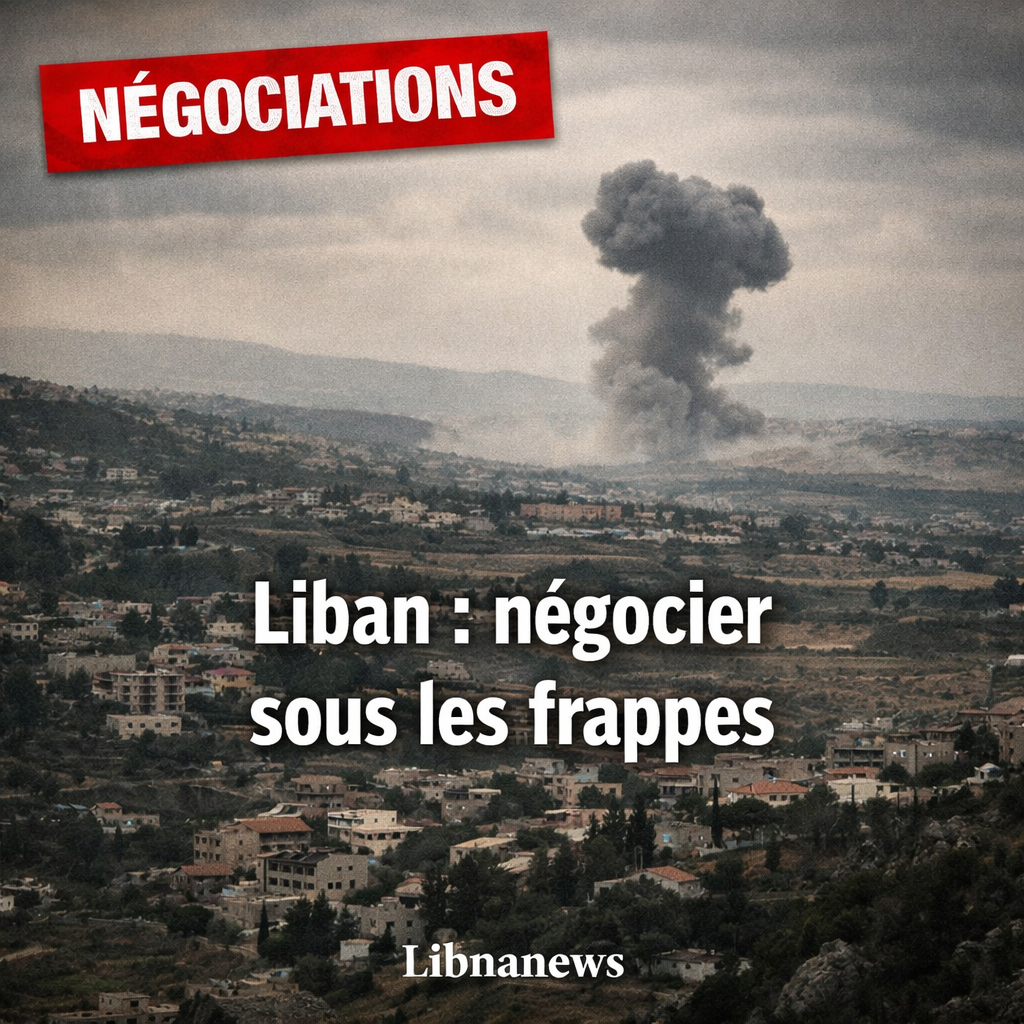
Lebanon is approaching an exceptional diplomatic sequence on 14 April, but it is not opening up in a climate of de-escalation. The meeting held in Washington between Lebanese, American and Israeli officials took place as Israeli strikes continued in the South and in the Bekaa, Hezbollah still claimed attacks and the Lebanese authorities tried, almost at the last moment, to impose a ceasefire as a political prerequisite.
The core of the problem is therefore no longer just the existence of a channel of dialogue between Beirut and Tel Aviv. He resides in the conditions of this dialogue. For Lebanon, a credible negotiation requires at least a suspension of fire. For Israel, the signals sent over the last few days suggest on the contrary that it is a matter of discussing without giving up the military lever, and perhaps even using it to weigh the content of the exchanges at the outset.
Washington opens a canal without truce
This asymmetry gives its tone to the talks. Beirut wants to test Washington’s ability to get a halt to the strikes, if only temporary, in order to open up a sustainable political space inside the country. Israel wants to place the security of its northern border, the lasting distance from Hezbollah and, increasingly explicitly, the issue of its disarmament at the centre of any discussion. Between these two lines, Hezbollah refuses to endorse a meeting which it deems futile as long as the bombing continues. The Washington meeting therefore does not appear as the result of a de-escalation. It is more like an attempt to negotiate while the war continues to establish the balance of power.
The Lebanese position on this point has remained remarkably constant. President Joseph Aoun stated that Beirut hoped to secure a ceasefire agreement in Washington before any broader phase of discussion. This line was also relayed by the National Information Agency, which highlighted the idea of complementary Italian mediation and the priority objective of a cessation of hostilities. It is part of an approach already described by Reuters a few days earlier: according to a Lebanese senior official, Lebanon was seeking a temporary ceasefire on a separate track, but inspired by the same model as the fragile truce negotiated between Washington and Tehran. In other words, Beirut wants to prevent negotiations with Israel from beginning in the form of a mere observation of weakness imposed by the war.
This Lebanese approach also responds to an internal constraint. Joseph Aoun recalled that negotiations with Israel were the responsibility of the Lebanese state, not of another actor. The formula may seem institutional. It is in reality deeply political. It is intended to reaffirm that negotiation sovereignty does not belong to foreign mediators, armed factions or Israeli readings of the Lebanese scene. For behind the discussion on the ceasefire is another question: who speaks on behalf of Lebanon when the country is under military pressure and one of its main armed actors rejects the ongoing process. The more Beirut insists on the state monopoly, the more it seeks to avoid the Washington talks being interpreted as a negotiation imposed on a weakened political centre.
The framework put in place by Washington is itself significant. According to LBCI, an official of the State Department presented the discussions as open, direct and high-level discussions between Israel and Lebanon, the first of its kind since the negotiations sponsored in 1993. The same official explained that the American objective was twofold: to ensure the long-term security of Israel’s northern border and to support the Lebanese government’s efforts to reaffirm its full sovereignty over its territory and political life. The wording is important. It shows that the United States does not only see these discussions as a mechanism for ad hoc de-escalation. They also seek to reshape the security and political framework of South Lebanon, against the backdrop of the future role of the State and that of Hezbollah.
The information from Washington and relayed by The Times of Israel and MTV further confirm that this Tuesday’s meeting is only a first step. The Times of Israel said that the meeting was to bring together Lebanon’s ambassador to Washington, D.C., Nada Hamadeh, his Israeli counterpart Yechiel Leiter and the American ambassador to Beirut, Michel Issa, after a first-ever telephone exchange between the two countries. MTV, for its part, evokes a very short preparatory format, with the hypothesis of further discussions that can be welcomed in Cyprus. This gradual architecture reflects the extreme fragility of the moment. Nobody talks about a close deal. The first question is whether there is minimal procedural ground, and whether this ground can survive the pressure of ongoing military events.
Israel wants to speak with military hands
This is precisely where the Israeli line is most clearly distinguished from that of Lebanon. On the Israeli side, there is no clear sign of acceptance of a prior ceasefire. The Times of Israel reported that Washington and Beirut urged Israel to consent to a truce prior to the meeting as evidence of seriousness, but Jerusalem insisted on discussing it even as fighting continued. LBCI, for its part, relayed Benjamin Netanyahu’s statement that it was no longer only five Israeli positions in South Lebanon, but a wider security zone designed to neutralize what it presented as the threat of Hezbollah infiltration and rocket fire. The logic is unambiguous: Israel wants to negotiate without loosening the fabric.
The evidence reported this morning by MTV on the Israeli army radio further reinforces this reading. According to this information, the meeting of the day aims to establish a general framework for negotiations with Lebanon, with a timetable, while no peace would be possible without the disarmament of Hezbollah. The Jerusalem Post goes in the same direction by presenting the Washington meeting as an exchange dedicated to the disarmament of Hezbollah and the search for a long-term Israeli security agreement. This Israeli media convergence does not mean that a scenario is already locked. On the other hand, it shows that, from the Israeli point of view, the discussion is not solely intended to stop the strikes. It is also used to establish, as soon as the process opens, the political terms that Israel would like to impose as a result.
The military terrain completes this arrangement. Reuters reported that the Israeli army had completed the encirclement of Bint Jbeil and launched a land assault on this border city of high strategic and symbolic value, with the stated aim of obtaining full operational control over it in the coming days. MTV and The Times of Israel gave this battle an additional relief by recalling the political charge of the place: Bint Jbeil is associated with the 2000 speech in which Hassan Nasrallah described Israel as weaker than a spider web. The takeover of the city stadium, staged by the Israeli army, is therefore not only a tactical gain. It participates in a demonstration that is both psychological and political, on the eve of a diplomatic meeting in which Israel intends to arrive in a position of force.
The terrain continues to dictate the rhythm
This overlap between military pressure and diplomatic agenda is not theoretical. It is observed in the chronology of the last 24 hours. The National Information Agency reported strikes in South Lebanon and the Bekaa, including in Sohmor, where two dead and several wounded were reported. Other reports reported by MTV include one dead and three wounded in Chabriha, Tyre district, while Al Manar reported raids on Qlaile and Shebaa in the morning, as well as the explosion of a drone in the latter town, causing minor injuries. The strike map therefore extends well beyond a single point of contact. It recalls that Lebanon does not negotiate after a pause in hostilities, but at the same time as an air and land campaign continues to impose its own pace.
The accumulated human cost gives this sequence a particular depth. According to the National Information Agency, the official assessment, which was arrested on 13 April, reported 2,089 deaths and 6,762 injuries in Lebanon since 2 March. Reuters also mentions more than one million displaced persons since the beginning of the current offensive. These figures do not only indicate the intensity of the war. They weigh directly on the credibility of a diplomatic process that, without a real stop to the fire, may appear to a large part of the public as a formal exercise while the losses continue. This inner dimension counts enormously. In a society already plagued by destruction, displacement and economic exhaustion, the question is not only whether to negotiate, but at what time, under what conditions and with what minimum protection for civilians.
Hezbollah is exploiting this point of tension precisely. Reuters reports that Naïm Qassem called on the Lebanese government to cancel the Washington meeting, finding it unnecessary as long as the Israeli attacks continued. This position is in line with a line already visible for several days: the movement refuses to recognize a political usefulness to talks launched while the military power ratio remains open. Negotiating in those circumstances would, in his view, legitimize a mechanism to diplomatically translate pressure from weapons. This objection is not only ideological. It aims to prevent the Lebanese State from transforming the search for a ceasefire into an entry-level one towards a broader debate on the military status of Hezbollah without prior national agreement.
In parallel, the forehead did not freeze. The National Information Agency reported drone attacks and rocket attacks claimed by Hezbollah, while Reuters reported that the Israeli army claimed to have intercepted more than ten drones and rockets fired from Lebanon on Monday. The Times of Israel reported that an Israeli reservist had been killed in southern Lebanon and that three others had been injured in the same incident. This continuity of confrontations counts politically as well as militarily. It allows Israel to argue that it cannot suspend its operations until the threat remains active, and Hezbollah to argue that it remains able to act despite the intensity of the strikes. In this face-to-face, each exchange of fire immediately returns to the negotiating table.
Three logics clash
Lebanon is thus caught between three logics that do not coincide. The first is in Beirut, which wants a truce to prevent dialogue from being reduced to recording an unfavourable balance of power. The second is in Washington, which seeks to stabilize Israel’s northern border while strengthening the Lebanese state and, implicitly, reducing Hezbollah’s military autonomy. The third is that of Israel, which wants to take advantage of the intensity of the moment to obtain a new security framework in southern Lebanon, with a de facto or de jure buffer zone and a lay-down of the issue of Hezbollah weapons. These objectives may cross at times, but they are not identical. Therefore, a simple opening of a diplomatic channel is not sufficient to dispel the substantive disagreement on the purpose of the process.
In this equation, European initiatives still weigh little, but they signal growing concern. Italy offered its mediation and its head of diplomacy called from Baabda for a ceasefire, while expressing its readiness to host any meetings between Lebanon and Israel. This support has a political usefulness for Beirut, as it broadens the circle of actors advocating for immediate de-escalation. However, it does not alter the core of the problem. As long as Washington does not obtain from Israel a tangible gesture on the strikes, mediation will remain suspended from a central contradiction: how to open a serious dialogue when one of the parties considers that military pressure is precisely part of the discussion.
This 14th April could, however, mark a turning point, but not necessarily that of a calming. If the Washington rendezvous only leads to a method, a calendar or a series of meetings, it will have already confirmed one essential thing: the Lebanese question is now being dealt with in a context where war and diplomacy advance in parallel, without waiting for one another. For Beirut, the challenge is to prevent this simultaneity from turning the talks into a recording chamber of demands formulated under the bombs. For Israel, the challenge is to use the military advantage to set the terms of a future arrangement. For Hezbollah, the challenge is not to let a process that would isolate politically without any guarantee on the cessation of strikes be established. It is from this initial imbalance, much more than a promise of peace, that the future depends.




