

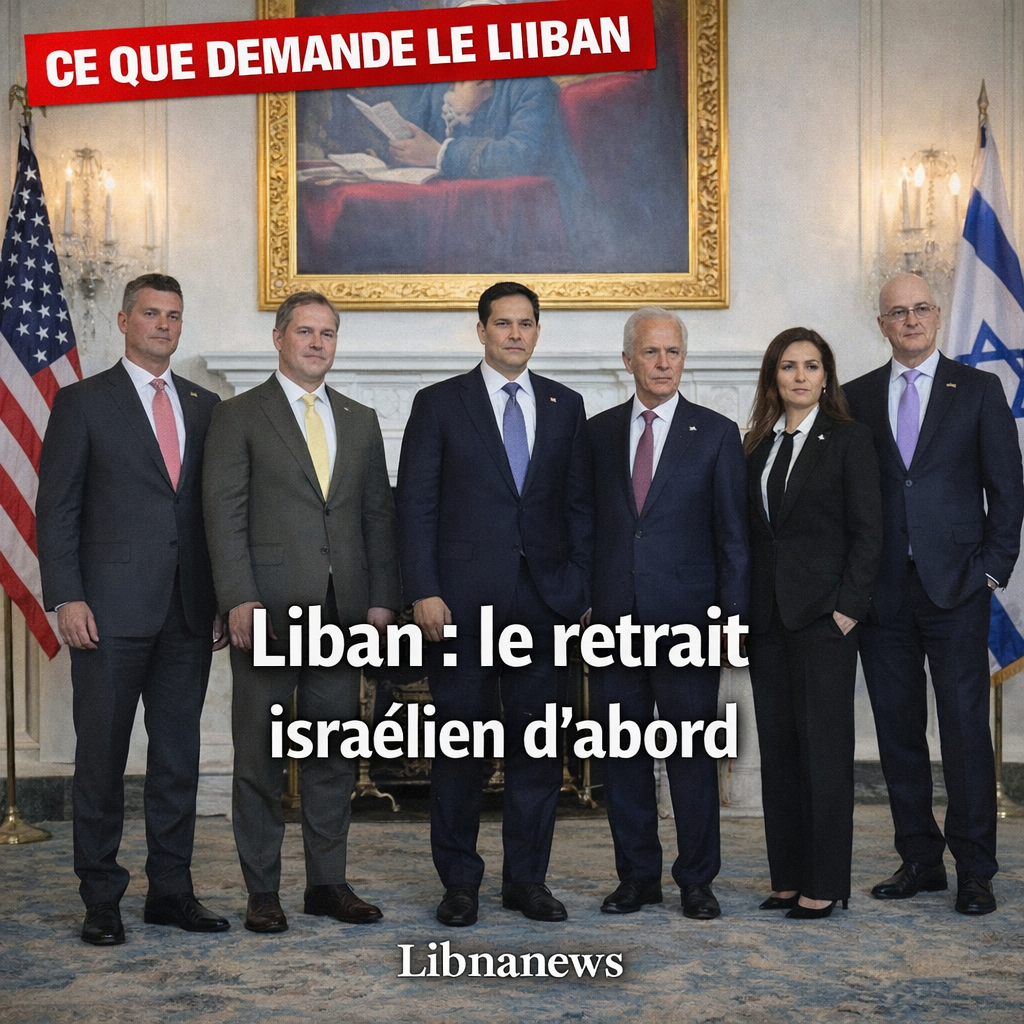
Lebanon arrives in Washington with a simple idea, almost minimal in view of the scale of the war: before any further discussion, Israel must withdraw from the territories it occupies in South Lebanon. It is this line that Joseph Aoun put at the centre of the debate, saying that he hopes that the talks open in the United States will mark « the beginning of the end » of the suffering of the Lebanese, while recalling that no lasting stability will be possible as long as the Israeli army remains present on Lebanese soil. In the same movement, the President reaffirmed the Beirut doctrine: the Lebanese army must redeploy to the internationally recognized borders and be solely responsible for the security of the border area, without any other partnership.
This position illuminates all Lebanese logic. For Beirut, negotiation only makes sense if it first restores territorial sovereignty. The problem is not presented as a mere outbreak of violence to contain or as a single issue of Hezbollah disarmament, unlike the Israeli grid. The Lebanese government seeks first to bring an end to the occupation and then to place the state, and more specifically the army, at the centre of the security system in the South. This is what distinguishes the Lebanese line from the framework intended by Israel, which refuses to make the ceasefire and withdrawal the starting point of the discussions and prefers to focus the dialogue on Hezbollah, on a security zone and on a regional order more favourable to Jerusalem.
Israeli withdrawal as a starting point
Joseph Aoun’s formula is not just a call for peace. She draws a very clear hierarchy. In his communiqué, the President explicitly links the return to stability with the Israeli withdrawal from the occupied territories in southern Lebanon. It does not refer first to normalization, nor to a comprehensive political agreement, nor even to a sequence that is primarily focused on the disarmament of Hezbollah. It first establishes a principle of sovereignty: as long as Israel continues to occupy portions of the territory, stability will remain out of reach. This reading joins the broader line of the Lebanese government, which wants to make Washington’s discussions a means of achieving a cessation of hostilities, an Israeli withdrawal and a return to a framework where the state becomes once again the sole guarantor of order in the South.
This insistence on withdrawal has nothing to do with an abstract posture. For weeks, Lebanon has reiterated that the war cannot be closed if it leads to prolonged occupation or to a buffer zone imposed by Israel. Reuters already pointed out, at the beginning of the month, that Nawaf Salam feared a lasting Israeli military presence in the South, while other analyses indicated that Beirut wanted to pull out at least one temporary ceasefire and then discuss from a position less crushed by the balance of power. The novelty on Tuesday is that Joseph Aoun has reformulated this line in more direct terms: withdrawal is no longer a goal among others, it becomes the very condition of a credible exit from crisis.
The choice of words is very important here. By calling for the Lebanese Armed Forces to redeploy « to the borders recognized by the international community », the Lebanese President places the discussion within the classical framework of State sovereignty and border law. It does not formulate a shared security project or a de facto coexistence between the army and other armed actors. It calls for a return to a situation in which the Lebanese State fully recovers the border band. This approach is also distinguished from another very sensitive debate in Lebanon on the future of Hezbollah’s weapons. By placing the Israeli withdrawal at the forefront, Beirut seeks to prevent Washington from turning into a Hezbollah-only court, while the Lebanese government wants to get the end of the Israeli military presence.
The Lebanese Army at the centre of the response
The second strong idea of the presidential message is the role assigned to the army. Joseph Aoun was not content to demand an Israeli withdrawal. He also stressed that the Lebanese army should be the sole security authority in the South, « without partnership with anyone ». The formula is very meaningful in the Lebanese context. It is obviously aimed at the Israeli army, but it is also aimed at any scheme that would leave Hezbollah a parallel security function in the border area. In this sense, the President tries to keep together two imperatives that Beirut considers complementary: the liberation of the territory and the restoration of the state monopoly on the security order.
This line wasn’t born on Tuesday. For several months, Joseph Aoun has defended the idea that the state should become the sole holder of military decision-making and border management. That speech had already been made within the framework of the 2024 ceasefire and then resumed in the discussions on the disarmament of armed groups. But the war that started on March 2 has moved everything. It made the issue much more urgent and much more difficult at the same time. Urgent, because the fighting showed how much the South could once again become a zone of military crushing. It is difficult, because the Lebanese state today demands a security monopoly at a time when its army lacks resources, Hezbollah remains a powerful armed actor and Israel publicly doubts Beirut’s ability to control the ground alone.
It is precisely for this reason that the Israeli withdrawal is placed first. From the Lebanese point of view, it is politically and practically impossible to ask the army to take full control of the South as long as the Israeli army continues to hold or threaten positions in the territory. The sequence order therefore counts as much as the content of the desired agreement. Beirut basically says: withdrawal first, redeployment then, security monopoly finally. Israel proposes the reverse order: neutralization of Hezbollah first, Israeli security then, and only after possible discussion on the future of the South. It is this reversal of priorities that already structures the main disagreement in Washington.
Washington, or the battle over the order of priorities
The Washington talks have a historical significance because they are the first direct diplomatic exchanges of this level between Lebanon and Israel in decades. But this spectacular novelty should not mask the fundamental reality: the two delegations did not go to talk about the same thing. Lebanon wants to make it a channel of withdrawal and a ceasefire. Israel wants to make it a framework for discussion on the disarmament of Hezbollah, on the security of its northern border and, in the longer term, on a peaceful or normalized relationship. The gap is so clear that several observers already consider that the real battle in Washington is not yet about the final content of an agreement, but about the very definition of the first subject to be dealt with.
This divergence is evident in the way each camp presents the meeting. On the Lebanese side, Joseph Aoun and Nawaf Salam talk about stopping suffering, stability in the South, Israeli withdrawal and the redeployment of the army. On the Israeli side, Benjamin Netanyahu and Gideon Saar talk about Hezbollah disarmament, future peace and continued military pressure until this issue is resolved. TheJerusalem PostSummarizes the disagreement in a simple formula: the Lebanese want first to see an Israeli withdrawal from the territory and a border demarcation, while Israel does not want to discuss a ceasefire until it has refocused negotiations on Hezbollah. From this point of view, Joseph Aoun’s statement also has a tactical function: to prevent the Israeli framework from imposing itself from the outset as the sole horizon of the discussions.
The choice of Washington is not neutral either. The United States is the only external actor that Beirut considers able to speak directly to Israel in the language of the balance of power. But they are also Israel’s main strategic ally. Lebanon therefore arrives at the table with a very precise expectation and a very unfavourable balance of power. Hence the importance of Joseph Aoun’s message: by publicly putting Israel’s withdrawal at the centre, he seeks to prevent negotiations from being read only through Israeli and American priorities. In other words, the Lebanese President tries to recall that he does not come to Washington to endorse a new security order imposed by the war, but to obtain the end of a military presence which he considers incompatible with any stabilization.
Why Beirut puts sovereignty first
Lebanon’s focus on Israeli withdrawal is also a domestic political necessity. The Lebanese Government knows that it will not be able to defend long before its opinion and before the political forces hostile to the talks a negotiation that would not produce withdrawal, cease fire or a clear reaffirmation of national sovereignty. Hezbollah, already, rejects the Washington talks and presents them as a free concession to Israel and the United States. In such a context, Joseph Aoun and Nawaf Salam need to show that Lebanon is not entering into an abstract peace process, nor into a face-to-face process to disarm a Lebanese actor under the bombs, but into a discussion aimed first at bringing the Israeli army out of the South.
This internal constraint is reinforced by the brutality of the ongoing war. Since 2 March, Israeli strikes have killed more than 2,000 people in Lebanon and displaced more than one million people, according to the Lebanese Ministry of Health cited by AP. In these circumstances, the question of withdrawal does not only refer to a legal principle. It directly affects the possibility of the return, reconstruction and restoration of an ordinary life in the South. As long as Israeli positions remain or the Israeli army seeks to create a safe area up to the Litani River, the people of the South cannot believe the restoration of normalcy. The withdrawal then becomes the concrete translation of Joseph Aoun’s idea of ending suffering.
There is also, behind this insistence, an attempt to preserve the Lebanese definition of sovereignty. The Lebanese government says that it is prepared to see the state take over the entire military function in the South, but it does not want this resumption to be conceived as the mere execution of an Israeli agenda. He wants this restoration of public authority to take place from an Israeli withdrawal and in a context where Lebanon is not treated as a territory to be remodelled from outside. This nuance is crucial. Beirut does not oppose sovereignty to security; It affirms that lasting security requires sovereignty. Israel, for its part, makes the opposite argument: its security begins with a transformation of southern Lebanon, even if this transformation involves prolonged military pressure or a de facto presence on the ground.
Withdrawal from the safe area
This is where the dispute becomes almost irreconcilable in the short term. Lebanon calls for Israeli withdrawal to the recognized borders. At the same time, Israel continues to speak of security, demilitarization and a buffer zone in southern Lebanon. AP reports that Israel intends to create a security zone along the Litani River, while the Lebanese government insists on the return of the Lebanese army and the end of any occupation. Reuters also indicated that Israel was seeking to create a buffer zone in South Lebanon. These two visions don’t cross yet. One assumes an Israeli departure. The other assumes at least a lasting, direct or indirect Israeli security grip.
The consequence for Beirut is clear. If Lebanon does not hammer its request for withdrawal as soon as the talks are opened, the negotiation risks slipping very quickly towards a debate on the modalities of an Israeli security presence, even if it is presented as a transitional presence. This is precisely what Joseph Aoun is trying to block by saying that the only solution is through the redeployment of the Lebanese army to recognized borders. The formula rejects in advance any architecture where the Lebanese army would be confined to a supportive role while Israel would retain real control of the border band.
This battle of words is therefore also a battle on the map. Who will hold the ground once the fighting is suspended, if they are? Who will control the villages of the South? Who will decide the return of displaced inhabitants? Who will have the last word on local security? Lebanon answers: the State, and only the State. Israel replied: first Israeli security, then the rest. Therefore, the request for withdrawal is not simply a diplomatic claim among others. It is the point from which everything else is ordered: the role of the army, the legitimacy of the state, the question of Hezbollah and even the possibility, one day, of wider discussions.
A line that also targets the post-war period
In reality, Joseph Aoun’s statement speaks as much of post-war as of war itself. When it states that the Lebanese army must be solely responsible for security in the South, it does not only provide a response to the Israeli occupation. He also drew the form of the state he wanted to see emerge once the war had stopped. This projection counts, because it allows Beirut not to arrive in Washington with a purely negative demand, limited to « Israel must leave ». On the contrary, Lebanon tries to articulate two things: the end of the occupation and a credible state alternative, embodied by the national army.
The problem is that this line, even if consistent, remains vulnerable. On the one hand, Israel doubts the real capacity of the Lebanese state to prevent Hezbollah from recovering in the South. On the other hand, part of the Lebanese camp hostile to the negotiations sees the call for a military monopoly of the State as a hijacked way of paving the way for a dictated disarmament from the outside. Joseph Aoun therefore attempted a particularly delicate exercise: to defend Lebanese sovereignty against Israel, while at the same time affirming that this sovereignty also presupposes an internal takeover that Hezbollah can no longer monopolize. It is this articulation, not the only word « withdrawal », that gives the presidential message its real scope.
It remains to be seen whether Washington can produce anything other than a simple photograph of this disagreement. For now, Israel maintains that it does not want to talk about a ceasefire first, continues its operations in the South and presents the disarmament of Hezbollah as the key to any outcome. Lebanon, for its part, replied that stability would not return until the Israeli army occupied Lebanese territory and only the national army could take over the internationally recognized borders. Between these two lines, the talks will start not with a compromise, but with a battle over the very meaning of the word security.




