

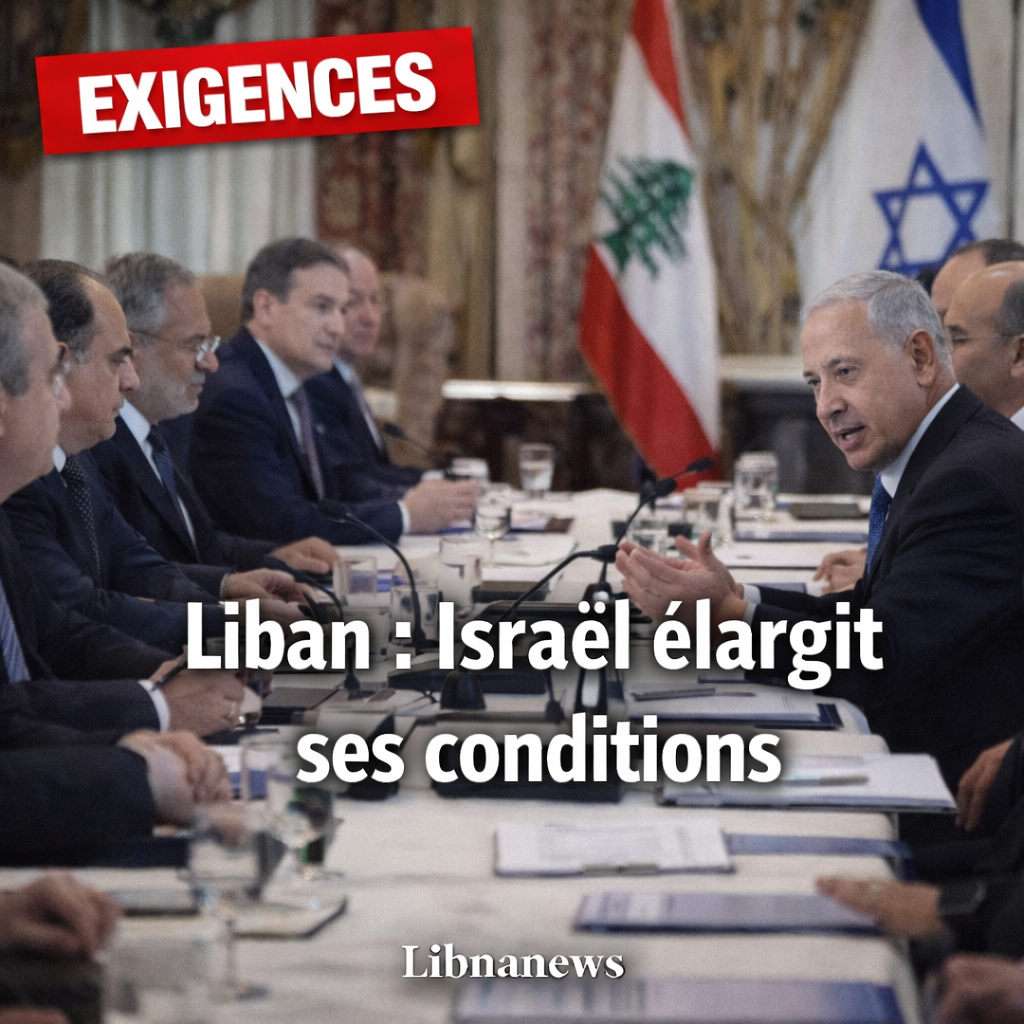
In Washington, the discussion between Lebanon and Israel does not open around a simple stop to the fire. On the Israeli side, the framework is already much wider. Benjamin Netanyahu’s government wants to make the Lebanese case a political and security transformation, not just a de-escalation issue. In the public statements of recent days, a core of demands is constantly returning: the disarmament of Hezbollah, a peaceful relationship between the two States, the exclusion of a pre-ceasefire and the maintenance of military pressure during negotiations. Around this base, the Israeli press and the security community are circulating an even larger agenda, which affects the composition of the Lebanese government, the place of Hezbollah in the State apparatus, the Syrian border and all its civil, financial and logistical networks. This extension of the debate sheds light on the current moment: Israel is not only seeking more security in the north. He wants to influence the very form of Lebanon after the war.
The starting point is therefore harder than it seems. Beirut arrives in Washington with a narrow but urgent demand: a ceasefire capable of opening up a minimum political space. Israel, on the other hand, refuses to make the truce the door to the process. His line is to speak under the strikes, keeping the military hand and using this balance of power to impose his priorities. It is this gap that gives meaning to the Israeli conditions. They are not an isolated list of claims. They already define a method, a hierarchy and a final objective. The method is to negotiate under duress. The hierarchy places Hezbollah above everything else. The ultimate goal, however, goes beyond the only southern border: it aims to bring out a Lebanon where the Shiite party has lost its armed power, its governmental weight and, for part of the Israeli ecosystem, much of its institutional and social relays.
An Israeli basement already public
On this first level, there is little ambiguity. On 9 April, Benjamin Netanyahu announced that direct negotiations with Lebanon should begin « as soon as possible » and that they would focus on two specific objectives: the disarmament of Hezbollah and the establishment of peaceful relations between Israel and Lebanon. This formula was taken up by Reuters, by theJerusalem Post, by Ynet andTimes of Israel. It therefore had nothing to do with a marginal leak. It is the official political line assumed by Jerusalem. The idea of a « full peace agreement » even appears in the Israeli press as the horizon claimed by Netanyahu. In this architecture, Hezbollah is not one of many topics. It is the subject around which the whole negotiation is organised.
This is essential because it moves the centre of gravity of the debate. Israel does not first talk about withdrawal, reconstruction, guarantees for civilians or reactivation of a multilateral framework. He talks first about the neutralization of Hezbollah. On 14 April, Gideon Saar further tightened this line by saying that Washington’s discussions should focus on the disarmament of the Shiite movement, and that this step should precede any peace agreement or normalization. In other words, peace is not presented as the path to disarmament. This is the opposite: disarmament is presented as a prerequisite for any other political phase. This hierarchy is not only diplomatic. It shows that Israel wants to make the military power ratio accumulated for weeks the basis of a new political architecture in Lebanon.
Talking while the war continues
The second pillar of the Israeli conditions is the refusal of a prior ceasefire. On the Lebanese side, the Washington meeting was to be used first to pull a stop to the strikes before any broader discussion. On the Israeli side, this logic has been rejected in a straightforward manner. The Israeli government spokesman said that Israel would not discuss a ceasefire during the meeting. TheTimes of Israelsummarized Jerusalem’s position even more clearly: no interest in a truce until Hezbollah was « defung », i.e. deprived of its capacity to act. Netanyahu himself insisted that « there is no ceasefire in Lebanon » and that Israel would continue to hit Hezbollah with force. This position is not a procedural detail. It means that, for Israel, the war does not frame the talks from outside. It is part of the negotiation itself.
This choice sheds light on the deep nature of the Israeli offer. Jerusalem does not propose a classic de-escalation sequence. It proposes a coerced dialogue, where the continuation of strikes and ground operations must push Beirut to accept an agenda focused on Hezbollah. In the Israeli press, this approach is evident. An official quoted by theTimes of Israeleven launched: « We will not let go of the doves of peace ». Behind the formula, the idea is clear: there is no question of suspending the military tool to create a favourable climate. On the contrary, it is a matter of discussing while maintaining the advantage of fire. For Lebanon, that changes everything. Open negotiations under these conditions cease to be a simple diplomatic channel. It becomes a political extension of an imposed balance of power on the ground.
The safe zone returns to the debate
Around this nucleus, a second element is becoming increasingly clear: the Israeli will to physically reshape southern Lebanon. Reuters indicates that Israel is seeking to create a buffer zone in South Lebanon. TheTimes of Israelwrites that Jerusalem is pushing for more aggressive action by the Israeli army and goes so far as to evoke the restoration of a security zone in the south of the country. This perspective is not only military. It gives territorial content to Israeli conditions. The disarmament of Hezbollah would not only be a matter of missiles, command or clandestine structures. It would be part of a redesigned border area, more deeply controlled, more sustainably monitored and potentially emptied of any hostile armed presence at a depth desired by Israel.
It is in this context that the issue of the Litani comes back to watermark in Israeli discussions. Even when the dominant press does not present it as an already locked condition, the idea of a more strictly demilitarized South Lebanon appears in the background of security analyses and comments. The Israeli logic is consistent: if war is to lead to a new arrangement, this arrangement must make it materially more difficult for Hezbollah to return to the border. This also explains why Jerusalem remains sceptical about the promises of the Lebanese state. The Israeli government does not only doubt Beirut’s will. He doubted his real ability to disarm Hezbollah and control the ground alone. It is this scepticism that feeds both the pressure to maintain military operations and the temptation to impose a wider transformation of the border space.
The heaviest political point: Hezbollah ministers
The most sensitive aspect, beyond disarmament, now concerns the place of Hezbollah within the Lebanese State itself. Reuters reports that a senior Israeli official involved in the cabinet’s discussions said that Israel would push Beirut to remove Hezbollah ministers from the government. This demand changes the nature of the talks. It is no longer limited to weapons, military positions or border arrangements. It affects the composition of the Lebanese executive. In other words, Israel no longer seeks only to reduce a security threat. It also seeks to change Lebanon’s internal political balance. In such a fragile institutional system, such a requirement is far-reaching. It links the possible end of the war to a form of government recomposition imposed under pressure.
This request is part of a broader Israeli reading of the Lebanese problem. For Jerusalem, Hezbollah is not only an autonomous armed actor. It is a force that weighs on the state, infiltrates its decision-making mechanisms and prevents the exercise of full sovereignty. That’s exactly what Gideon Saar said by presenting Hezbollah as a problem both for Israel’s security and for Lebanon’s sovereignty. Therefore, demanding the expulsion of its ministers amounts to translating this idea into a concrete political condition. The army alone would not suffice; Beirut should also agree to reduce the party’s presence in official structures. The transition from military to politics is decisive here. It shows that the Israeli project is already aiming further than simply pacification of the border.
What Israeli security circles say
It is around this core that the larger package that has been circulating for two days is grafted. In Israeli strategic circles, the agenda is much more ambitious. A note published on 12 April by Alma Research, an Israeli centre very attentive to the northern front, states that an agreement with the Lebanese State will be worth nothing if the Hezbollah issue is not addressed in its full thickness. The text calls for the prohibition and dismantling of all Hezbollah’s civil and economic systems, including its educational, health, welfare and financial networks. He also called for the breakdown of diplomatic ties with Iran and the closure of the Iranian embassy in Beirut, which was presented as a major centre of activity of the Revolutionary Guards. We’re no longer in border diplomacy alone. We are entering a much deeper project of redesigning the Lebanese landscape.
The same note goes even further. It calls for the dismissal of the government’s Hezbollah ministers, the future ban on its representatives in key posts, a wide-ranging purge in the Lebanese army and security apparatus against all personnel deemed to be close to the movement, as well as a tougher mechanism on the Syrian-Lebanese border. The text also refers to the exclusion and arrest of any person cooperating with Hezbollah at the crossing points, under international supervision. Finally, aid to the Lebanese army should, in this vision, go under strict American supervision. At this stage, this list does not constitute a road map formally endorsed by the Israeli cabinet. But it clearly shows in which direction an influential part of the Israeli security and analytical apparatus is pushing: towards a global strategic weakening of Hezbollah, military, political, financial, civilian and logistical.
It is here that we need to read the more radical list that circulates in Arabic and English. Its core is well within the visible Israeli agenda: Hezbollah disarmament, the peace horizon, the exclusion of the pre-ceasefire, the eviction of its ministers and the pressure to transform southern Lebanon. Another part of this list includes objectives formulated in Israeli security circles: the closure of Hezbollah’s civil and economic networks, the purging of security apparatus, the harsher control of the Syrian border, and the reduction of Iranian influence in Beirut. But two elements do not emerge, at this stage, as requests publicly assumed by Netanyahu or Saar in the dominant Israeli press around Washington: the nominative dismissal of the Lebanese army commander and an official list of general arrest warrants against the entire Hezbollah leadership. These two points relate more to the overbidding climate surrounding the negotiations than to the package already formalised by Jerusalem.
It doesn’t make them anodized. On the contrary, their circulation speaks something of the moment. Part of the Israeli debate is no longer based on a simple security arrangement. It is reasoning in terms of the forced transformation of Lebanon. In this context, the war should lead to a Lebanese state purged of Hezbollah’s influence in the army, ministries, transit networks, social institutions and financial channels. The longer the war continues, the greater the visibility of this maximalist vision. It is not yet fully formalized. But it is already exerting pressure on the government line, constantly pushing the negotiating framework towards more intrusive and politically heavier demands for Beirut.
What this means for Lebanon
For Beirut, therefore, the stakes go far beyond the question of a ceasefire. By accepting the Washington format, Lebanon is not content to enter into a discussion about the end of hostilities. It enters a framework where Israel is already seeking to set the terms of Lebanon after the war. The Israeli core is now legible: no prior truce, the disarmament of Hezbollah before any other phase, the horizon of peace or normalization, the eviction of the movement’s ministers and the consolidation of a new security order in the South. Around this hard heart, the most offensive Israeli circles want to go further: to reduce Hezbollah’s civilian networks, to purge the security apparatus and to tarnish its external connections. This gradual extension of the agenda makes the Lebanese position particularly narrow. It must try to get a halt to the strikes while resisting a negotiation that already overflows into the internal architecture of power.
It is this tension that will dominate the next few days. The more Israel advances militarily, the more it will seek to present as reasonable requests which were still yesterday of a maximalist program. The more Beirut agrees to speak without a cease-fire, the more likely it will be to see the discussion slide from the ground of de-escalation to that of interior re-engineering. Between the two, Hizbullah will continue to reject a framework that specifically aims to weaken all registers at once. The negotiations that are opening therefore have nothing to do with a simple border dialogue. It is already beginning as a battle over the future form of the Lebanese state, its internal balances and the place Israel now believes can be redefined by war and diplomacy.




