

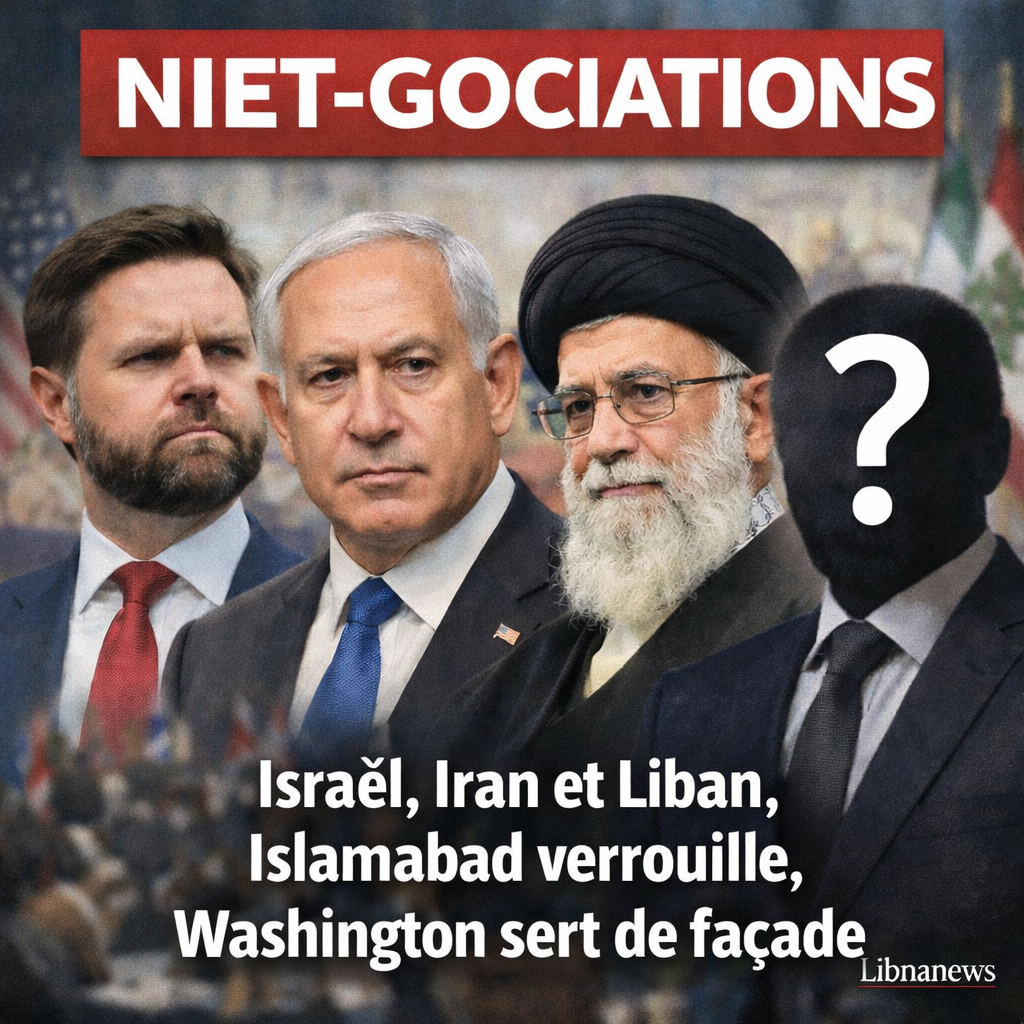
A comprehensive ceasefire will be announced tonight or at the dawn of Saturday throughout Lebanon, not just in the southern suburbs or Beirut. This is not a regulation, let alone lasting stabilisation. It is a political formula designed to enable each camp to assert that it has obtained satisfaction without publicly acknowledging that it has given way. Iran will say that he entered the hall in Islamabad only after his condition had been satisfied. The American, accompanied by the Israeli, will say that this condition was not part of the original agreement but was accepted as a gesture of goodwill to ensure the success of the negotiations. The Lebanese official party will say that it has imposed itself as interlocutor and that the ceasefire is preparing a new round in Washington on Tuesday. Hezbollah will say that Iran has kept its promise. The background will remain the same: Islamabad locks, Washington serves as a facade.
A ceasefire of passage, not a substantive agreement
The first point to be fixed is simple. The emerging ceasefire does not have the function of resolving the bottom of the crisis. It does not resolve the issue of Hezbollah, the relationship between Lebanon and Israel, the question of Lebanese internal rebalancing, or the question of regional architecture. He doesn’t have that ambition. It has another purpose: to organize a passage.
In this type of sequence, a ceasefire is not only a fire-stop mechanism. It is also a political construction. Its drafting, timing and presentation count as much as its immediate content. It must be formulated in such a way as to allow everyone to enter the next stage without open humiliation. It must distribute stories compatible with the needs of the various actors. It must be precise enough to produce an effect on the ground, but flexible enough to prevent a camp from having to admit defeat.
This is exactly what gives its consistency to the sequence. Iran needs to say that it obtained the satisfaction of its condition before entering Islamabad. The Americans need to say that this condition did not exist in the original agreement and that it was accepted only to ensure the success of the process. The Israelis need to argue that they have not retreated but have accepted a tactical formula. The Lebanese government needs to say that it has regained its place. Hezbollah needs to say that it has not been abandoned.
The global ceasefire thus becomes a transit formula. It doesn’t solve anything, but it allows everyone to continue. That is precisely why it is plausible. A major substantive agreement would have required confessions, clear renunciations and impossible clarifications at the present time. A step-by-step ceasefire requires only a text that is flexible enough for everyone to read what they need.
Why the wording counts as much as the fact
It would be wrong to believe that the only thing that counts is stopping the strikes. In this type of moment, the way to tell the stop counts almost as much as the stop itself. The actors do not enter into the next sequence according to one truth. They enter with different, sometimes contradictory, but politically necessary narratives.
Iran cannot present itself in Islamabad by giving the impression that it negotiated for itself while Lebanon remained exposed. That would be a major political cost. So he needs a simple sentence: we didn’t move until we got that. This phrase serves to protect its regional coherence, its credibility in the axis, and its image of power that does not deal with one case by sacrificing the other.
The Americans, for their part, cannot say that they have redefined the framework under Iranian pressure. They must be able to argue that they have kept the initial line and that they have only admitted a complementary gesture to ensure the success of a wider process. Again, the sentence counts more than anyone thinks. It allows us to talk about pragmatism instead of talking about hindsight.
Israelis need the same kind of narrative protection. They cannot present the stop of the fire as a suspension obtained against them. They must be able to translate it as a choice, a pause decided after a demonstration of force, a tactical transition, not as a political surrender. The formulation of the ceasefire will give them that opportunity.
The Lebanese official power needs to say that it still exists. He cannot admit that he was only called back when signing or swallowing what others have prepared. He will therefore say that he has imposed himself as an interlocutor, that he has made his place recognized, that he has reopened a political sequence. This language is necessary, even if the real power ratio does not give it control of the whole.
Hezbollah has an even greater imperative. He must prevent the idea that he was left alone while his ally entered another negotiation. That’s why his sentence is so simple: Iran has kept its promise. Everything else is secondary.
Islamabad, the real lock of the moment
The decisive point is in Islamabad. That’s where the Iranian-American sequence is played. This is where the political lock that conditions the opening of the suite is settled. This is where Iran can enter by saying that it did not move until it obtained satisfaction on the Lebanese question.
This precision is essential because it avoids frequent confusion. To say that the centre of the moment is in Islamabad does not mean that all cases are dealt with. This means that the decisive record, the one that allows to trigger the sequel, plays it. Islamabad does not absorb everything. Islamabad holds the key.
It’s a crucial point. Until this sequence is set, the rest remains suspended. There may be announcements, intentions, gestures, signals, but the real political lock remains: does Iran enter the room under conditions that allow it to say that it has not given way to Lebanon? If the answer is yes, the rest becomes possible. If the answer is no, everything is messed up.
That is why the global ceasefire throughout Lebanon is not a peripheral issue. It is not a side favor, nor a simple technical addition. It is the political condition that allows Iran to open the Islamabad sequence without losing face. This does not mean that Lebanon becomes the sovereign centre of the game. This means that it becomes the necessary point for the initiation of another negotiation.
In other words, Lebanon is not the main subject of Islamabad, but it becomes the condition of passage. It’s very different. The heart remains Iranian-American. But this heart needs, to beat politically, a formula that embraces Lebanon. It is this articulation that gives Islamabad its centrality.
Washington as a political facade
Washington comes next, but this role needs to be precisely defined. Washington is not the place where the lock of the moment is decided. Washington serves as a facade. This is where the next round, the one that will take the form of US-sponsored Lebanon-Israel discussions, will be presented.
This facade is important. It serves to give an institutional form to the follow-up. It is used to produce visible meetings, formal formulations, an impression of an orderly process, a diplomatic scene that is more legible for external partners and opinions. It also makes it possible to organize the official narrative of the sequence: that of a ceasefire obtained, and then to enter a wider political phase.
But Washington should not be confused with the real place where the key to the moment was forged. The facade is not the center. It is the visible political translation. It makes it appear to be a wider, more structured, more balanced sequence than it really is. It must not be read as a space where the bottom has been freely developed between parties having a comparable weight.
Washington is therefore used to stage what has been made possible elsewhere. It is used to dress a compromise of passage. It is used to give an orderly decor to a sequence whose real impulse comes from another lock. It doesn’t make it an empty place. This makes it a place of representation.
The difference is important. A place of decision imposes the substance. A place of representation organizes the story. Washington will belong to the second category in this sequence.
The Lebanese official party will say that it has imposed
The Lebanese government will say that it has succeeded in imposing itself as interlocutor. He said that the ceasefire had been obtained in preparation for a new round in Washington on Tuesday. He will say that the state has returned to the centre. He can’t say anything else.
This speech must not be despised. It responds to a real political necessity. After months of marginalization, after a long sequence where the state has often seemed absent from the heart of decisions, the official party must reoccupy the symbolic space. It must show that it is not reduced to commenting on what others have decided. It must resettle the idea that there is still a Lebanese State interlocutor.
But we must hear this speech for what it is: a necessary political narrative, not the faithful photograph of the balance of power. Official Lebanon does not return with master cards. He comes back with a language of presence. He can say he’s in the loop. He cannot demonstrate that he has set the terms.
This is where the danger lies. The more the official party insists on returning to the centre, the more one will have to wonder what exactly this centre means. Is it a speech centre, a representation centre, a symbolic validation centre? Or a real decision center? The answer is heavy. Official Lebanon will probably be at the centre of the story, not at the centre of the lock.
He can speak on his behalf. It can be shown. It can present itself as the legitimate facade of the cycle that opens. But this does not mean that he will master what will then be asked to swallow.
Lebanon no longer has real background maps
The question must be asked dryly: with what real maps does Lebanon come to Washington? The answer is brutal. He doesn’t have much more. He has already given everything without recovering any decisive lever. He did not arrive with a balance of power enabling him to impose a balanced framework on Israel. It does not happen with sufficient internal cohesion to carry a hard sovereign position. It does not happen with an instrument capable of forcing the other party to yield on the essential.
Therefore, the Lebanese presence in the sequence should not be read as the presence of an actor negotiating from a structuring position. It must be read as the presence of an actor who may be there when a Lebanese face must be given to a process that he does not really control.
The brutality of the question makes it possible to go to the bottom. What would Lebanon actually negotiate in substance? Southern annexation? Full peace? Hezbollah’s disarmament? None of these options exists as a serious basis for sovereign negotiation in the present context. Lebanon is not able to say yes or no to major options from a mastery position. He arrives in a sequence where he can be asked to give political form to compromises already worked elsewhere.
The danger is therefore not simply exclusion. It’s deeper. He is in forced participation. A weak actor may be less threatened by absence than by presence. Because being there can mean being placed before choices that have not really been built, but that must be publicly assumed.
The precedent of Oslo after Madrid
It is here that the parallel with Madrid and Oslo takes all its strength. The problem is not to say that the two situations would be identical. They’re not. The problem is to recognize that the method can be similar.
When a visible frame serves as an official scene while another channel holds the true balance of power, the weakest can eventually arrive at the table to endorse content already structured elsewhere. The Palestinian precedent remains a warning. The shift from the broad framework to a narrower channel has led to a situation where the PLO has finally taken on asymmetric concessions in an unfavourable balance of power.
What sabotaged the Madrid framework is not just the displacement of the place. It’s the shift in the power ratio. Once the negotiation was reduced to another format, a weakened actor found himself pushed towards arrangements that he might not have accepted in a broader, more visible, more balanced framework in his structure.
The risk to Lebanon is precisely that. Washington can serve as a front for a cycle in which official Lebanon would have to endorse unacceptable compromises against Israel. Not because he would have freely negotiated them, but because he would find himself in the conventional position of the weak actor: either he takes on in the name of realism and stability, or he carries the political cost of appearing like the one that blocks.
April 8: Saving the face before the rocking
The hypothesis on 8 April must be posed in all its brutality. What if this day was meant to save the face of Hezbollah opponents in Lebanon and the Israeli authorities? The idea seems huge. She is. But it remains plausible.
For the Israeli authorities, a day of demonstration of force just before a shift towards a cease-fire produces a clear benefit. It then allows us to say that the judgment was not suffered but chosen. It turns the break into a tactical decision. It gives the Israeli power the narrative material it needs to maintain that it has not stopped under pressure.
For Hezbollah opponents in Lebanon, the same day offers another advantage. It makes it possible to relaunch the trial against the party, to accuse him of having exposed the country, of having attracted destruction without containing it, of having embarked Lebanon in a sequence that he no longer controls. It also allows for a much heavier atmosphere of suspicion. At this level, the question is almost self-evident: have some simply benefited politically from this day, or have there been, at least in fact, convergences that give rise to the word collaboration?
It is not about inventing evidence. It is a question of recognizing a striking political usefulness. April 8 can be read as a day that allowed several actors to prepare the shift without arriving in a post in a position of apparent weakness. This is enough to give weight to the hypothesis.
The most important thing here is not to turn this reading into judicial truth. The most important thing is to recognize its political logic. In regional crises, a day of fire can perfectly serve as a narrative airlock before a compromise. It allows some to hit before stopping, others to load an opponent before he finds a protective formula, and then everyone to enter into a more orderly sequence without losing too much face.
Hezbollah and the trial in abandonment
In this context, Hezbollah faces a specific political danger: the trial in abandonment. His opponents need to establish the idea that he was overwhelmed, that his strategy exposed Lebanon, and that at the decisive moment his Iranian ally could deal elsewhere without him. It is this idea that he must block first.
His answer will be simple: Iran has kept its promise. This sentence is enough for many. It does not turn the ceasefire into a total victory. She doesn’t erase criticism. It does not remove internal pressure. But it closes the most dangerous breach: that of saying that Lebanon has been sacrificed in favour of another negotiation.
Hezbollah does not need a public triumph. He needs a sentence of consistency. If the global ceasefire is announced throughout Lebanon, he can say that the Iranian ally has not entered the room leaving Lebanon aside. This will give him enough to contain the adverse narrative.
This political function is central. In such a tense sequence, surviving politically does not mean appearing invincible. This means preventing the idea of being abandoned from being imposed.
The Hezbollah disarmament map does not exist
We must be completely clear here. The Hezbollah disarmament map does not exist in the negotiations. It can be cited. It can be brandy as a principle. It may be included in official statements. But it doesn’t belong to the real package of the moment.
Why? Because everyone knows that it is not applicable in the present sequence. Hezbollah cannot be disarmed either by them or by us under the present conditions. The Israelis know that. The Americans know that. The Lebanese know that. This is not only a technical difficulty. It is an immediate political impossibility.
We have to go to the end of this idea. Effective disarmament of Hezbollah, attempted today, would pose a massive risk of internal civil war. That is precisely why the political decision on the arms monopoly has no real effect. It functions as a state principle, as a slogan, as an official line. It does not turn into operational capability.
Therefore, putting Hezbollah’s weapons at the centre of the negotiations is about the background, not the background. This can be used to fill in a press release, reassure some partners, and feed a political front. This does not change the real nature of the sequence. The heart of the moment is not there. The heart of the moment is in the global ceasefire that allows Iran to enter Islamabad and the opening of the next cycle under the Washingtonian facade.
What everyone will say after the announcement
When the ceasefire is announced, the stories are already ready. Iran will say that he entered the room only after his condition had been satisfied. This sentence will allow him to show that he did not separate his own negotiation from the fate of Lebanon. The American, accompanied by the Israeli, will say that this condition was not part of the original agreement but was accepted as a gesture of goodwill to ensure the success of the negotiations. This sentence will allow him to speak of adjustment not to mention concession.
In Lebanon, the official party will say that it has succeeded in imposing itself as interlocutor and that the ceasefire is preparing the Washington round. This sentence will allow him to return to the centre of the national narrative. Hezbollah will say that Iran has kept its promise. This sentence will allow him to respond to the trial in abandonment.
The coherence of the ceasefire will depend precisely on that. It will not be read in the same way from all capitals. It will hold because everyone can tell it differently. This is not a defect in the mechanism. This is the condition.




